


To address negative AI brand sentiment, run a consistent set of buyer prompts across multiple AI engines, trace every negative claim to its source page, then fix or outrank that source and repeat the prompts. Prioritize by business impact so claims seen by buyers nearest purchase are resolved first. Updates typically take weeks, rather than days, to appear in answers. Sona AI Visibility connects the prompts and citations behind those answers to pipeline and revenue.
What do you need in place before you start fixing negative AI brand sentiment?
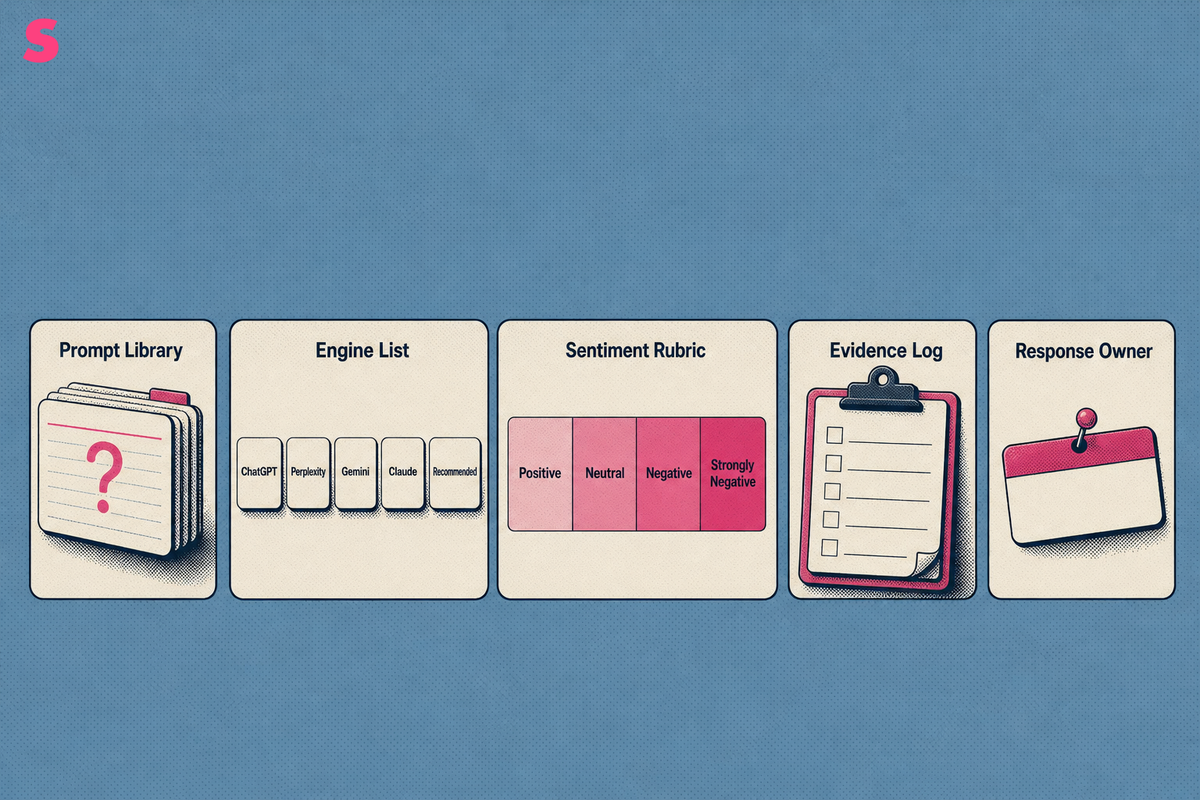
To fix negative AI brand sentiment, establish a repeatable baseline before changing content. You need a fixed prompt library, named AI engines, a documented sentiment rubric, an owner for each issue, and a record of the sources or claims behind every negative answer.
Start with buyer questions, not generic brand-name searches. Include comparison prompts, implementation questions, pricing questions, reliability concerns, alternatives, reviews, and problem-oriented searches. Sona AI Visibility connects citations to pipeline and revenue on one account timeline and tracks AI crawler activity, helping marketing teams treat AI answers as a measurable channel rather than a reputation score alone.
- Prompt library: a stable set of buyer questions grouped by topic and buying stage.
- Engine list: ChatGPT, Perplexity, Gemini, Claude, and other answer engines relevant to your buyers.
- Sentiment rubric: recommended, positive, neutral, negative, and strongly negative classifications.
- Evidence log: the full answer, cited sources, date, location, prompt, and reviewer decision.
- Response ownership: a named person in content, product marketing, customer success, or communications.
A single negative answer is an observation. A repeated negative claim across a controlled prompt set is a problem worth fixing.
Step 1: How do you measure negative brand sentiment consistently across AI engines?
Measure negative brand sentiment by running the same buyer prompts across several AI engines, preserving each response, and coding each statement with one defined rubric, whether in-house or through services that analyze brand presence in AI chat responses. A repeatable methodology listing dated July 22, 2026 recommends 20–40 fixed buyer prompts across at least 3 AI engines, run 3 times each.
- Write prompts in the language customers use when evaluating your category.
- Run each prompt separately in every selected engine and retain the complete answer.
- Mark each brand statement as recommended, positive, neutral, negative, or strongly negative.
- Record the topic, source citations, date, market, and exact negative wording.
- Review the same prompt list daily and compare changes over time.
Run prompts daily because answers shift with retrieval indexes, model updates, and newly published competitor material. Daily runs reveal patterns that a weekly snapshot can obscure. A sustained shift matters more than a one-day spike.
Sona AI Visibility can provide prompt-level visibility, position, mentions, sources, intent, and buying-stage context. The sentiment decision still needs a documented human rubric because a negative statement about pricing has a different business meaning from a negative statement about security, reliability, or customer support.
Step 2: How do you find the prompts and topics where AI describes your brand negatively?
Find negative AI descriptions by grouping every coded answer into topics and identifying repeated claims. Topic-level analysis identifies the specific weak points in how AI systems describe a brand, per an October 2026 listing.
Create topic groups that match buyer decisions. Useful groups include product capability, pricing, implementation, customer support, reliability, integrations, security, company stability, and competitor comparisons. Tag each prompt with a buying stage because a negative answer during vendor selection deserves more attention than a broad awareness-stage mention.
- Claim: the specific negative statement, such as an outdated pricing description.
- Topic: the buyer concern represented by the statement.
- Prompt frequency: how often the claim appears across the fixed library.
- Engine spread: whether the claim appears in one engine or several.
- Commercial relevance: whether the prompt signals evaluation, selection, or purchase intent.
Google AI Overviews and ChatGPT should be tracked separately. Google AI Overviews show negative sentiment in approximately 2.3% of brand mentions, compared with 1.6% for ChatGPT, per simplitas.com, September 18, 2026. The topic-level pattern behind those percentages matters more than the aggregate rate.
Step 3: How do you trace a negative AI claim to the source that supplies it?
Trace a negative AI claim by preserving the answer, reviewing cited material where available, and matching the claim against owned pages, reviews, forum discussions, news coverage, and historical documentation. Specific negative statements can be traced by AI engine when their supporting content is identified, per an October 2026 listing.
Most negative AI brand sentiment falls into four root causes. Factually wrong information requires comparison against current owned pages and cited third-party material. Outdated owned or third-party content requires review of dated pages, reviews, documentation, and coverage. Repeated citations can reinforce an old claim, so inspect every source category that repeats the statement. Entity or product confusion caused by inconsistent naming or positioning requires comparison of product pages, pricing, documentation, comparison pages, and brand descriptions.
| Source category | What to inspect | Typical negative claim | Correct response |
|---|---|---|---|
| Owned website pages | Pricing, feature, comparison, FAQ, documentation, and archived pages | Outdated features, pricing, or positioning | Correct the page, add dates where needed, and publish a direct explanation |
| Review platforms | Repeated complaints, unresolved responses, and dated product feedback | Poor support, difficult setup, or missing capabilities | Respond publicly, resolve the underlying issue, and document the current state |
| Forums and social threads | Detailed complaint threads, comparison discussions, and product anecdotes | Historical crisis or persistent reputation concern | Correct factual errors and publish evidence that addresses the concern |
| Third-party coverage | Editorial reviews, directories, analyst material, and old product summaries | Obsolete company narrative or product description | Request factual corrections and improve current primary-source material |
A visibility score shows the outcome, while a technical audit identifies page-level issues that can block improvement. Sona AI Visibility’s AI Search Insights scores a page out of 100 across crawlability, performance, security, content structure, content quality, and accessibility, ranks findings as critical or medium with the fix attached, and re-runs the audit on a watch so teams can confirm whether the fix landed, per Sona product documentation, October 2026.
Do not assume every negative answer has one source. An outdated feature page, a complaint thread, and an old comparison article can reinforce the same claim. Build an evidence packet for each repeated statement before assigning a fix.
Step 4: How do you decide which negative AI claims to fix first?
Fix negative AI claims that create the greatest commercial risk and can be corrected with credible evidence. Negative AI descriptions shape trust and shortlisting during research. Criticism in comparison, pricing, or selection prompts can create sales objections, remove a brand from consideration, or delay conversion, reducing or postponing commercial outcomes.
Rank each claim by commercial exposure first, then buyer-stage severity, recurrence across prompts and engines, evidence confidence, source persistence, and fixability. Commercial exposure means the prompt signals active evaluation or purchase. Buyer-stage severity distinguishes a decision-stage claim from an awareness-stage claim. Recurrence includes both prompt frequency and engine spread. Evidence confidence measures whether the claim is demonstrably wrong or outdated, source persistence measures how many source categories reinforce it, and fixability identifies whether a specific owner can make a credible correction.
| Priority factor | High-priority signal | Lower-priority signal | Decision |
|---|---|---|---|
| Commercial exposure and buying-stage severity | Appears in high-intent comparison, pricing, or selection prompts | Appears in broad educational prompts | Rank decision-stage claims ahead of awareness-stage claims |
| Recurrence across prompts and engines | Repeated across several prompts or engines | Appears once in an isolated answer | Rank widespread claims ahead of isolated claims |
| Evidence confidence and source persistence | Claim is demonstrably outdated or factually wrong and repeated by several source categories | Claim is a legitimate customer opinion or appears in one source category | Correct facts and address opinions through product improvement |
| Fixability | Owned page or correctable third-party listing with a clear accountable owner | Independent criticism with no factual error | Publish stronger evidence and respond openly |
Use the ordering rule consistently. A less frequent decision-stage claim ranks ahead of a frequent awareness-stage claim when its commercial exposure and buyer-stage severity are greater. When two claims have the same commercial exposure and severity, prioritize the claim with broader recurrence, then the stronger evidence, more persistent sources, and clearer path to correction. The resulting ranked queue determines what is fixed first.
Use a simple work queue. List the negative claim, affected topic, engines, prompt count, source category, accountable owner, and proof required for closure. Proof should be specific, such as a corrected pricing page, an updated implementation guide, or a documented customer-support change.
Do not prioritize a claim because it feels uncomfortable. Prioritize claims that recur, affect buying decisions, and have a credible path to correction.
Step 5: Which owned-content and technical changes correct how AI describes your brand?
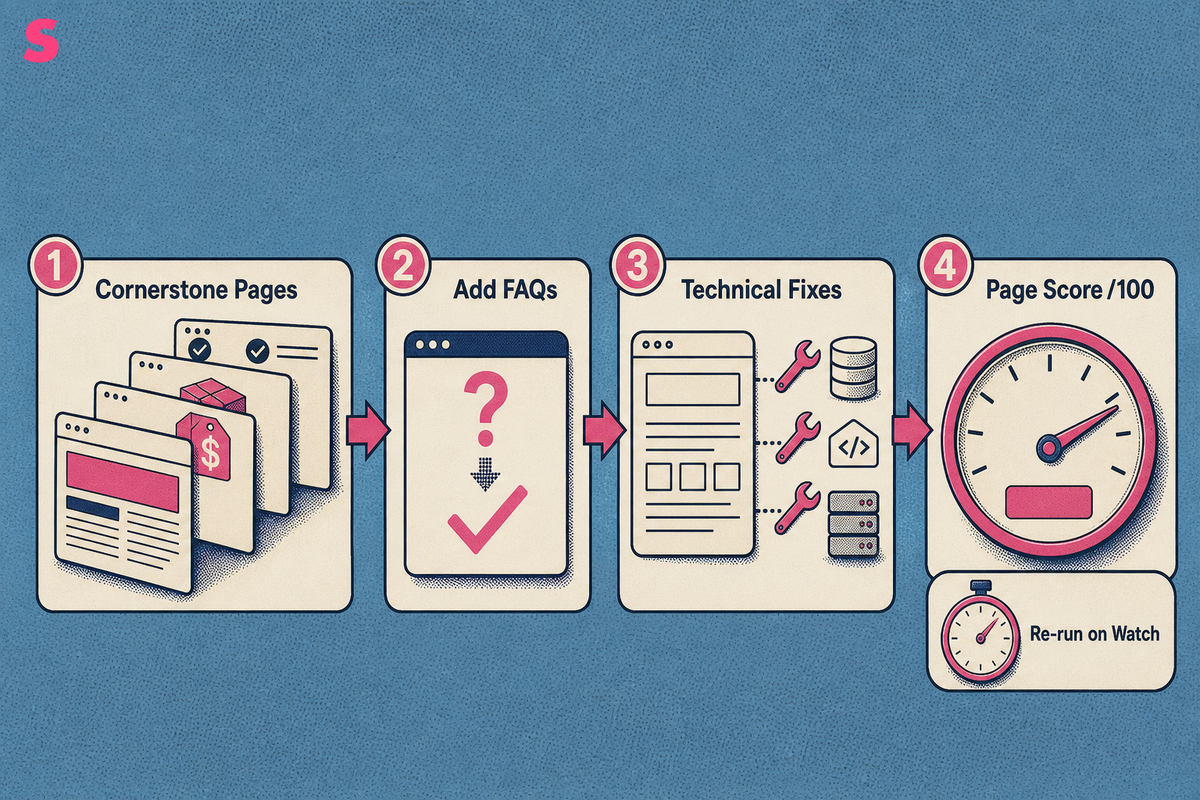
Correct AI descriptions by updating the pages that define your brand, answering recurring buyer concerns directly, and removing technical barriers that prevent AI systems from reading current information. Updating key website pages and adding FAQs provides accurate information for AI systems, per an October 2026 listing.
Start with cornerstone pages: homepage, product pages, pricing, comparison pages, implementation documentation, security material, and help content. Correct outdated features, pricing, and positioning wherever they appear. Stale cornerstone pages can continue supplying negative AI descriptions, per an October 2026 listing.
- Add direct answers to recurring customer concerns and objection-driven prompts.
- Use clear headings, factual claims, current dates, and consistent terminology.
- Validate structured data, canonical tags, metadata, server-rendered HTML, and internal links.
- Remove contradictory language between product pages, documentation, and pricing pages.
- Publish a dated clarification when a historical issue requires context.
Sona AI Visibility’s AI Search Insights returns a page score out of 100 across six categories, identifies critical or medium findings with the fix attached, and re-runs the audit on a watch so teams can confirm whether the correction landed.
Step 6: How should you respond to negative reviews, forum threads, and third-party coverage?
Respond to negative reviews, forum threads, and third-party coverage with factual corrections, accountable service recovery, and evidence of what changed. Bad reviews, complaint threads, and outdated third-party mentions directly contribute to negative AI brand sentiment, per an October 2026 listing.
Separate valid criticism from factual errors. A valid complaint needs a response that acknowledges the experience, explains the resolution where appropriate, and improves the operating problem. A false claim needs a concise correction supported by current documentation, not an argument with the author.
For third-party coverage, request correction only when a statement is demonstrably inaccurate or obsolete. Supply the corrected detail, relevant product context, and a date. Do not attempt to suppress legitimate negative opinions. AI systems can draw on those opinions, and defensive responses can create another source of unfavorable material.
Sona AI Visibility helps teams connect citations and AI-referred visits to pipeline and revenue, giving negative sentiment work commercial context. A recurring complaint in a high-intent vendor-comparison prompt deserves a different response from an isolated complaint in a low-intent discussion.
Step 7: How long do corrections take to change AI answers, and what does success look like?
Corrections take weeks rather than days after new evidence and sources are published, according to a current playbook dated August 30, 2026. Success is a sustained reduction in repeated negative claims across the fixed prompt library, not one favorable answer from one engine.
Run the same prompts daily and review the trend monthly. Track whether the negative statement disappears, becomes qualified with current context, moves from multiple engines to one, or stops appearing in decision-stage prompts. Keep the original answers as evidence because a before-and-after record proves the change better than a single current score.
- Worked: the outdated claim declines across repeated runs and is replaced by current, sourced information.
- Partially worked: the claim remains, but AI answers include the correction or distinguish historical facts from current conditions.
- Not worked: the same claim persists across engines after the owned and third-party evidence changed.
Sona AI Visibility connects citations to pipeline and closed-won revenue on one account timeline. That connection helps teams determine whether improved representation appears in prompts and buyer journeys associated with commercial outcomes.
What should you do when AI sentiment does not improve after the fixes?
When AI sentiment does not improve, recheck the evidence trail, expand the source audit, and verify that the correction addresses the exact claim rather than a related issue. Generic positive content will not displace negative evidence that is more specific, visible, or credible.
Recover with a structured review. Compare the negative statement word for word against the revised page. Then inspect whether the page answers the concern directly, whether the date is clear, whether the information is technically accessible, and whether third-party material still repeats the old claim.
- Re-run the fixed prompt library daily for another observation period.
- Identify every source category that repeats the claim.
- Assign factual corrections to owned and third-party material.
- Escalate valid product, support, or policy issues to the accountable operating team.
- Publish evidence that resolves the buyer concern, then monitor the same claim.
Do not reset the baseline after a poor result. Negative AI brand sentiment is manageable when the team retains the historical log, tests the same prompts, and measures whether the exact claim changes over time.
What are the frequently asked questions?
Is AI brand sentiment a reliable metric?
AI brand sentiment is not reliable as a single reading because one response varies by prompt, model version, location, and retrieval context. Treat sentiment as a repeated trend from a fixed prompt library run several times per engine. The useful unit is the evidence log, not an isolated score.
Can a company control what third-party sources say about it?
A company cannot fully control third-party sources, and legitimate criticism cannot be removed at will. A company can correct factual errors, respond openly, improve customer outcomes, and publish stronger evidence that directly addresses buyer concerns.
Will positive content make AI ignore negative reviews?
No. Positive content does not make AI systems ignore negative reviews. The practical goal is to improve the balance, freshness, credibility, and discoverability of the evidence AI systems draw upon while resolving the underlying issues behind legitimate criticism.
Why do different AI engines describe the same brand differently?
Each engine retrieves and weighs sources differently. Google AI Overviews and ChatGPT identify different brands in 73% of cases when both answer the same query with negative brand sentiment, per simplitas.com, September 18, 2026. Track each engine separately rather than treating AI search as one channel.
How many prompts are enough to track brand sentiment?
A repeatable sentiment-monitoring method uses 20–40 fixed buyer prompts across at least 3 AI engines, run 3 times each, per a methodology listing dated July 22, 2026. Add prompts only when they represent a distinct buyer concern, product line, market, or buying stage.
How is a net sentiment score calculated?
One proposed net-sentiment formula is (recommended + positive − negative) ÷ total mentions × 100, using a five-level classification scale, per a methodology listing dated July 22, 2026. Use the score as a summary measure, then inspect the underlying negative claims, topics, prompts, and sources before deciding what to fix.
Summarize this article with AI: ChatGPT · Claude · Perplexity · Google AI Mode
Last updated: October 2026







