Negative AI brand sentiment occurs when an answer engine, including ChatGPT, Google AI Overviews, and other answer engines, portrays your brand in doubtful or unfavorable terms, emphasizing shortcomings or poor fit while continuing to mention it. It can be corrected because it has sources: save the original response, categorize every negative assertion, and identify the page or review that supports it. Sona AI Visibility links the prompts and citations underlying those responses with pipeline and revenue, enabling fixes to be evaluated in business terms.
What is negative brand sentiment in AI search, and how is it different from negative reviews?
Negative brand sentiment in AI is skeptical or unfavorable language in an AI answer that emphasizes a brand’s limitations, mismatches, or drawbacks. It concerns tone and context, not whether the brand appears at all.
A brand can be highly visible in an answer yet still be framed as a poor choice. An answer that names a vendor repeatedly but describes it as expensive, difficult to implement, or unsuitable for enterprise buyers has high visibility and negative sentiment.
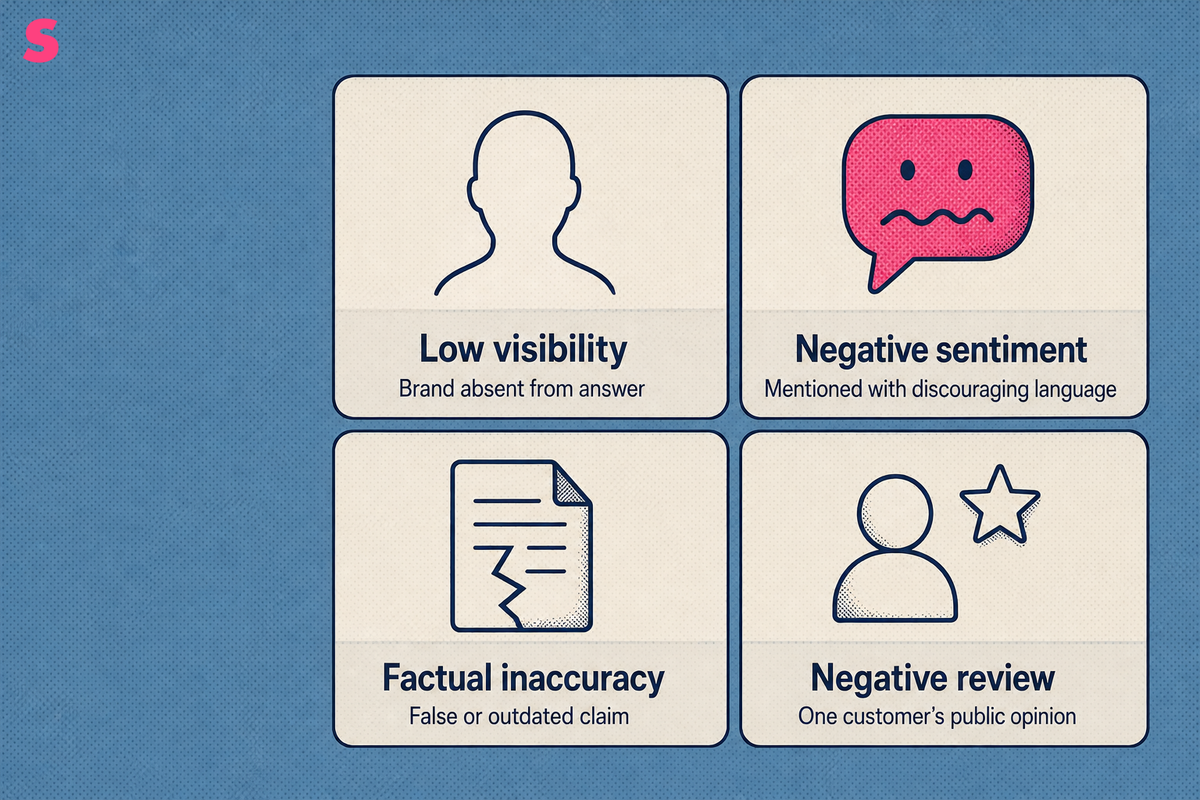
Negative AI sentiment differs from low visibility and factual inaccuracy. An inaccurate claim can have neutral tone. It also differs from social-media sentiment. Social listening captures public posts and conversations. AI-search monitoring captures how ChatGPT, Perplexity, Gemini, Claude, Google AI Overviews, and other answer engines synthesize evidence and recommend brands to prospective buyers.
- Low visibility: the brand is absent from an answer.
- Negative sentiment: the brand is mentioned with discouraging language.
- Factual inaccuracy: the answer includes a false or outdated claim.
- Negative review: an individual customer’s public opinion, rather than an answer engine’s synthesis.
Why does negative sentiment in AI answers matter to a marketing or brand team?
Negative AI sentiment can steer buyers away during vendor research, before they reach your website, submit a form, or enter your CRM. The problem is a pipeline risk, not merely a reputation issue.
Negative descriptions concentrate in predictable query patterns across Google AI Overviews, ChatGPT, and other answer engines. Comparison, alternatives, pricing, suitability, reliability, and risk questions create the greatest exposure because buyers use them to narrow a vendor shortlist.
A one-time audit cannot measure a changing answer environment. AI answers shift as retrieval indexes, model behavior, and published material change. Running the same prompt list daily reveals patterns that a weekly snapshot can obscure. A negative statement that persists in repeated daily runs deserves investigation. A single-day spike is evidence to review, not a conclusion.
Marketing teams cannot control each answer directly. They can improve the quality, recency, balance, and coverage of evidence available to answer engines. Start by identifying the buyer questions that consistently produce unfavorable descriptions.
How do you build a prompt set that surfaces negative AI descriptions of your brand?
A useful prompt set covers the questions buyers ask when deciding whether to trust, compare, or reject a brand. Segment prompts by intent, then run the same wording daily across ChatGPT, Perplexity, Google AI Overviews, and other answer engines.
- Branded prompts: “What is [Brand]?” and “Is [Brand] reliable?”
- Non-branded category prompts: “Best software for [job to be done].”
- Competitor prompts: “[Competitor] alternatives.”
- Head-to-head prompts: “[Brand] vs [Competitor] for enterprise teams.”
- Use-case prompts: “Best tool for [specific workflow].”
- Risk prompts: “[Brand] complaints,” “[Brand] drawbacks,” and “Is [Brand] worth it?”
Illustrative example: a fictional B2B workflow platform called Northstar Ops could track “Northstar Ops alternatives,” “Is Northstar Ops secure for enterprise teams?”, “Northstar Ops vs Flowline,” “best workflow software for regulated operations,” and “Northstar Ops complaints.” The goal is not to collect every possible query. It is to cover the buyer decisions most likely to shape a shortlist.
A small sample cannot represent all buyer behavior. Breadth across prompt types reduces blind spots, while consistent reruns show whether a description persists. A marketer can start with a spreadsheet containing the prompt, engine, answer date, raw answer, cited sources, tone, and next action.
How do you compare AI monitoring tool pricing, engine coverage and prompt capacity?
The comparison below helps buyers compare published plan pricing, agency availability, answer-engine coverage, and prompt capacity. A separate capability review should confirm whether a tool provides sentiment classification, citation tracking, inaccurate-claim review, raw-answer retention, and audit history for the workflow your team requires.
Assess engine coverage, daily prompt capacity, citation tracking, competitor comparison, alerts, and an auditable classification rule. Sentiment classification becomes useful when a marketer can read the exact sentence behind the label and determine whether it reflects fair criticism, stale information, a factual error, or an audience mismatch.
The comparison below uses public plan information and Sona AI Visibility plan information as of October 2026. Prices, plan limits, and engine coverage are stated as of October 2026.
| Tool | Starting price | Agency Plans? (Yes/No) | # of Answer Engines Tracked | Answer Engines | # of Daily Tracked Prompts (entry plan) | Cost per Daily Tracked Prompt | Differentiation |
|---|---|---|---|---|---|---|---|
| Sona AI Visibility | From $75/month billed annually | Yes | Up to 11 (3 on Starter) | Not published | 5,000 credits/month, about 56 prompts tracked daily across 3 engines | $0.45 per daily tracked prompt | Connects AI citations and prompts to pipeline and revenue on one account timeline. |
| Profound | Custom pricing | Yes | Up to 9 (3 on free Trial) | ChatGPT, Perplexity, Google AI Mode, Gemini, Microsoft Copilot, DeepSeek, Claude, Google AI Overviews, Exa Search | Custom prompt plan, daily | Not calculable from public pricing | Focus: custom Enterprise AI answer tracking across up to nine engines. |
| Peec AI | From $95/month | Yes | Up to 13 (3 of 6 on Starter, plus add-ons) | Answer engines not published | 50 prompts daily | $0.63 per daily tracked prompt | Focus: self-serve AI visibility tracking, with agency plans from $245/month. |
| Otterly.ai | From $29/month | Yes | Up to 7 (4 on Lite, 3 as paid add-ons) | ChatGPT, Google AI Overviews, Perplexity, Microsoft Copilot | 15 prompts daily | $0.48 per daily tracked prompt | Focus: prompt tracking across four entry-plan engines, with additional engines available as add-ons. |
| Scrunch AI | From $250/month | Yes | Up to 9 (4 on Core) | ChatGPT, Perplexity, Google AI Overviews, Microsoft Copilot | 125 prompts, refresh cadence not published | No refresh cadence published | Focus: AI visibility tracking for one brand workspace, with Agency Core from $500/month. |
Sona AI Visibility connects the question, citation, and resulting visit to commercial outcomes rather than stopping at a sentiment label. Most sentiment trackers report how an answer describes a brand. Marketing leaders need to know whether those answers influence qualified accounts and pipeline.
How can prompt gaps reveal weak spots in your brand’s reputation?
A prompt gap is a buyer question where competitors are named and your brand is absent, or where the answer cites sources about your brand that you do not control. Prompt gaps reveal reputation vulnerabilities by showing the question, competing narrative, and evidence behind an answer.
Three weak spots recur. Content coverage gaps occur when owned pages do not address a relevant use case or risk question. Third-party evidence gaps occur when reviews, press, or comparison pages present a thin or one-sided record. Risk prompts surface complaints without a clear factual response on your site.
Take a comparison prompt such as “Northstar Ops vs Flowline for regulated operations.” Record the brands named, recommendation order, citations, and claims about Northstar Ops. An answer that cites an old implementation guide points to stale owned content. Repeated citations of complaint threads point to an imbalanced review profile. An answer that names Flowline but omits Northstar Ops points to missing comparison coverage.
A brand-level visibility score is a dated snapshot, not a work item. Sona AI Visibility shows page by page the prompts a site should appear in but does not. That prompt-level view gives a team a page, question, and evidence problem to address.
How do you capture, classify and score negative claims in an AI answer?
Capture negative AI claims as evidence, then classify them by claim type and buyer importance. Save the raw answer with the exact prompt, answer engine, date, location, cited sources, and classification rule before anyone edits a page or responds publicly.
- Split each answer into distinct claims or passages, then assign favorable, neutral, unfavorable, or mixed labels under a fixed rubric.
- Break sentiment down by topic, such as price, implementation, reliability, security, support, or fit. Preserve mixed labels when an answer is favorable on one topic and unfavorable on another.
- Read the prompts that generated negative results instead of relying only on an aggregate score.
- Classify each claim as a factual error, outdated claim, fair criticism, audience mismatch, or unsupported comparison.
- Score severity by buyer intent and buying stage. A negative claim in a decision-stage comparison deserves more urgency than a neutral reference in an awareness query.
The monitoring layer usually classifies generated outputs. An answer engine does not necessarily expose an internal sentiment score. Aggregate the label mix across a defined prompt set, retain the raw text for audit, and reuse the same prompt wording, engines, locations, buyer topics, label definitions, and weighting. Scores from different tools are not directly comparable unless those inputs match.
Benchmark competitors by running the same prompts for your brand and named competitors on the same engines, dates, locations, and buyer topics. Compare negative-claim share, citation rate, factual accuracy, and recommendation position by topic and buying stage. Inspect the underlying claims before drawing a conclusion. This separates category-wide criticism, such as common implementation concerns, from a brand-specific weakness or a difference caused by prompt and engine mix.
Track mention rate, share of voice, citation rate, sentiment, factual accuracy, and recommendation position together. Correcting a factual error should improve accuracy first. Publishing a missing comparison page can improve citation rate and recommendation position. A more balanced review profile can change sentiment in risk-oriented prompts.
A sentiment score is trustworthy only when the underlying answer is visible and the same rubric is reused. The score is not the decision. Raw language, source patterns, prompt intent, and repeated results determine whether a marketing team should act.
How do you trace a negative AI claim to its source and fix it?
Negative AI sentiment is sourced, not felt. Find the exact negative statement for each answer engine, then trace it to the page, review, article, or missing coverage that supports the answer.
| Problem type | Typical root cause | How to confirm | Fix |
|---|---|---|---|
| Stale owned content | Old pricing, product, implementation, or positioning pages | Compare the AI claim with the current owned page and publication date | Update the source page, metadata, FAQs, and supporting documentation |
| Third-party criticism | Press coverage, comparison content, or commentary that frames the brand negatively | Record cited external sources and identify recurring claims | Correct factual records where possible and publish evidence that answers the claim |
| Review imbalance | Public reviews emphasize one product weakness or customer experience | Compare recurring review themes with the language in AI answers | Respond to valid reviews, address product issues, and encourage genuine balanced feedback |
| Missing coverage | No owned page answers a comparison, use-case, or risk prompt | Find prompts where competitors appear and your brand does not | Create a factual page or FAQ that answers the missing buyer question |
| Factual inaccuracy | Incorrect product, pricing, policy, or company information | Document the false statement and compare it with authoritative records | Correct owned pages and request corrections from relevant third-party publishers |
| Audience or use-case mismatch | The answer applies the brand to buyers it does not serve well | Review the prompt wording, recommendation rationale, and intended customer profile | Clarify ideal customer profile, use cases, exclusions, and implementation requirements |
Most fixes do not require dedicated software. Update key pages, add FAQs that answer exact risk questions, correct factual records on owned and third-party pages, respond to reviews, and rerun the same prompts daily. A quarterly positioning review can assess whether the broader narrative matches customer reality.
Sona AI Visibility supports source-level investigation by showing cited sources and page performance alongside prompt tracking. The useful output is a prioritized evidence problem, not a generic sentiment verdict.
What does a measured fix for negative AI sentiment look like, and how do you show business impact?
A measured fix starts with a baseline answer, makes one specific evidence change, then reruns the identical prompt daily to test whether the change persists. The objective is a durable improvement in how high-intent buyers encounter the brand.
Document the baseline negative claim, the cited or missing source that explains it, the intervention, and the repeated post-fix result. An evidence change can include updating an outdated owned page, adding an FAQ that addresses a risk question, or correcting a factual description with a relevant publisher.
Record the baseline answer, citation sources, recommendation position, sentiment classification, factual accuracy, AI-referred visits, identified accounts, and pipeline activity before the fix. A measured commercial outcome requires a documented change in qualified visits, accounts, pipeline, conversion, or revenue after the intervention, with the same prompt set retained for comparison.
Sentiment and mention metrics are leading indicators. Business impact appears when AI-referred visits and accounts move toward pipeline. Sona AI Visibility connects prompts and citations to pipeline and revenue, and tracks AI crawler and agent activity as the front of the same path. Tracking mentions is the baseline. The pipeline connection is the commercial test.
Can you really control how AI describes your brand, and where are the limits?
Brands cannot directly control what an AI model says, and no output can be guaranteed. They can improve the evidence available to answer engines through current owned pages, factual corrections, balanced reviews, and useful coverage of buyer risk questions.
The ethical boundary is clear. Correct inaccurate claims and publish real information. Do not manufacture reviews, hide fair criticism, or attempt to game sources. Fair negative feedback can clarify product positioning and help a team define the buyers it serves well.
Social listening still matters for understanding public conversation. AI-search monitoring answers a different question: how answer engines synthesize available evidence and recommend brands to potential buyers. Both belong in a reputation program, but neither replaces the other.
What are the frequently asked questions about negative brand sentiment in AI?
What is negative brand sentiment in AI?
Negative brand sentiment in AI is skeptical or unfavorable language an AI answer uses about a brand, such as stressing limitations, mismatches, or drawbacks. It can occur even when the brand is mentioned often because visibility and favorable tone are separate measures.
Can I stop ChatGPT, Google AI Overviews, and other answer engines from saying negative things about my brand?
Not directly, and no output can be guaranteed. A brand can improve the evidence answer engines draw from by fixing inaccurate pages, correcting third-party facts, balancing reviews, and covering risk questions, then measuring the same prompts repeatedly.
Why is my brand mentioned often but described negatively?
High visibility and positive sentiment are separate measures. Frequent mentions can still include warnings about price, fit, reliability, implementation, or support. Track tone and factual accuracy alongside mention rate to determine whether visibility helps or harms buyer consideration.
How often should I rerun prompts to track AI sentiment?
Run the same prompt list daily with identical wording. AI answers change with retrieval indexes, model updates, and newly published evidence. Daily results help a team separate a persistent issue from random variation, while a one-time audit can mislead.
Is AI sentiment tracking the same as social listening?
No. Social listening measures public posts and conversations. AI-search monitoring measures how answer engines synthesize evidence and recommend brands to prospective buyers. Both reveal reputation signals, but they capture different parts of the buyer journey.
Do I need a dedicated tool to find negative AI descriptions of my brand?
No. A spreadsheet, fixed prompt set, saved raw answers, and a consistent classification rubric are enough to start. A dedicated tool adds scale, repeated runs, citation tracking, alerting, and structured reporting when prompt monitoring becomes an ongoing responsibility.
Summarize this article with AI: ChatGPT · Claude · Perplexity · Google AI Mode
Last updated: October 2026