In a comparison of the Perplexity answer engine and Google, Perplexity provides a synthesized answer with citations, whereas Google provides ranked links, making Perplexity better for research and Google better for discovery and navigation. Google continues to generate substantially more traffic, while third-party estimates of each engine’s share cannot be compared directly. Sona AI Visibility connects the prompts and citations underlying AI answers with pipeline and revenue, and monitors the AI crawler activity preceding them, allowing the smaller channel to be evaluated by deals rather than reach.
What actually separates an answer engine from a results page?
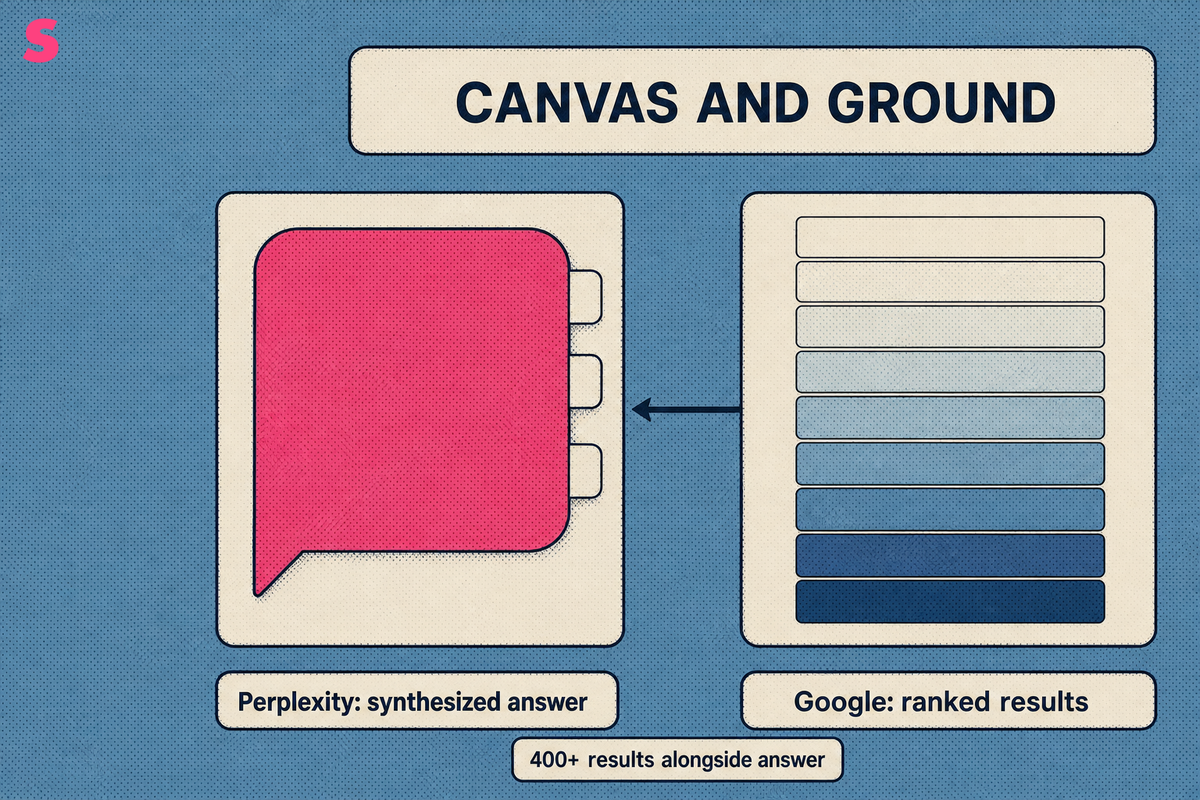
The central difference in the Perplexity answer engine vs Google comparison is the output. Perplexity produces a synthesized answer with citations. Google Search presents a results page that lets researchers choose sources, although Google AI Overviews can generate summaries for some queries.
That difference changes the research workflow. Perplexity compresses several source-reading steps into one response, which suits buyers seeking a vendor comparison, implementation trade-off, or concise explanation. Google gives buyers a broader set of documents, product pages, forums, analyst material, and primary sources to inspect.
Perplexity also delivers more than 400 traditional search results alongside its AI analysis, per Tom’s Guide. The interface does not eliminate link-based research. It shifts the starting point from a ranked list to an answer that proposes a conclusion.
For B2B teams, the practical question is whether the task requires synthesis or exhaustive discovery and source verification.
How do answer engines and search results compare on response format, citations, real-time data, cost and privacy?
Perplexity prioritizes a cited narrative response, while Google Search prioritizes discovery through a ranked results page. Google AI Overviews narrows that difference for eligible queries, but Google Search still gives users more control over the sources they open, compare, and trust.
Neither product is a fixed database. Answer quality changes with query wording, source availability, location, timing, and product settings. For current research, inspect the cited source directly, especially for pricing, security, procurement terms, and product capabilities.
| Dimension | Perplexity | Google Search | Google AI Overviews | What it means for B2B research |
|---|---|---|---|---|
| Primary output | Direct synthesized answer with citations | Ranked links and search features | AI-generated summary within Google Search | Use synthesis for orientation, then inspect primary sources before procurement. |
| Source workflow | Citations appear inside the answer | The researcher selects sources from results | Linked sources support the generated response | Google offers wider source discovery; Perplexity reduces initial reading time. |
| Research depth | Structured for concise research answers | Structured for broad discovery and direct source hunting | Structured for fast, in-search summaries | Use both when the buying decision carries material risk. |
| Current material and freshness | Review cited sources and their publication dates before relying on a current claim | Use results to locate current primary sources and inspect publication dates | Open linked sources and inspect publication dates before relying on a summary | Neither interface removes the need to verify source recency for news, pricing, or procurement evidence. |
| Privacy and data handling | Platform-specific retention, model-training use, and enterprise controls require review of current terms | Platform-specific retention, model-training use, and administrative controls require review of current terms | Uses the Google Search environment, so teams should review the applicable Google terms and controls | Do not enter confidential deal, customer, or product information before procurement reviews documented controls. |
| Cost to start | Free plan with usage limits | Free to use | Included within Google Search | Free access makes side-by-side testing practical for most teams. |
Privacy requires separate due diligence. Procurement teams should review enterprise terms, data handling, retention controls, and administrative settings before entering confidential deal, customer, or product information into either workflow.
Which search experience is better for B2B SaaS buyers doing vendor research and procurement?
Perplexity is better for fast, cited synthesis of a defined B2B SaaS question. Google Search is better for broad discovery, finding an exact vendor document, and testing a conclusion against primary sources. Use both for consequential procurement decisions.
Research reviewers describe a similar split. Perplexity excels at research and synthesis, while Google is stronger for general discovery and direct source hunting, per Jess Writes About Tech. Medium reports that Perplexity performs well on how-to guides and crisp summaries while reaching parity with Google for individual-fact recall.
- Use Perplexity first when the team needs a preliminary vendor landscape, category definition, or summary of competing approaches.
- Use Google Search first when the team needs an exact security page, pricing page, documentation article, customer reference, or legal term.
- Use both when a shortlist moves into a formal evaluation, proof of concept, or purchasing decision.
A sound procurement sequence starts with a synthesized answer, opens every material citation, then searches independently for omitted vendors and contrary evidence. That process prevents an answer engine from becoming the sole judge of a vendor category.
How should you test answer engines against Google, and what method makes the result trustworthy?
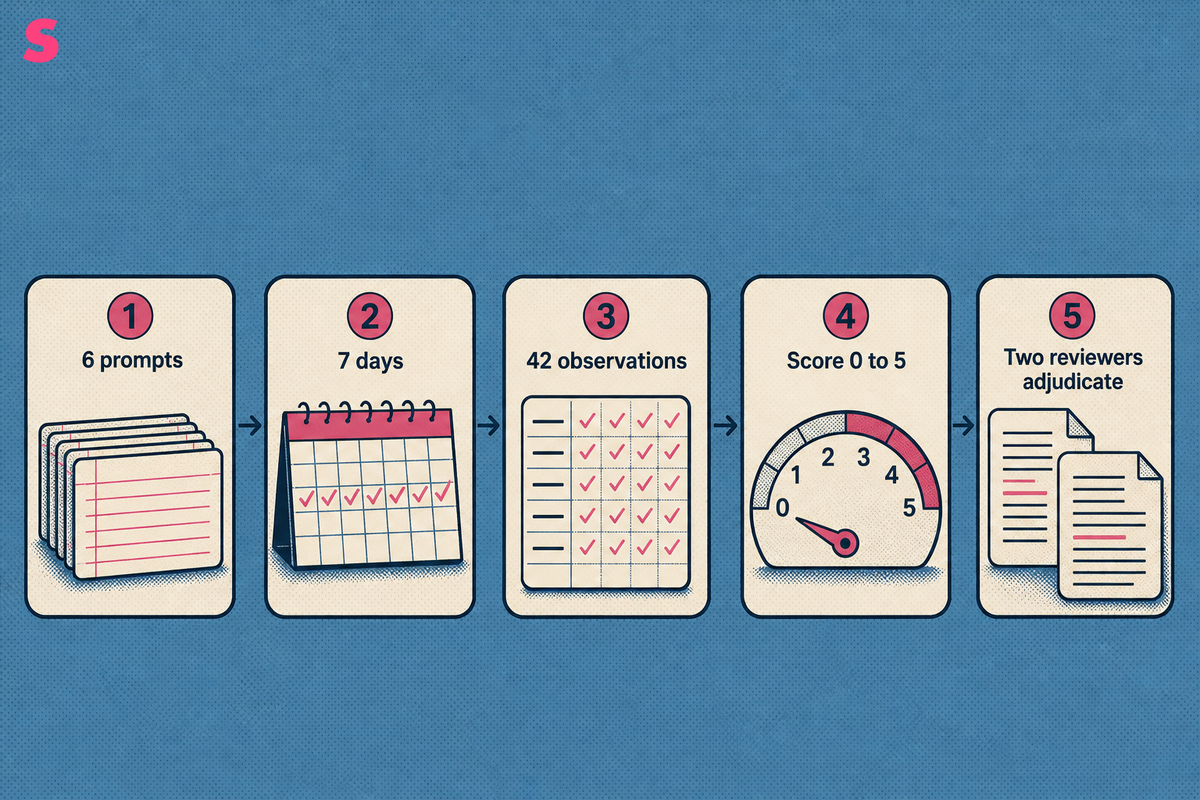
This article does not publish completed head-to-head performance results, so it makes no claim that Perplexity or Google Search wins a defined prompt set. A trustworthy comparison requires a stable prompt set, repeated daily runs, documented conditions, a predefined scoring rule, and a published observation record.
A reproducible test should use these six prompts verbatim: best B2B SaaS contract management software for mid-market teams; compare B2B SaaS contract management software pricing; how to implement contract management software with Salesforce; contract management software security and compliance requirements; contract management software API integration documentation; and contract management software vendor implementation timeline.
- Run all six prompts in Perplexity and Google Search once daily for seven consecutive days, producing 42 observations per search experience.
- Record the exact date and local time, country or region, account tier, signed-in status, browser, query wording, cited or selected sources, result type, and whether the evaluated brand appeared.
- Score each observation on five binary criteria: brand mention, cited or linked brand page, source relevance, factual accuracy against a primary source, and relevance to the stated buying stage. Each observation receives a score from 0 to 5.
- Have two reviewers adjudicate factual accuracy and buying-stage relevance independently. Resolve disagreements by reopening the primary source, recording the final decision, and retaining the raw observation record.
Daily testing reveals patterns that a weekly snapshot can obscure. Investigate a one-day spike before treating it as a sustained change. Sona AI Visibility’s October 2026 pricing lists tracking across 11 answer engines, but that plan detail is separate from a published performance result.
How does a brand get cited in answer engines compared with ranking in Google Search and Google AI Overviews?
A Perplexity citation places a source inside a generated answer, while a Google ranking is a position within a results page. Google AI Overviews create a third outcome: a brand can be cited in the AI-generated summary, appear in traditional results, both, or neither.
Google ranking work centers on earning visibility for a query and persuading a searcher to click. Answer-engine visibility centers on whether the system selects a source while composing an answer. The outcomes overlap, but they are not interchangeable measurements.
Perplexity’s cited-answer format makes citation presence a useful measurement unit. Google Search still requires position, result type, and page-level context. Google AI Overviews require separate observation because cited sources can differ from conventional organic results for the same query.
Sona AI Visibility’s October 2026 pricing lists tracking across 11 answer engines. For content teams, the useful output remains a record of buyer prompts that produced citations, pages that supplied evidence, and priority prompts that remain uncovered.
Is an answer engine too small to matter next to Google, and how reliable are the traffic figures?
Perplexity is not close to Google in overall traffic, but its cited-answer workflow can pressure Google by changing expectations from link selection to synthesized answers. The Product Space identifies Perplexity’s success as evidence of a shift toward direct, AI-synthesized answers rather than traditional link-based search results.
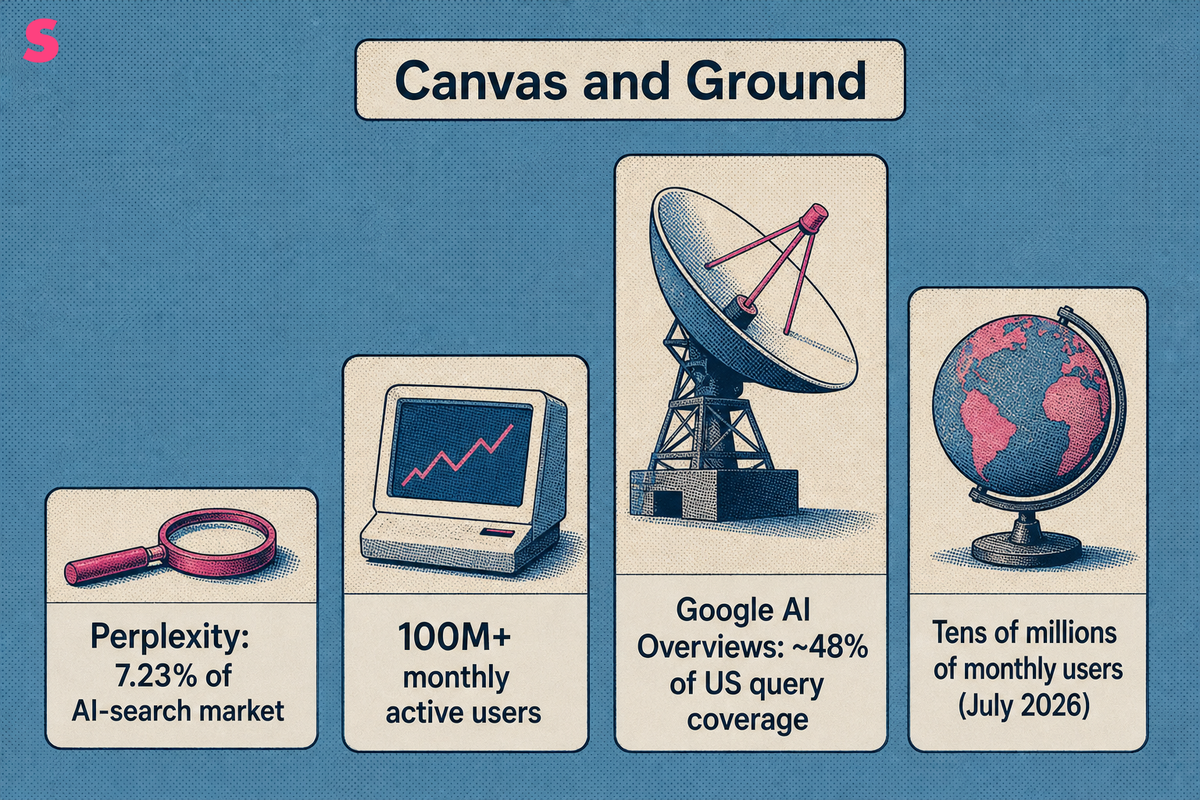
A third-party market estimate dated October 2026 placed Perplexity at 7.23% of the AI-search market and above 100 million monthly active users. The same estimate put Google AI Overviews at approximately 48% of United States query coverage. Those figures measure different things and are not directly comparable.
A July 2026 description characterized Perplexity as serving tens of millions of monthly users and handling hundreds of millions of queries per month. Those figures indicate meaningful usage, but they do not establish referral volume, buyer intent, market share, or influence within a specific B2B category.
Traffic claims need clear labels. Monthly users measure audience size. Query volume measures activity. Market share estimates measure a defined market model. Referral traffic measures visits sent to a site. B2B marketing teams should not combine those metrics into one adoption narrative.
What do answer-engine plans and limits cost compared with free Google Search?
Google Search is free to use, while Perplexity offers a free tier and paid monthly plans. Compare monthly cost and included research capacity rather than assuming one pricing model suits every B2B team.
| Plan or service | Monthly price | Included limit | Best fit |
|---|---|---|---|
| Google Search | Free | No paid search plan required for standard use | Broad discovery, source hunting, and routine web research |
| Perplexity Free | Free | 3 Pro Searches per day and 1 Research Query per month, per the October 2026 listing | Occasional synthesis and evaluation |
| Perplexity Pro | $20 per month, or $17 per month billed annually, per the October 2026 listing | Paid individual plan | Frequent individual research |
| Perplexity Max | $200 per month, or $167 per month billed annually, per the October 2026 listing | Paid individual plan with higher limits | High-volume individual research |
Perplexity’s business model spans free usage, paid individual subscriptions, per-seat enterprise subscriptions, and usage-priced API access. Google Search provides standard access without a paid search plan, and Google AI Overviews operate within Google Search. This article has no approved evidence about Google’s revenue model, advertising mechanics, or the commercial role of Google AI Overviews, so it does not infer those details from free access.
Enterprise pricing uses a different unit. Perplexity Enterprise Pro is listed at $34 per seat per month billed annually, and Enterprise Max is listed at $271 per seat per month billed annually, per the October 2026 listing. Enterprise Pro includes 400 Pro Searches per week and 50 Research Queries per month, while Enterprise Max includes 4,000 Pro Searches per week and 500 Research Queries per month, per the October 2026 listing.
For API use, Perplexity’s Search API is reported at $5 per 1,000 standard searches and $1 per 1,000 fast searches, per aibusinessweekly.net, October 2026. API pricing and end-user research subscriptions answer different procurement questions.
Which metrics and tools measure answer-engine visibility alongside Google rankings and referral traffic?
Answer-engine visibility requires citation and mention frequency across repeated prompts, while Google measurement requires rankings, impressions, clicks, and referral traffic. A single metric cannot explain both systems because Perplexity has no fixed ranked list comparable with a Google SERP position.
Sona’s own AI visibility data, September 2026, covers 8 answer surfaces: ChatGPT, Google AI Overviews, Perplexity, Google AI Mode, Gemini, Mistral, Qwen and Claude. The archive treats each answer surface as a distinct observation rather than treating every AI-generated answer as a Google ranking.
- Perplexity visibility: record brand mention rate, citation frequency, cited page, cited domain, prompt category, and answer variation.
- Google Search visibility: record organic position, result type, impressions, clicks, and landing-page traffic.
- Google AI Overviews visibility: record citation presence, cited URLs, query context, and coexistence with organic results.
- Commercial outcome: record qualified visits, account engagement, opportunities, pipeline, and revenue.
A score is a dated snapshot. A comparable series of observed answers reveals whether visibility changed.
When does the choice between an answer engine and Google stop mattering?
The choice matters less when the task has one verifiable fact, the source is already known, or the answer carries little commercial consequence. In those cases, either Perplexity or Google Search can provide a useful starting point, and the fastest path may be sufficient.
Perplexity and Google also converge when a researcher reads the primary document directly. A buyer who opens a vendor’s pricing page, security documentation, contract terms, or technical specification no longer relies on the search interface for the final claim.
The choice matters again when a team measures brand discovery. Monitoring which AI answers mention a brand is only half the job. Sona’s own AI visibility data, September 2026, covers 8 answer surfaces and treats each answer surface as a distinct observation.
Use Perplexity for concise synthesis, Google Search for broad discovery, and primary sources for decisions. That division of labor is more reliable than treating either interface as a complete research system.
What are the frequently asked questions about answer engines and Google?
Is an answer engine better than Google for research?
For synthesis and cited summaries, reviewers favor Perplexity. Jess Writes About Tech finds Perplexity stronger for research and synthesis, while Google is stronger for broad discovery and direct source hunting. Medium reports parity for recalling individual facts, so neither has a decisive advantage for a simple fact check.
Does an answer engine replace Google Search?
No. Google remains dominant in overall traffic, and the systems serve different stages of a research journey. Perplexity signals a shift toward direct, AI-synthesized answers, per The Product Space, while Google remains useful for discovery, source validation, and navigational searches.
Is an answer engine free, and how does its cost compare with Google?
Google Search is free to use. Perplexity has a free plan with 3 Pro Searches per day and 1 Research Query per month, per the October 2026 listing. Perplexity Pro starts at $20 per month, or $17 per month billed annually, per the October 2026 listing.
Can you track answer-engine visibility like a Google SERP position?
Not in the same way. Perplexity has no fixed ranked list, so visibility is measured through citation and mention frequency across repeated prompts under documented conditions. Google Search visibility still uses position, impressions, clicks, and result-page context.
Does an answer engine send as much traffic as Google?
No. Google delivers far more traffic. Market share, monthly users, query volume, and referral traffic measure different things, so each figure needs a clear label rather than being combined into one traffic claim.
Do answer-engine responses change from one run to another?
Yes. Model choice, plan tier, location, timing, source availability, and query wording can change an answer. A reliable visibility test repeats the same prompt list daily and records the conditions for every run.
Summarize this article with AI: ChatGPT · Claude · Perplexity · Google AI Mode
Last updated: October 2026