Services that assess brand presence in AI chat assistant replies run a fixed set of prompts across engines including ChatGPT, Gemini, Perplexity, and other answer engines, then report mentions, citations, sentiment and share of voice. Results vary by prompt, model, location and date, so evaluate a service by its disclosed methodology, not its headline score. Sona AI Visibility connects prompts and citations to pipeline and revenue, while tracking the AI crawler and agent activity that precedes them.
What do services that analyze brand presence in AI chat assistant responses actually do?
Services that analyze brand presence in AI chat assistant responses run defined buyer questions through answer engines. They record whether a brand appears, how the answer describes it, which sources support the response, and which competitors appear alongside it. The result is a dated record of brand inclusion, not a conventional search-ranking report.
These services commonly organize prompts by topic, funnel stage, product category, or competitor comparison. They track mentions, citations, sentiment, topic associations, and share of voice across LLMs. Competitor benchmarks matter because a brand can appear often while missing the commercial prompts that shape vendor evaluation.
The central question is narrow: when a prospective buyer asks an AI assistant for recommendations, does the answer include the brand in a useful context?
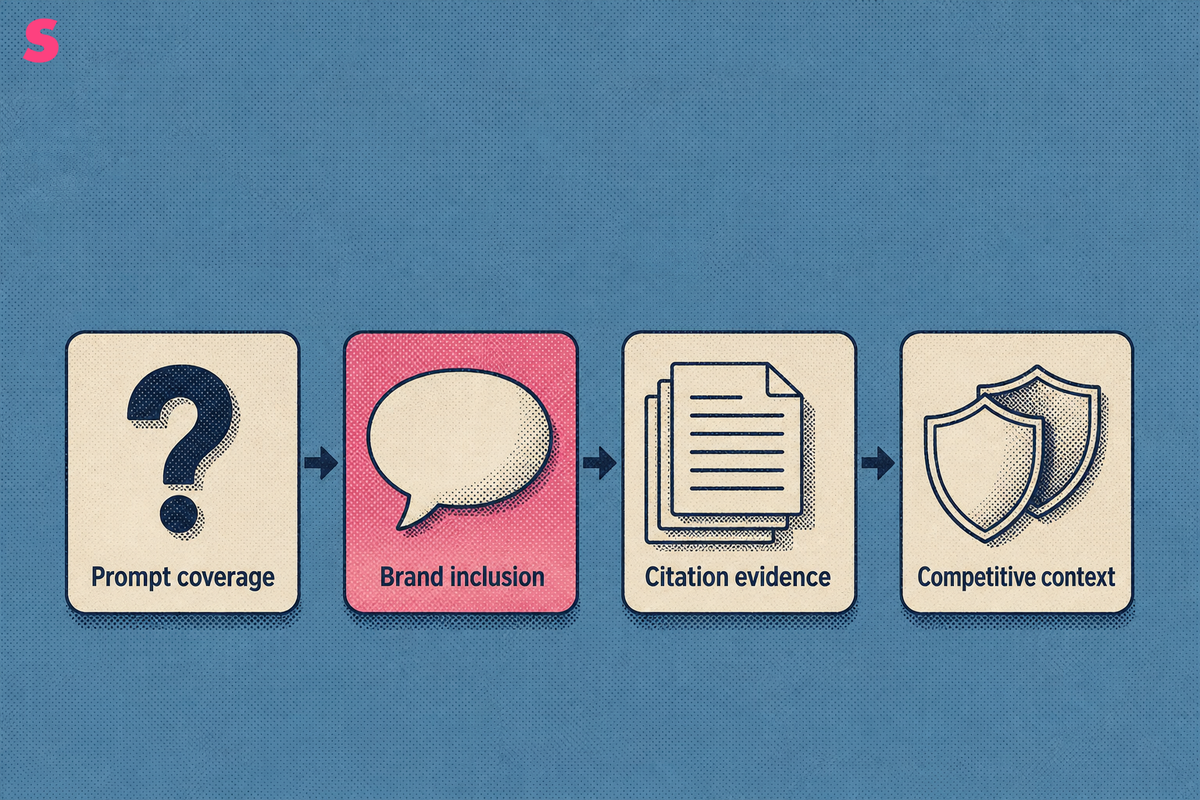
- Prompt coverage: the questions the service runs and preserves over time.
- Brand inclusion: whether the answer mentions, recommends, compares, or omits the brand.
- Citation evidence: the pages, publications, or domains that answer engines cite.
- Competitive context: which alternatives appear in the same answer.
Which AI engines and search surfaces do these services track?
AI brand-presence services track different combinations of ChatGPT, Gemini, Perplexity, Google AI Overviews, Google AI Mode, Claude, Copilot, and other answer engines. Engine coverage is not standardized, so a service can report broad visibility while omitting an answer surface that matters to the buyer journey.
Semrush One lists five tracked surfaces as of October 2026: ChatGPT, Perplexity, Gemini, Google AI Overviews, and Google AI Mode. These surfaces behave differently. Some generate conversational responses, while Google AI Overviews and Google AI Mode combine generated answers with search retrieval.
Evaluate engine coverage against audience behavior. A B2B software company whose buyers research vendors through ChatGPT and Google needs those surfaces in its prompt set. A company selling through technical communities may also need Claude, Perplexity, Gemini, and other answer engines where buyers ask product questions.
Engine count alone is insufficient. A service should disclose which engines are active on the entry plan, which require an upgrade, and whether the same prompt runs across every listed engine. An advertised total can otherwise conceal a narrower practical dataset.
How do AI assistants decide which brands to mention, and how is that different from SEO rankings?
AI assistants generate answers from model knowledge, retrieval systems, available sources, and prompt wording, rather than returning one fixed ranked list of webpages. Brand inclusion can change with the model, location, retrieval index, source set, or wording.
Traditional SEO measures positions and clicks around ranked links. LLM optimization services examine whether a generated answer names a brand, presents it accurately, and cites pages that support the recommendation. Generative engine optimization research provides a framework for studying visibility in generated answers.
SEO still matters because answer engines retrieve web content. The measurement unit changes. Instead of asking whether a page ranks for a keyword, AI brand-presence analysis asks whether a buyer-facing prompt produces a credible answer that includes the brand and supporting sources.
Which capabilities separate one brand-presence service from another?
The meaningful differences between brand-presence services are disclosed engine coverage, prompt capacity, refresh cadence, geographic controls, citation-level evidence, competitor definitions, and whether a visibility score can be reproduced from the underlying prompt set. Mention tracking is the baseline, not the buying decision.
A buyer should ask whether the service preserves the exact prompt, engine, date, answer text, brand mention, and cited source behind every reported result. A score without those records is difficult to audit. Reproducible measurement lets teams rerun the same prompt list and distinguish a changed answer from a changed methodology.
- Prompt design: whether teams can import, group, and classify commercial buyer questions.
- Answer capture: whether the service stores the answer text and citations rather than only a mention flag.
- Geographic controls: whether location and market settings are explicit for each run.
- Competitive rules: whether the service defines which companies count as competitors before reporting share of voice.
- Measurement cadence: whether the same prompt set runs daily and builds a comparable history.
A brand-level visibility score is a dated snapshot, not a work item. Prompt-level evidence identifies the questions and cited sources behind the score. Sona AI Visibility uses AI Search Insights to show tracked prompts, cited sources, and page-level performance, so teams can identify prompt gaps rather than act on one aggregate number.
The larger separation is commercial measurement. Sona AI Visibility connects AI citations to pipeline and revenue on one account timeline, and tracks AI crawler activity from server logs or a lightweight edge worker. That evidence distinguishes a visible brand from a measurable acquisition channel.
Which services are worth evaluating, and what do their entry plans cost?
The most useful shortlist starts with services that disclose entry price, prompt allowance, engine coverage, and operating model. The table compares a compact set of services for orientation, not a full feature-parity assessment. All pricing and plan details are current as of October 2026.
| Tool | Starting price | Agency Plans? (Yes/No) | # of Answer Engines Tracked | Answer Engines | # of Daily Tracked Prompts (entry plan) | Cost per Daily Tracked Prompt | Differentiation |
|---|---|---|---|---|---|---|---|
| Sona AI Visibility | From $75/month, billed annually | Yes | Up to 11 (3 on Starter) | Not published | 5,000 credits/month, about 56 daily tracked prompts across three engines | $0.45 per daily tracked prompt | Connects AI citations to pipeline and revenue on one account timeline, and tracks AI crawler activity from server logs or a lightweight edge worker. |
| Profound | Free 7-day trial; Enterprise custom pricing | Yes | Up to 9 (3 on free Trial) | ChatGPT, Gemini, Google AI Overviews | 50 prompts daily during the 7-day trial | Cannot calculate from custom pricing | Prompt tracking across AI answer engines, with agency plans from $99/month. |
| Peec AI | From $95/month | Yes | Up to 13 (3 of 6 on Starter, plus add-ons) | Not published | 50 prompts daily | $0.63 per daily tracked prompt | Brand visibility and competitor tracking across self-serve and agency plans. |
| Otterly.ai | From $29/month | Yes | Up to 7 (4 on Lite, 3 as paid add-ons) | ChatGPT, Google AI Overviews, Perplexity, Microsoft Copilot | 15 prompts daily | $0.48 per daily tracked prompt | AI search monitoring across four answer engines on the Lite plan. |
Costs rise as teams add prompts, engines, countries, API access, and client workspaces. Compare plans using the same operating unit, daily prompts across active engines, rather than comparing a monthly subscription price without its monitoring capacity.
How reliable are AI visibility measurements when answers vary by prompt, model, location and date?
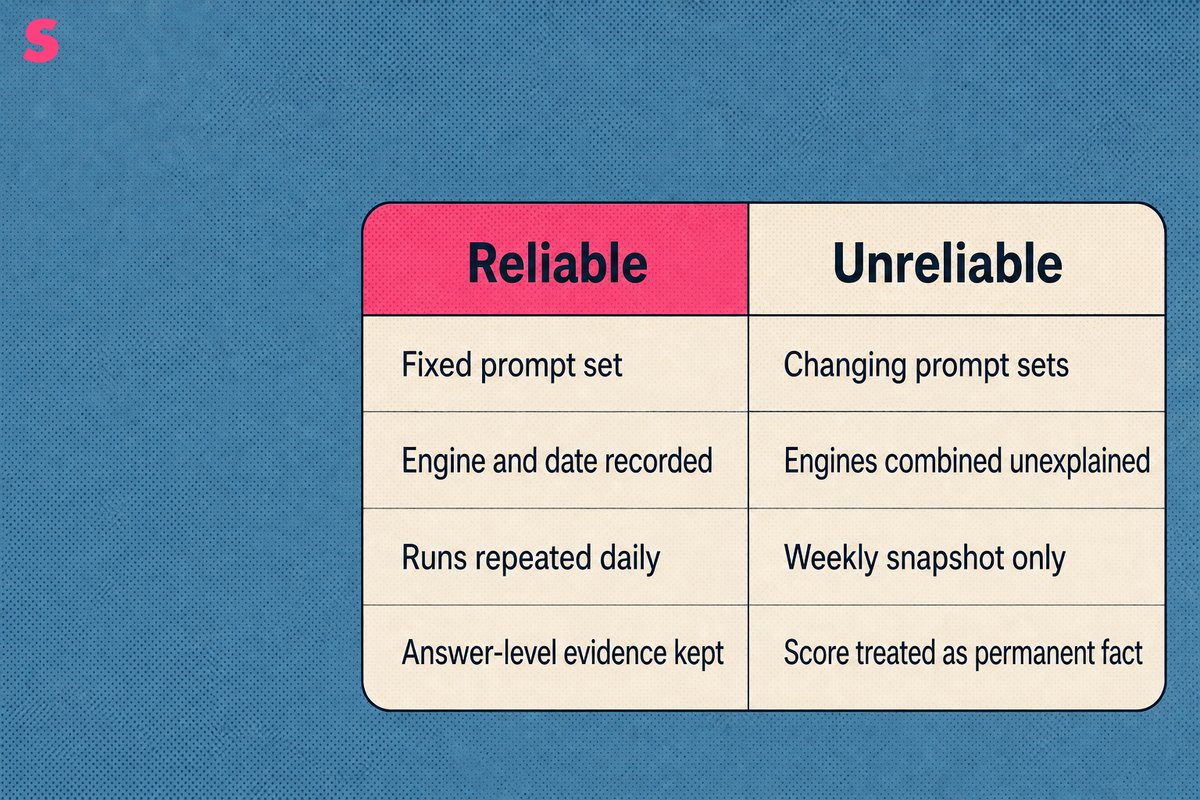
AI visibility measurements provide reliable trend evidence when the service fixes the prompt set, records the engine and date, repeats runs, and preserves answer-level evidence. They become unreliable when a vendor compares changing prompt sets or combines incompatible engine results into one unexplained score.
Answer variability is normal. A model update, changed retrieval index, different location, or newly published competitor page can alter an answer. Daily runs of the same prompt list reveal patterns that a weekly snapshot can obscure. Sustained changes indicate a trend, while isolated spikes are noise.
A trustworthy service should state its prompt sample, refresh cadence, engine list, geographic settings, and definition of a mention. It should also retain dated snapshots. The useful output is a log that lets a team compare answer changes over time, not a score treated as a permanent fact.
Use separate review cycles for separate work. Run prompts daily, review competitive patterns quarterly, and conduct broader positioning reviews on a schedule that matches the buying cycle.
How can you test whether a service detects your brand mentions reliably?
Test brand-mention detection with a fixed prompt set, repeated runs, a manual record of answer evidence, and a comparison of every service record against that ground truth. The method evaluates missed mentions, false mentions, citation accuracy, and run-to-run variance without relying on vendor claims. No approved cross-service test results are available for this page, so the protocol below is not evidence that any named service detects or misses mentions.
- Create a fixed prompt set. Include recommendation prompts where the brand should appear, category prompts where it should not appear, competitor comparisons, and non-branded educational questions.
- Freeze the test conditions. Record the engine, country, language, date, prompt wording, and whether the prompt is run in a clean session.
- Run every prompt repeatedly. Use daily runs across a defined test window, because one answer does not establish stable detection.
- Build a manual ground-truth file. Save the answer text, brand mentions, competitor mentions, citations, and any ambiguous references.
- Compare service records against the manual file. Count missed mentions, false mentions, mismatched citations, and answer records that differ across repeated runs.
- Review the evidence, not just the score. Ask whether the service exposes the underlying prompt and answer for each reported mention.
An illustrative scenario is a prompt that names three vendors in a manual answer but produces only two logged mentions in a service dashboard. The discrepancy is a missed mention. A service that logs a brand absent from the manual answer produces a false mention.
Use the same protocol for every product under consideration. Sona AI Visibility can be evaluated against the same prompt-level evidence as any other service, including whether citations connect to identifiable account activity, pipeline, and revenue.
How do LLM optimization services and AI-driven SEO services improve brand inclusion in AI answers?
LLM optimization services and AI-driven SEO services improve brand inclusion by identifying content gaps, strengthening citable source material, correcting page-level technical issues, and aligning pages with buyer questions. The work targets answer retrieval and citation eligibility, not guaranteed placement in an AI response.
Useful programs turn visibility data into a content and technical backlog. That work can include clarifying product claims, publishing evidence that supports comparisons, improving structured content, resolving crawl barriers, and updating pages that answer engines retrieve but do not cite.
Sona AI Visibility identifies page-level gap prompts and re-audits key pages on an ongoing basis, with fixes ranked by severity. Sona done-for-you services add a team that handles content, AI search optimization, technical fixes, strategy, and reporting on top of an AI Visibility Growth plan or above.
AI-driven SEO work becomes repetitive when teams write for model outputs rather than buyers. Useful buyer information is the practical test. Pages should answer a real decision question with evidence, clear terminology, and source material that survives direct review.
Who should not pay for an AI brand-presence analysis service?
AI brand-presence analysis services are not for every company. A manual spot-check is enough for teams with little published content, no evidence that buyers ask assistants for recommendations, or no capacity to act on prompt and citation findings.
Do not buy a service if the expected outcome is a guaranteed AI ranking. Generated answers change, and no legitimate monitoring platform can promise permanent inclusion. Do not buy one solely to produce a mention count for leadership, because visibility alone does not prove clicks, opportunities, pipeline, or revenue.
- Teams with little content and no clear category or product narrative.
- Companies whose buyers do not use answer engines during research.
- Buyers seeking a guaranteed recommendation or fixed AI ranking.
- Teams unable to assign owners to content, technical, or source-coverage fixes.
- Organizations that need broad brand-health and perception benchmarking rather than answer-engine tracking.
A manual check works when the question is simple: does the brand appear in a small set of high-value prompts this month? Paid monitoring becomes appropriate when the team needs repeatable evidence across prompts, engines, competitors, dates, and markets.
What are the frequently asked questions?
What is a service that analyzes brand presence in AI chat responses?
A service that analyzes brand presence in AI chat responses is software, sometimes paired with a services team, that runs a set of prompts through AI assistants on a schedule. It records whether and how a brand is mentioned, cited, described, and compared with competitors.
How many prompts should a brand track?
The right number is the set of questions real buyers ask during evaluation. Start with high-value category, comparison, implementation, and pricing prompts, then widen the set after the data becomes stable.
Can I trust an AI visibility score?
Treat an AI visibility score as a trend, not a fact. Scores depend on the vendor’s prompt set, engines, geography, and refresh rate. Ask for the exact measurement method, answer evidence, and repeat-run policy before comparing one score with another.
How often should brand-presence data be refreshed?
Run the same prompt list daily. Daily runs smooth answer variance better than occasional snapshots, and teams can judge changes over weeks rather than reacting to one-off swings. Sona AI Visibility, Otterly.ai, PromptRush, and Semrush all support daily tracking in published plans as of October 2026.
Does a mention in an AI answer lead to revenue?
No. A mention does not prove a click, a qualified account, or a purchase. Look for a service that connects prompts and citations to accounts, pipeline, and revenue, rather than treating answer inclusion as the final business outcome.
How do LLM optimization services differ from traditional SEO services?
SEO targets ranked links in a results page. LLM optimization targets whether a generated answer mentions and cites a brand, so the work focuses on citable content, source coverage, technical accessibility, and the pages answer engines retrieve for buyer questions.
Summarize this article with AI: ChatGPT · Claude · Perplexity · Google AI Mode
Last updated: October 2026