


ChatGPT gets information from four sources: patterns acquired during training, the ongoing conversation, files or apps a user links, and live web search when it decides to browse. Training knowledge is locked to a cutoff and influenced by fine-tuning and human feedback, whereas search finds current pages and provides citations. According to OpenAI's help documentation from October 2026, ChatGPT Search evaluates sources using several factors and does not guarantee top placement.
What are the four places ChatGPT gets its information?
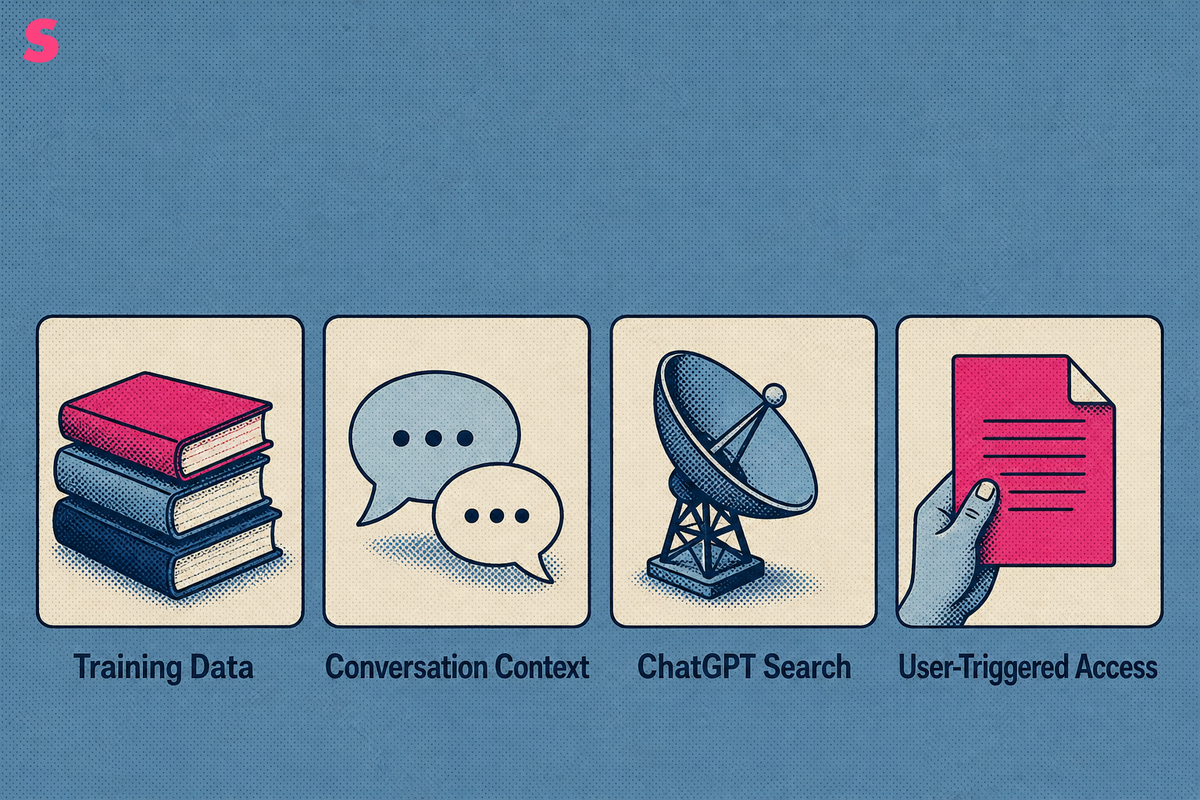
ChatGPT gets information from four places: patterns learned during training, the current conversation, web search results, and pages a user asks it to open. The source it uses depends on whether the answer requires current information or can rely on learned knowledge.
The distinction matters at work. A product marketer checking a competitor’s current pricing needs live retrieval. A writer asking for a definition may receive an answer generated from training data and conversation context, with no external source attached.
- Training data: information learned before a model release.
- Conversation context: text, files, and instructions provided during the chat.
- ChatGPT Search: current web pages retrieved for an answer.
- User-triggered access: a page ChatGPT opens because a user asks it to inspect a specific link.
These are not interchangeable databases. ChatGPT does not search a live index for every sentence, and it does not retain a browsable copy of every page used in training. It generates responses by predicting useful text from learned patterns, conversation context, and retrieved material when search or page access occurs.
For example, ChatGPT can search the web for a company’s current leadership team, retrieve current pages, and cite them. For a general explanation of regression analysis, it can answer from learned knowledge without opening a page.
What data was ChatGPT trained on, and what role does each source play?
ChatGPT was trained on a large body of text from sources such as Wikipedia, books, news articles, and other publicly available text, per Scribbr. Training teaches the model patterns in language, concepts, formats, and relationships. It does not give ChatGPT a searchable catalogue of every training document.
Training material also includes Common Crawl, books, code, licensed data, and text from social platforms. Text from platforms including Twitter, Facebook, Reddit, and Instagram provides examples of how people write, argue, explain, and ask questions. ChatGPT is designed to learn patterns from large amounts of information, including text and images, per OpenAI’s help documentation.
| Training-data category | Examples | Role in ChatGPT responses | What it does not provide |
|---|---|---|---|
| Publicly available text | Wikipedia, news articles, web text | Broad factual and linguistic patterns | A live view of the current web |
| Books and reference material | Books and long-form text | Explanatory depth and structured language | A citation trail for each generated claim |
| Code and technical text | Code and technical documentation | Programming syntax and technical conventions | Access to a private repository |
| Licensed and social-platform data | Licensed data, Reddit, Twitter, Facebook, Instagram | Additional language, discussion, and topical patterns | Proof that a specific post caused an answer |
Answer quality depends on the training material’s coverage, reliability, balance, and recency. Well-represented patterns tend to produce stronger answers, while gaps, errors, and conflicting material can produce omissions or confidently incorrect output.
For publishers, the boundary matters. Training exposure is not a current citation, a ranking signal, or evidence that ChatGPT will mention a brand. A current answer can depend on retrieval, prompt wording, and the pages available when ChatGPT searches.
Sona AI Visibility treats AI answers as observable outputs rather than assumed training exposure. Its AI Search Insights shows the prompts buyers ask and the sources AI answers cite, giving teams evidence to review instead of a theory about whether a page entered training data.
How do fine-tuning and human feedback change what ChatGPT says?
Fine-tuning and human feedback shape how ChatGPT applies learned patterns, follows instructions, and presents answers. They do not turn ChatGPT into a live research database or guarantee that every statement is current, complete, or correct.
Base training gives a model broad language and subject patterns. Fine-tuning then uses annotated prompt-and-response demonstrations, where examples show the response a model should produce for a stated instruction or task. Those demonstrations provide a supervised signal that adjusts model behaviour, such as following a response format or handling a class of tasks.
Human feedback adds another annotation process. Reviewers compare or rank candidate answers against stated criteria, such as instruction following, usefulness, clarity, and safety. Those preferences become a training signal, and optimization uses that signal to make the model more likely to produce responses aligned with the preferred examples.
Evaluation then tests whether the updated model follows instructions, remains useful, and responds safely. These stages shape behaviour and presentation, rather than adding current factual knowledge. A model can become better at answering in a requested format without gaining access to events that occurred after training.
Fine-tuning is often confused with retrieval. Fine-tuning changes model behaviour during development. ChatGPT Search retrieves current pages at answer time. Only retrieval creates a direct, inspectable path to a current page.
Why does ChatGPT's trained knowledge stop at a cutoff date?
ChatGPT’s trained knowledge stops at a cutoff date because training happens before the model is released. Information published after that point is unavailable through learned model knowledge alone, even when the topic is widely discussed online.
A cutoff date does not mean every older fact is correct. It marks the information the model learned during development. Company roles, product prices, regulations, event results, and software documentation can all change after training.
ChatGPT can analyze websites when it retrieves a current page through search or opens a page at a user’s request. OpenAI’s crawler documentation distinguishes ChatGPT-User, which supports user-triggered page access, from GPTBot and OAI-SearchBot, which serve different functions.
Use trained knowledge for stable concepts, then verify time-sensitive claims through retrieved sources. Page analysis also has boundaries. ChatGPT can assess the content it accesses, but it should not be treated as proof that every page on a domain, every private asset, or every historical version was reviewed.
When does ChatGPT search the web, and how can you tell it did?
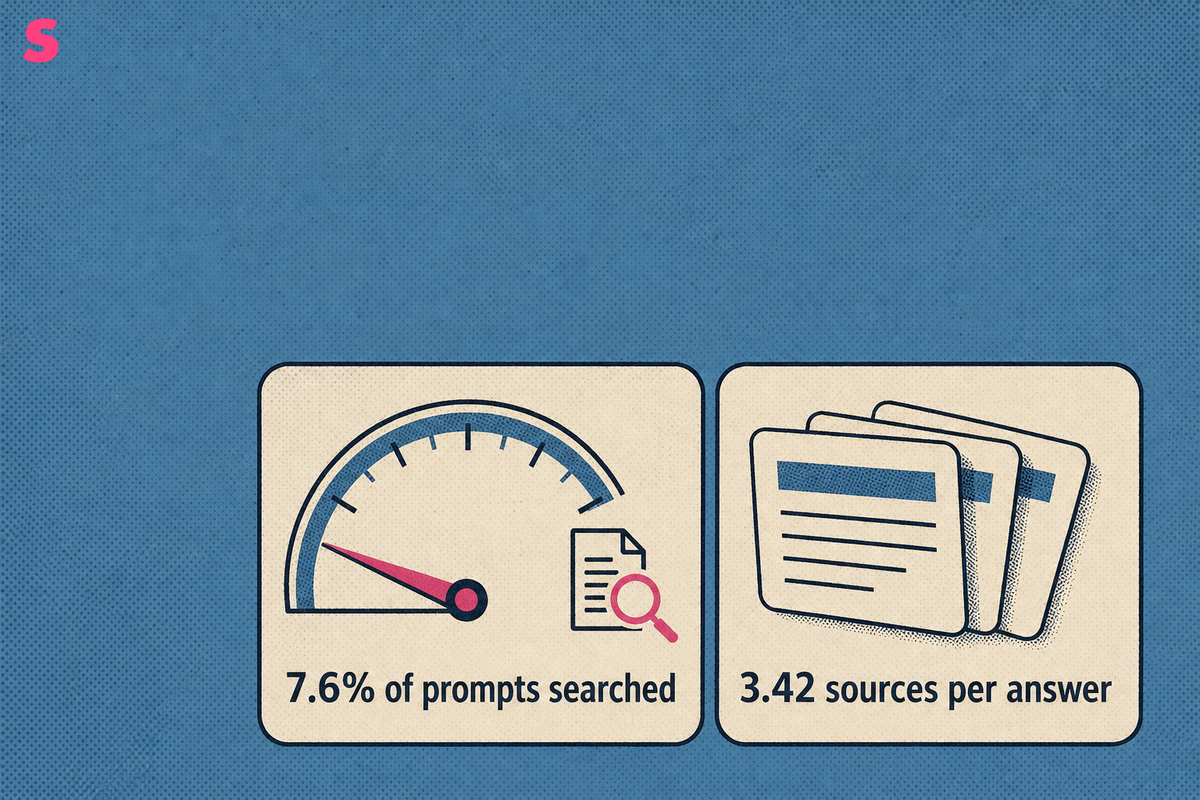
ChatGPT searches the web when current information is needed or when a user asks it to search. Inline citations or a Sources panel are visible indicators that retrieval occurred. ChatGPT Search may provide either interface, per OpenAI’s help documentation, October 18, 2026.
Search is selective rather than universal. A third-party estimate found that the public version of ChatGPT performed web searches for 7.6% of prompts in December 2025, reported by agentswelcome.dev in June 2026. That is an outside estimate, not an OpenAI figure.
When linked answers appeared, the same analysis found an average of 3.42 sources per answer, reported by agentswelcome.dev in June 2026. A citation signals that ChatGPT retrieved material, but it does not mean each sentence maps neatly to one source or that every relevant source appears in the answer.
For a content team, the operating task is to run a defined prompt list daily and record cited pages, answer wording, and brand mentions. Daily monitoring reveals patterns that a weekly snapshot can average away. Sona AI Visibility tracks mentions across 11 answer engines and connects AI-referred visits to pipeline and revenue.
How does ChatGPT Search pick, rank and cite its sources?
ChatGPT Search picks and ranks sources using several factors, but OpenAI does not provide a formula that guarantees citation placement. OpenAI states that “ranking in ChatGPT Search is based on several factors to help users find reliable, relevant information,” in its ChatGPT Search documentation, October 18, 2026.
Source selection is retrieval-driven, not a fixed copy of traditional search rankings. Query wording, recency, page relevance, crawler availability, and the retrieved result set can affect what ChatGPT cites. OpenAI’s help documentation, October 18, 2026, also states that no method can guarantee top placement.
| Evidence area | What the evidence shows | Figure | Boundary for interpretation |
|---|---|---|---|
| OpenAI ranking guidance | ChatGPT Search uses several ranking factors | No guaranteed top placement | OpenAI does not publish a complete ranking formula |
| Retrieved-page position | Higher-ranked pages appeared more often in one citation dataset | 43.8% for rank-one pages versus 3.5% for pages ranked 11–20 | October 2026 third-party analysis |
| Retrieval conditions | Retrieval-related factors explained more variation than page properties | 32% versus 2.8% | October 2026 third-party analysis |
| Citation sample | One analysis reviewed cited URLs | 22,315 cited URLs | October 2026 third-party analysis, not OpenAI research |
One third-party guide reported an 87% overlap between ChatGPT citations and websites in Bing’s top 10, August 2026. OpenAI has not confirmed that figure, so it should guide investigation rather than become a ranking rule.
Sona AI Visibility helps teams inspect which prompts produce citations, which sources appear, and which pages are associated with visibility. Sona’s own AI visibility data, September 2026, covers 8 answer surfaces: ChatGPT, Google AI Overviews, Perplexity, Google AI Mode, Gemini, Mistral, Qwen and Claude.
Can ChatGPT open links and analyze a website?
ChatGPT can open and analyze a website when a user asks it to access a specific page and the page is reachable. OpenAI’s crawler documentation identifies ChatGPT-User as the crawler associated with user-triggered page access.
Opening a link differs from having trained knowledge about a site. User-triggered access happens during a request. Training occurred earlier. A page that ChatGPT opens can inform that session’s answer, while a training-derived response may contain no live page access.
Website analysis depends on what the page exposes. A crawlable page with readable text gives ChatGPT material to assess. A blocked page, inaccessible resource, or content unavailable to the crawler produces a different result. The relevant question is whether ChatGPT can access the relevant page during the request.
Does ChatGPT give the same answer to everyone?
ChatGPT does not give the same answer to everyone because prompts, conversation context, model behaviour, and live retrieval can differ. Two users can ask similar questions and receive different wording, examples, or cited sources.
A small prompt change can alter the task. “Explain customer data platforms” asks for a definition. “Compare customer data platforms for a mid-market SaaS company” asks for selection criteria. The first answer can rely on learned knowledge, while the second can trigger retrieval for current vendor information.
Live search adds another source of variation. Retrieved pages can change as websites update, indexes refresh, and new pages become available. A citation set is evidence of one answer event, not a permanent statement of what ChatGPT will cite for every user.
Teams should preserve the exact prompt, date, answer text, and citations when monitoring AI visibility. Sona AI Visibility can help record prompt-level visibility over time, so a team can distinguish sustained movement from a one-day change in an answer engine.
Which OpenAI crawlers decide whether your content reaches ChatGPT?
Three OpenAI crawler roles affect different paths into ChatGPT: GPTBot relates to training-data collection, OAI-SearchBot relates to ChatGPT Search visibility, and ChatGPT-User relates to user-triggered page access. OpenAI’s crawler documentation separates these functions.
- GPTBot: associated with training-data collection.
- OAI-SearchBot: associated with visibility in ChatGPT Search.
- ChatGPT-User: associated with opening pages because a user requested access.
These crawler roles create two independently controllable pathways: a site can block GPTBot while allowing OAI-SearchBot, according to an August 2026 third-party review. That distinction separates participation in training collection from discoverability through ChatGPT Search.
Monitoring which AI answers mention a brand is only half the job. Sona AI Visibility connects citations and AI-referred visits to accounts, pipeline, and revenue on one account timeline, while also tracking AI crawler activity from server logs or a lightweight edge worker.
What are the frequently asked questions about ChatGPT sources?
Does ChatGPT search the web for every answer?
No. Many answers come from learned model knowledge and the current conversation alone. ChatGPT Search runs when current information is needed or when the user asks for it. A third-party estimate found web searches for 7.6% of public ChatGPT prompts in December 2025, reported by agentswelcome.dev in June 2026.
Does ChatGPT always choose at least one source?
No. An answer generated from trained knowledge or conversation context can have no citations. Inline citations or a separate Sources panel are visible indicators that retrieval occurred, and ChatGPT Search may provide either interface, per OpenAI’s help documentation, October 18, 2026.
Does a ChatGPT citation prove the answer is accurate?
No. A citation identifies a source ChatGPT retrieved, but it does not guarantee that every generated claim faithfully represents the page. Open the cited page, locate the supporting passage, and check whether the claim matches the source’s date, scope, and wording.
Does blocking GPTBot remove a site from ChatGPT?
Not entirely. OpenAI’s crawler documentation separates GPTBot, which relates to training-data collection, from OAI-SearchBot, which relates to ChatGPT Search visibility. A site can set crawler rules for each function independently.
Does ChatGPT use Reddit and Wikipedia as sources?
Both appear in descriptions of ChatGPT training material. In a July 2026 third-party citation analysis, Reddit accounted for 16.7% of citations and Wikipedia accounted for 8.9%. Those shares are not an OpenAI endorsement and do not establish a permanent citation pattern.
Can ChatGPT access real-time information?
ChatGPT can access current information through search or user-triggered page access. OpenAI’s crawler documentation associates ChatGPT-User with user-triggered page access. Without retrieval or page access, ChatGPT relies on training knowledge bounded by its cutoff date and information available in the conversation.
Summarize this article with AI: ChatGPT · Claude · Perplexity · Google AI Mode
Last updated: October 2026







