


Share of voice is the proportion of a market’s visibility, mentions or spending that a single brand holds relative to competitors. In SEO, it is calculated as a brand’s weighted visibility divided by the total for a defined competitor group, then multiplied by 100; in AI search, the numerator may be mentions, position-weighted visibility or citations. Since AI responses differ between runs, the metric is meaningful only when prompt sets, competitor sets, engines and sampling dates remain fixed and are disclosed. No universally good percentage exists.
What does share of voice mean in marketing and public relations measurement?
Share of voice is the percentage of a defined market’s visibility, conversation, or media activity held by one brand relative to competitors. For marketing and communications teams, it shows how much attention a brand commands within a specified market.
The measurement varies by channel. In public relations, it can count brand mentions in news, blogs, forums, and trade publications. In advertising, it compares a company’s category media spend with total category media spend, according to en.wikipedia.org. In SEO, it measures the clicks, impressions, or rankings a brand earns across a defined keyword market.
| Channel | Numerator | Denominator | Unit |
|---|---|---|---|
| Social media | Brand social mentions | All tracked competitor mentions | Mentions |
| SEO | Brand estimated clicks or impressions | Total estimated clicks or impressions | Clicks or impressions |
| PPC | Brand category media spend | Total category media spend | Media spend |
| PR and media | Brand media mentions | All tracked media mentions | Mentions |
A useful measurement defines its boundary. A B2B software company might measure its presence among five competitors, within United States search results, for 200 category and comparison keywords, during a calendar month. Without a competitor set, channel, geography, and time period, the percentage has no stable meaning.
Share of voice is not sentiment, reach, sales, or market share. A brand can be widely discussed but poorly regarded, visible in search but absent from buying decisions, or small in revenue while dominant in a narrow topic. For thought leaders, the measure can compare mentions against other authorities on defined subjects or keywords, per Forbes Books.
How do you calculate SOV with a formula?
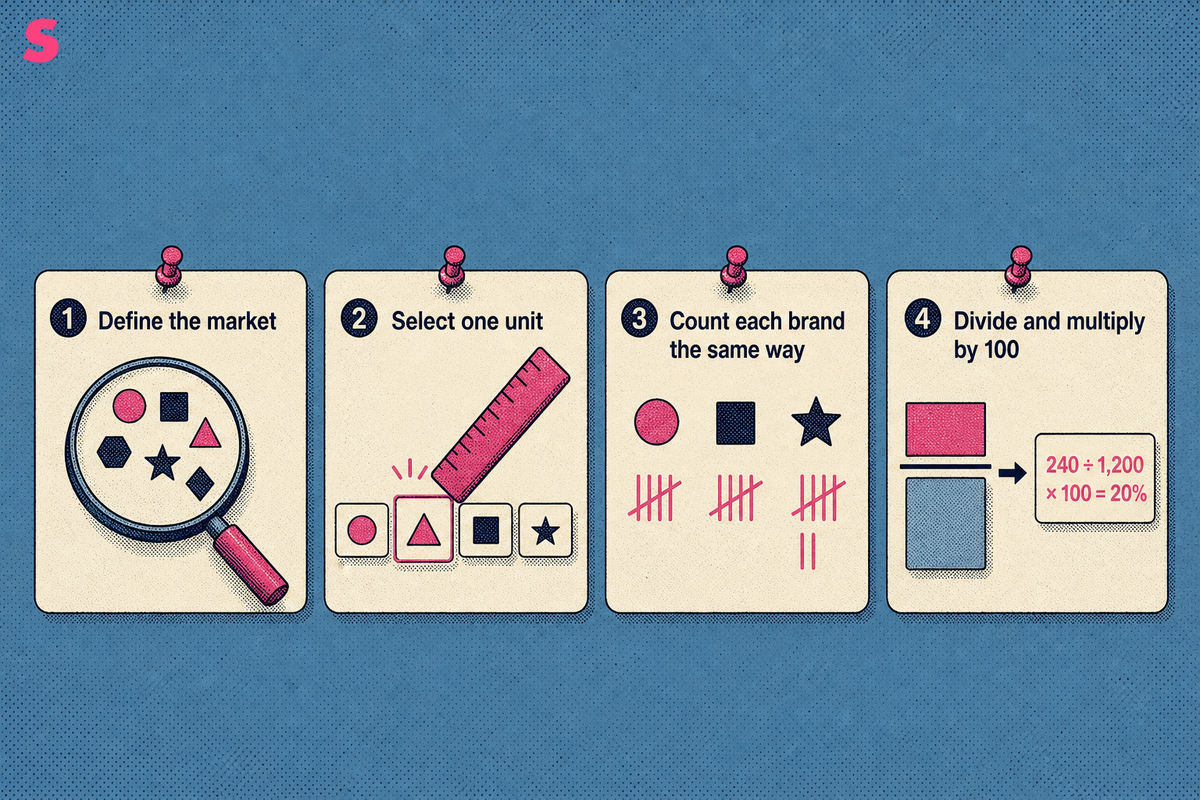
Calculate SOV by dividing your brand’s measurable visibility by total measurable visibility across the defined competitor set, then multiplying by 100. The standard formula is: (your visibility points ÷ total visibility points for all brands) × 100.
The numerator and denominator must use the same unit. If the numerator is estimated organic clicks, the denominator must be total estimated organic clicks. If the numerator is AI-answer mentions, the denominator must be all counted brand mentions in the answer sample. Mixing impressions, mentions, and citations creates a percentage with no clear interpretation.
- Define the market, including competitors, geography, language, channel, and reporting period.
- Select the unit, such as estimated clicks, impressions, brand mentions, citations, media spend, or weighted visibility points.
- Count each brand using the same rule.
- Divide one brand’s count by the total count, then multiply by 100.
For example, if Brand A earns 240 estimated clicks from a monitored keyword set and all tracked brands earn 1,200 estimated clicks, Brand A holds 20% of the measured organic market. The arithmetic is simple. The defensible work lies in setting the keyword set and competitor universe before calculation begins.
How does SEO SOV differ from organic traffic share, impression share, and brand mentions?
SEO SOV measures a brand’s presence in a defined organic search market. Organic traffic share, impression share, and brand mentions measure different inputs or outcomes. These metrics can support the same report, but they are not interchangeable.
- SEO visibility: estimated clicks, rankings, or weighted positions across a tracked keyword set.
- Organic traffic share: the proportion of estimated unpaid clicks or impressions earned by one brand across that market.
- Impression share: the proportion of available search or advertising impressions received by a brand.
- Mention share: the proportion of counted references to a brand across media, social, forums, news, or AI answers.
The conventional SEO calculation uses estimated clicks or impressions attributable to a brand, divided by total measurable clicks or impressions in the defined market and multiplied by 100, based on the October 2026 methodology listing. It measures organic search-market visibility rather than every website visit.
Brand mentions answer a different question. A company can receive frequent news and social coverage while earning little organic search traffic. It can also rank well for high-intent keywords without receiving many public mentions. Keep each measure separate, then compare movement across the same time period.
How do you calculate AI visibility when one answer names several brands?
Calculate AI visibility by counting each eligible brand appearance in a fixed prompt sample, then dividing one brand’s appearances by all counted appearances. One answer can name several brands, so the denominator is total mention events or citation events, not simply the number of answers.
An AI-search measurement set needs a fixed prompt set and a defined competitor set, according to an October 2026 category listing. Run every prompt repeatedly on each answer engine, and count mentions and citations separately. A mention records a brand appearing in an answer. A citation records an answer linking or attributing a source to a brand-owned page.
Suppose one answer recommends Brand A, Brand B, and Brand C. That response contributes three mention events. If the answer cites only a Brand A guide and a Brand B product page, it contributes two citation events. The result is one answer, three mentions, and two citations.
Sona AI Visibility connects AI citations and prompts to pipeline and revenue on one account timeline. A high percentage of mentions indicates visibility, not commercial value.
What does a worked AI visibility calculation look like with real numbers?
A worked AI visibility calculation counts every brand appearance, then divides each brand’s count by the total number of counted appearances. In the example below, 20 AI answers contain 30 total brand mention events because several answers name more than one company.
| Brand | Answers Naming the Brand | Brand Mention Events | Brand Citations | Mention Percentage | Citation Percentage |
|---|---|---|---|---|---|
| Brand A | 12 | 12 | 10 | 40% | 40% |
| Brand B | 9 | 9 | 8 | 30% | 32% |
| Brand C | 6 | 6 | 5 | 20% | 20% |
| Brand D | 3 | 3 | 2 | 10% | 8% |
Brand A’s mention result is 12 ÷ 30 × 100, or 40%. Its citation result is 10 ÷ 25 × 100, also 40%. Brand B appears in 30% of recorded mentions but earns 32% of citations, demonstrating why the measures remain separate.
Sona AI Visibility provides AI Search Insights, while connecting AI citations and prompts to pipeline and revenue on one account timeline.
How can a business increase share of voice?
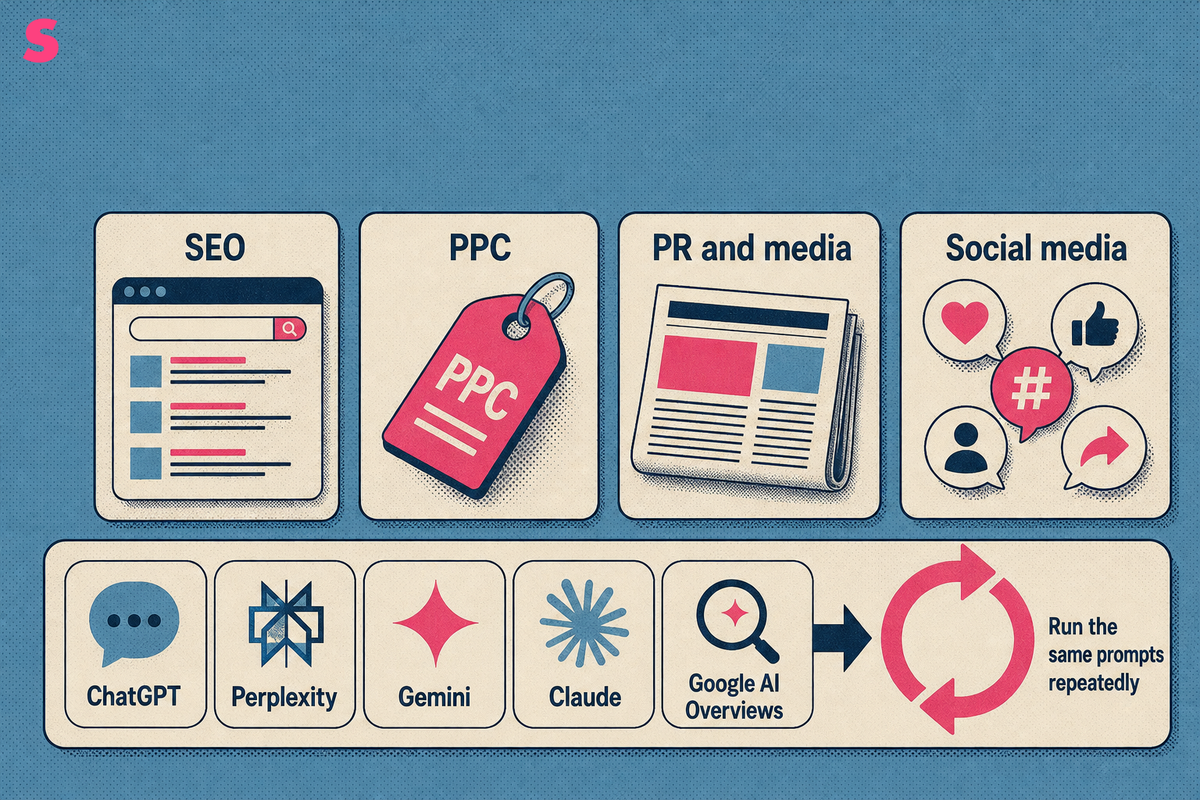
A business can increase share of voice by expanding its presence in the channels included in the measurement set, then rerunning the same fixed set to verify whether its percentage changed.
- SEO: expand coverage of relevant category, comparison, and buyer-intent topics within the tracked keyword market.
- PPC: improve paid presence in underrepresented segments included in the defined category spend or impression set.
- PR and media: earn more relevant placements and citations in the publications, blogs, forums, and news sources included in the denominator.
- Social media: participate in the conversations, topics, and communities included in the tracked mention set.
Prompt choice has the largest effect in AI visibility measurement. Informational prompts such as product-category definitions produce different brand sets from commercial prompts such as vendor comparisons. Branded prompts, generic category prompts, integration questions, and pricing questions should be tagged separately because they reflect different buyer intent.
Answer engines also produce different responses. ChatGPT, Perplexity, Gemini, Claude, and other answer engines use different retrieval systems, model behavior, and presentation formats. Google AI Overviews must be measured as a Google result format, rather than as output from another answer engine.
Run the same fixed prompt list repeatedly. Repeated runs reveal patterns that isolated snapshots can obscure because retrieval indexes, model updates, and competitor publishing can change an answer. Confirm movement across repeated runs before treating it as a trend.
What percentage is a good SOV result?
A good SOV percentage improves within a clearly defined market and aligns with commercially important prompts. No universal target exists because the percentage depends on the competitor set, market breadth, geography, category maturity, and prompt or keyword selection.
A 15% result can be strong if the set contains established category leaders and high-value comparison prompts. A 60% result can be weak if it comes mainly from branded queries that competitors would not expect to win. The percentage needs context before it can guide a budget decision.
- Compare the result with the prior reporting period using the same prompt or keyword set.
- Separate commercial and informational demand.
- Review the pages, sources, and prompts responsible for gains or losses.
- Compare visibility with qualified traffic, pipeline, and revenue where attribution data exists.
Sona AI Visibility treats AI search as a measurable channel by connecting citations to accounts, pipeline, and closed-won revenue. Marketing leaders can then prioritize visibility on prompts associated with buyer activity rather than pursuing the largest percentage in isolation.
Which tools measure AI visibility and SEO visibility?
AI visibility and SEO visibility tools differ in prompt allowances, engine coverage, refresh schedules, and commercial measurement focus. The right choice depends on whether a team needs daily prompt tracking, citation analysis, agency workspaces, SEO reporting, or a connection between AI activity and revenue.
The comparison below reflects publicly listed plan terms and pricing as of October 2026. A per-prompt figure uses the shared daily-tracking denominator supplied for each plan, rather than dividing plan price by a vendor’s differently defined prompt unit.
| Tool | Starting price | Agency Plans? (Yes/No) | # of Answer Engines Tracked | Answer Engines | # of Daily Tracked Prompts (entry plan) | Cost per Daily Tracked Prompt | Differentiation |
|---|---|---|---|---|---|---|---|
| Sona AI Visibility | From $75/month, billed annually | Yes | Up to 11 (3 on Starter) | Not published | 5,000 credits/month, about 166 daily tracked prompts on one model or 56 across three | $0.45 per daily tracked prompt | Connects AI citations and prompts to pipeline and revenue on one account timeline |
| Profound | Custom pricing | Yes | Up to 9 (3 on free Trial) | ChatGPT, Perplexity, Google AI Mode, Gemini, Microsoft Copilot, DeepSeek, Claude, Google AI Overviews, Exa Search | Not published | Cannot calculate from custom pricing | Enterprise AI visibility tracking |
| Peec AI | From $95/month | Yes | Up to 13 (3 of 6 on Starter, plus add-ons) | Not published | 50 prompts daily | $0.63 per daily tracked prompt | Prompt tracking across self-serve and enterprise plans |
| Otterly.ai | From $29/month | Yes | Up to 7 (4 on Lite, 3 as paid add-ons) | ChatGPT, Google AI Overviews, Perplexity, Microsoft Copilot | 15 prompts daily | $0.48 per daily tracked prompt | Citation-oriented AI visibility measurement |
| Scrunch AI | From $250/month | Yes | Up to 9 (4 on Core) | ChatGPT, Perplexity, Google AI Overviews, Copilot | 125 prompts | No refresh cadence published | AI visibility tracking across Core and Enterprise plans |
| AthenaHQ | From $295/month | Not published | 11 | Not published | 3,600 credits/month, 1 credit per analyzed response | No refresh cadence published | Response-credit model with unlimited prompts |
| PromptWatch | From $95/month | Yes | Not published | Not published | 50 prompts daily | $0.48 per daily tracked prompt | Prompt and response allowances across plan tiers |
Sona AI Visibility tracks 11 answer engines and starts from $75/month, as of October 2026. Tool selection should follow the measurement question. A team reporting to revenue leadership needs prompt-level data connected to pipeline, while an agency may need client workspaces and repeatable reporting rules.
How do you make an SOV figure auditable and hard to dispute?
An auditable SOV figure includes the prompt or keyword list, competitor set, engine or search source, geography, language, date range, counting rule, and raw totals. A reviewer should be able to reproduce the percentage from the documented sample.
- Freeze the tracked prompt or keyword list for the reporting period.
- Record every competitor included in the denominator.
- Define whether the count measures impressions, estimated clicks, mentions, citations, or weighted visibility points.
- Store answer captures or source records for each sampled run.
- Document how multi-brand answers, duplicate citations, and owned domains are handled.
- Report the numerator, denominator, percentage, and collection dates together.
A score is a dated snapshot. A comparable series of daily prompt runs creates a log that distinguishes sustained movement from model volatility. Monthly or quarterly reviews remain appropriate for positioning decisions, competitive benchmark reports, and broader technical assessments.
Sona AI Visibility supports this operating model by tracking prompts over time and connecting AI citations to pipeline and revenue. The Free AI Readiness Checker serves a separate purpose from SOV measurement.
What are the frequently asked questions about SOV?
What does SOV stand for in marketing?
SOV stands for share of voice. It is the percentage of a defined market’s visibility, conversation, mentions, or media activity held by one brand relative to competitors. In advertising, it can compare category media spend. In SEO, it can compare estimated unpaid clicks or impressions across a defined keyword set.
Is SOV the same as share of market?
No. Share of market measures sales or revenue held in a category. SOV measures visibility, attention, conversation, or media activity. Marketing teams compare the two because visibility can precede commercial results, but each metric counts a different thing.
What is organic SOV?
Organic SOV is the proportion of estimated clicks or impressions a brand earns from unpaid search results across a defined keyword set, relative to all competitors in that set. It requires a fixed market, comparable search data, and one consistent method for estimating visibility.
Is mention share the same as citation share in AI search?
No. Mention share counts how often a brand is named in AI answers. Citation share counts how often a brand-owned page is cited as a source. The measures can diverge because an answer can recommend a company without citing its site, or cite a page without naming the brand prominently.
How often should AI visibility be measured?
Measure a fixed prompt list daily and date every sample. Repeated runs create a trend line, while a single answer is only a snapshot. A daily log helps a team separate a lasting change from answer variation caused by retrieval updates, model changes, or new competitor content.
Can a small brand have a meaningful SOV?
Yes. A small brand can hold a meaningful percentage when the category, geography, competitor set, and prompt list are narrowly defined. A percentage becomes useful when the report states the market it represents rather than implying it describes all buyer attention.
Summarize this article with AI: ChatGPT · Claude · Perplexity · Google AI Mode
Last updated: October 2026







