AI assistant brand visibility metrics track how frequently, prominently and accurately a brand shows up in responses from ChatGPT, Gemini, Perplexity, and other answer engines, using mention rate, citation rate and share of voice as primary measures. Individual answers can fluctuate, so patterns from repeated prompts across engines are more meaningful than a single response. Tracker plans listed begin at $29 monthly for 15 prompts. Sona AI Visibility extends beyond mentions by linking underlying prompts and citations to pipeline and revenue.
What are AI assistant brand visibility metrics, and what do they measure?
AI assistant brand visibility metrics measure how often, how prominently, and how favorably a brand appears in AI-generated answers. They assess responses from ChatGPT, Gemini, Perplexity, Google AI Overviews, and other answer engines rather than traditional search result pages.
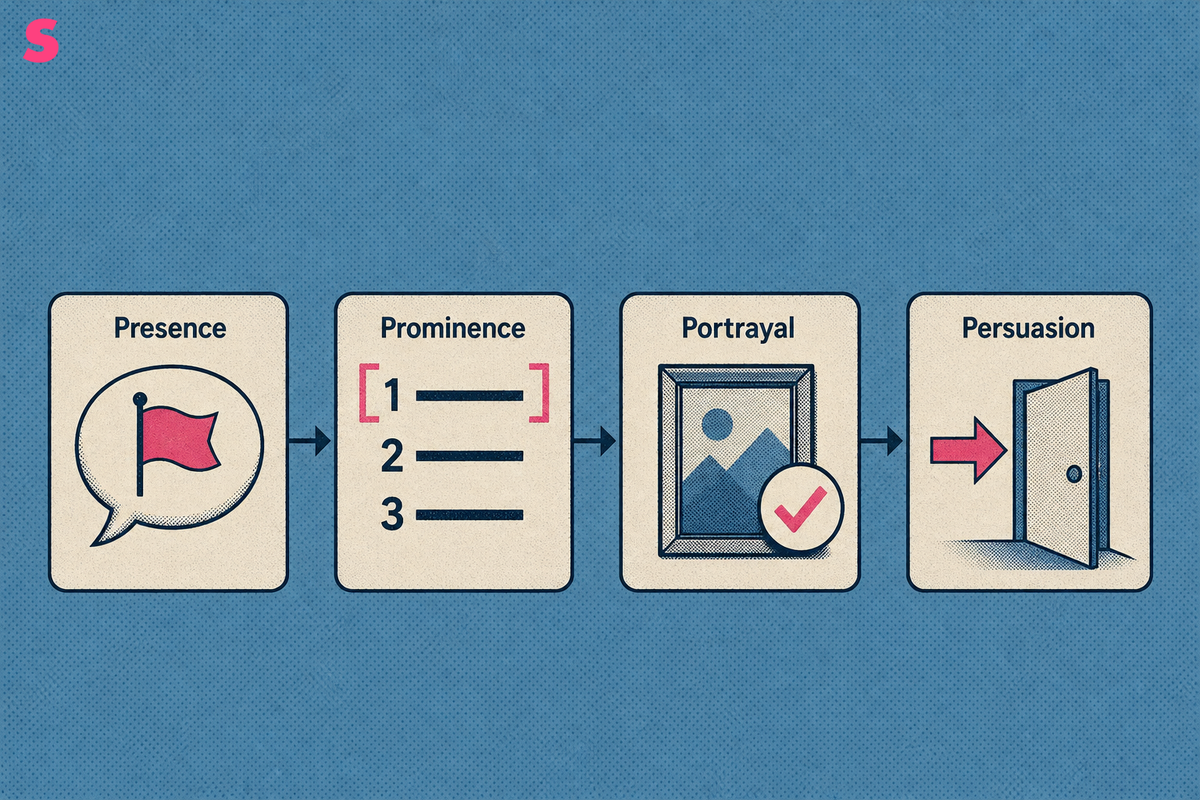
The IAB framework separates measurement into four dimensions: Presence, Prominence, Portrayal, and Persuasion, per iab.com, August 2026. Presence asks whether the brand appears. Prominence measures where and how strongly it appears. Portrayal evaluates framing, accuracy, and sentiment. Persuasion examines whether an answer moves a buyer toward a next action.
Consider the prompt: “What are the best attribution platforms for B2B SaaS?” A brand named in the answer has Presence. A brand listed first with a detailed explanation has Prominence. A description calling it reliable for revenue reporting reflects Portrayal. A recommendation to book a demo or evaluate a product reflects Persuasion.
AI visibility trackers run prompt sets tied to a brand, product, competitor set, or category through AI assistants, then log the answers. The output is a dated record of mentions, citations, answer position, framing, and changes across engines.
What is an AI visibility metric not, and what is it confused with?
An AI visibility metric is not a Google ranking, a web-traffic total, or a generic social mention count. It measures how an assistant answers a buyer’s question, including whether the assistant names, recommends, or cites a brand.
A mention means the brand name appears in an answer. A citation means the answer identifies a source, page, publication, or website associated with the brand. A brand can receive a mention without a citation, or a citation without an explicit recommendation.
Share of voice is often confused with Share of Model. Share of Model is the percentage of AI assistant answers in a category that mention or recommend a brand, per cdp.com. It measures share of voice inside assistant answers rather than across advertising impressions or conventional search results.
AI visibility is not simply SEO with a new label. Search rankings do not reveal whether an assistant recommends a brand, how it frames the brand, or which sources support the answer. Visibility also depends on third-party coverage and cited sources, not only on content the brand controls.
Why does a B2B SaaS team need to measure how AI assistants talk about its brand?
B2B SaaS teams need AI assistant visibility measurement because buyers use assistants to build vendor shortlists, compare products, and investigate category problems before speaking with sales. Demand-generation leaders need a reportable view of presence, framing, citations, and competitor representation.
Traditional SEO metrics capture rankings, impressions, clicks, and sessions. They do not show whether an assistant describes a brand as a category leader, positions it against alternatives, or omits it from a comparison prompt. AI assistants create a separate decision surface.
The operational question is straightforward: when a buyer asks for a shortlist, does the answer include the brand, cite credible material, and describe the product accurately? Teams that cannot answer those questions cannot separate visibility from influence.
AI visibility metrics also guide content decisions. If a product page is cited for one category question but missing from comparison prompts, the team needs to examine the prompts, sources, and answer framing behind the gap.
Which metrics should a B2B SaaS team track first?
B2B SaaS teams should begin with mention rate, citation rate, recommendation rate, share of voice, prominence, portrayal, visibility momentum, and AI referral traffic. IAB identifies mention rate, citation rate, share of voice, and visibility momentum as four core Presence metrics, per iab.com, August 2026.
| Metric | Formula | Question it answers | IAB dimension |
|---|---|---|---|
| Mention rate | Responses naming the brand ÷ total tracked responses × 100 | How often does the brand appear? | Presence |
| Citation rate | Responses citing the brand or its content ÷ total tracked responses × 100 | How often does the answer use the brand as a source? | Presence |
| Recommendation rate | Responses recommending the brand ÷ total tracked responses × 100 | How often does the assistant endorse the brand? | Persuasion |
| Share of voice | Brand mentions ÷ all tracked brand mentions in the category × 100 | How visible is the brand against competitors? | Presence |
| Prominence | Position and answer-space scoring rule | Where does the brand appear in the answer? | Prominence |
| Portrayal | Accuracy, sentiment, and framing assessment | How does the assistant describe the brand? | Portrayal |
| Visibility momentum | Change in visibility metrics across fixed periods | Is brand visibility improving, declining, or volatile? | Presence |
A mention alone is weak evidence. Read it with citation quality, prominence, accuracy, and recommendation strength. A brand that appears at the bottom of a generic list has a different commercial meaning than a brand cited first in a decision-stage comparison.
Sona AI Visibility shows prompts, cited sources, and page-level performance so teams can identify which questions produce visibility and which pages should support missing prompts.
How do you calculate mention rate, citation rate and share of voice from raw AI responses?
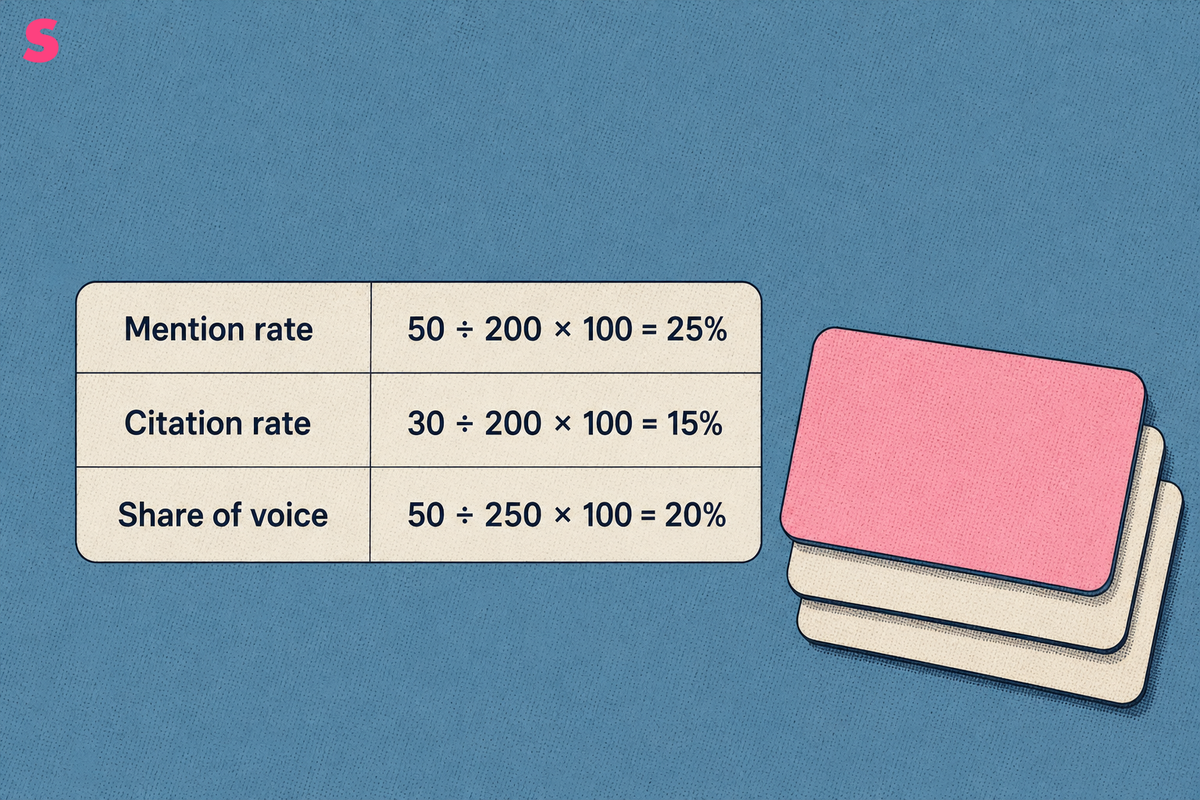
Mention rate is the number of tracked AI responses containing a brand divided by total responses, multiplied by 100. The calculation turns raw assistant answers into a comparable percentage when the prompt set and scoring rules remain consistent.
Illustrative example, not observed data: a team runs 200 responses across a fixed prompt set. The brand appears in 50 responses. Mention rate is 50 ÷ 200 × 100, or 25%. If 30 of those 200 responses cite the brand’s website, product documentation, or named content, citation rate is 30 ÷ 200 × 100, or 15%.
For share of voice, assume the same 200 answers contain 250 total category-brand mentions across all tracked vendors, and the measured brand receives 50 mentions. Share of voice is 50 ÷ 250 × 100, or 20%. The numerator should use the same brand-matching rule for every competitor.
Prompt categories shape results. Category prompts test broad awareness. Comparison prompts test shortlisting. Problem-led prompts test whether the brand is associated with a buyer need. Branded prompts test direct representation. Each category introduces different bias, so teams should label prompts instead of combining every answer into one undifferentiated score.
Teams can collect answers manually in a spreadsheet or through a tracker. Running the same prompt list daily reveals patterns that a weekly snapshot can obscure. Repeated observations are more reliable than a single-day movement.
Are AI assistant visibility measurements reliable enough to report to leadership?
AI assistant visibility measurements are reliable enough for leadership reporting when the method is repeated, disclosed, and interpreted as a trend rather than a single answer. One response varies. A fixed prompt set, multiple engines, repeated runs, and stable scoring rules produce a usable series.
IAB states: “Decision-grade measurement: Meets a higher standard of rigor across query volume, sample size, prompt type coverage, testing cadence, reproducibility, and platform coverage and is the required standard before making any budget or strategy decisions.” This guidance comes from iab.com, August 2026.
Visibility volatility measures how much answers change across repeated runs. High volatility means leadership should avoid treating a single mention rate as a durable market position. Low volatility makes directional changes easier to interpret.
A report should disclose the prompt count, prompt categories, engines measured, run dates, scoring rules, and treatment of partial mentions or citations. It should also distinguish daily prompt tracking from monthly or quarterly competitive benchmark reviews.
Sona AI Visibility supports this operating rhythm by tracking prompts over time and connecting citations to account-level business outcomes, rather than treating an isolated score as the final result.
Which AI assistants and search surfaces should you track?
AI assistant visibility measurement should cover the assistants and search surfaces that match buyer behavior, including ChatGPT, Perplexity, Gemini, Claude, Google AI Overviews, and other answer engines. The same brand can appear differently across models because each system retrieves, ranks, and summarizes information differently.
Google AI Overviews is a Google search feature, while ChatGPT, Perplexity, Gemini, and Claude generate AI answers through their own products. Reports should preserve that distinction because search-surface visibility and assistant-answer visibility are related but distinct measurement categories.
More engines do not automatically create better measurement. Coverage helps only when the prompt set is representative, sampling is repeated, scoring is reproducible, and the methodology is transparent. Broad engine coverage with weak prompts produces a broader version of the same measurement error.
Pricing models illustrate the trade-off. Sona AI Visibility tracks 11 AI engines as of October 2026. Other platforms publish coverage from three engines on entry plans to more than 17 engines on larger plans, as of October 2026. Evaluate engine breadth alongside prompt volume and cadence.
How does an AI visibility metric turn into traffic, pipeline and revenue?
An AI visibility metric becomes a business outcome when a citation or recommendation creates a visit, identifies a buyer account, and contributes to pipeline or revenue. The metric is the first measurable event in a buyer journey.
Illustrative assumptions, not performance data: citation rate rises from 10% to 15% across a fixed prompt set. More cited answers generate additional AI referral visits. Some visits belong to qualified accounts. A subset of those accounts enters an opportunity stage, and one or more opportunities create pipeline.
Persuasion bridges visibility and action. A brand can appear in an answer without persuading a buyer. Post-citation actions, such as a referral visit, product-page engagement, form completion, qualified account creation, and opportunity creation, show whether visibility reaches commercial activity.
Sona AI Visibility connects prompts and citations to pipeline and revenue on one account timeline, and tracks AI crawler and agent activity from server logs or a lightweight edge worker without a JavaScript tag. AI Attribution connects AI-referred activity to accounts, pipeline, and closed-won revenue, while mention tracking remains the baseline measurement.
How much does it cost to track brand visibility in AI assistants?
AI assistant brand visibility tracking ranges from manual spreadsheet work that can avoid a dedicated AI-visibility subscription to paid platforms with monthly pricing, prompt allowances, and engine coverage that vary by plan. Prices below are stated as of October 2026 and should be compared alongside cadence, prompt volume, citation analysis, and reporting requirements.
| Tool | Starting price | Agency Plans? | # of Answer Engines Tracked | Answer Engines | # of Daily Tracked Prompts (entry plan) | Cost per Daily Tracked Prompt | Differentiation |
|---|---|---|---|---|---|---|---|
| Sona AI Visibility | From $75/month, billed annually | Yes | Up to 11 (3 on Starter) | Not published | 5,000 credits/month, about 166 daily tracked prompts on one model or 56 across three | $0.45 per daily tracked prompt | Connects AI citations and prompts to pipeline and revenue, and resolves anonymous accounts behind AI-referred visits |
| Profound | Custom pricing | Yes | Up to 9 (3 on free Trial) | ChatGPT, Gemini, Google AI Overviews | 50 prompts daily during the 7-day trial | Cannot be calculated, brand pricing is custom | Daily prompt tracking during the trial |
| Peec AI | From $95/month, monthly | Yes | Up to 13 (3 of 6 on Starter, plus add-ons) | ChatGPT, Google AI Mode, Google AI Overviews | 50 prompts daily | $0.63 per daily tracked prompt | AI visibility tracking across self-serve and agency plans |
| Otterly.ai | From $29/month, monthly | Yes | Up to 7 (4 on Lite, 3 as paid add-ons) | ChatGPT, Google AI Overviews, Perplexity, Microsoft Copilot | 15 prompts daily | $0.48 per daily tracked prompt | Entry-level monitoring across four listed engines |
| Scrunch AI | From $250/month, monthly | Yes | Up to 9 (4 on Core) | ChatGPT, Perplexity, Google AI Overviews, Microsoft Copilot | 125 prompts | No refresh cadence published | Core plan tracking across four engines |
| AthenaHQ | From $295/month, shown under the annual billing toggle | Yes | 11 | Not published | 3,600 credits/month, unlimited prompts | No refresh cadence published | Credit-based response monitoring |
| PromptWatch | From $95/month, monthly | Yes | Not published | Not published | 50 prompts daily | $0.48 per daily tracked prompt | Prompt and response allowances across monthly plans |
A manual workflow can avoid a dedicated AI-visibility subscription, but carries a time cost and makes repeated scoring harder. Adobe offers a free single-page visibility check with no ongoing tracking. A spreadsheet works for a periodic baseline, while paid tracking supports larger prompt sets, repeated runs, competitor monitoring, and exports.
Tool pricing is not the only budget question. Compare prompt volume, engine coverage, tracking cadence, citation analysis, competitor tracking, and exportability. A lower entry price can serve a narrow prompt set, while a larger plan can support broader reporting.
What are the frequently asked questions about AI assistant brand visibility metrics?
What is Share of Model, and how does it differ from share of voice?
Share of Model is the percentage of AI assistant answers in a category that mention or recommend a brand, per cdp.com. It is share of voice measured inside assistant answers rather than across advertising placements, social conversation, or search result pages.
How often should a team measure AI assistant brand visibility?
A team should run the same prompt set daily so changes in mention rate and visibility momentum can be read as trends. Repeated observations are more reliable than a one-day spike. Manual checks suit a periodic baseline when daily measurement is impractical.
Is mention rate a vanity metric?
Mention rate is weak on its own because it does not show prominence, accuracy, citation quality, or recommendation strength. Read mention rate alongside citation rate, portrayal, AI referral traffic, qualified-account activity, and pipeline contribution.
Can a small team track AI visibility for free?
Yes. A small team can run a fixed prompt list by hand and log answers in a spreadsheet. The method costs no money, but requires time, offers limited sampling, and becomes difficult to repeat consistently across assistants and dates.
Does covering more AI engines make a visibility tool more accurate?
No. More engine coverage helps only when the tool also uses representative prompts, repeated sampling, reproducible runs, and transparent scoring. A narrow but disciplined measurement program is more useful than broad coverage with inconsistent methodology.
What are the four dimensions of the IAB visibility framework?
Per iab.com, August 2026, the four dimensions are Presence, Prominence, Portrayal, and Persuasion. IAB identifies mention rate, citation rate, share of voice, and visibility momentum as the core Presence metrics.
Summarize this article with AI: ChatGPT · Claude · Perplexity · Google AI Mode
Last updated: October 2026