


AI search visibility metrics and KPIs gauge how frequently, how prominently, and how accurately a brand appears in AI-generated responses, with key measures including mention rate, citation rate, share of voice, sentiment, and AI-referred revenue. Track them using a fixed prompt set across repeated runs, since AI responses vary by model, region, and phrasing. Sona AI Visibility links prompts and citations to pipeline and revenue while monitoring the AI crawler activity that precedes them.
What do AI search visibility metrics and KPIs measure, and what do they not measure?
AI search visibility metrics and KPIs measure how often, how prominently, and how accurately a brand appears in AI-generated answers across answer engines. They show whether an answer mentions the brand, cites its content, frames it positively, or recommends a competitor.
B2B teams use these metrics to determine whether buyers encounter their brand during AI-assisted research. Organic rankings and sessions still matter, but neither shows whether ChatGPT, Perplexity, Gemini, Claude, and other answer engines named a brand in an answer.
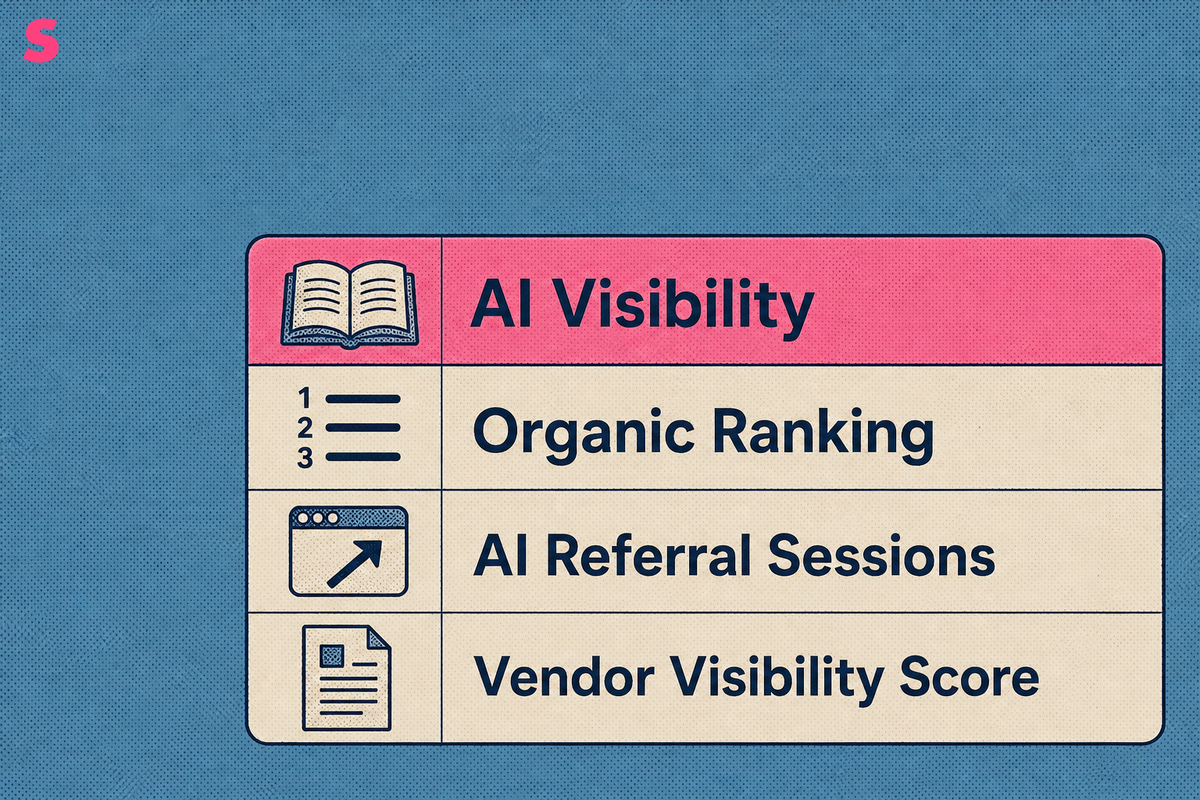
AI visibility differs from organic ranking, AI referral traffic, and a vendor visibility score. A page can rank well in traditional search yet receive no AI citations. Conversely, a brand can be recommended in an answer that produces no click, leaving no referral session to measure.
The distinction matters in zero-click research. A buyer may ask an answer engine for software recommendations, read several brands, then visit later through branded search or a direct session. AI visibility metrics record the earlier presence. Attribution measures whether that presence influenced a commercial outcome.
- Organic ranking measures placement in a results page.
- AI referral sessions measure visits with detectable AI referrers.
- AI visibility measures brand presence inside the generated answer itself.
- Vendor scores summarize results but do not replace prompt-level evidence.
Which AI search visibility KPIs should a B2B SaaS team track first?
B2B SaaS teams should track three KPI layers: presence, authority, and influence. Start with mention rate and citation rate. Then assess share of voice, sentiment, and answer accuracy before connecting visibility to referral sessions, conversions, pipeline, and revenue.
The formulas below use a fixed prompt set containing category, comparison, problem, and purchase-intent questions that match the buyer journey. Long-term AI search impact appears in citation-share growth, prompt-level visibility trends, and sentiment accuracy.
| Metric | Formula | Data source | Measurement method | Business outcome indicated |
|---|---|---|---|---|
| Mention rate | Answers naming the brand ÷ answers tested × 100 | Captured AI answers | Count direct brand references per prompt | Basic presence |
| Citation rate | Answers citing brand-owned pages ÷ answers tested × 100 | Answer citations and linked sources | Classify cited domains | Source authority and discoverability |
| Share of voice | Brand mentions ÷ all tracked competitor mentions × 100 | Prompt-level brand counts | Compare named brands in each answer | Competitive visibility |
| Sentiment | Positive mentions ÷ classified mentions × 100 | Answer text | Apply a stated positive, neutral, negative rule | Brand framing |
| Answer accuracy | Accurate brand claims ÷ reviewed brand claims × 100 | Answer text and approved facts | Review claims against current evidence | Message and product correctness |
| AI-influenced revenue | Revenue from AI-influenced opportunities | Analytics, CRM, and attribution data | Join AI touchpoints to opportunities | Commercial influence |
Illustrative example: if a brand appears in 24 of 60 tested answers, its mention rate is 40%. If its pages are cited in 12 answers, citation rate is 20%. If those answers contain 80 total competitor mentions and the brand receives 20, share of voice is 25%.
Presence without influence remains useful diagnostic evidence. A brand with a strong mention rate but weak citation rate may be known by name yet absent from sources answer engines retrieve. A brand with citations but low assisted conversion volume needs stronger attribution evidence before the team treats AI search as a revenue channel.
How do you measure AI visibility across ChatGPT, Google AI Overviews, Gemini, Perplexity, Copilot, and other answer engines?
Measure AI visibility at prompt, topic, brand, competitor, and engine levels. A blended score can conceal material differences because ChatGPT, Google AI Overviews, Gemini, Perplexity, Copilot, and other answer engines retrieve, summarize, and cite sources differently.
Start with one prompt, such as “best B2B attribution platform for AI search.” Record whether the answer names the brand, where it appears, which sources it cites, and which competitors appear. That record creates a prompt-level result.
Group related prompts into a topic, such as AI search attribution. Topic-level share of voice equals the brand’s mentions across answers in that topic divided by all tracked competitor mentions. Repeat the calculation by engine before calculating a blended view.
- Define a fixed set of buyer prompts by topic and buying stage.
- Run each prompt across each selected answer engine.
- Record mention, citation, position, sentiment, and answer-accuracy results.
- Calculate rates per engine, then roll them into a stated aggregate.
A brand-level score is not actionable by itself. The useful view identifies the prompts and cited sources behind the score. Sona AI Visibility connects citations to pipeline and revenue, while Growth adds page-level insights, Agent Analytics, company-level visitor identification, and AI search attribution.
What counts as a meaningful citation, and how should citation quality be scored?
A meaningful citation is a source reference that supports a relevant claim in an AI-generated answer. Citation counts reward volume, so citation quality should assess relevance, source authority, position in the answer, ownership of the cited page, and factual accuracy.
A mention is a brand name appearing in text. A citation is a source reference associated with an answer claim. A linked source is a citation that gives the reader a navigable destination. These measures often overlap, but they are not interchangeable.
A simple quality model assigns one point for each of five conditions: the citation supports a relevant buyer question, the source is authoritative for the claim, the source appears near the core recommendation, the cited page belongs to the brand, and the answer’s claim is accurate. The score runs from 0 to 5.
Illustrative example: an answer recommends a payroll platform, cites that platform’s security page beside the recommendation, and accurately describes a documented capability. The citation earns five points when the page is relevant, authoritative, prominent, owned by the brand, and factually correct. A low-position citation to an unrelated blog post earns fewer points.
This model prevents teams from treating every citation as equal. Ten low-relevance source references can carry less value than two accurate citations attached to commercial, decision-stage prompts.
How can you get stable numbers when AI answers change from run to run?
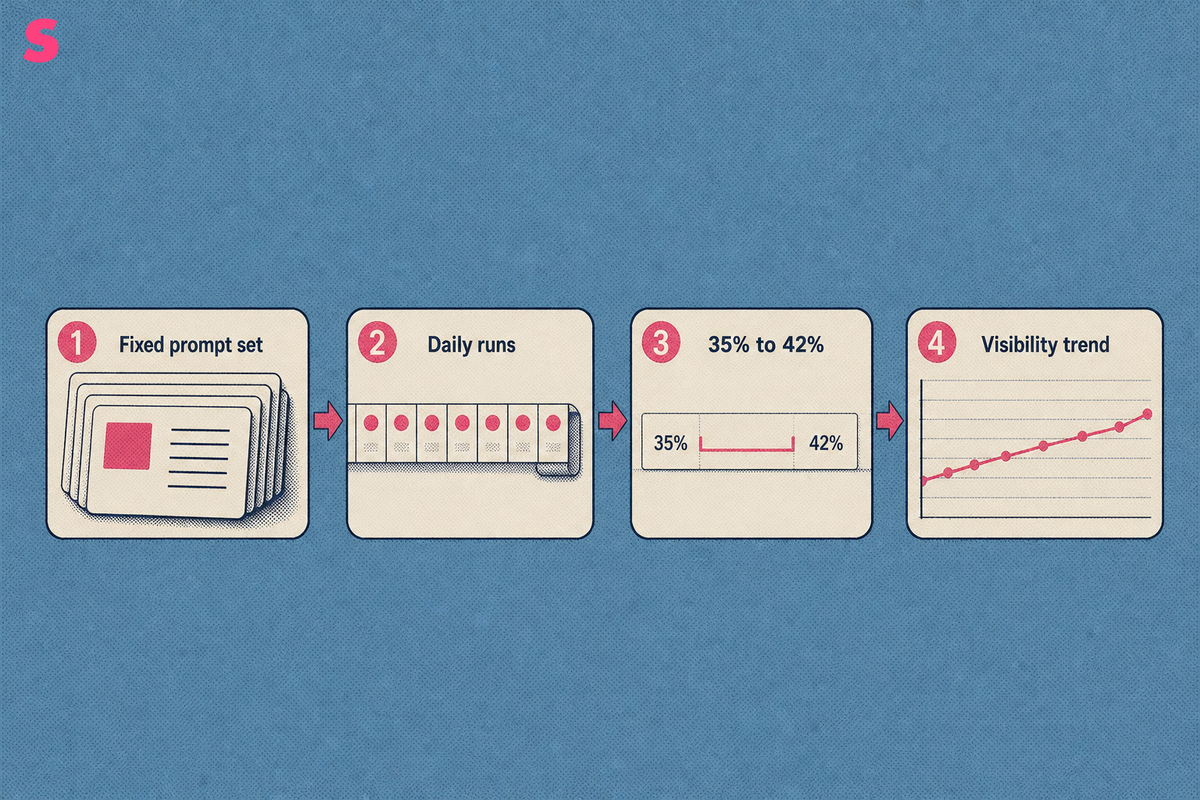
Stable AI visibility numbers require repeated observations of a fixed prompt set, the same scoring rule, region, and reporting method. AI answers change with model updates, retrieval indexes, prompt wording, personalization, and random variation, so one captured answer is a snapshot rather than a benchmark.
Run the same prompt list daily to identify patterns that a weekly snapshot can average away. Define a minimum observation window in advance, then classify movement as a trend only when it persists across repeated runs under unchanged measurement conditions.
- Freeze the prompt wording, target region, engine list, and competitor set.
- Apply one documented rule for mentions, citations, sentiment, and accuracy.
- Collect repeated answer observations on the daily prompt cadence.
- Report the rate and its observed range, rather than one isolated reading.
For example, a mention rate reported as 35% to 42% across repeated daily observations communicates more than a single 39% result. The range shows answer variability, while the series reveals whether visibility is improving, stable, or declining.
Prompt monitoring runs daily, while a full positioning review or competitive benchmark report can run quarterly. The output should be a log, not merely a score, because a comparable series shows which prompt and source pattern deserves action.
How do AI visibility KPIs connect to referral sessions, leads and revenue?
AI visibility KPIs connect to revenue by separating direct outcomes from proxy signals. Mentions, citations, share of voice, sentiment, and answer accuracy show visibility. AI referral sessions, assisted conversions, pipeline, and revenue show whether that visibility contributed to commercial activity.
A June 2026 measurement framework recommends tracking AI referral sessions, AI-referred users, engagement rate, assisted conversions, revenue from AI referrals, AI-influenced leads, and conversion rate by AI source alongside visibility and citations. These measures connect an answer-engine interaction to the buyer journey when a detectable visit exists.
AI search attribution remains difficult for three reasons: answer engines do not always pass a referrer, buyers often read an answer without clicking, and AI research can influence a later visit from another channel. A direct AI referral is therefore a lower-bound measure of AI influence rather than a complete count.
Sona AI Visibility connects prompts and citations to pipeline and revenue. On Growth, it adds page-level insights, Agent Analytics, company-level visitor identification, and AI search attribution.
A practical reporting model separates outcomes into three columns: directly referred revenue, assisted revenue where AI appeared earlier in the journey, and unattributed research indicated by self-reported discovery. That separation prevents teams from overstating either the precision or value of AI visibility data.
What does AI search traffic and revenue look like for real brands?
The supplied research contains no approved real-brand AI referral, conversion, pipeline, or revenue results. Crawler activity is not a substitute for human traffic, conversions, or revenue evidence.
Teams should read AI search performance through three commercial ratios. AI session share is AI referral sessions divided by all sessions. Conversion rate by AI source is conversions from a named AI source divided by sessions from that source. Revenue per AI-referred visit is attributed revenue divided by AI-referred visits.
Illustrative calculation: if an AI source produces 100 measurable visits and 5 conversions, conversion rate by AI source is 5%. If the associated revenue is $10,000, revenue per AI-referred visit is $100. These are example calculations, not real-brand results.
AI search reporting should distinguish crawler visits, citations, AI-referred sessions, assisted opportunities, and closed-won revenue. Each measure answers a different question. Combining them into one number obscures where the buyer journey works or breaks.
How do AI visibility tracking tools differ in engines, prompt limits and price?
AI visibility tracking tools differ most clearly in answer-engine coverage, prompt allowance, tracking cadence, and published price. Compare those operating inputs before comparing a vendor’s visibility score, because score definitions are not standardized across platforms.
| Tool | Starting price | Agency Plans? (Yes/No) | # of Answer Engines Tracked | Answer Engines | # of Daily Tracked Prompts (entry plan) | Cost per Daily Tracked Prompt | Differentiation |
|---|---|---|---|---|---|---|---|
| Sona AI Visibility | From $75/month, billed annually | Yes | Up to 11 (3 on Starter) | Not published | 5,000 credits/month, about 166 daily tracked prompts on one model or 56 across three | $0.45 per daily tracked prompt | Growth adds page-level insights, Agent Analytics, company-level visitor identification, and AI search attribution. |
| Profound | Custom pricing | Yes | Up to 9 (3 on free Trial) | ChatGPT, Perplexity, Google AI Mode, Gemini, Microsoft Copilot, DeepSeek, Claude, Google AI Overviews, Exa Search | Custom prompt plan, tracked daily | Not published | Enterprise AI visibility tracking across up to nine answer engines. |
| Peec AI | From $95/month | Yes | Up to 13 (3 of 6 on Starter, plus add-ons) | Not published | 50 prompts daily | $0.63 per daily tracked prompt | Daily prompt tracking with plans that expand to 350 prompts daily. |
| Otterly.ai | From $29/month | Yes | Up to 7 (4 on Lite, 3 as paid add-ons) | ChatGPT, Google AI Overviews, Perplexity, Microsoft Copilot | 15 prompts daily | $0.48 per daily tracked prompt | AI visibility monitoring across four engines on its Lite tier. |
| Scrunch AI | From $250/month | Yes | Up to 9 (4 on Core) | ChatGPT, Perplexity, Google AI Overviews, Microsoft Copilot | 125 prompts, frequency not stated | No refresh cadence published | Core plan coverage across four answer engines. |
As of October 2026, dedicated AI visibility trackers commonly range from about $29 to more than $500 per month, while enterprise plans are often custom-priced. Compare pricing against engine coverage, prompt refresh frequency, countries covered, and commercial attribution support.
What are the limits of AI visibility data, and when should a score not be trusted?
AI visibility data is useful directionally, but a score requires its prompt set, engine coverage, scoring rule, date range, and attribution boundaries. Incomplete referrers, unstable answers, sampling bias, and non-comparable vendor definitions affect the result.
Traditional SEO data still answers important questions about rankings, impressions, clicks, and organic sessions. It does not show whether an AI-generated answer mentioned a brand, cited a page, described a competitor more favorably, or influenced a buyer who did not click.
- Were the same prompts run across every engine and date?
- Does the score separate mentions from citations and linked sources?
- Are regional settings and personalization controls documented?
- Does the report show the underlying prompts, answers, and cited pages?
- Does attribution distinguish direct AI referrals from assisted influence?
A score is a dated snapshot. Trust increases when prompt-level evidence is available and the score can be compared across repeated observations. Sona AI Visibility tracks mention and competitor patterns, but the business decision depends on the prompts, pages, accounts, and revenue outcomes beneath the aggregate.
Frequently asked questions about AI search visibility metrics and KPIs.
What are the most important AI search visibility KPIs?
The core presence and authority KPIs are mention rate, citation rate, share of voice, sentiment, and answer accuracy. Mention rate equals answers naming the brand divided by answers tested. Citation rate equals answers citing brand-owned pages divided by answers tested. Share of voice equals brand mentions divided by all tracked competitor mentions. Sentiment equals positive mentions divided by classified mentions, while answer accuracy equals accurate brand claims divided by reviewed claims. Influence KPIs include AI referral sessions, assisted conversions, and revenue connected to AI-influenced opportunities.
How is an AI search visibility KPI different from a traditional SEO metric?
Traditional SEO metrics measure placement and clicks on a results page. Rankings show where a page appears, and organic sessions show visits from search results. AI visibility KPIs measure whether an answer mentions, cites, or recommends a brand, including answers that produce no click. Both systems matter because they describe different parts of buyer research.
How often should AI visibility prompts be monitored?
Monitor a fixed prompt set daily when category changes make answer variability material. Daily observations show whether movement persists through model changes, retrieval changes, and competitor publishing activity. A weekly snapshot can average away a meaningful pattern. Use a periodic, often quarterly, review for positioning and competitive interpretation.
Can you track revenue from ChatGPT and Perplexity?
Revenue from ChatGPT, Perplexity, and other answer engines can be tracked partly through referral sessions, conversion events, assisted conversions, and CRM attribution. The measurement remains incomplete because AI-influenced buyers can arrive without a visible referrer or research a vendor without clicking. Account-level attribution helps connect later activity to earlier AI research.
How much do AI visibility tracking tools cost?
As of October 2026, dedicated AI visibility trackers are listed from about $29 to more than $500 per month, with enterprise plans commonly sold at custom prices. Price alone is not comparable. Teams should evaluate published engine count, prompt allowance, refresh cadence, countries, history retention, and attribution capabilities beside the monthly fee.
Are AI visibility scores comparable between tools?
AI visibility scores are not directly comparable when tools use different answer engines, prompt limits, refresh cadences, regions, and visibility definitions. Compare underlying mention rate, citation rate, share of voice, and sentiment on a shared prompt set. A normalized prompt set produces a more defensible comparison than two proprietary aggregate scores.
Summarize this article with AI: ChatGPT · Claude · Perplexity · Google AI Mode
Last updated: October 2026







