


The best ways to track brand mentions in AI search combine a fixed prompt set, repeated sampling across ChatGPT, Google AI Overviews, Gemini and Perplexity, and a tracker that records mentions, citations, position and sentiment over time. Most checkers stop at mention counts; Sona AI Visibility connects those prompts and citations to pipeline and revenue, and tracks AI crawler and agent activity from server logs. Sample on a fixed cadence, log model and location with every result, and read trends rather than single answers.
How do you track brand mentions in AI search results?
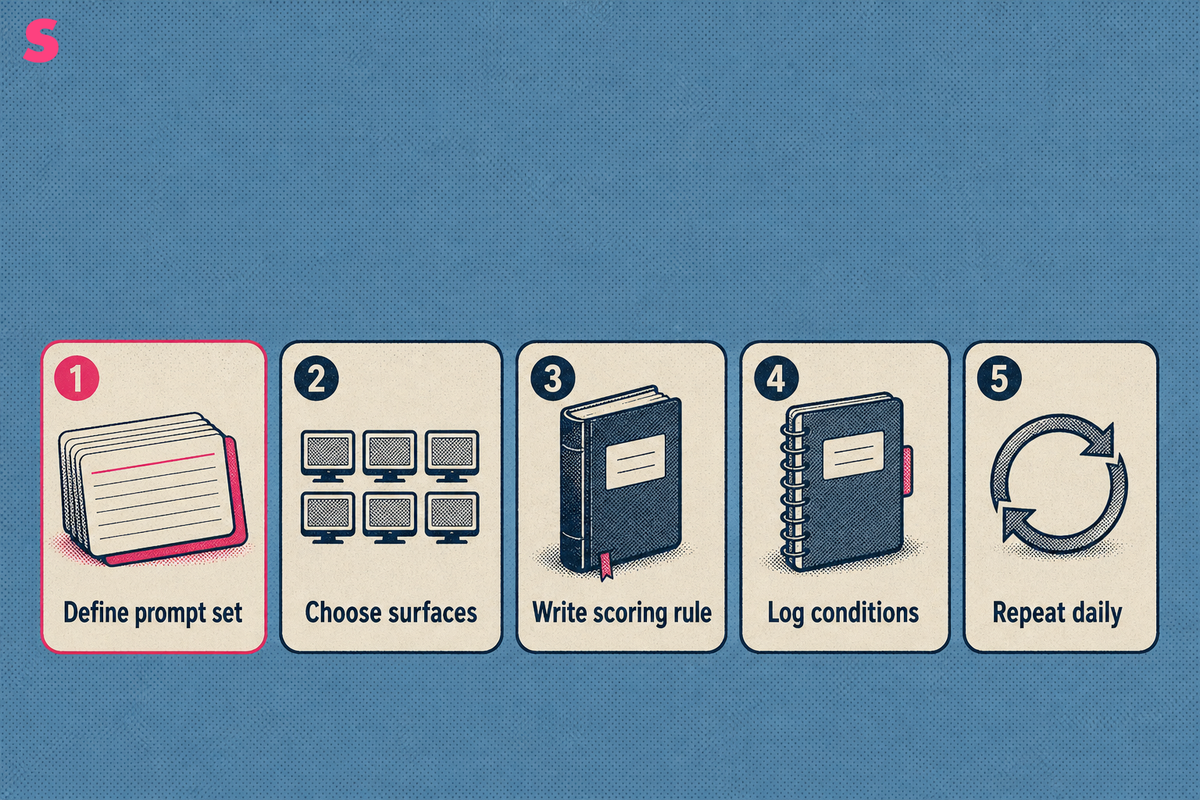
You track brand mentions in AI search by running a fixed set of buyer prompts through each answer engine on a schedule, then recording what came back: whether the brand appeared in the answer text, whether your domain was cited as a source, and whether the engine recommended you. It is sampling, not rank checking.
- Define the prompt set. Category, comparison, alternative and branded questions, written the way a buyer would type them.
- Choose the surfaces. ChatGPT, Google AI Overviews, Google AI Mode, Perplexity, Gemini and Copilot are a practical starting set.
- Write the scoring rule before you run anything. Mentioned, cited, recommended, absent. One value per prompt per engine.
- Log the conditions. Date, engine, model version, country, and the full answer text.
- Repeat the same set daily and read the series, not the single run.
A manual pass through a handful of prompts in one afternoon is a legitimate first audit. It tells you whether you appear at all. What it cannot do is repeat itself across every engine, every market and every week that matters, which is the point where monitoring software earns its price.
Why should you monitor brand mentions in AI search, and what can you do with the data?
Monitor AI mentions because the shortlist is now built before anyone reaches your site. A buyer asks ChatGPT or Perplexity which tools solve their problem, gets a narrowed list of names, and arrives already decided about who is in contention. If your brand is missing from that answer, the loss never surfaces in any analytics report.
The data supports four concrete actions: fixing the pages that should be answering a prompt and are not, earning mentions on the third-party sources engines cite, tracking competitor share of voice on commercial prompts, and briefing sales on what buyers ask. Ahrefs' analysis of 75,000 brands, reported by digitalapplied.com on June 20, 2026, found branded web mentions the strongest AI visibility signal, with a Spearman correlation of 0.664 to 0.709.
Most monitoring tools stop at the mention count and the share of voice chart. Sona AI Visibility connects those citations to pipeline and revenue on one account timeline, and tracks which AI crawlers reach your pages, so a mention becomes a number you can defend in a budget meeting rather than one you merely report.
What is the difference between an AI mention, a citation, a recommendation, and a source appearance?
These are four distinct events, and a tracker that collapses them into one "visibility" number will mislead you. A mention is your brand name in the generated text. A citation is your own domain listed as a source. A recommendation is the engine telling the user to choose you. A source appearance is your brand named inside someone else's page that the engine cited.
| Event | What it is | Where it appears | What it tells you |
|---|---|---|---|
| AI mention | Brand name in the answer body | Generated text | The model knows you exist for this prompt |
| Citation | Your URL in the source list | Footnotes, link cards, source panel | Your own page earned the retrieval |
| Recommendation | Explicit "use X" or a ranked shortlist slot | Generated text, often a list | Commercial intent is being served to you |
| Source appearance | Your brand inside a cited third-party page | A review site, forum or roundup | Where to invest in earned coverage |
The practical split: mentions and recommendations are outcomes, citations and source appearances are levers. You cannot edit an answer. You can publish a better page, or get named in the roundup the engine keeps citing.
Which AI engines and surfaces should a B2B company monitor?
Start with six: ChatGPT, Google AI Overviews, Google AI Mode, Perplexity, Gemini and Microsoft Copilot. That is the recommended starting set for a B2B company, and it should expand based on where your buyers and technical audiences conduct research. Add Claude where your buyers are technical, and treat Grok, DeepSeek, Mistral and Qwen as coverage you grow into rather than a day-one requirement.
Sona's own AI visibility archive covers 8 answer surfaces: ChatGPT, Google AI Overviews, Perplexity, Google AI Mode, Gemini, Mistral, Qwen and Claude (Sona's own AI visibility data, September 2026). Published coverage counts range widely, so read what each plan includes rather than the marketing headline. Profound's Starter plan tracks ChatGPT only. Otterly.ai's plans cover four engines. Peec AI lets you pick three models on Starter.
One collection detail matters before you compare those numbers. Some offerings capture the end-user experience directly, scraping the prompt response the way a person would see it, including ads and formatting. Others pull data from the vendor's official API, which returns a structured response that does not necessarily match what appears on screen. The two methods do not simply collect data differently; they can capture different answers. Sona aims to mirror the end-user experience as closely as possible and uses both methods.
How do you build a prompt set that reflects how buyers actually search?
Build the prompt set from demand evidence, not from imagination. Pull the keywords your category already ranks for, cluster them by intent, then reshape the commercial clusters into full conversational questions. A generative engine takes a multi-constraint sentence, not a three-word string, so "best AI visibility software for B2B SaaS under $200 a month" is the unit of work.
Cover five prompt types, weighted toward the bottom of the funnel:
- Category: "what tools track brand mentions in AI search"
- Comparison: "X vs Y for AI search monitoring"
- Alternatives: "alternatives to X"
- Problem: "how do I find out if ChatGPT recommends my product"
- Branded: "is X any good", "X pricing"
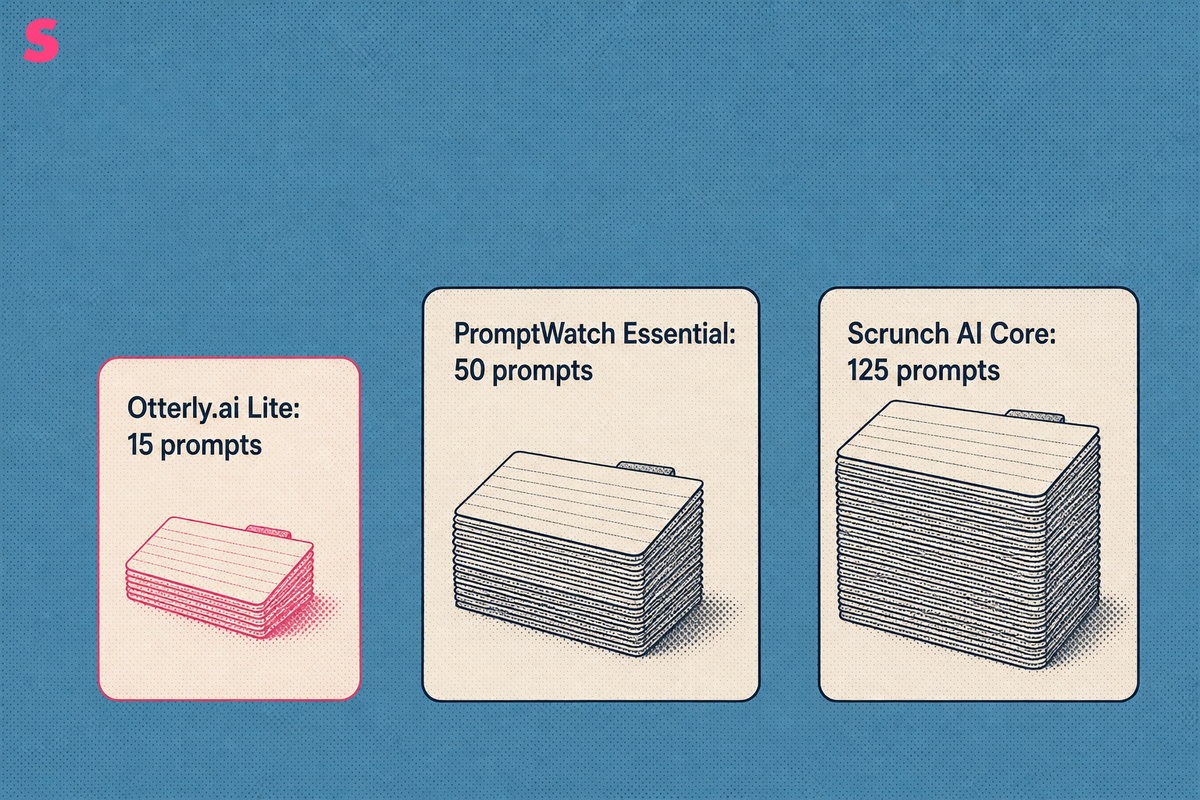
Size follows coverage, not a round number. Entry plans are built for small sets: Otterly.ai's Lite plan includes 15 prompts, PromptWatch's Essential plan 50, Scrunch AI's Core plan 125 unique prompts. Tag every prompt with an intent value and a buying stage when you load it. A perfect visibility score on an informational, awareness-stage question is worth less than a partial score on a commercial, decision-stage one.
Which metrics matter most, and how often should prompts be sampled?
Five metrics carry the weight: mention rate (share of runs where the brand appears), share of voice against named competitors, citation rate (share of answers citing your domain), position within the answer, and sentiment. Track all five per prompt and per engine. A single blended brand score hides the movement that matters.
A brand-level visibility number is not a work item. A blended visibility score tells nobody which prompts failed or which sources the engine preferred instead. Sona AI Search Insights reports visibility and share of voice per engine on the prompt row itself, alongside the citation and source-authority tracking that shows which pages produced each answer, which turns a metric into a list of pages to fix.
Sample daily. An engine's answer to the same prompt shifts with the retrieval index, with a model update, and with whatever a competitor published last week, so a weekly check averages a real move into noise. Run the same prompt list every day and the pattern a weekly snapshot would have hidden becomes visible: movement sustained across repeated samples is a trend; a single-run spike is not. Daily is the category standard, and Otterly.ai checks daily on every tier. Keep the slower clocks for the slower work, since a full technical re-audit and a competitive positioning review are quarterly jobs. Any single day's score is a dated snapshot; the comparable series is what a team actually reads.
What criteria should you use to choose an AI mention tracking tool?
Six criteria decide the choice, and they set the order of the tool comparison in this article. Judging the best ways to track brand mentions in AI search starts with what a plan actually buys, not with the feature list on the homepage.
- Engine coverage on the plan you will buy, not on the enterprise tier. Entry plans differ from 1 engine to 11.
- Prompt allowance and refresh cadence together. 50 prompts checked daily is a different product from 50 prompts checked weekly.
- Cost per daily tracked prompt on one shared denominator. Vendors count prompts per model, per project, or in credits, and mixing those units produces errors of four times or more.
- Citation-level detail. Does it name the sources behind each answer, or only whether you appeared?
- Multi-client support if you are an agency: a named agency plan, shared credits, white-label reports.
- Whether visibility connects to pipeline. Everything above measures appearance. Only some of it measures value.
Prices in the comparison that follows were read from each vendor's own pricing page in August and September 2026, and pricing in this category moves. Verify before you sign.
Which 6 tools track brand mentions in AI search, and what do they cost?
| Tool | Starting price | Agency Plans? (Yes/No) | # of Answer Engines Tracked | Answer Engines | # of Daily Tracked Prompts (entry plan) | Cost per Daily Tracked Prompt | Differentiation |
|---|---|---|---|---|---|---|---|
| Sona AI Visibility | Brands from $75/month, agencies from $199/month, both billed annually. 14-day free trial, no credit card. Unlimited seats and API/MCP access on every plan | Yes | 11 | ChatGPT, Gemini, Google AI Mode, Google AI Overviews and Perplexity on standard, plus Claude, DeepSeek, Grok, Copilot, Qwen and Mistral on premium | 5,000 credits/month on Starter 5K, which is about 166 prompts tracked daily on one model, or 56 across three. 1 credit = 1 AI answer | $0.45 per daily tracked prompt | Connects AI citations and prompts to pipeline and revenue on one account timeline, and tracks AI crawler activity from server logs or a lightweight edge worker with no JavaScript tag |
| Profound | From $99/month (Starter), $399 (Growth), Enterprise custom, billed yearly. Free trial on Growth | Yes | 1 | ChatGPT only | 50 prompts and 1,500 responses/month on Starter | $1.98 per daily tracked prompt | Focus: answer-engine visibility reporting, starting on ChatGPT alone and widening to three engines on Growth |
| Peec AI | From $80/month (Starter), $205 (Pro), $420 (Advanced), Enterprise custom. Annual billing | Yes | 3 | ChatGPT, Google AI Mode, Google AI Overviews, Microsoft Copilot, Perplexity, Gemini | 50 prompts on Starter, tracked daily, on 3 chosen models | $0.53 per daily tracked prompt | Focus: daily prompt tracking on a buyer-chosen subset of models |
| Otterly.ai | From $29/month (Lite), $189 (Standard), $489 (Premium), Enterprise from $1,000. Free trial, no commitment. 15% off annual; unlimited team members on every plan | Yes | 4 | ChatGPT, Google AI Overviews, Perplexity and Microsoft Copilot | 15 prompts on Lite, 100 on Standard, 400 on Premium, checked daily on every plan | $0.48 per daily tracked prompt | Focus: low-commitment daily mention checks with seats included at every tier |
| PromptWatch | Essential $95/month, Professional $245, Business $579. Agency plans from $199/month (Kick-off) | Yes | 4 | ChatGPT, Claude, Gemini and Perplexity | 50 prompts and 6,000 responses/month on Essential, with 500 agent credits | $0.48 per daily tracked prompt | Focus: prompt monitoring metered in responses, with a separate agency ladder |
| Scrunch AI | Core $250/month for brands, Agency Core $500/month, Enterprise custom. 7-day trial of Starter, no credit card | Yes | 4 | ChatGPT, Perplexity, Google AI Overviews and Copilot | 125 unique prompts on Core, 250 on Agency Core | $1.50 per daily tracked prompt | Focus: larger unique-prompt libraries for brands and multi-client agency use |
1. Sona AI Visibility
What it does: Tracks mentions, citations and sentiment across 11 engines, then connects those citations and the prompts behind them to pipeline and revenue on one account timeline, with AI crawler activity read from server logs or a lightweight edge worker. What it costs: Brands from $75/month, agencies from $199/month, both billed annually, with a 14-day free trial and unlimited seats. Who it suits: B2B teams accountable for pipeline, and agencies reporting to clients.
2. Profound
What it does: Answer-engine visibility reporting, with Starter scoped to ChatGPT and Growth widening to three engines. What it costs: From $99/month for Starter and $399/month for Growth, billed yearly, with a free trial on Growth. Who it suits: Teams whose buyers research mainly in ChatGPT and who want depth on one surface before widening.
3. Peec AI
What it does: Daily prompt tracking across three models you select from six supported engines. What it costs: From $80/month for Starter, $205 for Pro and $420 for Advanced, billed annually, with Enterprise quoted. Who it suits: Small marketing teams with a focused prompt list who want daily resolution without an enterprise contract.
4. Otterly.ai
What it does: Daily mention and link checks across ChatGPT, Google AI Overviews, Perplexity and Microsoft Copilot. What it costs: $29/month for Lite with 15 prompts, $189 for Standard with 100, $489 for Premium with 400, Enterprise from $1,000. Who it suits: Solo marketers and lean teams running a first AI visibility audit on a small budget.
5. PromptWatch
What it does: Prompt monitoring across ChatGPT, Claude, Gemini and Perplexity, metered in monthly responses alongside agent credits. What it costs: $95/month for Essential, $245 for Professional, $579 for Business, with agency plans from $199/month. Who it suits: Teams that want Claude coverage at the entry tier, and agencies wanting a separate multi-client ladder.
6. Scrunch AI
What it does: Brand and agency monitoring across ChatGPT, Perplexity, Google AI Overviews and Copilot, built around larger unique-prompt libraries. What it costs: $250/month for Core, $500/month for Agency Core, Enterprise quoted, with a 7-day trial of Starter. Who it suits: Brands with broad category coverage to track, and agencies running several clients from one workspace.
Which of these tools should you pick for your team and budget?
Match the tool to the question you have to answer, not to the longest feature list.
- You have to justify AI search spend in pipeline terms. Sona AI Visibility, from $75/month for brands, because it follows the prompt through to the account and the deal instead of ending at a mention count.
- You are running a first audit with almost no budget. Otterly.ai at $29/month buys 15 prompts checked daily across four engines. That is enough to learn whether you appear at all.
- Your buyers live in ChatGPT. Profound's $99/month Starter is scoped to that one surface, which fits if your category is not showing up elsewhere yet.
- You need Claude in the entry tier. PromptWatch's $95/month Essential plan covers ChatGPT, Claude, Gemini and Perplexity with 6,000 responses a month.
- You manage several clients. Scrunch AI's Agency Core at $500/month and Sona's agency plans from $199/month are both sold for multi-client use; compare them on prompt volume per client.
- You want daily resolution on a short, high-intent list. Peec AI's $80/month Starter gives 50 prompts across three chosen models.
Whichever you pick, budget for the prompt list before the seat count. Coverage of the right commercial prompts beats broad coverage of informational ones.
Frequently Asked Questions
How do I check whether ChatGPT mentions my brand?
Run a fixed set of category, comparison and branded prompts in ChatGPT, then record three things per prompt: whether the brand appears in the answer text, whether your domain appears in the cited sources, and whether the engine explicitly recommends you. Repeat the same prompts on a schedule, logging the date, model version and location each time.
How many prompts do I need to monitor to get a reliable picture?
Enough to cover every buying stage rather than a fixed number. Entry plans are sized small: Otterly.ai's Lite tier includes 15 prompts across four engines, Peec AI's Starter 50, Scrunch AI's Core 125. Reliability comes from sampling the same set repeatedly, not from set size, so a focused list run daily beats a long list run once.
How often do AI answers change for the same prompt?
Often enough that a single response is not a ranking. Answers shift with the retrieval index, model updates and newly published competitor content. Treat each response as one sample, run a fixed daily cadence with timestamps, and read mention rate and share of voice at the trend level. Movement sustained across consecutive samples is a signal; a single response is not.
Does a brand mention in an AI answer actually drive traffic?
Sometimes directly, through AI referral clicks. More often it works indirectly, through branded search later and assisted conversions that land in analytics as direct traffic. Read AI visibility data alongside referral sessions, demo requests and pipeline rather than in isolation, otherwise a rising mention rate looks like a result with nothing attached.
What is the difference between AI mention tracking and traditional rank tracking?
Rank tracking measures the position of a URL on a results page for a keyword. AI mention tracking measures whether a brand appears inside a generated answer, whether its domain is cited as a source, and how often it is recommended across repeated samples of the same prompt. One returns a position, the other returns a distribution.
Can I track brand mentions in AI search without paying for a tool?
Yes, for a first pass. Run manual prompt checks and review server logs for AI crawler activity. Sona's Free AI Readiness Checker returns a page-readiness score for whether engines can crawl and parse a page, which is a different question from whether you are mentioned. Reproducing checks across engines, locations, prompts and weeks is where automation becomes necessary.
Summarize this article with AI: ChatGPT · Claude · Perplexity · Google AI Mode
Last updated: September 2026







