LLM brand visibility refers to how often, how prominently, and how favorably your brand appears in responses generated by AI engines like ChatGPT, Perplexity, Google AI Overviews, and Claude. B2B SaaS companies can monitor this using dedicated tracking tools that measure mentions, citations, sentiment, and share of voice across platforms, then improve visibility through structured content, schema markup, and strategic source optimization. The gap between brands that appear in AI answers and those that don't is widening fast: 67% of organizations already deploy LLMs for customer-facing applications, making this a present-day revenue issue, not a future one.
Why Does LLM Brand Visibility Matter for B2B SaaS Companies?
LLM brand visibility matters because AI engines are now a primary discovery channel for B2B buyers, and if your brand isn't surfaced in their responses, you're losing pipeline to competitors who are.
According to Nick Lafferty's analysis of LLM tracking tools, 67% of organizations already deploy LLMs for customer-facing applications. Your prospects are using ChatGPT, Perplexity, and Google AI Overviews to research vendors, compare solutions, and shortlist categories before they ever visit your website.
The Hootsuite Blog's 2026 breakdown of LLM visibility frames this as a distinct brand exposure category, separate from traditional search rankings. A brand can rank on page one of Google and still be completely absent from AI-generated answers. These are different systems with different inputs. Optimizing for one does not guarantee presence in the other.
The business case sharpens at the citation level. Microsoft Copilot shows 17.6x more citations for the top 10% of brands versus the rest. Brands already appearing in AI answers compound their advantage with every query, while brands outside that top tier become progressively less visible. For B2B SaaS companies at Seed through Series B, this is a current pipeline problem.
Sona AI Visibility runs a free 35-check audit across crawlability, content structure, content quality, performance, security, and accessibility, identifying exactly whether AI engines like ChatGPT and Perplexity can discover and cite your content. Three in four websites are partially or fully invisible to AI engines. Most fixes cost $0 once identified.
What Key Metrics Should You Track to Measure LLM Brand Visibility?
The five core metrics for LLM brand visibility are mention rate, citation rate, average rank position, sentiment score, and share of voice, each mapping to a distinct stage of AI-driven brand discovery.
According to Connective3's 2026 guide to LLM visibility tracking tools, the standard framework covers visibility (average brand presence across prompts), sentiment (favorability score of language used), rank (average position in a response list), mentions (brand named in a response), and citations (brand content directly attributed as a source). Trakkr.ai refines this with two composite scores: a presence score measuring how often a brand appears across all tracked prompts, and a visibility score measuring how prominently it features when it does appear.
Click Insights specifies additional granular data points worth tracking: generative engine type, rank #1 count, rank #1 share of voice, and featured sources. Knowing which external sources AI engines cite when mentioning your category tells you exactly where to pursue listicle outreach.
These metrics have direct analogues in traditional SEO, but they measure different things:
| Metric | What It Measures | Traditional SEO Equivalent |
|---|---|---|
| Mention Rate | % of AI responses that name your brand | Brand search volume |
| Citation Rate | % of responses that link or attribute your content | Backlink count |
| Average Rank Position | Where your brand appears in a response list | SERP position |
| Sentiment Score | Favorability of language used about your brand | Review ratings |
| Share of Voice | Your mentions vs. competitors across prompts | Organic traffic share |
| Presence Score | How often brand appears across all tracked prompts | Impressions |
| Visibility Score | How prominently brand features when it appears | Click-through rate |
If your team is mapping AI-driven brand discovery to pipeline, Sona Attribution provides multi-touch revenue attribution that incorporates AI-sourced touchpoints alongside traditional channels.
How Do ChatGPT, Perplexity, Google AI Overviews, and Claude Differ for Brand Visibility?
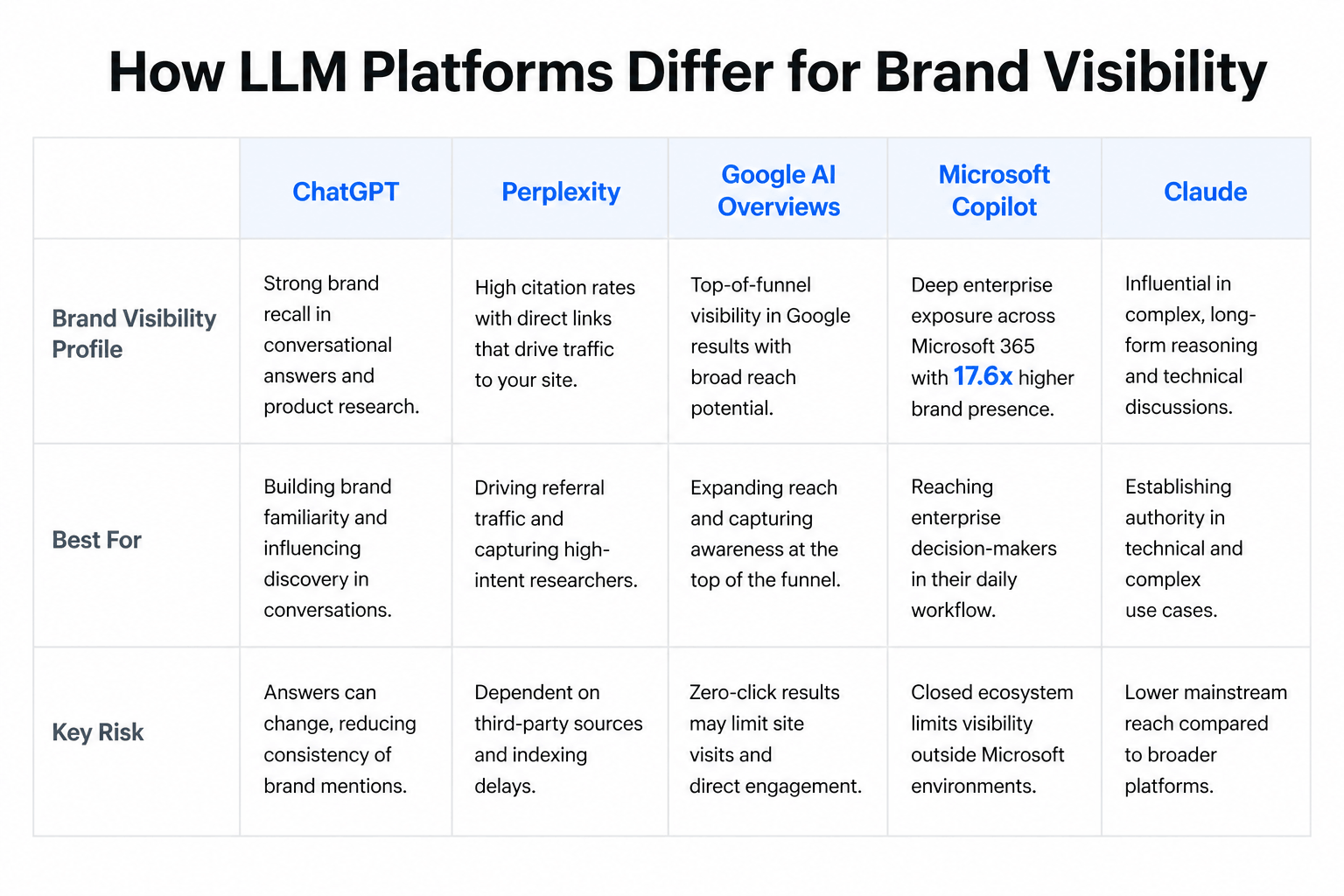
Each major LLM platform has a distinct brand visibility profile: ChatGPT rewards brand popularity, Perplexity surfaces the most brands per answer, Google AI Overviews show the highest brand diversity, and Microsoft Copilot creates the starkest citation inequality.
Nick Lafferty's platform-specific analysis provides the clearest breakdown. ChatGPT shows a .542 correlation between brand popularity and citation frequency. Perplexity mentions the most brands per answer, making it the most accessible platform for niche or emerging brands. Google AI Overviews show the highest brand diversity. Microsoft Copilot concentrates citations most severely, with the top 10% of brands receiving 17.6x more citations than the rest.
As Yoast's 2026 analysis explains, single-platform monitoring creates dangerous blind spots. A brand that tracks only ChatGPT might conclude it has strong AI visibility while being completely absent from Perplexity and Google AI Overviews, which serve different user bases with different query patterns.
| Platform | Brand Visibility Profile | Best For | Key Risk |
|---|---|---|---|
| ChatGPT | Favors already-popular brands (.542 correlation) | Brand awareness amplification | Newer brands get less organic lift |
| Perplexity | Mentions most brands per answer | Niche and emerging brand discovery | Lower citation authority weight |
| Google AI Overviews | Highest brand diversity | Broad category visibility | Volatile; tied to Google algorithm |
| Microsoft Copilot | 17.6x citation advantage for top 10% | Enterprise and high-authority brands | Severe inequality for mid-market |
| Claude | Emerging; citation-heavy responses | Thought leadership content | Smaller user base currently |
A brand entering a new category should prioritize Perplexity and Google AI Overviews, where diversity is highest. An established brand defending market position needs to monitor Copilot closely, where citation inequality compounds fastest.
What Are the Best Tools for LLM Brand Visibility Tracking?
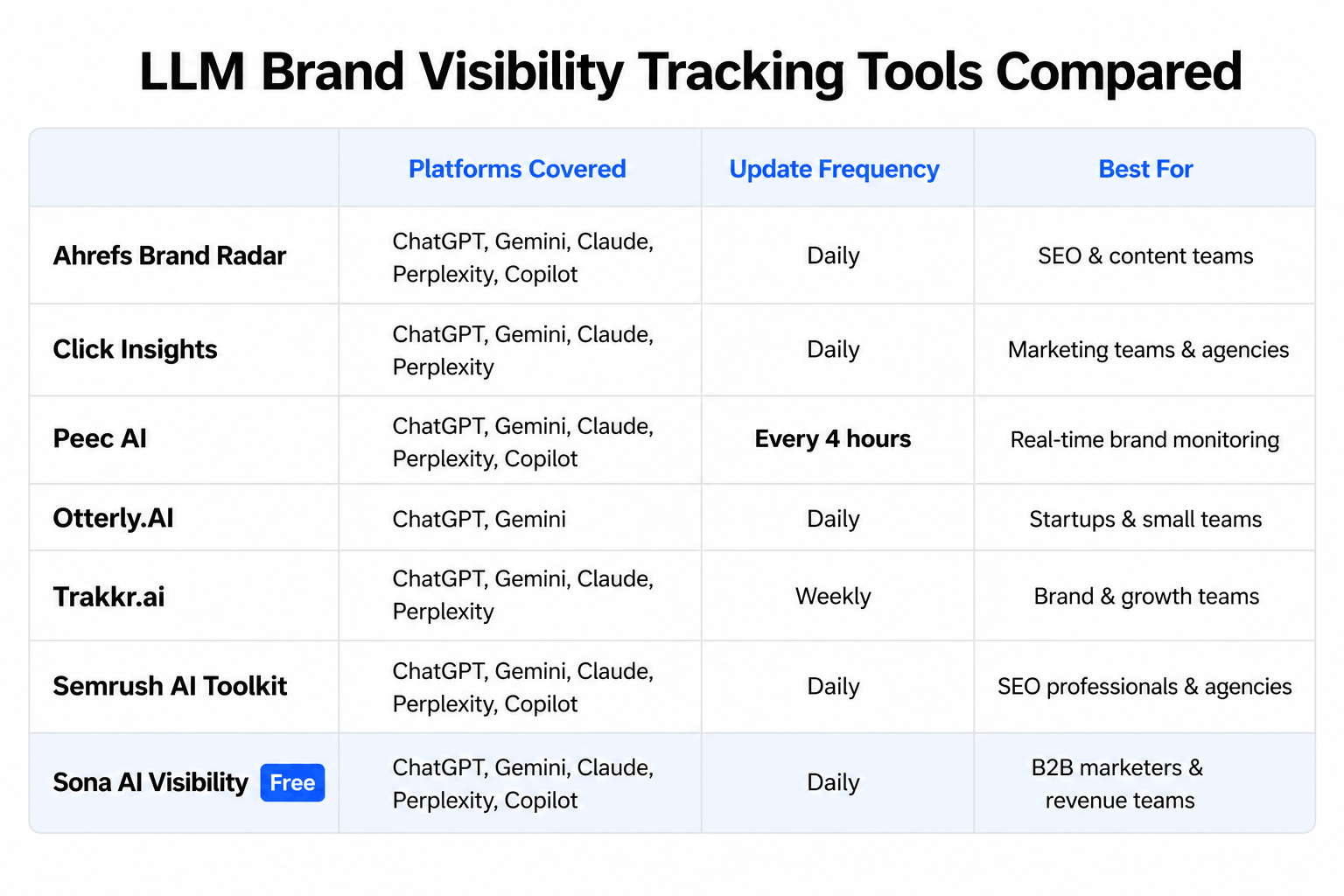
The leading LLM brand visibility tracking tools in 2026 include Ahrefs Brand Radar, Click Insights, Peec AI, Otterly.AI, Trakkr.ai, and Semrush's AI Toolkit, each with distinct strengths in monitoring depth, update frequency, and competitive benchmarking.
Wix Studio's AI Search Lab comparison of 14 tools highlights Peec AI's 4-hour update frequency as the fastest in the category for competitive verticals, alongside Otterly.AI's streamlined prompt generation and export capabilities, Brandlight's brand sentiment focus, and Semrush AI Toolkit's integration with broader communication strategy workflows.
SitePoint's 2026 comparative analysis evaluates monitoring options across ChatGPT, AI search, and LLMs, noting that tool selection depends primarily on how many platforms you need to cover and whether you need real-time alerts or scheduled reporting.
Yotpo's review of 15 LLM monitoring tools provides feature-level breakdowns for brand visibility use cases, including which tools handle brand sentiment analysis most reliably and which are better suited to share-of-voice tracking.
| Tool | Platforms Covered | Update Frequency | Best For | Pricing Tier |
|---|---|---|---|---|
| Ahrefs Brand Radar | ChatGPT, Perplexity, Gemini, others | Regular | Comprehensive prompt analysis and competitive rank tracking | Paid |
| Click Insights | ChatGPT, Gemini, DeepSeek, Perplexity, Grok | Scheduled | Multi-engine share of voice and source tracking | Paid |
| Peec AI | ChatGPT, Perplexity, Gemini, Llama, DeepSeek, Claude | Every 4 hours | Real-time competitive tracking | Paid |
| Otterly.AI | ChatGPT, Perplexity, others | Regular | Easy prompt generation and export | Paid |
| Trakkr.ai | Multiple LLMs | Regular | Digestible top-level presence and visibility scores | Paid |
| Semrush AI Toolkit | ChatGPT, Google AI Overviews | Regular | Brand sentiment and communication strategy | Paid (Enterprise) |
| Sona AI Visibility | ChatGPT, Perplexity, Google AI Overviews | On-demand | Site-level AI readability audit (crawlability, schema, freshness) | Free |
Tracking tools tell you what AI engines are saying about your brand. They can't fix why AI engines ignore your site. If your site has JavaScript rendering issues blocking GPTBot, missing schema markup, or no llms.txt file, monitoring won't change your citation frequency. Run the free Sona AI Visibility audit first to identify what's broken, then deploy tracking tools to measure improvement.
How Do You Set Up LLM Brand Visibility Tracking Step by Step?
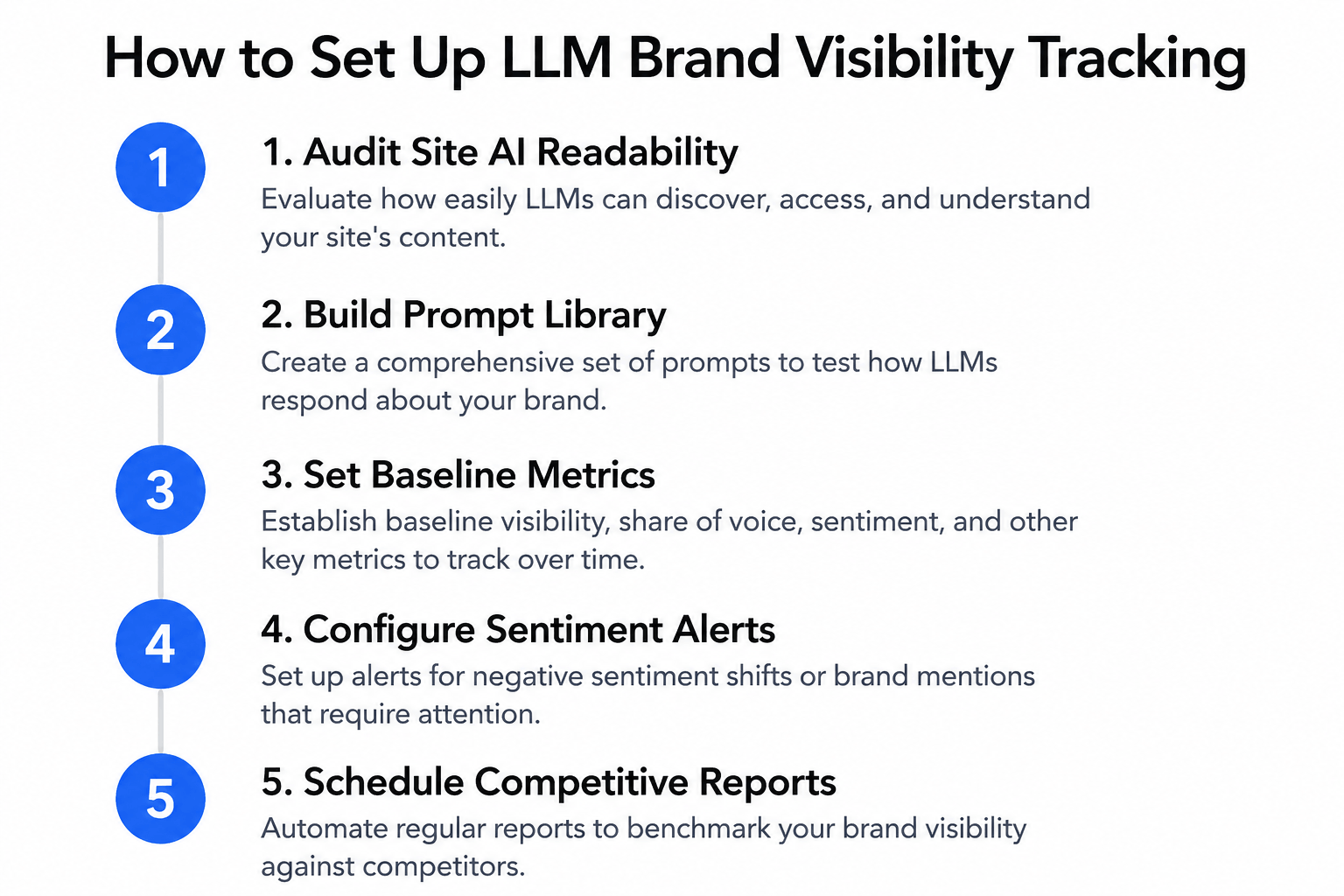
Setting up LLM brand visibility tracking requires four steps: auditing your site's AI readability, building a prompt library, establishing baseline metrics across platforms, and scheduling recurring monitoring cadences.
Previsible.io's step-by-step LLM visibility tracking framework covers the full sequence from brand audit through prompt library construction to citation planning. Click Insights demonstrates that one user intent keyword combination generates five highly targeted prompts, meaning a library of 20 seed keywords scales to 100 targeted prompts without manual effort. Meltwater's 2026 guide to tracking LLM brand mentions recommends weekly competitive checks and monthly share-of-voice reports as the baseline cadence for B2B SaaS teams.
Step 1: Audit your site's AI readability. Run a free scan with Sona AI Visibility to identify crawlability issues, schema gaps, missing llms.txt, and content freshness problems. It takes under 30 seconds and covers 35 checks across six categories. Fix what's broken before investing in tracking tools.
Step 2: Build your prompt library. Create three prompt types: brand queries (your company name plus category), category queries (your product category without brand names), and competitor comparison queries (your brand versus named competitors). Start with 20 to 30 prompts and expand using a tool's auto-generation feature.
Step 3: Set baseline metrics across target LLM platforms. Run your full prompt library across ChatGPT, Perplexity, and Google AI Overviews simultaneously. Record mention rate, average rank position, sentiment score, and share of voice for each platform.
Step 4: Configure alerts for sentiment shifts and new citation sources. Most tracking tools support alerts when sentiment scores drop or when new domains start appearing as featured sources for your category prompts. These signals tell you when a competitor has improved their AI visibility or when a new publication is being cited heavily.
Step 5: Schedule weekly and monthly competitive benchmarking reports. Weekly checks catch sentiment shifts and new citation sources. Monthly reports track share-of-voice trends and rank position changes against your defined competitor set.
What Strategies Actually Improve Your Brand's Visibility in LLM Responses?
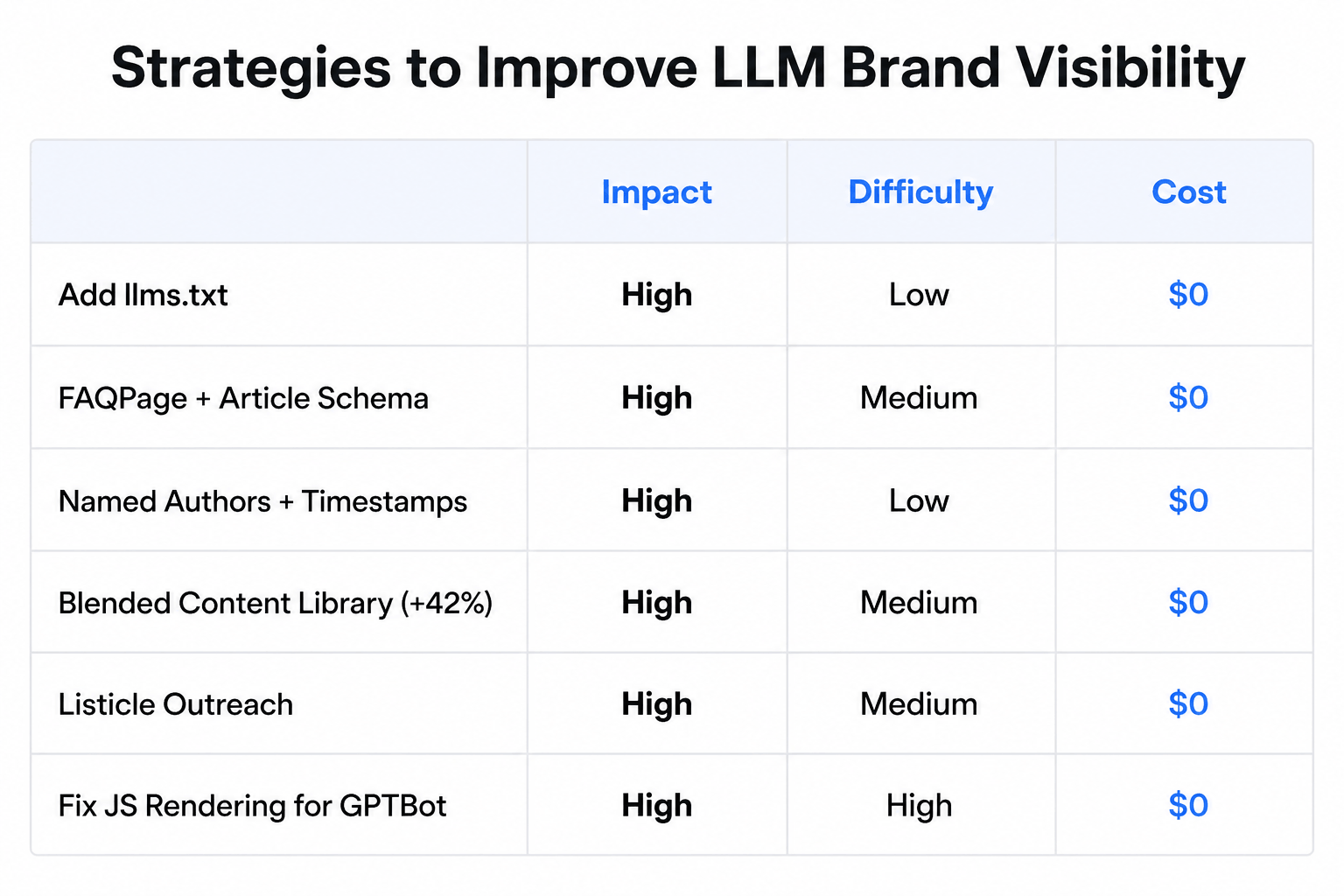
The strategies with the strongest evidence for improving LLM brand visibility are blended query content planning, structured data implementation, named-author content, llms.txt configuration, and listicle outreach to frequently cited sources.
According to Nick Lafferty's research on LLM tracking tools, combining your top 1,000 organic keywords with three times as many synthetic long-tail variants generated using GPT-4 improves LLM visibility coverage by 42% compared to organic keywords alone, based on Profound's December 2024 pilot programs. The synthetic variants capture the conversational query patterns AI engines actually use, which differ substantially from the head terms that dominate traditional SEO keyword research.
Plug and Play Tech Center's 2026 guide to improving brand visibility in AI search engines identifies content structure and authority signals as the two highest-leverage improvement areas. Advanced Web Ranking's documentation on how LLMs evaluate brands confirms that AI engines weight named authorship, content freshness, and structured data heavily when deciding what to cite.
| Strategy | Impact | Difficulty | Cost |
|---|---|---|---|
| Add llms.txt to guide AI reading | High | Low | $0 |
| Implement FAQPage and Article schema | High | Low-Medium | $0 |
| Add named authors and "Last updated" timestamps | Medium | Low | $0 |
| Build blended prompt and content library (organic plus synthetic) | High | Medium | Low |
| Pursue listicle outreach to frequently cited sources | High | Medium-High | Low |
| Fix JS rendering issues blocking GPTBot | High | Medium | $0–Low |
The free audit from Sona AI Visibility identifies which of these fixes apply to your site, checking for llms.txt validity, FAQPage and Article schema, named authors, "Last updated" timestamps, JavaScript rendering issues blocking GPTBot, and dateModified in schema, with per-category scores and specific remediation guidance.
How Do You Benchmark Your LLM Brand Visibility Against Competitors?
Competitive benchmarking in LLM visibility tracks your brand's share of voice, average rank position, and citation frequency relative to named competitors across the same prompt sets, giving you a clear gap analysis for prioritization.
According to Connective3's analysis of LLM visibility tracking tools, Ahrefs Brand Radar displays competitor URLs on line graphs for direct rank comparison over time, while AccuLLM surfaces the most frequently cited domains for any prompt set regardless of whether those domains were included in your defined competitor set. That second capability reveals which publishers and third-party sources AI engines trust for your category, pointing directly to outreach targets.
Sight AI's guide to multi-LLM brand monitoring outlines seven essential strategies for competitive benchmarking across platforms, emphasizing that prompt design is the variable most teams underinvest in. Practitioners on Reddit's r/SEO community confirm that the most useful competitive prompts are comparison queries ("best [category] tools for [use case]") rather than direct brand queries.
Step 1: Define your competitor set. Choose three to five direct competitors. Include one aspirational brand that consistently appears in AI answers for your category. Their citation sources become your outreach targets.
Step 2: Run identical prompt sets for your brand and each competitor. Use the same prompt library across all tracked LLM platforms. Variation in prompt wording between brands contaminates the comparison.
Step 3: Compare mention rate, average rank, sentiment score, and share of voice per platform. Platform-level gaps are more actionable than aggregate scores. A brand that leads on Perplexity but trails on Google AI Overviews needs a different content fix than one that's absent across all platforms.
Report competitive benchmarks monthly. Weekly reporting introduces noise from AI engine volatility that obscures genuine trend lines. If your team uses intent signals to inform outreach prioritization, Sona Intent Signals can surface which competitor-researching accounts are showing active buying behavior, connecting AI visibility intelligence to pipeline action.
Frequently Asked Questions
How do I track my brand's visibility across different large language models?
Use a dedicated LLM visibility tracking tool that runs your brand-relevant prompts across ChatGPT, Perplexity, Google AI Overviews, and Claude simultaneously. Tools like Peec AI (4-hour update frequency), Click Insights (multi-engine share of voice), and Ahrefs Brand Radar (comprehensive prompt analysis) all support multi-platform tracking. Start by auditing whether your site is readable by AI crawlers using Sona AI Visibility, then layer tracking tools on top once foundational issues are resolved.
What are the top tools to monitor brand mentions in AI-generated search results?
The leading tools in 2026 include Ahrefs Brand Radar for comprehensive prompt analysis and competitive rank tracking, Peec AI for real-time monitoring with 4-hour update cycles, Click Insights for multi-engine share of voice and featured source tracking, Otterly.AI for streamlined prompt generation and export, Trakkr.ai for digestible presence and visibility scores, and Semrush AI Toolkit for brand sentiment analysis integrated with communication strategy. For site-level AI readability audits before deploying any of these tools, Sona AI Visibility is a free starting point that identifies crawlability, schema, and freshness issues in under 30 seconds.
How do I measure how often my brand appears in LLM responses?
Define a representative prompt library covering your brand, product category, and competitor comparison queries. Run these prompts across your target LLM platforms and track mention rate (the percentage of responses naming your brand), average rank position (where in the response your brand appears), and share of voice (your mentions versus competitors across the same prompt set). Tools like Click Insights automate this at scale. One user intent keyword combination generates five highly targeted prompts, so a library of 20 seed keywords produces 100 trackable prompts without manual writing.
What is the best way to improve brand visibility in AI chatbots?
The highest-impact, lowest-cost improvements are adding llms.txt to your site, implementing FAQPage and Article schema markup, adding named authors and "Last updated" timestamps to content, and fixing JavaScript rendering issues that block GPTBot. Profound's December 2024 pilot programs found that combining organic keyword content with synthetic long-tail variants improves LLM visibility coverage by 42%. A free audit from Sona AI Visibility tells you exactly which fixes apply to your site.
How can I benchmark my brand's AI visibility against competitors?
Define a competitor set of three to five brands, build identical prompt sets for all of them, and run those prompts across each LLM platform you track. Compare mention rate, average rank, sentiment score, and share of voice per platform. Tools like Ahrefs Brand Radar and AccuLLM surface competitor citation data automatically, including which domains are most frequently cited for your category's prompts. Report monthly rather than weekly to avoid noise from AI engine volatility obscuring genuine trend lines.
Why does my brand appear in some LLMs but not others?
Each LLM has a different training data composition, retrieval mechanism, and citation weighting system. ChatGPT shows the highest correlation with brand popularity (.542), meaning established brands get more organic lift. Perplexity surfaces the most brands per answer, making it more accessible for niche or emerging brands. Microsoft Copilot shows 17.6x more citations for the top 10% of brands, creating significant inequality for mid-market companies. Tracking across all platforms reveals where your specific gaps are and which fixes to prioritize.
Is LLM brand visibility tracking worth the investment for B2B SaaS?
Yes. 67% of organizations already deploy LLMs for customer-facing applications, meaning your buyers are actively using AI engines to research vendors. The foundational fixes (schema markup, llms.txt, content structure improvements, named authorship) cost $0 to implement once identified, and tracking tools that measure improvement start at free tiers for most platforms.
What is llms.txt and how does it affect my brand's AI visibility?
llms.txt is a plain-text file placed in your site's root directory that tells AI engines which pages to prioritize when reading your content, analogous to robots.txt for traditional crawlers. Sites with a properly configured llms.txt file give AI engines clearer guidance on what content to surface, improving citation frequency for the pages you most want cited. You can check whether your site has a valid llms.txt file, along with 16 other AI readability checks, using Sona AI Visibility.
Last updated: April 2026