


LLM-powered AI sales software has moved from novelty to necessity. The best platforms in 2026 combine generative AI with CRM integration, automated outreach, and conversation intelligence to measurably improve pipeline and forecast accuracy. This guide ranks and compares the leading options, from no-code agents deployable in hours to enterprise forecasting platforms, so B2B sales teams can choose the right fit based on team size, CRM stack, and LLM maturity.
What Are the Most Effective AI Sales Software Tools That Use Large Language Models?
The most effective LLM-powered AI sales tools in 2026 span five categories: conversation intelligence, forecasting, prospecting, engagement automation, and no-code agent building. Standout platforms include Gong, Clari, ZoomInfo Copilot, Highspot, Apollo, Clay, Outreach, and Gumloop.
According to Highspot's 2026 review of AI sales tools, the top platforms now deliver LLM-driven features across proposals, real-time coaching, and deal guidance. The best tools combine multiple capabilities rather than solving a single problem. The ZoomInfo Blog's 2026 generative AI sales tools roundup covers 12 platforms across prospecting, coaching, and engagement, confirming that the market has consolidated around a core set of proven tools.
Conversation intelligence and forecasting
- Gong: Records, transcribes, and analyzes sales calls. Surfaces deal risk signals and generates pipeline forecasts from conversation data.
- Clari: Revenue forecasting and pipeline inspection using activity-based ML. Built for enterprise revenue operations teams.
- Oliv AI: Conversation-driven forecasting with reported accuracy of 92–98%, implemented in 2–4 weeks at $19/user/month.
Prospecting and GTM intelligence
- ZoomInfo Copilot: AI-generated outreach, buyer intent signals, and GTM intelligence layered on ZoomInfo's contact database.
- Apollo: Contact database plus outbound sequencing, with template-based workflows for prospecting at scale.
- Clay: Low-code data enrichment and personalization, pulling from multiple data sources to build hyper-targeted prospect lists.
Sales enablement and coaching
- Highspot: LLM-powered coaching agents, AI-guided content recommendations, and real-time deal guidance surfaced during live calls.
Engagement automation
- Outreach: AI-powered cadences and sales engagement for high-velocity outbound teams.
No-code LLM agent builders
- Gumloop: No-code platform for building custom LLM agents that handle lead enrichment, CRM updates, and outbound sequencing.
- Lindy AI: No-code AI agents with 6,000+ integrations covering CRMs, communication tools, and data sources.
CRM-native AI layers
- Salesforce Einstein: Native LLM layer inside Salesforce for lead scoring, opportunity insights, and AI-generated outreach.
- HubSpot Breeze AI: Native AI inside HubSpot covering contact enrichment, email generation, and pipeline summaries.
Oliv AI's 2026 benchmarking of AI sales forecasting software draws a clear line between LLM-native platforms that use live conversation data and tools that have bolted AI onto legacy ML architectures. The performance gap between the two is now visible in published accuracy figures.
How Do LLM-Powered AI Sales Tools Actually Improve Sales Team Productivity?
LLM-powered sales tools improve productivity by automating the highest-friction tasks in a sales rep's day: call summarization, follow-up drafting, CRM data entry, and pipeline updates.
According to Sybill AI's 2025 research on generative AI tools for sales, platforms like Sybill reduce the manual CRM burden that consumes a disproportionate share of rep time by surfacing automated prospect insights, call summaries, and trend data directly from LLMs. The ZoomInfo Blog confirms that tools like Gong and Outreach automate call analysis, engagement sequencing, and deal insight generation.
1. Automated call notes and CRM logging Gong and Sybill both transcribe calls, extract key moments, and push structured summaries directly into CRM records. Reps stop spending 20–30 minutes per call on manual notes.
2. AI-generated follow-up emails and outreach sequences Outreach and Apollo generate personalized follow-up emails from call context, prospect firmographics, and prior engagement history. Sequences that previously required manual customization run automatically.
3. Real-time coaching and battle card surfacing Highspot's AI agents deliver just-in-time guidance during live deals, surfacing relevant case studies, competitive battle cards, and pricing guidance at the moment a rep needs them, without requiring a manager on the call.
4. Pipeline health alerts and deal risk flagging Clari and Gong flag deals showing risk signals: stalled engagement, missing stakeholders, forecast gaps. Sales managers get a prioritized view of where to intervene rather than reviewing every deal manually.
Oliv AI's 2026 benchmarking notes that 40% of sales teams are actively seeking AI forecasting consolidation, a signal that the current multi-tool stack is generating more complexity than insight. The highest-ROI use cases eliminate repetitive administrative work rather than attempting to replace human judgment in complex deals.
Which AI Sales Platforms Integrate Best With Salesforce, HubSpot, and Other CRMs?
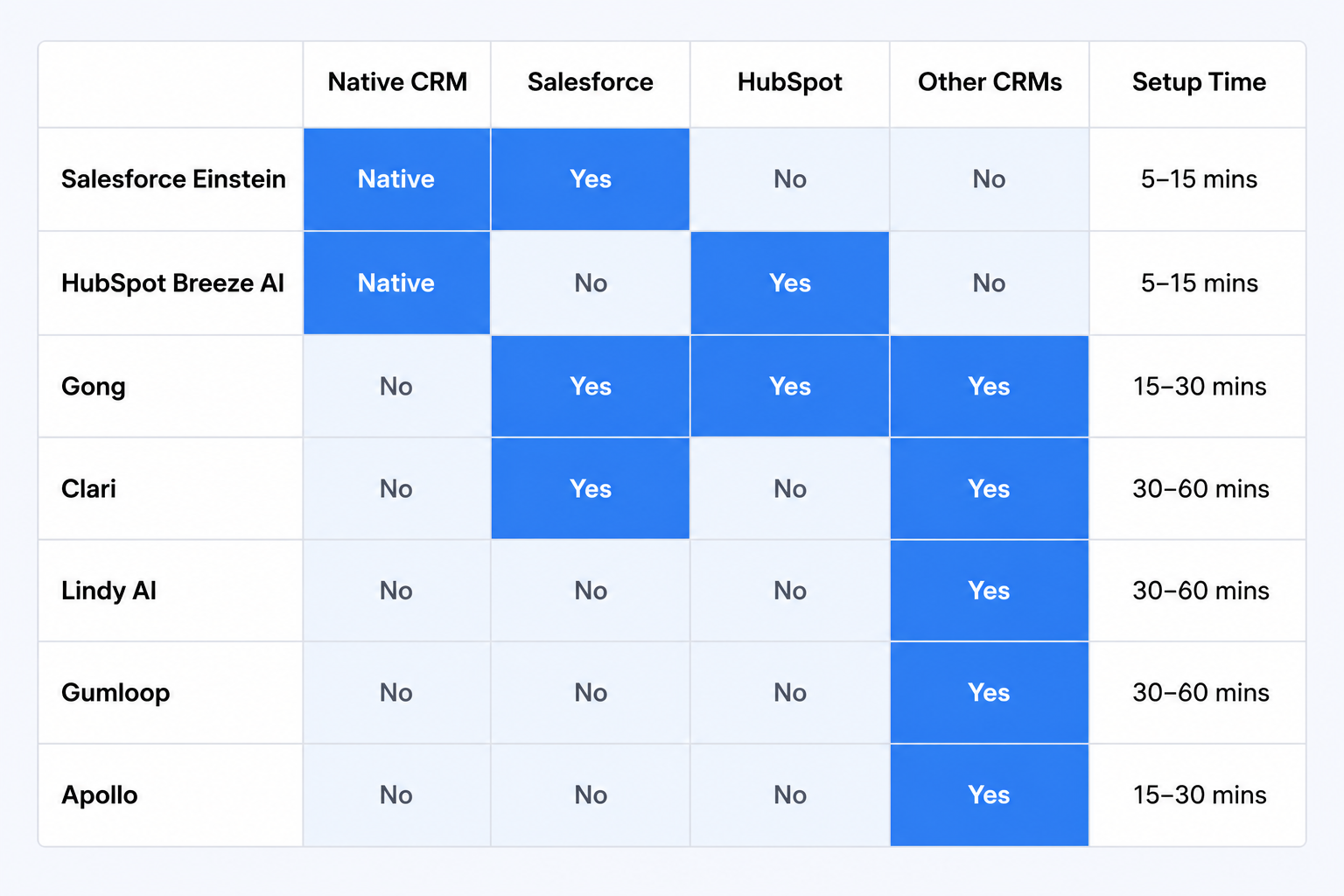
The AI sales platforms with the deepest CRM integration in 2026 are Salesforce Einstein (native), HubSpot Breeze AI (native), Clari, Gong, and Lindy AI. No-code platforms like Gumloop and Lindy AI offer the broadest connector libraries for teams on non-standard CRM stacks.
MindStudio AI's analysis of LLM-CRM integration platforms confirms that platforms connecting LLMs with Salesforce and HubSpot enable automated lead scoring, contact enrichment, and pipeline updates without custom engineering, making integration depth a primary selection criterion for revenue operations teams.
The ZoomInfo Blog notes that Salesforce Einstein and HubSpot Sales Hub offer native CRM AI layers for lead scoring, opportunity insights, and AI-generated outreach, while third-party tools like Gong and Clari require connector setup but deliver deeper analytical capabilities than either native option.
According to Gumloop's 2026 AI sales agent guide, Lindy AI Pro connects to 6,000+ integrations including all major CRMs, enabling no-code LLM agents to handle lead routing, CRM updates, and follow-up sequencing without engineering resources.
| Platform | Native CRM | Salesforce | HubSpot | Other CRMs | Setup Time |
|---|---|---|---|---|---|
| Salesforce Einstein | Native | Yes | No | Limited | 4–8 weeks |
| HubSpot Breeze AI | Native | No | Yes | Limited | 1–2 weeks |
| Gong | No | Yes | Yes | Select | 2–4 weeks |
| Clari | No | Yes | Yes | Select | 8–12 weeks |
| Lindy AI | No | Yes | Yes | 6,000+ | Hours |
| Gumloop | No | Yes | Yes | 6,000+ | Hours |
| Apollo | No | Yes | Yes | Select | Days |
For teams on non-standard CRMs (Pipedrive, Zoho, Monday CRM), Lindy AI and Gumloop are the only platforms that reliably cover the full integration surface without custom development.
What Features Should You Look for in AI Sales Software Built for LLMs?
The most important features in LLM-designed AI sales software are: native generative AI (not just ML), real-time conversation intelligence, CRM write-back automation, predictive pipeline scoring, and transparent accuracy benchmarks. Not all "AI" sales tools actually use LLMs under the hood. The architecture difference produces measurable performance gaps.
Oliv AI's 2026 benchmarking draws a sharp line between generative AI agents that use live conversation data and legacy ML tools that depend on CRM field inputs. The former achieves 92–98% forecast accuracy versus 68–75% for CRM-dependent tools. That 20-plus-percentage-point gap is the clearest evidence that underlying AI architecture matters more than the feature list on a vendor's website.
Highspot identifies AI-guided content recommendations, conversational coaching, and real-time analytics that surface deal risk before it appears in the CRM as the features that separate high-performing platforms from the rest.
1. Generative AI (LLM-native) vs. legacy ML scoring Ask vendors directly: does the platform use a large language model for its core outputs, or is "AI" a label on a decision tree? LLM-native tools generate text, summarize conversations, and reason over unstructured data. ML-scoring tools assign numeric probabilities based on historical CRM fields. Both have value, but they solve different problems.
2. Real-time conversation intelligence with automated CRM write-back The tool should transcribe calls, extract structured data (next steps, objections, stakeholders), and push that data into CRM records automatically. Manual CRM entry is the single largest time sink in most sales orgs.
3. Predictive pipeline scoring with explainability Scores without explanations create distrust. The best platforms show which signals drove a risk flag (no executive engagement in 14 days, pricing objection raised twice) so reps can act on the insight rather than dismiss it.
4. Personalized outreach generation at scale LLM-native tools generate outreach that incorporates prospect-specific context: recent funding, job change, relevant case study. Generic sequence templates are a legacy ML output.
5. No-code or low-code customization Teams should be able to build and modify workflows without filing engineering tickets. The ZoomInfo Blog identifies cadence automation and predictive lead scoring as baseline LLM-powered features that should require zero engineering to configure.
6. Transparent accuracy benchmarks and data requirements Any vendor claiming forecast accuracy should publish the methodology: what data inputs, what time period, what deal size range. Oliv AI publishes 92–98% against a conversation-driven methodology. Clari publishes 70–85% against activity-based ML. Salesforce Einstein reports 68–75% against CRM-field inputs. These numbers are only comparable if the methodology is disclosed.
7. GDPR and compliance controls European teams need data residency options and processing agreements. This is a non-negotiable filter for any company with EU customers or employees.
Red flags to avoid: Vendors who cannot specify whether their core model is generative AI or legacy ML. Platforms that require 6+ months of CRM data before delivering any output. Tools that claim "AI-powered" for features that are rule-based automations with no LLM component.
No-Code vs. Enterprise LLM Sales Platforms: Which Is Right for Your Team?
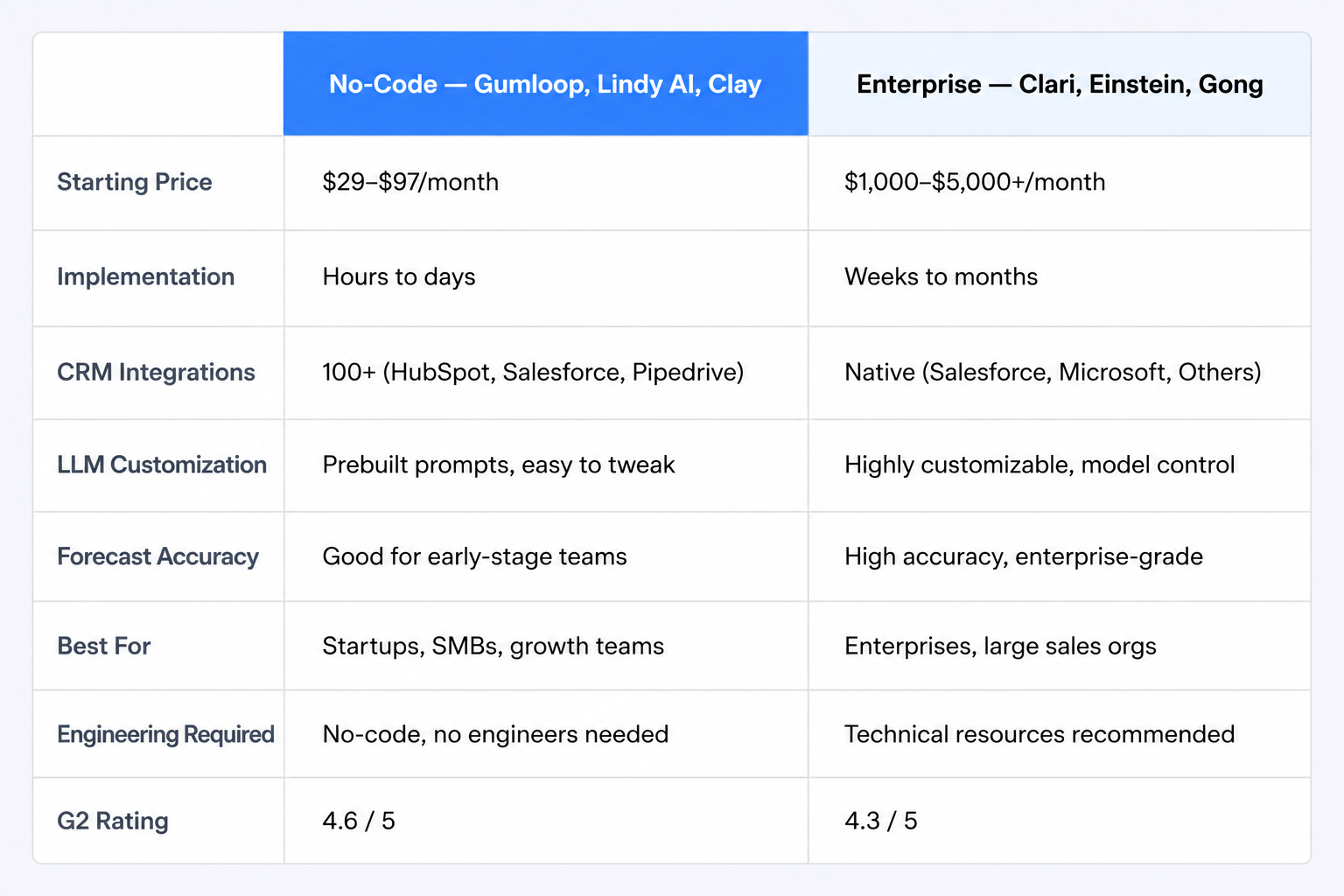
No-code LLM sales platforms like Gumloop and Lindy AI deploy in hours at $37–$50/month. Enterprise platforms like Clari and Salesforce Einstein require 8–12 weeks of implementation at $100+/user/month. The build-vs-buy decision comes down to team size, CRM complexity, and how quickly you need ROI.
According to Gumloop's 2026 AI sales agent guide, Gumloop starts at $37/month after a free plan, Apollo at $59/user/month, and Lindy AI Pro at $49.99/month, all deployable without engineering resources. Oliv AI's 2026 benchmarking sharpens the contrast: Oliv AI implements in 2–4 weeks at $19/user/month with a G2 rating of 4.8/5, versus Clari at 8–12 weeks, $100–120/user/month, and a G2 rating of 4.5/5.
As Monday Digital's 2025 LLM business growth guide notes, LLM selection depends on use case specificity, integration flexibility, and total cost of ownership, not raw model capability. A smaller team with a straightforward outbound motion will generate faster ROI from a no-code platform than from an enterprise tool that requires a dedicated RevOps engineer to configure.
| Dimension | No-Code (Gumloop, Lindy AI, Clay) | Enterprise (Clari, Einstein, Gong) |
|---|---|---|
| Starting price | $37–$60/month | $100–$120/user/month |
| Implementation time | Hours to days | 8–12 weeks |
| CRM integrations | 6,000+ (Lindy AI) | Deep native (Salesforce, HubSpot) |
| LLM customization | High (build your own agents) | Low (vendor-defined models) |
| Forecast accuracy | Workflow-dependent | 70–85% (ML-based) |
| Best for | SMB, Seed–Series B | Series C+, Enterprise |
| Engineering required | None | Requires dedicated RevOps |
| G2 rating | 4.5–4.8 | 4.3–4.5 |
Scenario A: Team under 20 reps, HubSpot CRM. Start with Gumloop or Lindy AI. Both connect natively to HubSpot, deploy in hours, and give you a working LLM agent for lead enrichment and follow-up sequencing before the end of the week. Total cost: under $60/month.
Scenario B: Team of 20–100 reps, Salesforce CRM. Oliv AI or Apollo plus Clay. Oliv AI delivers conversation-driven forecasting with Salesforce write-back in 2–4 weeks. Clay handles enrichment and personalization for outbound sequences. Combined cost stays under $100/user/month.
Scenario C: Team of 100+ reps, complex multi-stage pipeline. Clari or Gong plus Salesforce Einstein. The implementation investment is justified by the depth of pipeline analytics, executive dashboards, and multi-CRM data consolidation that no-code tools cannot replicate at this scale.
How Do Top LLM Sales Tools Compare on Forecasting Accuracy and ROI?

Forecasting accuracy ranges from 92–98% for conversation-driven tools like Oliv AI down to 68–75% for CRM-dependent tools like Salesforce Einstein. The gap comes down to whether the tool uses live conversation data or historical CRM fields as its primary signal.
Oliv AI's 2026 benchmarking provides the most detailed accuracy comparison currently available: Oliv AI at 92–98% (conversation-driven LLM), Clari at 70–85% (activity-based ML), Gong Forecast at 72–78% (keyword and call tracking), and Salesforce Einstein at 68–75% (CRM-field dependent). The same report notes that 40% of sales teams are actively seeking AI forecasting consolidation.
A practitioner deep-dive published on LinkedIn by Vardanyan in 2025 reinforces this finding: LLM-powered tools consistently outperform traditional ML-based forecasters in real-world accuracy, but implementation friction and data quality remain the primary barriers to realizing those gains.
CRM-dependent tools like Salesforce Einstein forecast based on fields that reps fill in manually: stage, close date, deal value. Those fields are frequently stale, optimistic, or incomplete. Conversation-driven tools like Oliv AI analyze what was actually said on calls, what objections were raised, whether a champion is engaged, and whether a decision-maker has gone quiet. Live conversation data is harder to game and closer to ground truth.
| Platform | Accuracy Range | Method | Price/User/Month | Implementation |
|---|---|---|---|---|
| Oliv AI | 92–98% | Conversation-driven LLM | $19 | 2–4 weeks |
| Clari | 70–85% | Activity-based ML | $100–120 | 8–12 weeks |
| Gong Forecast | 72–78% | Keyword and call tracking | Custom | 2–4 weeks |
| Salesforce Einstein | 68–75% | CRM-field dependent | Bundled | 4–8 weeks |
For a 50-rep team closing $2M per quarter, the 17–30 percentage point accuracy gap between Oliv AI and Salesforce Einstein translates to fewer deals slipping at quarter-end, fewer sandbagged pipelines, and more reliable revenue planning, with direct reductions in the cost of missed targets and emergency discounting.
"LLM-powered AI sales tools that use live conversation data, like Oliv AI, achieve 92–98% forecast accuracy, compared to 68–75% for CRM-field-dependent tools like Salesforce Einstein, making data source the single biggest predictor of AI sales software performance."
Is Your Website Visible to the AI Engines Your Buyers Are Using?
Choosing the right AI sales software is only half the equation. Buyers researching "best AI sales software" or "LLM-powered sales tools" are increasingly getting their answers directly from AI engines like ChatGPT, Perplexity, and Google AI Overviews, not from clicking through to review sites or vendor pages.
Three in four websites are partially or fully invisible to AI engines, according to data from Sona AI Visibility. Separately, 60% of Google searches now end without a click, meaning AI-generated answers are the last touchpoint before a buying decision for a growing share of B2B buyers.
The technical reasons for invisibility are specific and fixable: JavaScript-rendered pages that AI bots cannot read, missing schema markup that prevents structured data extraction, absent llms.txt files that would guide AI reading, stale content that freshness signals deprioritize, and missing "Last updated" timestamps that AI engines use to assess recency.
Sona AI Visibility runs a free 35-check audit across crawlability, content structure, content quality, performance, security, and accessibility. It tells B2B marketers in under 30 seconds whether AI engines can discover, read, and cite their site. The audit covers live GPTBot probing, robots.txt and llms.txt validation, FAQPage and Article schema checks, H1-to-H3 hierarchy, named authors, and dateModified signals. Most fixes cost nothing to implement once identified.
If your company sells into any B2B software category where buyers use AI engines to shortlist vendors, your site's AI visibility is now a pipeline variable. Run a free AI visibility audit on your site. No account required.
Frequently asked questions
What is the best AI sales software that uses large language models in 2026?
The top LLM-powered AI sales platforms in 2026 include Gong (conversation intelligence), Clari (forecasting), ZoomInfo Copilot (prospecting), Highspot (sales enablement), Apollo (outbound), Clay (enrichment), Gumloop and Lindy AI (no-code agents), and Salesforce Einstein and HubSpot Breeze (CRM-native AI). The best fit depends on use case: no-code teams favor Gumloop or Lindy AI for fast deployment at $37–$50/month; enterprise teams with complex forecasting needs lean toward Clari or Gong despite the longer implementation timeline and higher per-seat cost.
How can LLM-powered AI tools improve my sales workflow and CRM integration?
LLM sales tools improve workflows by automating call summarization, CRM data entry, follow-up email drafting, and pipeline health alerts. These tasks consume 30–40% of a rep's day in most sales orgs. Platforms like Lindy AI connect to 6,000+ tools including Salesforce and HubSpot, enabling no-code automation of lead routing, contact enrichment, and CRM updates without engineering resources.
What features make AI sales platforms more effective when combined with LLMs?
The five most impactful features are: native generative AI rather than legacy ML scoring, real-time conversation intelligence with automated CRM write-back, predictive pipeline scoring with explainability, personalized outreach generation at scale, and transparent accuracy benchmarks. Tools that use live conversation data as their primary signal, like Oliv AI, consistently outperform CRM-field-dependent tools on forecast accuracy (92–98% versus 68–75%). Explainability matters too: scores without reasoning create distrust and get ignored.
Which AI sales agents are easiest to set up for a team new to LLM technology?
Gumloop and Lindy AI are the easiest entry points: no-code platforms deployable in hours, starting at $37–$50/month, with pre-built templates for lead enrichment, CRM updates, and outbound sequencing. Apollo also offers guided setup with template-based outbound workflows that require no technical configuration. For teams already on HubSpot, HubSpot Breeze AI activates directly inside the CRM interface with zero additional setup.
What are the top AI tools for automating sales prospecting and outreach with LLM support?
For prospecting: ZoomInfo Copilot (GTM intelligence plus AI-generated outreach), Apollo (contact database plus sequences), and Clay (low-code enrichment and personalization at scale). For outreach automation: Outreach and Salesloft use AI agents for high-velocity cadences with LLM-generated personalization. For no-code prospecting workflows: Gumloop enables custom LLM agents that pull, enrich, and route leads without engineering, making it the fastest path to a working prospecting system for teams under 20 reps.
How do I know if my B2B website will be cited by AI engines when buyers search for sales software?
AI engines like ChatGPT and Perplexity cite websites based on crawlability, content structure, content quality, performance, security, and accessibility signals, not traditional SEO rankings. Three in four websites are partially or fully invisible to AI engines. Sona AI Visibility runs a free 35-check audit in under 30 seconds to tell you exactly where your site stands across all six categories and what to fix. Most fixes cost nothing to implement once identified.
Last updated: April 2026







