


HubSpot AEO tracks how a brand appears across ChatGPT, Gemini, and Perplexity, using a 0 to 100% visibility score and citation analysis inside a familiar HubSpot dashboard. It suits teams already on Marketing Hub Pro or Enterprise who want AI visibility metrics without a new login. Tools built to connect those citations to pipeline, such as Sona AI Visibility, or dedicated tracking platforms like Profound, Scrunch AI, and Otterly.ai, matter most once a team needs to prove revenue impact rather than just mention counts.
What is HubSpot AEO and how does it differ from traditional SEO tools?
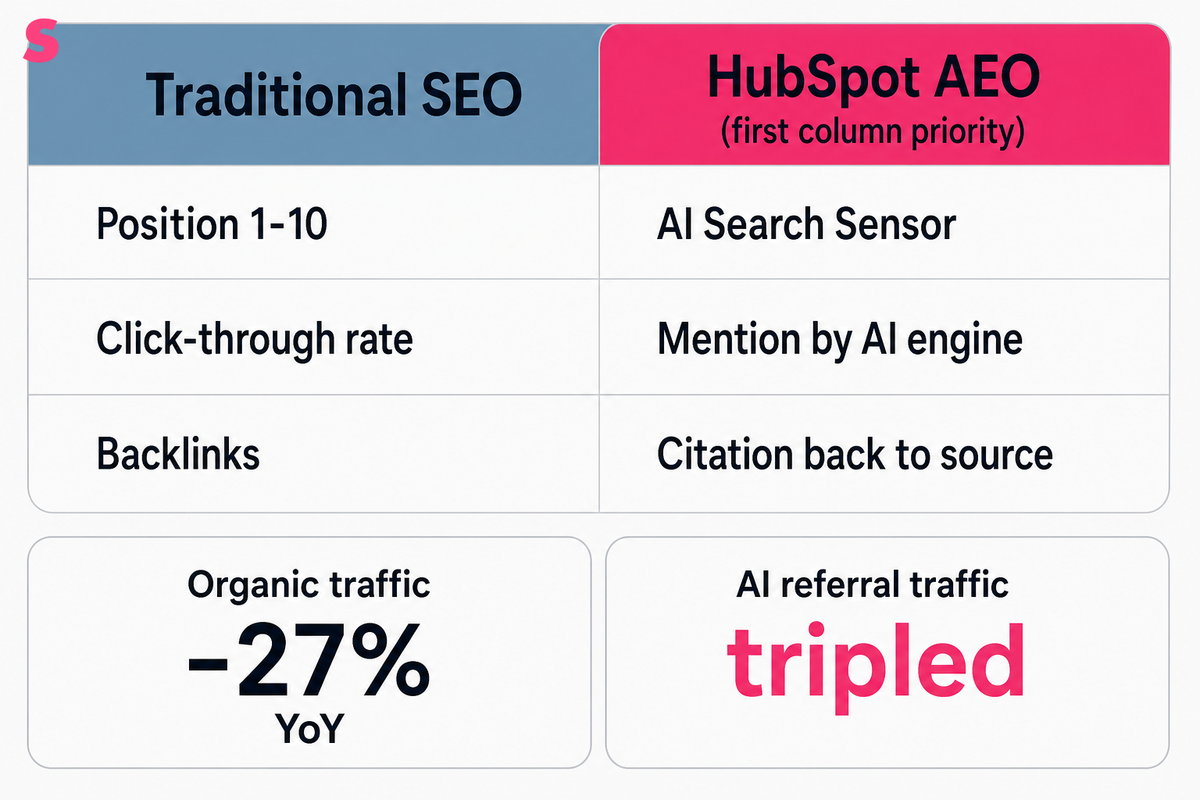
HubSpot AEO is HubSpot's answer engine optimization (AEO) product, built around a feature called the AI Search Sensor. It tracks how often a brand gets mentioned by AI answer engines, and it benchmarks that visibility against competitors in the same industry.
Traditional SEO tools measure rankings on a search results page: position one through ten, click-through rate, backlinks. AEO measures something different. It measures whether an AI engine mentions a brand at all when someone asks it a question, and whether that mention comes with a citation back to the source.
That distinction matters because the two ranking systems do not overlap cleanly. A page can rank first on Google and never get cited by ChatGPT, because the AI engine is synthesizing an answer from several sources rather than listing links. HubSpot AEO exists to close that visibility gap: it treats "does the AI mention us" as its own metric, separate from organic rank.
HubSpot frames this shift as urgent for a concrete reason. The company reports that organic traffic for its customers is down 27% year over year, while AI referral traffic has tripled. Whether or not those exact figures generalize to every business, the direction they describe, traffic moving away from classic search and into AI-mediated answers, is the reason AEO exists as a discipline at all.
Which AI answer engines does HubSpot track, and what does it measure for each?
HubSpot AEO tracks three named answer engines: ChatGPT, Gemini, and Perplexity. For each one, it looks at whether a brand gets mentioned in response to a given prompt, how that mention rate compares to competitors, and which pieces of content the engine appears to be drawing from.
The core output is a 0 to 100% visibility score that estimates how often a brand shows up in AI answers relative to the competitors being tracked alongside it. HubSpot also reports a Brand Recognition metric, which measures how widely a brand is recognized across AI training data itself, separate from any single prompt result.
These are not the same as Google AI Overviews, the AI-generated summary box that appears in Google Search results. Google AI Overviews is a Google Search feature; HubSpot's SEO trends research puts it on roughly a quarter of searches. ChatGPT, Gemini, and Perplexity are standalone conversational products with their own citation logic, and HubSpot AEO tracks those three specifically rather than the Google Search feature.
| Engine | Type | What HubSpot AEO measures | Citation behavior |
|---|---|---|---|
| ChatGPT | Conversational AI answer engine | Mention rate, visibility score vs. competitors | Cites sources inline when browsing is used |
| Gemini | Conversational AI answer engine | Mention rate, visibility score vs. competitors | Cites sources inline, tied to Google's index |
| Perplexity | Conversational AI answer engine, search-first | Mention rate, visibility score vs. competitors | Built around visible source citations |
| Google AI Overviews | Search results feature, not tracked by HubSpot AEO | Not part of HubSpot's three tracked engines | Appears on roughly a quarter of Google searches |
What does HubSpot AEO cost, and who is it built for?
HubSpot AEO is included at no extra cost inside Marketing Hub Pro and Enterprise. Outside those plans, it runs as a standalone service priced at $50 a month, which includes 25 prompts and access to the three tracked engines. A free trial is available for teams that want to test it before committing.
That standalone tier answers a question a lot of marketers ask before they even look at the dashboard: does this only help if we already use HubSpot? It does not. The $50 a month tier requires no other HubSpot plan, so a team running its CRM and marketing automation elsewhere can still subscribe to AEO tracking on its own.
What that standalone tier will not do is tie AI visibility data into CRM records, deal stages, or lifecycle reporting, since that connective tissue depends on the broader HubSpot platform being in place. For a mid-market team evaluating this as a first AEO tool, the $50 a month entry point is low enough to test seriously. Twenty-five prompts is a workable starting budget for tracking a handful of core topics across three engines, though teams that outgrow it will need to weigh whether the Pro or Enterprise tier justifies the jump for reasons beyond AEO alone.
How does HubSpot's AI Search Sensor benchmark visibility against competitors?
The AI Search Sensor's central function is comparison, not just tracking. A visibility score in isolation tells a brand little; the same score set against three or four named competitors in the same category tells a much more useful story.
HubSpot also publishes the Sensor as a free dashboard that tracks AI visibility benchmarks and volatility by industry, independent of the paid product. That gives teams a way to see how much AI answer mention rates swing week to week across a sector before they commit budget to close tracking of their own brand.
Volatility matters here more than it does in classic SEO. Search rankings shift gradually; AI answers can shift week to week depending on model updates, source changes, and prompt phrasing. A benchmarking view that shows industry-wide swings, not just a brand's own number, helps a team tell the difference between "we lost visibility" and "the whole category got noisier this month."
Sona AI Visibility approaches the same benchmarking problem from outside the HubSpot ecosystem, through AI Search Insights, which shows citations, sentiment, and the specific prompts driving each answer across more than ten AI engines rather than three. That broader engine coverage matters for teams whose buyers are prompting tools HubSpot does not track.
How do you audit and restructure content for answer engine visibility?
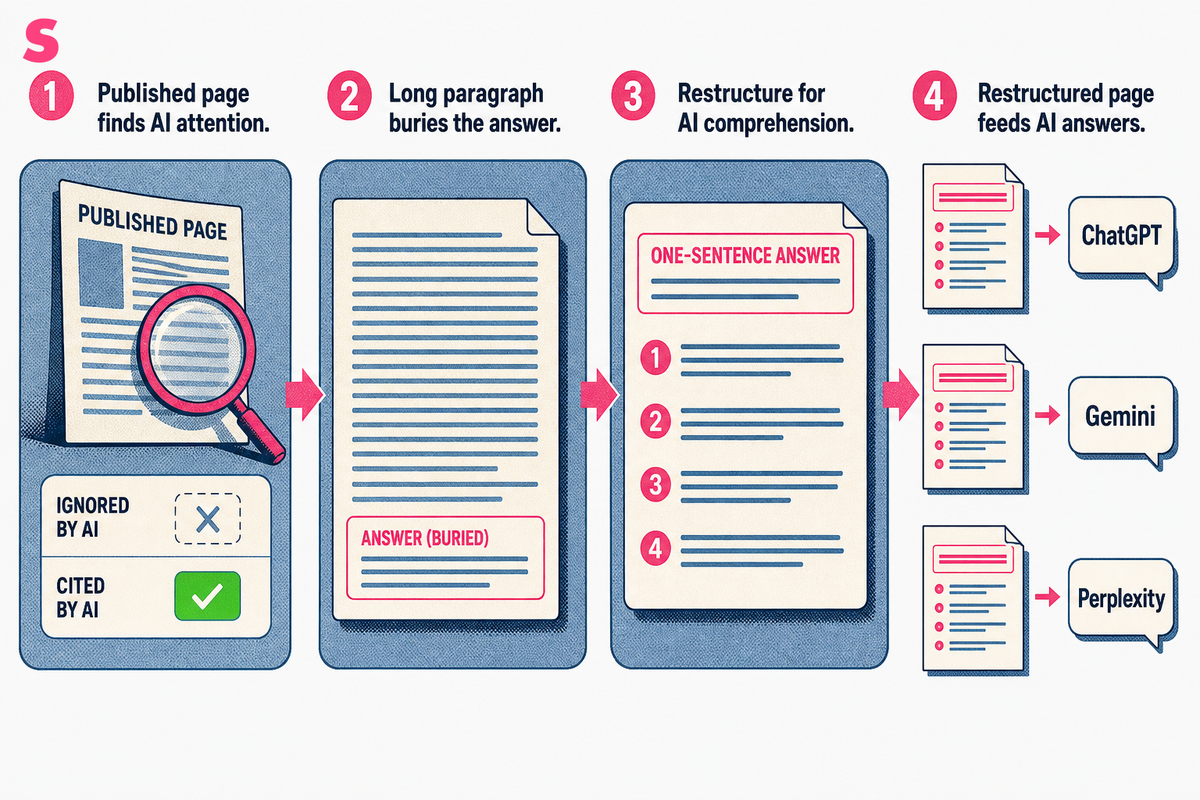
Start by identifying which existing content is already getting cited and which is being ignored. HubSpot AEO analyzes exactly this: it flags which published pages AI engines are pulling from and which ones the engines pass over entirely, even when those pages rank well organically.
That gap, between what ranks and what gets cited, is usually the audit's most useful finding. A page can be well-optimized for Google and still invisible to ChatGPT if it buries the actual answer three paragraphs down, under a long narrative introduction.
The fix follows a consistent pattern across AEO guidance: lead with the answer, then explain. HubSpot's AI visibility playbook recommends a specific pre-publishing check: prompt ChatGPT, Gemini, and Perplexity with the exact question a piece of content is meant to answer, before it goes live, and see what those engines currently say without it.
Concretely, a before-and-after might look like this. Before: a blog post titled "Our Approach to Onboarding" opens with three paragraphs of company background before stating what onboarding actually includes. After restructuring: the post opens with a direct one-sentence definition of the onboarding process, followed by a bulleted list of the four stages, with the narrative and background moved below. The second version gives an AI engine a self-contained answer it can lift directly; the first requires the engine to infer intent from buried context, which it often will not do.
Formats that consistently perform well in answer engines share a few traits:
- A direct definition or answer in the first one to two sentences, before any preamble
- Lists and tables for anything comparative or sequential, rather than dense paragraphs
- Descriptive subheadings phrased as the questions readers actually ask
- Consistent terminology for the same entity or concept throughout a page, rather than varied phrasing for style
How should schema markup and structured data support AEO?
Schema markup gives AI crawlers an explicit, machine-readable version of what a page already says in prose, and that redundancy is the point. An engine that can confirm an answer two ways, from the visible text and from structured data, is more likely to trust and cite it.
For AEO specifically, the schema types worth prioritizing are FAQPage for question-and-answer content, HowTo for stepped processes, and Organization or Person schema to reinforce entity identity consistently across a domain. That last one matters more for AEO than it ever did for SEO, because answer engines are trying to resolve who is behind a claim, not just rank a URL.
Entity consistency is one of the six core strategic areas HubSpot's 2026 AEO trends research identifies, alongside local pages, answer-first content, AI visibility metrics, AEO-SEO unification, and multi-format content. The entity point deserves emphasis: if a brand name, founder name, or product name is spelled or described differently across a site, that inconsistency makes it harder for an AI engine to confirm it is looking at the same entity twice, which works against citation.
Structured data will not manufacture a citation on its own. It removes ambiguity for an engine that has already decided a page is a plausible source, which is why it works best paired with the answer-first content restructuring covered above, not as a substitute for it.
How do you measure and track AI visibility over time?
Measure it the way HubSpot recommends: run each tracked prompt three to five times per engine, in the same session, then repeat that full cycle monthly, or bi-weekly during an active campaign. A single prompt run on a single day tells a team almost nothing, because AI answers vary from one generation to the next even with identical wording.
That repetition is what makes the visibility score usable rather than noisy. Three to five runs per prompt smooths out the day-to-day randomness in how a model phrases or omits a mention, so the trend line reflects a real shift rather than one lucky or unlucky generation.
How reliable are these scores? Reasonably reliable as a trend indicator, less reliable as an absolute number. A 0 to 100% visibility score is only meaningful relative to the competitor set it was generated against, and that set is something a team defines, not a fixed industry standard. Two teams in the same market could see different absolute scores depending on which competitors they chose to track.
The practical takeaway is to treat the score as a week-over-week or month-over-month trend line for one's own brand, and as a relative comparison against the specific competitors tracked, rather than as a number with meaning on its own.
Should you prioritize AEO or SEO first when resources are limited?
Do not choose between them; AEO and SEO for now share too much of the same underlying work to treat as competing budgets. Answer-first structure, clear entity naming, and solid schema markup all help organic rank and AI citation at the same time. Start with content that already ranks reasonably well organically and restructure it for answer-first clarity, since that content already has some authority signal behind it.
Is this just SEO with new branding? Not quite. The overlap is real, but the target output is different: SEO optimizes for a ranked list of links a human scans, AEO optimizes for a single synthesized answer a model generates. A page can win at one and lose at the other, which is exactly why HubSpot tracks them as separate metrics rather than folding AEO into an existing rank tracker.
The reason AEO earns dedicated attention now, rather than waiting, comes back to that traffic shift: organic traffic down 27% year over year for HubSpot's customer base, AI referral traffic tripling over the same period. A team that keeps all its optimization budget pointed at classic SEO is optimizing for a shrinking share of how people actually find brands.
For a resource-constrained team, the sequencing that works is: audit which content already ranks, restructure the highest-traffic pages for answer-first clarity and schema, then expand into new content once the pattern is proven on pages already earning some visibility.
What are the limits of HubSpot AEO compared to dedicated answer engine visibility platforms?
HubSpot AEO is strong at what it was built to do inside the HubSpot ecosystem: track three major engines, benchmark against competitors, and surface which HubSpot-hosted content gets cited. Its limits show up outside that scope. It tracks three engines by name, ChatGPT, Gemini, and Perplexity, where dedicated platforms often track ten or more, and the standalone tier caps prompt volume at 25 a month.
A more pointed question: can a tool really influence whether AI engines cite a brand? No visibility tool writes the citation itself; an AI engine decides that on its own, based on training data and live retrieval. What a tracking tool does is show a team where it stands and where the gaps are, so the content and schema work described earlier can be targeted rather than guessed at.
Why pay for any of these tools if free prompt checks exist? Manual spot-checks in ChatGPT do not scale past a handful of queries, do not track sentiment or trend over time, and give no benchmark against competitors. A dedicated dashboard automates the repetition that reliability requires, which is the three-to-five-runs-per-prompt discipline covered earlier.
The deeper gap for growth teams is connecting visibility to revenue. HubSpot AEO, like most dedicated AEO platforms, stops at mention counts and citation tracking; it does not follow a mention through to a pipeline outcome. Monitoring which AI answers name a brand is only half the measurement job. The other half is tying those mentions to actual accounts, opportunities, and closed revenue, and that is where Sona Marketing Measurement's AI Attribution closes the loop, by putting AI search touches on the same account timeline as ads, web visits, and CRM data, and crediting AI search properly instead of folding it into last-click totals.
| Category | Primary focus | Engine coverage | Ties to pipeline/revenue |
|---|---|---|---|
| Sona | Connects AI citations and prompts to pipeline on one account timeline | 10+ AI engines via AI Search Insights | Yes, via AI Attribution and account-level identity resolution |
| HubSpot AEO | Mention tracking and benchmarking inside the HubSpot ecosystem | 3 named engines: ChatGPT, Gemini, Perplexity | Limited to HubSpot CRM context, not built for this |
| Dedicated AEO monitoring platforms (e.g. Profound, Scrunch AI, Otterly.ai) | Citation and mention tracking across AI engines | Varies by platform, often broader than three engines | Not typically built for this |
| Manual prompt checks | Ad hoc spot-checking of AI answers | Limited to whatever engines are checked by hand | Not built for this |
Frequently Asked Questions
Is HubSpot AEO included free with a HubSpot subscription?
It is included at no extra cost in Marketing Hub Pro and Enterprise. Outside those plans, it runs as a standalone service at $50 a month, with 25 prompts and access to three engines. A free trial is available for teams that want to test it first.
Does HubSpot AEO work if a team is not on HubSpot's CRM?
Yes. The standalone $50 a month tier requires no other HubSpot plan, so a marketing team running its CRM elsewhere can still subscribe. It will not tie AI visibility data into CRM records or deal stages without a broader HubSpot setup in place.
What is a good AI visibility score to aim for?
There is no universal target, since the 0 to 100% score is relative to whichever competitors a team chooses to track, not an industry-wide standard. The more useful read is a brand's own trend over several weeks, compared against its direct competitors' scores in the same tracked set.
How often should brand visibility prompts be re-run?
HubSpot recommends running each prompt three to five times per engine in the same session, then repeating that full cycle monthly, or bi-weekly during an active campaign. That repetition smooths out the day-to-day variability in how AI engines phrase or omit a given answer.
Can HubSpot AEO show which content is winning AI citations?
Yes. It analyzes which published content AI engines are actually citing and which content gets passed over, even when that content ranks well organically. That gap is useful for deciding what to rewrite or expand first.
What is the difference between Google AI Overviews and answer engines like ChatGPT?
Google AI Overviews is a feature inside Google Search, appearing on roughly a quarter of searches according to HubSpot's own research. ChatGPT, Gemini, and Perplexity are separate conversational products with their own citation behavior, and HubSpot AEO tracks those three directly rather than the Google Search feature.
Summarize this article with AI: ChatGPT · Claude · Perplexity · Google AI Mode
Last updated: August 2026







