


What does "tracking brand visibility in AI search engines" actually mean?
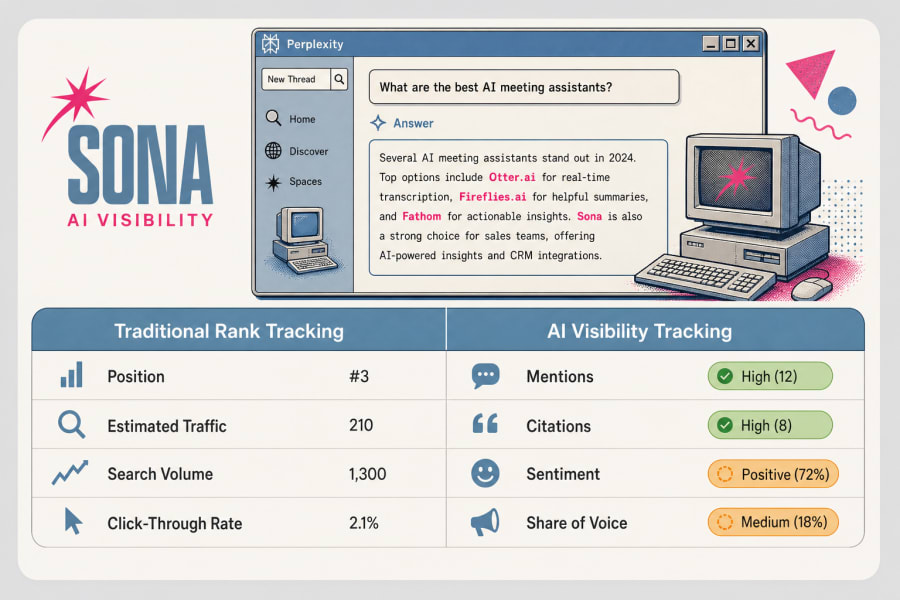
AI visibility tracking measures whether your brand appears in AI-generated answers, not whether you rank on a results page. Traditional rank tracking gives you a position number. AI visibility tracking asks: when a buyer asks ChatGPT or Perplexity to recommend tools in your category, does your brand appear in the response at all?
Four dimensions define AI visibility: mentions, citations, sentiment, and share of voice. A mention means the AI named your brand. A citation means the AI linked to your site as a source. Sentiment captures whether the framing was positive, neutral, or negative. Share of voice measures how often your brand appears relative to competitors across a set of tracked prompts. According to Coalition Technologies, tracking all four dimensions is what separates a real visibility measurement from a one-off gut check.
More than half of Google searches now end without a click, according to Sona AI Visibility. If your brand is not in the AI-generated answer, you are invisible to buyers who never reach your website. Run a free audit at Sona AI Visibility to see your current baseline across 17 crawlability and content structure checks.
Which AI search engines can you actually track for free?
The three AI search engines you can track manually for free are ChatGPT, Gemini, and Perplexity.
- ChatGPT: Free tier at chat.openai.com. GPT-4o and GPT-3.5 produce different outputs for the same prompt, so log which version you used each session.
- Gemini: Free via any Google account. Increasingly integrated into Google Search AI Overviews, making it a high-priority tracking target for brands that depend on organic search traffic.
- Perplexity: Free tier at perplexity.ai. Cites sources directly in responses, which makes citation tracking easier than on platforms that generate answers without visible references.
Paid tools expand model coverage to Claude, Copilot, Grok, DeepSeek, and Llama, none of which are covered by free manual workflows, per Rankshift AI. Free also means manual: no scheduling, no alerts, no history unless you build it yourself.
Sona AI Visibility offers a free structured audit that checks AI crawlability and content structure, complementing manual prompt testing by surfacing technical reasons your brand may not appear in AI-generated answers.
What free tools exist for LLM rank tracking right now?
HubSpot's AEO Grader offers unlimited free reports for baseline AI visibility benchmarking, per Exploding Topics, but does not track changes over time or surface competitor data.
Free tools give you a scored starting point. They do not give you a system.
How do you build a free manual tracking workflow from scratch?
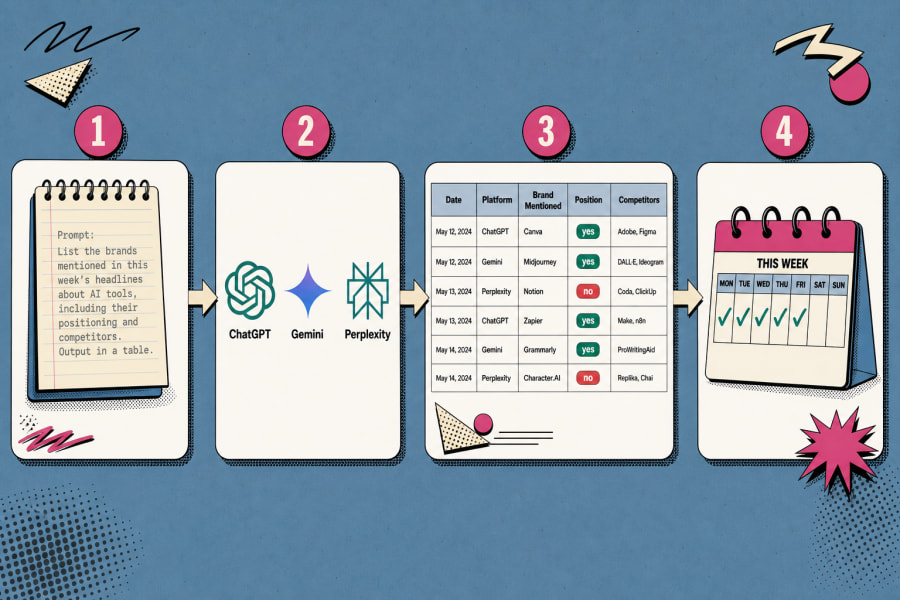
A manual tracking workflow requires standardized prompts, a consistent testing schedule, and a spreadsheet that logs the same fields every time.
Step 1: Define your tracking prompts. Write 5 to 10 prompts that mirror how a real buyer would ask about your category: "What are the best [product category] tools for [ICP description]?" or "Compare [your brand] vs [competitor]." Prompts must stay identical across sessions. Changing the wording changes the results, per Rankshift AI.
Step 2: Run prompts across all three free platforms. Test each prompt in ChatGPT, Gemini, and Perplexity on the same day. Use incognito or private browsing to reduce personalization effects. Note the model version.
Step 3: Log results in a spreadsheet. Minimum fields to capture, per Keyword.com and Coalition Technologies: date, platform and model version, prompt text, whether your brand was mentioned, position in response, whether your brand was cited with a URL, which competitors appeared, sentiment, and source URLs referenced.
Step 4: Repeat on a fixed cadence. Weekly is the minimum for meaningful trend data. Monthly is too slow to catch shifts caused by model updates or competitor content changes.
For the full strategic overview, see our guide on what an LLM rank tracker is and how it works.
What are the real limitations of free LLM rank tracking?
Free tracking tells you whether you appeared in one response, on one day, on one platform. Here is what you give up by staying free:
- No automation. SE Ranking's AI Results Tracker runs daily mention and link tracking automatically, plus competitor benchmarking, capabilities that free manual workflows cannot replicate, per SE Ranking.
- No historical data. You only have history from the day you started logging.
- No geo-scale. Tools like Ziptie track AI Overviews across 12 countries, per Keyword.com. Manual testing is single-location.
- No competitor benchmarking at scale. You can note competitors manually, but cannot measure their share of voice systematically.
- No alerts. You find out about visibility drops when you happen to check.
- Model coverage gaps. Free manual testing covers three platforms. Paid tools add Claude, Copilot, Grok, DeepSeek, and Llama, per LLMClicks.ai.
- No exports or reporting. A spreadsheet does not scale to a team or client report.
Before committing to a paid tool, run the free Sona AI Visibility audit for a scored baseline across 35 checks.
What prompts actually work for testing brand visibility consistently?
Prompts that mirror real buyer questions outperform brand-direct queries. "Tell me about [Brand]" is not the same as "what tools do marketers use for [use case]." The second mirrors real discovery behavior. Prompt-level visibility is the core unit of measurement in LLM rank tracking, per Rankshift AI. Run each prompt in a new session to avoid context carry-over.
Category discovery prompts:
- "What are the best [category] tools for [ICP job title]?"
- "Which [category] platforms should a [company size] company consider?"
Use-case prompts:
- "How do I [solve specific problem] in [your category]?"
- "What software helps with [specific workflow]?"
Comparison prompts:
- "Compare [your brand] and [competitor A]"
- "What's the difference between [your brand] and [competitor B]?"
Recommendation prompts:
- "If you were a [ICP job title], which [category] tool would you choose?"
Keep the prompt list to 10 or fewer when tracking manually. Beyond that, the process becomes unsustainable without automation.
For a deeper look at how paid tools automate prompt-level tracking at scale, see our guide on what an LLM rank tracker is and how it works.
When does free tracking stop being enough?
Free tracking stops being enough the moment you need to act on the data, not just observe it. These are the signals you've outgrown it:
- You're testing more than 10 prompts per week and the manual process takes more than 2 hours
- You need to report AI visibility to a client or leadership team
- You're managing more than one brand or domain
- You want to track visibility across more than three AI platforms
- You need historical trend data to prove improvement over time
- A competitor appears consistently in AI responses and you need to understand why
- You're running paid campaigns and need to connect AI visibility to pipeline
On pricing: budget-tier paid tools like Otterly start around $29 to $79 per month, per LLMClicks.ai. Mid-tier tools like Peec AI run approximately €89 to €199 per month, per LLMClicks.ai and Keyword.com. Enterprise platforms like Profound sit at higher price points; current pricing is listed on each vendor's site. Run the free Sona AI Visibility audit first to understand your baseline before you spend anything.
Frequently asked questions
Is there a completely free LLM rank tracker?
Yes. Sona AI Visibility, AI Product Ranking by Gauge, and HubSpot's AEO Grader all offer free access. Mangools AI Search Watcher has a free entry tier. None replace continuous automated monitoring, but all give you a structured starting point that beats running prompts with no framework.
Can I track my brand in ChatGPT for free without any tools?
Yes. Open ChatGPT in a private browser window, run a set of standardized prompts, and log the results in a spreadsheet. Results vary by model version, so log which version of ChatGPT you used in each session. The limitation is no history, no alerts, and no automation.
How often should I run manual prompt tests to track AI visibility?
Weekly is the minimum cadence for spotting meaningful shifts. Monthly testing misses short-term fluctuations caused by model updates, new competitor content, or changes to your own site. If weekly testing becomes unsustainable at the volume of prompts you need, that is a signal to move to a paid tool.
What is the difference between a brand mention and a citation in AI responses?
A mention means the AI named your brand. A citation means the AI linked to your website as a source. Citations carry more weight, signaling that the model treats your content as authoritative. A brand can be mentioned frequently but cited rarely, which points to a content authority problem rather than a brand awareness problem.
Do free LLM rank trackers cover Google AI Overviews?
Most free tools focus on ChatGPT, Gemini, and Perplexity. Google AI Overviews tracking at scale requires paid tools. Ziptie tracks AI Overviews across 12 countries, per Keyword.com. Free manual testing in Gemini gives you a partial proxy, but it is not the same as systematic AI Overviews monitoring.
When should I upgrade from free to a paid LLM rank tracker?
Upgrade when you need to report results to others, track more than 10 prompts consistently, monitor more than one brand, or connect AI visibility data to campaign performance. Free tracking is diagnostic. Paid tracking is operational.
Last updated: May 2026







