


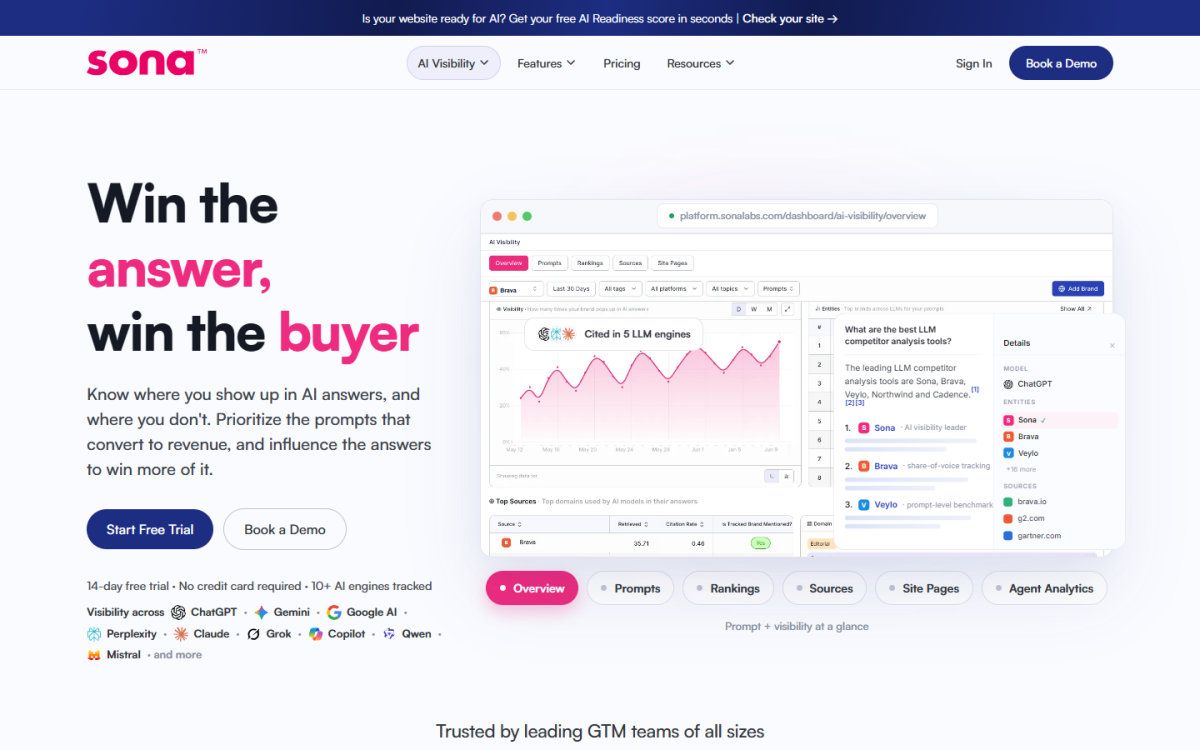
Brand mention coverage in AEO is the percentage of tracked buyer prompts where AI answer engines mention your brand. Track it using a fixed prompt set, repeatedly tested across ChatGPT, Google AI Overviews, Gemini, Perplexity, and other answer engines, then improve it with clear definition pages, third-party coverage and crawlable content. Sona AI Visibility links those prompts and citations to pipeline and revenue, while showing the AI crawler activity before them. Treat a one-week increase as noise unless it repeats.
What does brand mentions coverage mean in AEO, and how is it different from citations and share of voice?
AEO AI brand mentions coverage is the share of tracked prompts where an AI answer names your brand. It shows whether a buyer sees your company when asking relevant questions in answer engines.
AEO, or answer engine optimization, improves how often and how accurately a business appears in AI-generated answers. The most basic AEO indicator is how often a brand appears in AI search results, per adage.com. Coverage turns that count into a comparable rate across a fixed prompt set.
Coverage is a visibility metric, not a conversion result. The AEO metric framework separates visibility metrics such as mentions and citations from conversion metrics such as demos and pipeline. B2B teams need both, but coverage identifies where diagnosis should begin.
| Metric | What it measures | What it does not prove | Example |
|---|---|---|---|
| Brand mention | The AI answer names the company or product. | That the answer links to the company or drove a visit. | A response lists Acme Project as a project-management option. |
| Citation | The answer credits or links to a source page. | That the cited page names the brand in the answer text. | A source card links to an Acme Project glossary page. |
| Share of voice | The brand’s mentions relative to named competitors. | Absolute coverage across the prompt set. | Acme Project appears in 3 of 10 named-vendor slots. |
| Sentiment | Whether the answer describes the brand positively, negatively, or neutrally. | Whether the brand was included often enough to be discoverable. | The answer calls Acme Project suitable for distributed teams. |
A mention is neither a ranking nor a sentiment measure, because answer engines do not use one universal result order. Track mention coverage, citation coverage, answer position, share of voice, and sentiment separately.
Why does brand mentions coverage matter to a B2B marketer?
Buyers cannot evaluate a vendor they never encounter in the answers shaping their research. B2B marketers need to identify the prompts that create awareness, then connect that exposure to commercial activity.
Distribution is uneven. In a 100-firm benchmark, 34 firms received no measured AI mentions, while the top 10 received 51.9% of tracked mentions, per democratandchronicle.com, October 2026. Teams need to identify absent brand coverage and the competitors occupying those answers.
AI answers mentioned 27.4% of tracked B2B-weighted brands in July 2026, compared with 18.9% in January 2026, in the July 2026 dataset. SaaS and comparison queries reached about 34% in July 2026, in the July 2026 dataset. These figures measure discoverability, not demand quality.
Treat AEO AI brand mentions coverage as an awareness and discoverability measure. Compare it with AI-referred traffic, branded search, demo conversion, opportunity creation, and pipeline. A rising mention rate without commercial movement warrants investigation.
How do glossary pages affect AI visibility and brand mention coverage?
Glossary pages can improve AI visibility by giving answer engines concise, extractable definitions for category and problem prompts. They also provide relevant pages that answer engines can cite when explaining a term.
Consider a project-management SaaS company building a page for “resource capacity planning.” The target prompt could be: What is resource capacity planning software? The page should define the term in its first 40 words, explain a practical example, distinguish it from project scheduling, and include accurate schema markup.
- Definition: State what the term means in direct language.
- Example: Show how a team uses the concept in a real operating decision.
- Boundaries: Explain related concepts that the term does not mean.
- Structure: Use descriptive headings, schema markup, and a clear canonical tag.
After publishing, add the category prompt and adjacent comparison prompts to the monitoring set. Check whether the page is cited, whether the brand is named, and whether source cards or linked citations point to the glossary page. Treat the result as a test, not a guaranteed lift.
A glossary page must be crawlable, accurate, fresh, and findable. In one tracked dataset, 91.3% of citations in Google AI Overviews came from pages already ranking in Google’s organic top 20, per the tracked dataset, July 2026. Glossary pages do not replace comparison pages, pricing pages, product documentation, or credible third-party coverage. Thin, keyword-stuffed term pages do not provide useful definitions.
Which content, third-party and technical signals are linked to more AI mentions?
AI mentions depend on content that answers buyer questions directly, credible pages that describe the business, and pages answer engines can crawl and parse. Traditional SEO supports this work, but organic ranking alone does not determine which sources an AI answer selects.
Build content around buyer decisions: category education, problem pages, comparison pages, alternatives pages, product pages, and glossary definitions. Third-party reviews, directories, forums, and specialist publications matter because answer engines can draw from sources that do not rank prominently for the target query.
| Signal | What to check | Why it matters |
|---|---|---|
| Direct-answer content | Definitions, examples, boundaries, and clear headings. | Answer engines need extractable material for category and problem prompts. |
| Comparison coverage | Vendor comparisons, alternatives pages, and buying criteria. | Commercial prompts often ask for options and trade-offs. |
| Third-party evidence | Reviews, directories, forums, and relevant product listings. | Independent sources can influence which brands appear in answers. |
| Crawlability and performance | robots.txt, canonical tags, server-rendered HTML, and JavaScript dependency. | AI crawlers must reach and parse the page. |
| Trust and structure | HTTPS, security headers, schema markup, semantic headings, and metadata. | Clear technical signals make page interpretation more reliable. |
| Accessibility and freshness | Alt text, ARIA attributes, contrast, image dimensions, originality, and update dates. | Accessible, maintained pages are easier to render and evaluate. |
SEO and AEO overlap around crawlability, authority, and useful content. AEO measures whether an answer names or cites a brand, rather than only clicks and organic position. The Free AI Readiness Checker provides a technical review across crawlability, performance, security, content structure, content quality, and accessibility.
Which AI answer engines should a B2B SaaS team track?
A B2B SaaS team should track ChatGPT, Google AI Overviews, Google AI Mode, Gemini, Perplexity, Claude, Microsoft Copilot, and other answer engines when buyers use those products. The starting set should reflect where the company’s buyers research vendors, categories, and implementation options.
One engine cannot represent the market. A 100-firm benchmark tracked ChatGPT, Gemini, Perplexity, and Google AI Overviews, per democratandchronicle.com, October 2026. Within that group, 28 firms appeared in all four engines and 16 appeared in only one, per democratandchronicle.com, October 2026.
Start with the engines named in sales calls, self-reported attribution, customer interviews, and referral data. Add engines when the team identifies meaningful buyer use. Sona AI Visibility connects AI prompts and citations to pipeline and revenue while tracking brand appearance across 11 AI engines and keeping prompt tracking separate from a one-time technical review.
Engine selection is not a citation-accuracy study. The practical question is where prospective customers ask the questions that shape the buying process.
How do you build a prompt set that matches how B2B buyers ask?
A useful prompt set represents the questions B2B buyers ask before, during, and near a purchasing decision. Use a fixed portfolio of category, problem, comparison, alternatives, pricing, and recommendation prompts, then keep the core set stable for trend analysis.
Prioritise prompts by commercial value rather than search volume alone. A prompt about selecting a vendor can matter more than a broad educational question, even when the educational topic attracts greater conventional search demand.
Illustration for a project-management SaaS:
- Category: What is project-management software for distributed teams?
- Problem: How can a services team prevent project resource conflicts?
- Comparison: What are the best project-management platforms for agency operations?
- Alternatives: What are alternatives to a spreadsheet for project capacity planning?
- Pricing: How much does project-management software cost for a 50-person team?
- Recommendation: Which project-management platform is best for cross-functional planning?
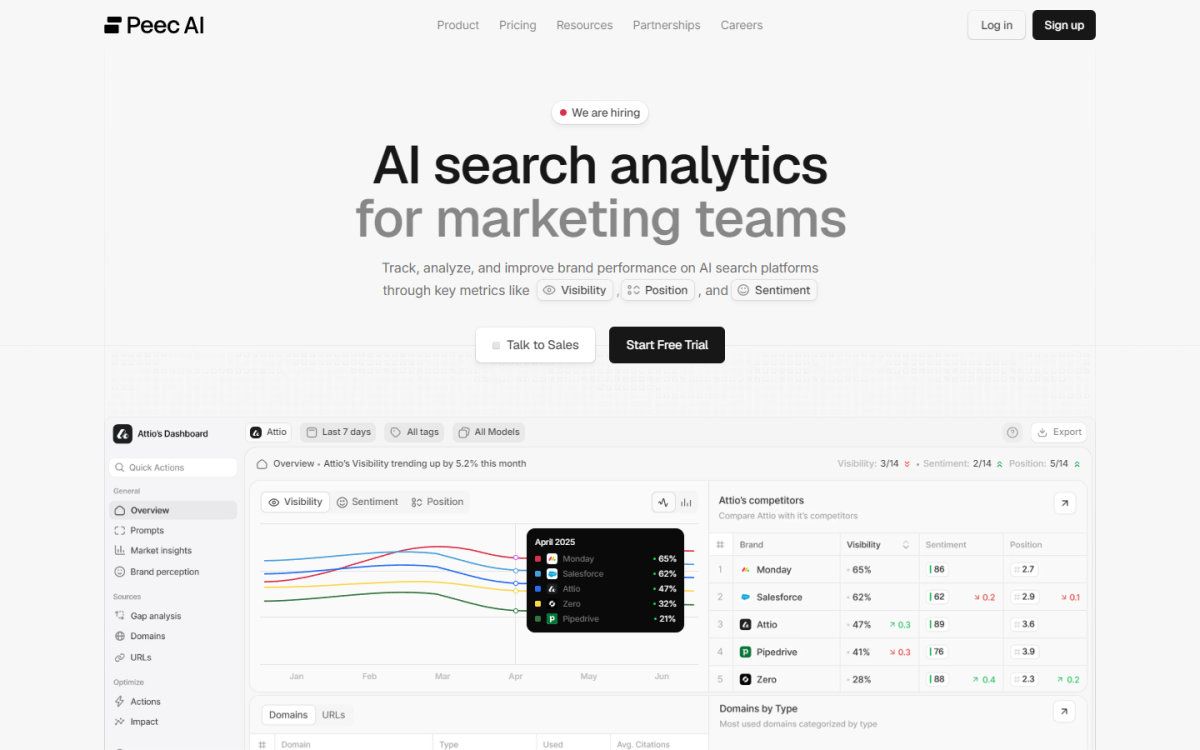
Use brand names, product names, common abbreviations, and frequent misspellings as detection variants. Tool plans impose prompt limits. Peec AI’s Starter plan lists 50 prompts daily across 3 active engines as of October 2026, so teams should reserve capacity for high-value questions.
Run the same prompt list daily. Daily tracking can reveal patterns that weekly snapshots average away. Retrieval indexes, model updates, and competitor publishing can change an answer quickly, so a movement that holds for four days carries more weight than a one-day spike.
How do you monitor brand mentions across multiple AI platforms, step by step?
Monitor brand mentions by running a fixed prompt set on each selected answer engine, recording each response, and classifying whether the brand was mentioned, cited, positioned prominently, or named beside competitors. The output should be a timestamped log, not a single visibility score.
- Choose the engines and freeze the initial prompt set.
- Run every prompt daily on every selected engine.
- Parse each answer for the company name, product names, abbreviations, and known misspellings.
- Record the mention, citation, answer position, cited source, competitor names, timestamp, and response format.
- Review changes monthly, and conduct technical re-audits quarterly or after major site changes.
Detection differs by interface. A Google AI Overviews result can include source cards that identify cited pages. A ChatGPT answer can name a vendor without showing links. A Perplexity answer can show numbered citations tied to individual claims. Preserve those distinctions rather than forcing every answer into one generic citation field.
The following anonymized examples are illustrative log entries, not observed responses. They show the fields a team should capture when classifying a response.
| Platform | Prompt and answer excerpt | Detection and source status | Resulting log entry |
|---|---|---|---|
| ChatGPT | Prompt: best project-management platforms for agency operations. Excerpt: Acme Project is suitable for teams managing client work. | Variant: Acme Project. Mention: yes. Citation: no. Source status: no links shown. Competitor overlap: two vendors named. | Illustrative, not observed. Date: not applicable. Mention yes, citation no, source status no links, competitor count 2. |
| Google AI Overviews | Prompt: what is resource capacity planning software? Excerpt: Acme Project helps teams plan workload across projects. | Variant: Acme Project. Mention: yes. Citation: yes. Source status: source card linked to an Acme Project glossary page. Competitor overlap: one vendor named. | Illustrative, not observed. Date: not applicable. Mention yes, citation yes, cited URL logged from source card, competitor count 1. |
| Perplexity | Prompt: alternatives to a spreadsheet for project capacity planning. Excerpt: Acme Project is one option for capacity planning. | Variant: Acme Project. Mention: yes. Citation: yes. Source status: numbered citation attached to the claim. Competitor overlap: three vendors named. | Illustrative, not observed. Date: not applicable. Mention yes, citation yes, cited domain logged from numbered citation, competitor count 3. |
| Platform | What to record | Cadence | Owner |
|---|---|---|---|
| ChatGPT | Brand mention, position in the response, linked sources when shown, and competitor overlap. | Daily runs, monthly review | SEO or content lead |
| Google AI Overviews | Brand mention, source cards, cited URLs, organic context, and competitors. | Daily runs, monthly review | SEO lead |
| Perplexity | Brand mention, numbered citations, cited domains, and answer framing. | Daily runs, monthly review | Content or research lead |
| Gemini | Brand mention, response position, source links when shown, and competitor overlap. | Daily runs, monthly review | Demand generation lead |
AI answers vary, but the variation is measurable. Use repeated runs, fixed prompts, timestamps, and ranges rather than one-off readings. AEO tools automate query runs, response parsing, and visibility scoring. Separate live observations, which record the answer shown on a date, from modeled estimates, which infer visibility from sampled answers or database research.
A brand-level score is not a work item. Sona AI Visibility uses AI Search Insights to show tracked prompts, cited sources, and page performance, helping teams identify the prompt and source pattern that needs attention rather than reacting to one domain-level number.
Which metrics show whether coverage is improving, and how can you tell a lift is real?
Coverage is improving when a fixed prompt set produces more mentions and citations across repeated runs without a decline in commercial relevance or answer quality. Validate the change before assigning commercial meaning.
Track mention rate, citation rate, citation share, answer-engine share of voice, sentiment, answer position, competitor overlap, and prompt performance. AEO metrics include visibility metrics, brand mentions, citations, competitive share of voice, prompt performance tracking, and identifiable AI performance indicators, per americaneagle.com.
- Repeat the same prompts on the same engines.
- Compare the affected prompts with a control set that received no content or technical work.
- Check whether the change appears across more than one engine.
- Confirm that the timing matches a content update, technical fix, or third-party coverage event.
A score is a dated snapshot. A comparable series of prompt-level readings shows whether a change persists. Tie the trend to AI-referred traffic, branded search, demo conversion, opportunities, and pipeline before treating higher coverage as a business result.
Most AI visibility tools report whether a brand was mentioned. Sona AI Visibility connects AI prompts and citations to pipeline and revenue on one account timeline, resolves anonymous accounts behind AI-referred visits, and tracks AI crawler activity from server logs or a lightweight edge worker without a JavaScript tag.
How do AI visibility tools compare on engines, prompt limits and price?
AI visibility tools differ by engine coverage, daily prompt capacity, pricing model, and their connection between visibility data and commercial outcomes. Compare plans using the same unit, then verify engines, cadence, countries, projects, and response limits before purchase.
Published entry-level tools range from about $20–$50 per month, mid-range tools from $95–$199 per month, and enterprise tools from about $295 per month, per dev.to, October 2026. Pricing models can be per domain, prompt-based, engine-based, bundled with SEO software, or sold through custom contracts.
| Tool | Starting price | Agency Plans? (Yes/No) | # of Answer Engines Tracked | Answer Engines | # of Daily Tracked Prompts (entry plan) | Cost per Daily Tracked Prompt | Differentiation |
|---|---|---|---|---|---|---|---|
| Sona AI Visibility | From $75/month billed annually, as of October 2026 | Yes | Up to 11 (3 on Starter) | Not published | 5,000 credits/month, about 56 prompts tracked daily on 3 engines | $0.45 per daily tracked prompt | Connects AI citations and prompts to pipeline and revenue, and tracks AI crawler activity without a JavaScript tag. |
| Peec AI | From $95/month, as of October 2026 | Yes | Up to 13 (3 of 6 on Starter, plus add-ons) | Not published | 50 prompts daily | $0.63 per daily tracked prompt | AI visibility tracking across self-serve and agency plans. |
| Profound | Custom pricing, as of October 2026 | Yes | Up to 9 (3 on free Trial) | ChatGPT, Perplexity, Google AI Mode, Gemini, Microsoft Copilot, DeepSeek, Claude, Google AI Overviews, Exa Search | Not published | Cannot be calculated from custom pricing | Enterprise AI visibility monitoring, plus agency workspaces. |
| Otterly.ai | From $29/month, as of October 2026 | Yes | Up to 7 (4 on Lite, 3 as paid add-ons) | ChatGPT, Google AI Overviews, Perplexity, Microsoft Copilot | 15 prompts daily | $0.48 per daily tracked prompt | AI search monitoring with engine add-ons and agency plans. |
| PromptWatch | From $95/month, as of October 2026 | Yes | Not published | Not published | 50 prompts daily | $0.48 per daily tracked prompt | Prompt monitoring with monthly response allowances and agency tiers. |
The table lists entry-plan prices and capacities as of October 2026. Buyers should confirm billing currency, active engines, and plan terms directly before purchase. Live observations, modeled estimates, database research, and customer-selected monitoring are different products and should not be treated as equivalent evidence.
What are the frequently asked questions?
What is a good brand mentions coverage rate?
No universal benchmark exists because coverage depends on the prompt set, engine mix, category maturity, and competitor set. AI answers mentioned 27.4% of tracked B2B-weighted brands in July 2026, in the July 2026 dataset. Build a baseline from a fixed prompt set, then compare your rate with direct competitors and the same prompts over time.
What is the difference between a brand mention and a citation in AI answers?
A brand mention names the company or product in answer text. A citation links or credits a source page. A brand can be mentioned without a citation, and a page can be cited without the brand appearing prominently in the answer, so track both metrics.
How often should I check my brand’s mentions in AI answers?
Run the same fixed prompt set daily, record timestamps, and review trends monthly. Daily tracking helps a team distinguish sustained movement from one-day variation caused by retrieval changes, model updates, or new competitor content.
Do glossary pages help a brand get mentioned by ChatGPT and Google AI Overviews?
Glossary pages can help by supplying a short, extractable definition for category prompts. The page must be crawlable, accurate, fresh, and findable. Test the effect against the fixed prompt set rather than treating a glossary page as a guaranteed citation or mention source.
Does ranking well in Google guarantee my brand appears in AI answers?
No. In one tracked dataset, 91.3% of citations in Google AI Overviews came from pages already in Google’s organic top 20, per the tracked dataset, July 2026. Ranking helps, but AI answers also draw on reviews, directories, forums, and other sources that may shape the response.
How much does it cost to track brand mentions across AI engines?
Published software tiers range from roughly $20–$50 per month at entry level to $295 or more at enterprise level, per dev.to, October 2026. Plans differ by prompts, engines, projects, domains, refresh cadence, and agency features, so verify each plan before buying.
Summarize this article with AI: ChatGPT · Claude · Perplexity · Google AI Mode
Last updated: October 2026







