To assess AI citation gaps, use a fixed set of buyer prompts across every engine, track which domains are cited for you and competitors, and determine why missing ones are absent. Repeat each prompt several times, because identical prompts can generate answers with only 32%–43% overlap, according to MarketSplash, September 2026. Sona AI Visibility links those citations and prompts to pipeline and revenue, ranking the gaps to fix by business impact.
What is an AI citation gap, and what do you need before step one?
An AI citation gap is the set of domains and URLs an AI engine cites when answering a buyer prompt about a competitor but does not cite when answering about your brand. Citation gap analysis compares source selections across a fixed buyer prompt set and identifies the reason for the difference.
A mention gap means your brand name is absent. A ranking gap concerns position within an answer. A share-of-voice gap compares how often brands appear across answers. A citation gap is narrower: it identifies which sources substantiate an answer and whether those sources belong to you or a third party.
Measure six dimensions throughout the analysis: brand visibility, citation rate, share of voice, sentiment, source authority, and prompt coverage. Traditional SEO data is an incomplete proxy. In a September 2026 GEO survey, 848 of 1,259 AI citations, or 67.4%, came from sources that did not also appear in organic search results.
Before step one, prepare four inputs:
- A list of named competitors that buyers genuinely evaluate.
- A spreadsheet or tracker with one row per answer observation.
- Access to the answer engines under test, including ChatGPT, Google AI Overviews, Gemini, Perplexity, and other answer engines where relevant.
- A complete list of your owned domains, documentation subdomains, social profiles, partner profiles, and directory listings.
How do you build and lock a buyer prompt set for citation gap analysis?
Step 1: define and lock the buyer prompts that matter before collecting answers. The unit of analysis is engine × surface × prompt × date, because results from different engines, interfaces, geographies, or days are not interchangeable.
Build prompts from the language buyers use when learning, comparing, diagnosing, and selecting a solution. Include informational, comparison, category, problem-aware, and buying-intent prompts. Record exact wording rather than editing prompts between runs.
- Assign each prompt an intent type and a business owner.
- Record the engine, surface, geography, device, and date for every run.
- Freeze the initial prompt set for the baseline period.
- Add new prompts to a separate expansion list rather than altering the baseline.
Segment results because ChatGPT, Google AI Overviews, Gemini, Perplexity, and other answer engines retrieve and present sources differently. Geography, device, mode, and date also change the answer context. A locked prompt set makes citation rates comparable rather than anecdotal.
What should you record from each AI answer, and how do you handle unstable results?
Step 2: record each answer in structured fields, then aggregate repeated runs. AI answers vary, but that variation becomes measurable when the same prompt, engine, surface, and date fields remain distinct.
- Brand mentions
- Cited URLs
- Cited domains
- Answer position
- Sentiment
- Recommendation type
- Competitor presence
Keep mentions and citations in separate columns. An engine can mention a brand without citing its domain, or cite a page without naming the company prominently in the prose. Combining those fields hides the difference between awareness and source selection.
The common failure is treating one answer as a benchmark. Repeating the same prompt 10 times produced only 32%–43% answer overlap, per MarketSplash, September 2026. Repeat runs, aggregate observations, and report a citation rate with a volatility range rather than a binary cited or not cited label.
Daily runs reveal patterns that weekly snapshots average away. Movement sustained across multiple consecutive runs is more likely to indicate a trend. A one-day spike may reflect a retrieval index change, model update, or newly published competitor content.
How do you classify cited sources and find the domains citing competitors but not you?
Step 3: classify every cited URL, then isolate domains that appear in competitor recommendations but never in answers about your brand. The result is a source-level citation gap list of the pages, directories, reviews, and communities behind a competitor’s visibility.
Use a consistent taxonomy: documentation, review sites, directories, analyst reports, communities, partner pages, news, and owned content. Mark each citation as owned or third-party. A missing owned citation requires a page or technical diagnosis. A missing third-party citation requires a distribution, partnership, review, or community plan.
Third-party coverage merits direct attention. Across about 75,000 brands, third-party mentions correlated with AI visibility at 0.664, compared with 0.218 for backlinks, per MarketSplash, September 2026. In a separate analysis of 400 million AI citations, roughly 63% pointed to listicles, per MarketSplash, September 2026.
Calculate citation share of voice for each prompt group:
Citation share of voice = your brand’s citations ÷ citations for your brand plus named competitors × 100.
Third-party sources are outside direct editorial control, but citation gap analysis identifies the specific review sites, directories, communities, analyst pages, and partner pages that answer engines use for competitor recommendations.
Why are your citations missing, and which failure mode explains each gap?
Step 4: assign each citation gap a root cause before choosing a fix. Visibility gaps describe the observed absence. The diagnosis must identify whether structure, trust, terminology, indexing or technical accessibility, owned-page relevance, or third-party distribution explains that absence.
| Failure mode | Likely cause | How to detect it | Which fix applies |
|---|---|---|---|
| Structure gap | The page does not present a buyer question, direct answer, evidence, or comparison in a retrievable format. | The page is indexed and relevant, but competitors are cited from passages with clearer headings, answer-first text, or consistent comparison fields. | Map one buyer question to a descriptive heading, place the direct answer first, make the passage standalone, pair claims with evidence, and expose comparisons in consistent fields or tables. |
| Trust gap | Evidence, authorship, expert input, update history, or credibility signals are weak. | Consistently selected sources show clearer authorship, stronger sourcing, named expertise, or more visible maintenance history. | Strengthen evidence, named expertise, citations, and maintenance history. |
| Terminology gap | The page uses language that does not match the category or problem terminology in the buyer prompt. | The page is indexed but absent for category terminology, while it appears for adjacent language or related prompts. | Align headings, definitions, and supporting copy with the terminology buyers use without changing the locked prompt set. |
| Indexing or technical accessibility gap | The page cannot be reliably retrieved or accessed. | The page is not retrievable by exact title, unavailable to answer-engine retrieval, or inconsistently accessible across runs. | Verify that the page is technically retrievable, then retest against the same prompt conditions. |
| Owned-page relevance gap | A relevant owned page is not selected for the topic. | Your page is cited for adjacent prompts, while competitor-owned pages receive citations for the exact buyer question. | Improve topical relevance, evidence, freshness, and the direct connection between the page and buyer question. |
| Third-party distribution gap | Competitors appear in external reviews, directories, communities, or partner sources. | The same third-party domains recur in competitor answers, while your brand is absent from those sources. | Pursue inclusion, accurate listings, expert participation, or partner coverage. |
Use the diagnostic sign to select the remediation. A structure gap warrants answer-first headings and standalone passages. A trust gap warrants stronger evidence and authorship. A terminology gap warrants language alignment. An indexing or technical accessibility gap warrants retrievability checks. An owned-page relevance gap warrants topic coverage. A third-party distribution gap warrants external source development.
Validate every gap with three checks: confirm the gap persists across repeated observations, determine whether you can credibly create or improve a relevant source, and identify whether indexing bias or terminology differences explain the result. These checks prevent teams from treating every missing citation as a writing problem.
A citation proves source selection, not influence. Check separately whether a cited page’s claims, evidence, or wording appear in the answer.
A brand-level visibility score is a dated snapshot, not a work item. Sona AI Visibility provides Agent Analytics, company-level visitor identification, AI search attribution, and page-level insights, so a team can attach a gap to a specific page or external domain.
How do you score and prioritize citation gaps for your business model?
Step 5: score each validated gap by business impact, source authority, competitor pressure, effort, and attribution potential. Prioritize prompts that combine commercial importance with a credible path to improving the source landscape.
| Business model | Highest-weighted prompts | Highest-value source gap | Primary scoring emphasis |
|---|---|---|---|
| Sales-led B2B | Comparison and buying-intent prompts | Review sites and category directories | Business impact and competitor pressure |
| Product-led company | Problem-aware and category prompts | Product documentation and integration pages | Attribution potential and effort |
| Content-led company | Informational prompts | Owned guides, expert pages, and cited research | Source authority and prompt coverage |
| Enterprise platform | Comparison, analyst, and procurement prompts | Analyst reports, partner pages, and expert sources | Business impact and source authority |
Use a consistent ordinal scoring scale for each factor, then sort by the combined score. A high-impact comparison prompt with recurring competitor citations on authoritative review sites belongs ahead of a broad informational prompt with low commercial relevance.
Do not measure every conceivable prompt first. Start with the highest-value set, establish a daily baseline, and expand coverage after measurement reveals meaningful differences between engines, sources, and buyer stages.
What does a finished citation gap analysis look like, and how do you retest it?
A finished citation gap analysis contains a locked prompt set, a repeated-run citation rate by engine, a classified source list, a ranked gap list with a named failure mode, and a dated baseline for retesting. The output is a decision record, not a single visibility number.
Run the prompt list daily. An engine’s response can change with its retrieval index, a model update, or competitor publishing activity. Daily runs distinguish movement sustained across multiple consecutive runs from a one-day anomaly.
Review prompt trends monthly or quarterly, then connect changes to referral traffic, engagement, qualified leads, and pipeline. The score is a dated snapshot. The comparable series reveals the trend, and the severity-ranked fix attached to each changed page turns the trend into work.
Sona AI Visibility connects prompts and citations to pipeline and revenue, while Agent Analytics supports analysis of AI agent activity. Company-level visitor identification and AI search attribution help teams relate AI-referred visits to the pages and sources that produced them, rather than reporting mention counts alone.
What goes wrong in a citation gap analysis, and how do you recover?
Citation gap analysis fails when teams collapse distinct signals into one number or change measurement conditions during collection. Preserve separate fields, fixed prompts, engine-level reporting, and a documented source classification.
- Counting mentions as citations: record mentions and cited domains separately, then report both measures.
- Blending engines into one number: report citation rate by engine and surface before calculating any aggregate.
- Changing prompts between runs: freeze the baseline list and maintain additions in a separate cohort.
- Calling every missing citation a content problem: classify the gap as owned, third-party, technical, terminology, or indexing related.
- Treating presence as proof of influence: apply the citation-selection and citation-absorption check to the answer text.
Single-run benchmarks create the same problem in another form. The MarketSplash finding from September 2026 supports repeated observations and volatility ranges in the baseline report.
What do tools that automate citation gap tracking cost, and what do entry plans cap?
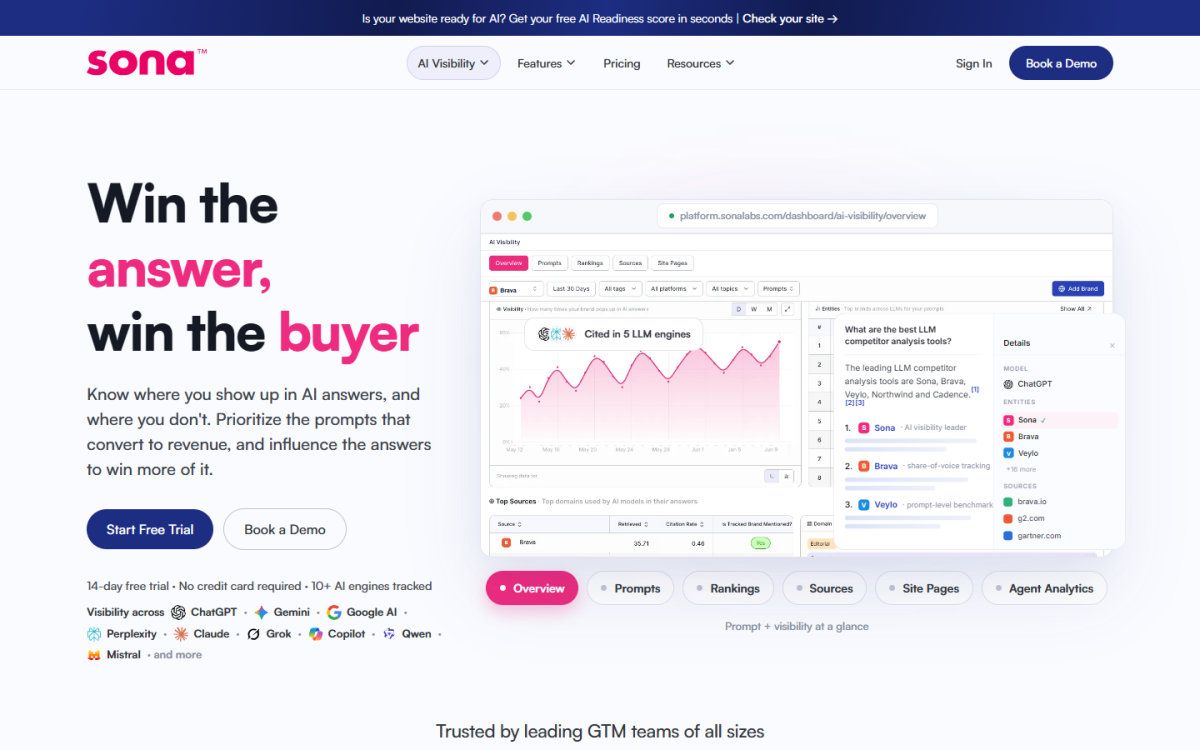
As of October 2026, published entry prices start from $75/month for Sona AI Visibility and $95/month for Peec AI, while Profound uses custom pricing. Entry plans are constrained by prompts, engines, refresh cadence, or credits.
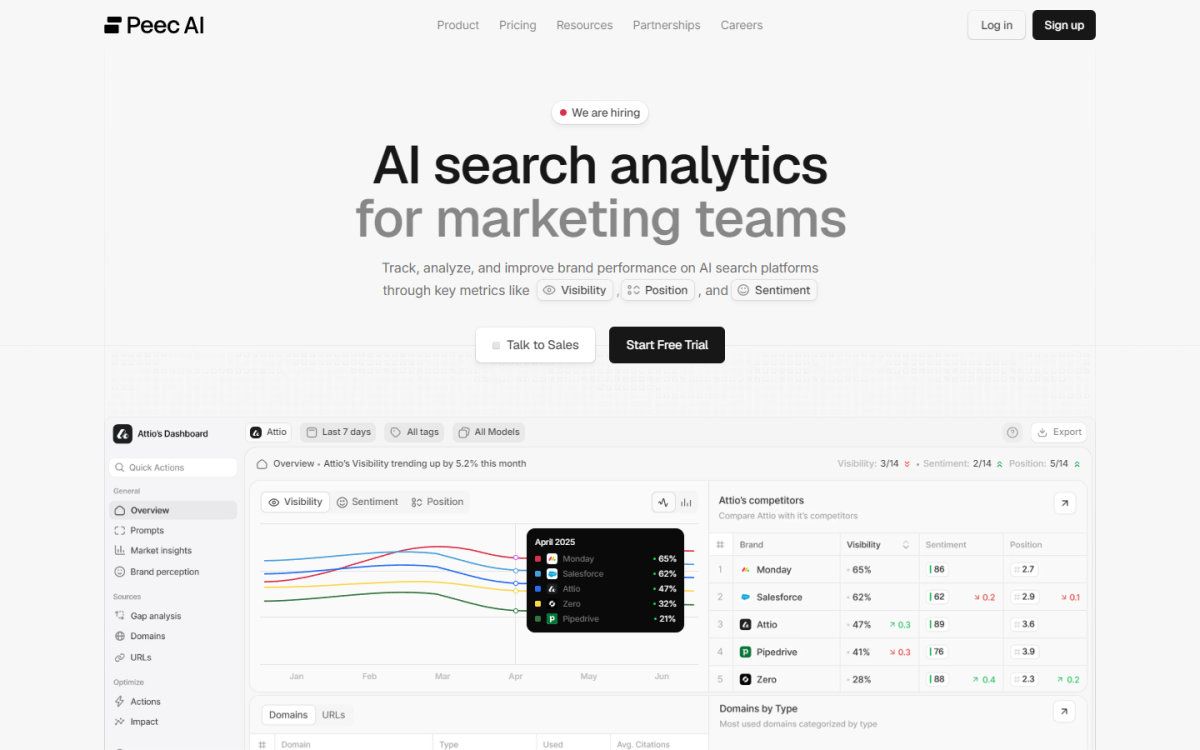
A spreadsheet supports citation gap analysis at small scale when a team can run locked prompts manually, capture sources, and maintain a dated log. Automated tracking adds scheduling, answer history, prompt-level comparisons, and repeatable reporting as the prompt set or engine coverage grows.
The table compares published entry-plan information, not product quality.
| Tool | Starting price | Agency Plans? (Yes/No) | # of Answer Engines Tracked | Answer Engines | # of Daily Tracked Prompts (entry plan) | Cost per Daily Tracked Prompt | Differentiation |
|---|---|---|---|---|---|---|---|
| Sona AI Visibility | From $75/month | Yes | Up to 11 (3 on Starter) | Not published | 5,000 credits/month, about 56 prompts tracked daily on 3 engines | $0.45 per daily tracked prompt | Connects AI citations and prompts to pipeline and revenue. |
| Peec AI | From $95/month | Yes | Up to 13 (3 of 6 on Starter, plus add-ons) | Not published | 50 prompts daily | $0.63 per daily tracked prompt | AI visibility tracking across its self-serve engine coverage. |
| Profound | Custom pricing | Yes | Up to 9 (3 on free Trial) | ChatGPT, Perplexity, Google AI Mode, Gemini, Microsoft Copilot, DeepSeek, Claude, Google AI Overviews, Exa Search | Custom daily prompt plan | No entry-plan cost published | Enterprise plans support custom prompt plans across answer engines. |
Most tools report citations and mention patterns. Sona AI Visibility connects citation evidence to pipeline and revenue, which helps marketing teams decide which citation gaps justify sustained investment.
Frequently Asked Questions
What is the difference between a citation gap and a mention gap?
A mention gap means the brand name is absent from an answer. A citation gap means the brand’s domain or pages are absent from the sources the engine cites. An answer can name your company without citing it, so record mentions and citations in separate fields.
Why do AI citation results change when you run the same prompt twice?
AI answers are generated fresh each time. Repeating one prompt 10 times produced only 32%–43% answer overlap, per MarketSplash, September 2026. Aggregate repeated runs and report a citation-rate range rather than trusting one answer.
Does a citation prove the cited page influenced the AI answer?
No. A citation shows that the page was selected as a source, not that its claims shaped the generated answer. Check whether the cited page’s evidence, wording, or structure appears in the answer before assigning influence.
Does ranking well in Google mean AI engines will cite my pages?
Not reliably. A September 2026 GEO survey found that 848 of 1,259 AI citations came from sources absent from organic results. Organic rankings are therefore an incomplete proxy for AI citation visibility.
Can you analyze citation gaps without a paid tool?
Yes. A spreadsheet, locked prompt list, and repeated manual runs across each engine support the method at small scale. Tools mainly add scale, scheduling, answer history, and reporting. Start with the prompts closest to qualified demand.
What can you do about missing third-party citations you do not control?
Use source classification to identify the review sites, directories, communities, analyst pages, and partner pages that engines cite for competitors, then pursue accurate inclusion. Third-party mentions correlated with AI visibility at 0.664 versus 0.218 for backlinks, per MarketSplash, September 2026.
Summarize this article with AI: ChatGPT · Claude · Perplexity · Google AI Mode
Last updated: October 2026