AI visibility ROI is the monetary return from appearing in AI-generated answers, measured by linking prompt coverage and citations with branded demand, sign-ups and pipeline. Visibility alone is not ROI, so report it as a leading indicator alongside referral sessions, self-reported discovery and CRM influence. Establish a prompt panel, sample it repeatedly, and compare it with a baseline period. Sona AI Visibility links prompts and citations to pipeline and revenue, while tracking AI crawler and agent activity at the start of that path.
What is AI visibility ROI, and how is it different from mentions, citations and share of voice?
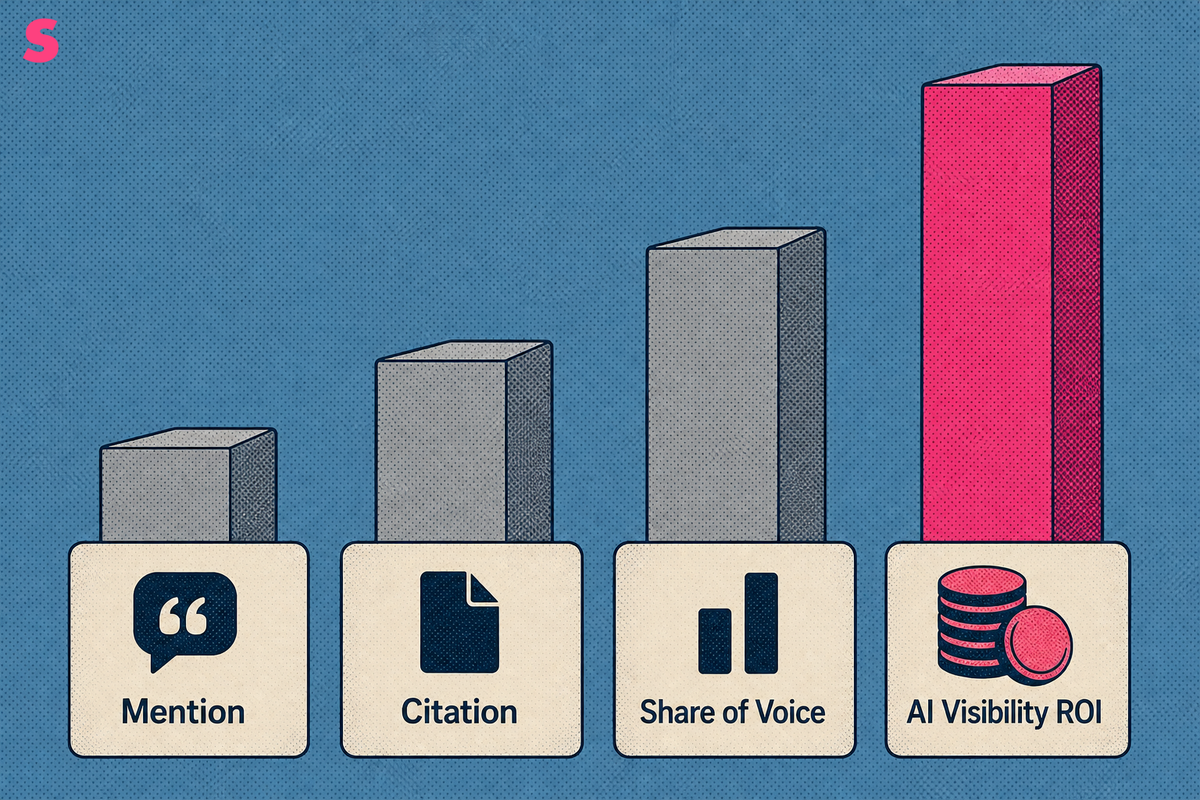
AI visibility ROI is the financial return generated when a brand appears in AI-generated answers. It measures whether that presence creates commercial outcomes, not merely whether the brand appears.
Mentions, citations and share of voice belong to the visibility layer. A mention records that an answer names a brand. A citation records that an answer references a brand or its content. Share of voice compares a brand’s presence with competitors across a defined prompt set. None of those metrics proves that a buyer signed up, created pipeline or became revenue.
A B2B SaaS company can appear in a comparison answer for a commercial prompt, receive an AI-referred visit, see a later branded search and then create a CRM opportunity. The visibility event is the first signal. The commercial outcome is the return.
AI visibility ROI is not an impressions metric, traffic metric or ranking report. Those measures can explain reach or engagement, but financial return requires evidence that the brand’s presence influenced a buyer journey.
Why can't AI visibility be reported to leadership as a standalone metric?
AI visibility should not be reported to leadership as a standalone metric because leadership needs commercial impact. A rising mention count is a leading indicator, not a budget justification.
A marketing leader needs to answer three practical questions: which buyer questions produced visibility, whether those answers generated qualified attention, and whether that attention influenced pipeline. Reporting only citations leaves the commercial outcome unresolved.
Use visibility as an operating metric. Track whether priority prompts surface the brand, whether the answer is accurate and whether the cited page matches buyer intent. Then connect those observations with referral sessions, branded demand and CRM outcomes.
- Activity: pages published, prompts added and answers checked.
- Leading indicators: prompt visibility, citation share, answer accuracy and sentiment.
- Business outcomes: sign-ups, opportunity influence, pipeline and closed-won revenue.
The executive report should begin with outcomes, then use visibility metrics to explain movement. That framing turns AI visibility into a channel hypothesis that marketing and revenue teams can test.
Which four layers of metrics connect AI visibility to revenue?
A useful measurement model connects four layers: visibility, engagement signals, branded search lift and revenue attribution. Each layer answers a different question, and the chain is incomplete when any layer is missing.
- Visibility: Track prompt coverage, citation share, answer position, answer accuracy and sentiment across the prompt panel.
- Engagement signals: Review AI-referred sessions, landing-page engagement, demo starts and repeat visits.
- Branded search lift: Compare branded search demand and direct visits after visibility improves for priority prompts.
- Revenue attribution: Connect identified accounts, opportunity creation, pipeline stages and closed-won revenue to the journey.
Vanity counts stop at the first layer. A brand can have strong visibility on informational prompts that never reach buying teams. A lower citation rate on commercial comparison prompts can matter more when it creates qualified account activity.
Sona AI Visibility provides page-level insights, Agent Analytics, company-level visitor identification and AI search attribution. Revenue teams can use those capabilities to investigate the path from prompt coverage to account activity.
Score quality beside quantity. An answer that names the brand but misstates positioning, pricing or capability should not receive the same credit as an accurate, favorable answer that sends a buyer to a relevant page.
How do you set a baseline and a fixed prompt panel before measuring anything?
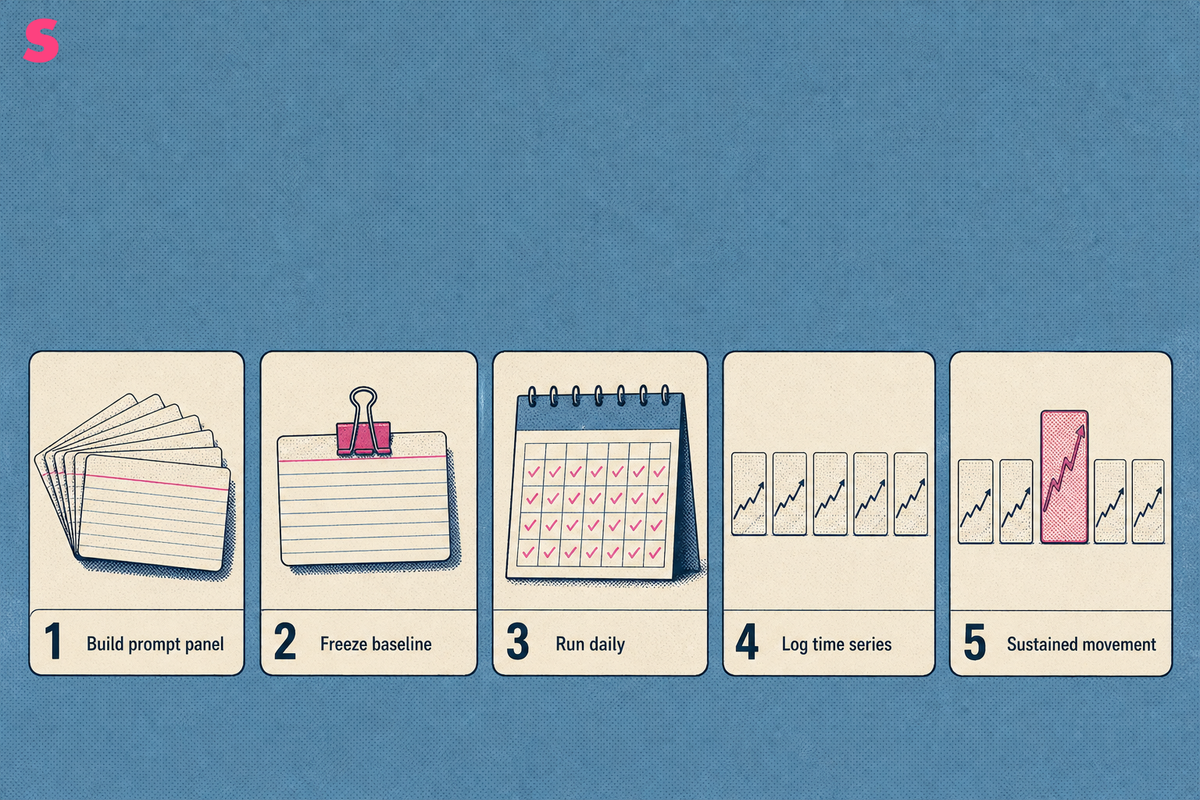
Set a baseline before publishing or optimizing content, then run the same fixed prompt panel daily across the engines relevant to buyers. A fixed panel makes change measurable because the question, market, location and scoring rules remain stable.
Build the panel from high-intent category, comparison, implementation and pricing questions. Include branded prompts, competitor-adjacent prompts and use-case prompts. Record the exact wording, engine, geography, device context, cited sources, answer accuracy and sentiment for every observation.
- Define the buyer segment and the commercial questions that segment asks.
- Freeze a prompt panel that represents those questions and document its scoring rubric.
- Capture a pre-change baseline for visibility, citations, accuracy, referrals and branded demand.
- Run the same prompt list daily and retain the observations as a time series.
- Review content changes, competitor movement and CRM outcomes against the same reporting period.
Daily tracking can reveal changes that a weekly snapshot obscures. Answers can change after retrieval-index updates, model changes or competitor publication. Sustained movement is more credible than a one-day spike.
Use confidence ranges rather than treating one answer as definitive. Where possible, compare priority prompts with a control group of similar prompts that received no content or technical intervention. The output is a log, not merely a score, because the comparable series reveals trend direction over time.
How do you attribute sign-ups, pipeline and revenue to AI answers when referral data is sparse?
Attribute AI-driven revenue by combining tagged links, AI-referral segmentation, self-reported discovery and CRM opportunity influence. Last-click attribution is inadequate because many buyers research in an answer engine, leave without clicking and return later through branded search or direct traffic.
A practical B2B SaaS journey starts when a buyer asks an AI assistant for software options. The answer cites a product page. The buyer later searches the brand name, requests a demo and enters the CRM. The AI answer influenced discovery even when the final session carries no usable referral value.
- Define a GA4 channel or referral rule for known AI-assistant referrers, and retain source, medium, campaign, landing page, session ID and first-touch timestamp for every qualifying session.
- Tag controlled links with campaign parameters where tagging is available. Record the campaign, source, medium, content and landing-page values, then configure demo starts, sign-ups and qualified lead submissions as GA4 conversion events.
- Create a GA4 segment for known AI-referred sessions and compare its landing-page engagement, conversion events and later branded-search behavior with other acquisition segments.
- Pass source data, campaign parameters, landing-page values, form responses and first-touch timestamps into corresponding CRM fields. Retain lifecycle-stage timestamps for lead creation, qualification, opportunity creation and closed-won status.
- Associate opportunity contacts with the CRM opportunity, then join the opportunity record to the retained acquisition fields for reporting. Review opportunity influence alongside branded-search lift and the fixed prompt panel during the same date range.
Use first-touch discovery when the objective is to identify how an account first found the brand, assigning discovery credit to the earliest qualifying AI interaction. Use multi-touch influence when several interactions contributed to the opportunity, assigning defined credit across the recorded touchpoints. Use pre/post analysis or a control group when the objective is incrementality, comparing outcomes after an intervention with an unchanged prompt or audience group.
Sona AI Visibility includes AI Attribution, page-level insights, Agent Analytics and company-level visitor identification. These capabilities help teams investigate AI search activity alongside account-level outcomes.
Use a time-series comparison rather than claiming certainty from one session. If priority prompt coverage rises, branded demand increases and influenced opportunities appear within the defined attribution window, the combined evidence is stronger than any isolated referral record.
Why does AI visibility measurement fail, and what do frameworks that work do differently?
AI visibility measurement fails when teams treat a volatile visibility score as a business result. Effective frameworks preserve a baseline, sample repeatedly, score answer quality and connect buyer activity to CRM outcomes.
| Failure mode | What gets reported | Why the result is weak | Correction |
|---|---|---|---|
| Visibility as the outcome | Mentions or share of voice | Presence does not establish commercial influence | Connect prompt coverage to engagement, branded demand and opportunities |
| One-off checks | A single answer snapshot | Model, retrieval and prompt variation can distort the result | Run a fixed prompt panel daily and report the trend |
| Last-click only | Referral sessions | Zero-click research disappears from attribution | Combine referrals, tagged links, self-reporting and CRM influence |
| No baseline | Post-publication visibility | No comparison period exists for judging change | Capture pre-change prompt, traffic and demand benchmarks |
| Citation counts without quality | Total citations | Incorrect or negative answers create brand risk | Score accuracy, sentiment and message alignment beside citations |
A sound framework distinguishes correlation from evidence. It does not claim that every cited answer caused revenue. It documents the chain of prompt visibility, buyer engagement, branded demand and opportunity influence, then tests whether that chain strengthens after defined interventions.
Use different clocks for different work. Prompt tracking needs daily resolution, while a positioning review, competitive benchmark report and technical re-audit can run monthly or quarterly.
Where does AI visibility measurement break down, and how do you work around each limit?
AI visibility measurement breaks down when teams assume answer engines provide complete referral data, stable outputs or clean causal attribution. Document uncertainty, use repeated sampling and combine multiple forms of buyer evidence.
The return cycle is longer than paid media. The first 0–30 days cover content publication, indexing and initial AI tool engagement. A reporting window that closes before that period can mistake an incomplete observation cycle for poor performance.
- Dark social and zero-click research: use self-reported discovery fields, branded-demand trends and CRM notes.
- Unstable outputs: preserve a fixed prompt panel, sample daily and report ranges instead of one answer.
- Sampling bias: include engines, locations and prompt types that match the target buyer journey.
- Brand-safety errors: score pricing, product claims, positioning and sentiment before counting a citation as favorable.
- Competitive benchmarking: compare the same prompts, engines and scoring rules for every tracked brand.
Google AI Overviews, ChatGPT, Perplexity, Gemini, Claude and other answer engines can produce different answers to similar questions. The measurement goal is not a false universal score. It is a defensible record of how buyer-facing answers change over time.
Keep attribution windows explicit. A longer sales cycle requires a longer opportunity-influence review, while content and answer-quality checks can identify operational problems sooner.
Which AI visibility tools measure prompts, engines and conversions, and what do they cost?
Tool selection should start with the prompts, engines and revenue evidence a team needs to monitor, rather than headline subscription price. Vendors use different units, including prompts, credits, domains, models and add-ons, so like-for-like comparison matters.
The table records published plan details as of October 2026. A listed price does not establish equivalent coverage because refresh cadence, engine coverage and prompt allowances differ by plan.
| Tool | Starting price | Agency Plans? (Yes/No) | # of Answer Engines Tracked | Answer Engines | # of Daily Tracked Prompts (entry plan) | Cost per Daily Tracked Prompt | Differentiation |
|---|---|---|---|---|---|---|---|
| Sona AI Visibility | From $75/month, billed annually | Yes | Up to 11 (3 on Starter) | Not published | 5,000 credits/month, about 56 prompts tracked daily across 3 engines | $0.45 per daily tracked prompt | Page-level insights, Agent Analytics, company-level visitor identification and AI search attribution |
| Peec AI | From $95/month | Yes | Up to 13 (3 of 6 on Starter, plus add-ons) | Not published | 50 prompts daily | $0.63 per daily tracked prompt | Citation and mention tracking across AI engines |
| Otterly.ai | From $29/month | Yes | Up to 7 (4 on Lite, 3 as paid add-ons) | ChatGPT, Google AI Overviews, Perplexity, Microsoft Copilot | 15 prompts daily | $0.48 per daily tracked prompt | AI search visibility tracking across supported engines |
| Scrunch AI | From $250/month | Yes | Up to 9 (4 on Core) | ChatGPT, Perplexity, Google AI Overviews, Copilot | 125 prompts, refresh cadence not published | No refresh cadence published | Prompt and AI-search visibility tracking |
| AthenaHQ | From $295/month under the annual toggle | Yes | 11 | Not published | 3,600 credits/month, unlimited prompts, refresh cadence not published | No refresh cadence published | AI visibility monitoring through response credits |
| PromptWatch | From $95/month | Yes | Not published | Not published | 50 prompts daily | $0.48 per daily tracked prompt | Prompt monitoring with monthly AI response allowances |
| Goodie | From $295/month | Yes | Up to 14 (5 on Core) | Not published | 110 prompts daily | $0.67 per daily tracked prompt | AI visibility measurement across multiple models |
Use the table to narrow a shortlist, then test whether the platform preserves answer history, supports the required prompt panel and exports data for CRM analysis. Daily resolution matters because the measurement task is trend detection, not a weekly snapshot.
What costs and returns should a B2B SaaS team count when judging an AI visibility program?
A B2B SaaS team should count the full cost of measurement, content and operational work, then compare those inputs with influenced sign-ups, branded demand, pipeline and revenue. Subscription cost alone understates the investment, while citation counts alone overstate the return.
- Costs: platform subscription, content production, technical remediation, analyst time and outside services.
- Intermediate returns: accurate citations on priority prompts, AI-referred engagement and branded-search lift.
- Commercial returns: qualified sign-ups, opportunity influence, created pipeline and closed-won revenue.
Calculate total program cost for the reporting period first. Next, select one financial basis, either attribution-adjusted closed-won revenue or attribution-adjusted gross profit, and use that basis consistently. Subtract total program cost from the selected return to calculate net return. Divide net return by total program cost to calculate ROI.
Report influenced pipeline separately from closed-won revenue. Pipeline shows potential commercial impact, while closed-won revenue or gross profit supplies the realized return in the ROI calculation. Do not add influenced pipeline to closed-won revenue because the same opportunity can otherwise receive credit twice.
Reconcile self-reported discovery with CRM opportunities rather than forcing every buyer journey into a last-click source. A buyer can first encounter the brand in an answer engine, later return by branded search and still represent valid AI-influenced demand.
Sona AI Visibility pairs AI search attribution with company-level visitor identification. These capabilities support investigation of AI search activity alongside account and CRM evidence.
Report costs and returns on the same operating cadence as the underlying evidence. Review the prompt log daily, evaluate content and technical work monthly, and assess pipeline influence against the sales cycle rather than a short traffic window.
What are the frequently asked questions about AI visibility ROI?
What is the difference between AI visibility and AI visibility ROI?
AI visibility describes how often and how accurately a brand appears in generated answers. AI visibility ROI measures the financial return from that presence. It requires visibility data plus branded demand, AI-referred engagement, sign-ups, opportunity influence and CRM revenue outcomes.
How long does it take for AI visibility work to show a return?
The cycle is longer than paid media. The first 0–30 days cover content publication, indexing and initial AI tool engagement. Set the baseline period, attribution window and reporting cadence around that operating reality.
Can GA4 track traffic that comes from AI assistants?
GA4 can track part of the traffic when an AI assistant passes usable referral data. It cannot capture every journey because assistants can omit referral information and buyers can return through direct or branded search. Combine GA4 segmentation with tagged links, self-reported discovery and CRM opportunity influence.
Do AI answers vary too much to measure reliably?
AI answers vary by model, location, date and prompt wording, so single checks mislead. A fixed prompt panel sampled daily and reported with confidence ranges provides a defensible trend. Teams can then distinguish sustained movement from temporary answer volatility.
Do I need a paid tool to measure AI visibility ROI?
A small prompt panel can be checked manually, but repeated sampling across engines becomes laborious. Evaluate measurement cost beside the content and technical investment already required.
Should a citation count as a win if the answer gets the details wrong?
No. A citation that misstates pricing, positioning or capability can create brand risk and misdirect qualified buyers. Score factual accuracy and sentiment beside visibility before counting a citation toward return, then assign remediation work to the page or source that needs correction.
Summarize this article with AI: ChatGPT · Claude · Perplexity · Google AI Mode
Last updated: October 2026