A branded question checklist for AI search visibility is a consistent group of prompts that include your brand name, tested across answer engines and evaluated for mentions, citations, accuracy and recommendations. Structure it around the buyer journey, add adversarial and competitor prompts, and rerun each question to average out variability. Branded performance is a diagnostic layer because a brand may dominate searches for its own name yet remain missing from category questions. Sona AI Visibility connects these prompts and citations to pipeline and revenue, something mention totals alone cannot reveal.
What counts as a branded question, and what do you need before starting the audit?
A branded question names a company, product, or product line and asks an answer engine to evaluate it. This branded questions for AI search visibility checklist defines the brand entities and test conditions before any prompt runs.
A branded keyword is a short term, such as a company name. An unbranded category query, such as “best attribution platform for B2B SaaS,” does not name the company. A branded question is more diagnostic, such as “Is [brand] worth it for enterprise attribution?” or “How hard is it to cancel [brand]?”
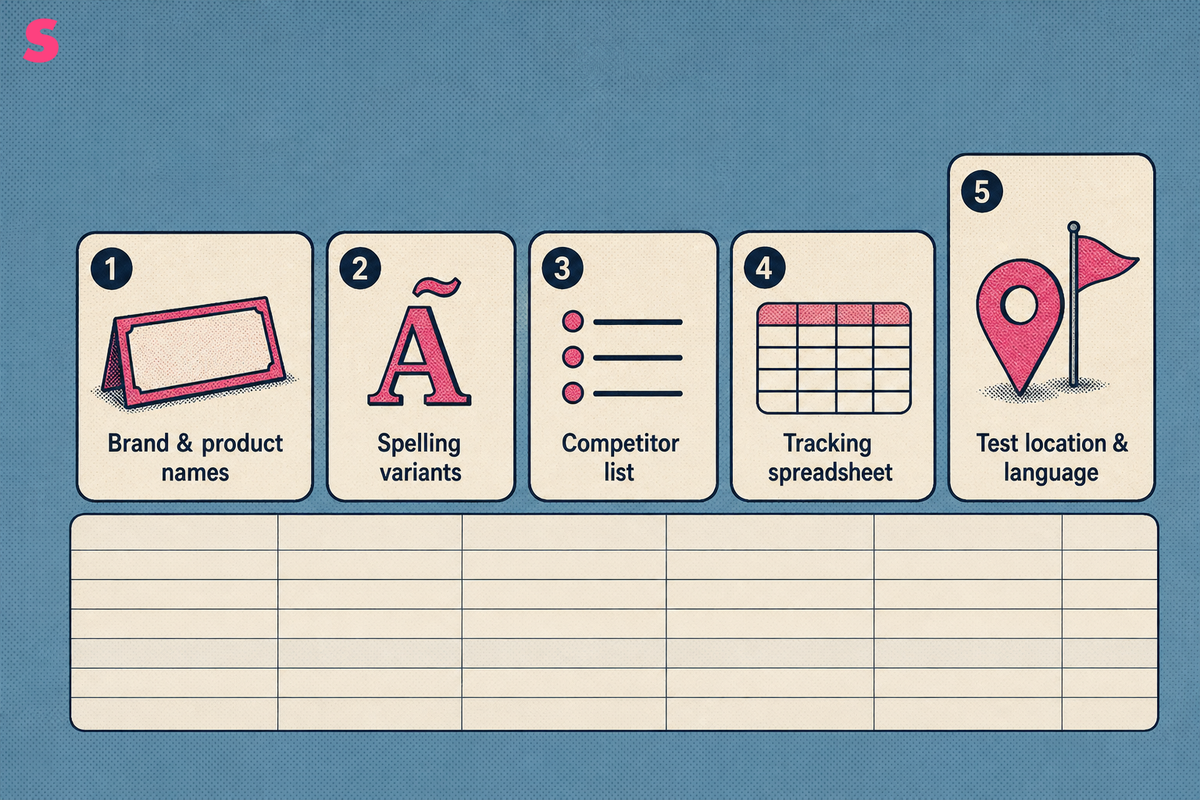
Prepare five inputs before Step 1: your brand and product names, common spelling variants, a competitor list, a spreadsheet or tracking system, and one fixed test location and language. Reserve several hours for the first baseline. Consistent conditions matter more than a rushed collection of screenshots.
Traditional SEO visibility centers on rankings and clicks. AI search visibility centers on answers, citations, recommendations, and how an engine describes a brand. Branded questions are narrow by design, so use them as a diagnostic layer rather than a complete AI search strategy.
- Step 1 of 6: define scope. List the legal company name, public brand name, product names, discontinued names, senior executives strongly associated with the brand, and competitor names buyers compare against.
- Choose one country, language, and buyer segment. Record those settings in the audit sheet before collecting answers.
Which branded questions should the checklist include for each stage of a B2B SaaS buyer journey?
Step 2 of 6: select buyer-journey prompts. A useful branded-question set covers the full buyer journey, including favorable, neutral, hostile, and competitor-comparison prompts. Use 30–50 prompts as a repeatable operating range, balanced across stages rather than concentrated in discovery.
Confirmation bias is the main risk. A prompt set that asks only whether a brand is good produces flattering evidence while concealing questions that delay deals. Include questions about pricing, security, cancellation, migration, failed implementations, and competing products.
| Buyer stage | Question purpose | Prompt template | Audit type |
|---|---|---|---|
| Discovery | Test basic brand description | What is [brand]? | Neutral |
| Category fit | Test audience and use-case fit | Is [brand] worth it for [company type]? | Favorable and hostile |
| Competitor comparison | Test differentiation and displacement | [brand] vs. [competitor] | Comparison |
| Integrations | Test technical compatibility | What does [brand] integrate with? | Neutral |
| Security | Test trust and procurement claims | Is [brand] secure for enterprise use? | Hostile |
| Pricing and implementation | Test commercial readiness | How much does [brand] cost, and how long does implementation take? | Commercial |
| Renewal and switching | Test retention concerns | How do I cancel, migrate from, or replace [brand]? | Hostile |
Add a prompt ID, journey stage, prompt type, and intended page owner beside every question. This structure supports later scoring and exposes gaps, such as extensive comparison coverage with no implementation or renewal questions.
Which AI engines should a branded-question audit cover, and how do their answers differ?
A branded-question audit should start with ChatGPT, Perplexity, Claude, Gemini, Google AI Overviews, and other answer engines. Add Copilot and Google AI Mode when they match the answer engines your buyers use during research, and log each engine as a separate environment.
Sona's own AI visibility data, September 2026, covers 8 answer surfaces: ChatGPT, Google AI Overviews, Perplexity, Google AI Mode, Gemini, Mistral, Qwen and Claude. One engine result cannot represent AI search as a whole.
| Answer surface | Audit role | What to record | What to compare across runs |
|---|---|---|---|
| ChatGPT | Direct research answer | Full answer text, brand position, tone, cited URLs | Brand description and recommendation language |
| Perplexity | Research answer with source review | Full answer text, sources cited, brand position, tone | Source selection and factual claims |
| Claude | Long-form evaluation answer | Full answer text, brand position, tone, cited URLs if shown | Qualification language and competitor framing |
| Gemini | Google-connected answer research | Full answer text, citations, brand position, tone | Entity description and source consistency |
| Google AI Overviews | Search-result answer surface | Overview text, cited URLs, placement, location | Citations, wording, and result-page context |
Record what each answer shows. Note whether citations appear by default, whether the answer names competitors, and whether wording changes between runs. The audit log is evidence, not a prediction about model behavior.
How do you run branded prompts so the results are reproducible?
Run each prompt-engine pair four times during one fixed daily 24-hour window, and record the complete answer rather than a summary. A single answer is a dated observation. Four runs create a comparable series that distinguishes durable movement from one-off variation.
- Step 3 of 6: run the prompts. Use a fresh logged-out browser profile for every run, one fixed location, one language, and unchanged prompt wording.
- Run prompt IDs in ascending order for every engine and begin every prompt in a fresh thread. Do not use follow-up context, prior chat history, or prompt refinements.
- Record the prompt ID, journey stage, type, engine, run date, timestamp, location, full answer, cited URLs, brand position, and observed tone.
- Do not retry a completed run. Record refusals, interface errors, and failed answers as separate statuses, and record missing citations as no citation shown rather than inferring a source.
- Run the full prompt list daily. Daily runs reveal patterns that a weekly sample can miss between observations.
AI answers shift with retrieval indexes, model updates, localization, personalization, and new competitor content. Treat changes as documented noise until a pattern persists. A change that holds for four daily runs is more useful than a one-day spike.
Use monthly or quarterly intervals for a full technical re-audit and broader positioning review. Prompt tracking and page diagnostics operate on different clocks. Preserve both the raw answer and the conditions that produced it.
How do you score branded-question answers with a rubric?
A branded-question rubric should score each answer across seven dimensions from 0 to 2, then separate visibility from commercial quality. Mention rate alone cannot show whether the answer recommends the brand, cites reliable evidence, or influences qualified pipeline.
Use the same rubric for every engine and prompt. A score of 0 means the condition is absent or harmful, 1 means mixed or incomplete, and 2 means clear and favorable. Score factual accuracy against current owned documentation and approved external profiles.
| Dimension | 0 points | 1 point | 2 points |
|---|---|---|---|
| Mention | Brand absent | Brand named without detail | Brand named with relevant description |
| Citation quality | No supporting citation or weak source | Mixed source quality | Relevant, credible supporting source |
| Recommendation | Discouraged or excluded | Qualified mention | Clear fit for the stated use case |
| Answer position | Absent or buried | Middle of the answer | Lead recommendation or early mention |
| Sentiment | Negative | Neutral or mixed | Accurate and favorable |
| Factual accuracy | Materially wrong | Partly correct | Correct and current |
| Competitor displacement | Competitor dominates | Balanced comparison | Brand is clearly differentiated |
Score each answer without weighting. Visibility consists of Mention, Citation quality, and Answer position. Commercial quality consists of Recommendation, Sentiment, Factual accuracy, and Competitor displacement. Divide each applicable subtotal by its applicable maximum and multiply by 100. The overall answer score uses all applicable dimensions on the same basis. Mark Citation quality not applicable only when an answer surface does not expose citations, and mark Competitor displacement not applicable only when the prompt does not call for a comparison. Exclude each not-applicable dimension from both numerator and denominator.
Illustrative template: For the answer “Brand X suits mid-market teams but has a longer implementation,” with a credible citation and an early mention, score Mention 2, Citation quality 2, Recommendation 1, Answer position 2, Sentiment 1, and Factual accuracy 2 after checking the implementation claim. Mark Competitor displacement not applicable when no competitor appears. The answer score is 10 out of 12, or 83.3. Its visibility score is 6 out of 6, or 100, and its commercial-quality score is 4 out of 6, or 66.7. Calculate each journey-stage score and engine score as the unweighted mean of completed normalized answer scores. If this is the only completed answer in its stage and engine, both final scores are 83.3.
Step 4 of 6: score the answers. Roll results into a scorecard by journey stage and engine. Report mention rate, recommendation rate, citation-quality average, qualified AI-referred traffic, and pipeline influence separately. Sona AI Visibility connects prompts and citations to pipeline and revenue on one account timeline, keeping branded-answer scores distinct from commercial impact.
Which page-level checks explain why an AI engine gets your brand wrong or ignores it?
Weak branded answers often trace back to pages that answer the question poorly, cannot be reached, or present outdated facts. Step 5 of 6 is to inspect the pages behind incorrect, missing, or weakly cited answers across six technical and editorial dimensions.
- Crawlability: Check robots rules, canonical tags, indexability, and server-side access. A blocked pricing or security page can distort answers to procurement questions.
- Performance: Check rendered experience, server-rendered HTML, and JavaScript dependency. Integration and implementation pages need extractable content.
- Security: Review HTTPS and response-header hygiene. Security questions require pages that communicate trust clearly.
- Content structure: Use descriptive headings, valid schema markup, and one clear question per page. Comparison prompts need direct, structured answers.
- Content quality: Check whether the copy supplies evidence, names the relevant use case, and reflects current facts. Pricing and switching answers decay quickly.
- Accessibility: Review alt text, ARIA attributes, contrast, and explicit image dimensions. Accessible pages are easier to parse and verify.
A visibility score reports the outcome, while a technical audit identifies the page-level cause. Sona AI Visibility uses AI Search Insights to score a page out of 100 across six categories, rank each finding as critical or medium with an attached fix, and re-run the audit on a watch so a team can verify whether the fix landed.
Prioritize pages tied to high-intent comparison, pricing, security, and integration prompts. A dated snapshot supports triage, but the severity-ranked fix attached to the page creates an assignable work item.
How can you improve the sources AI engines use to answer questions about your brand?
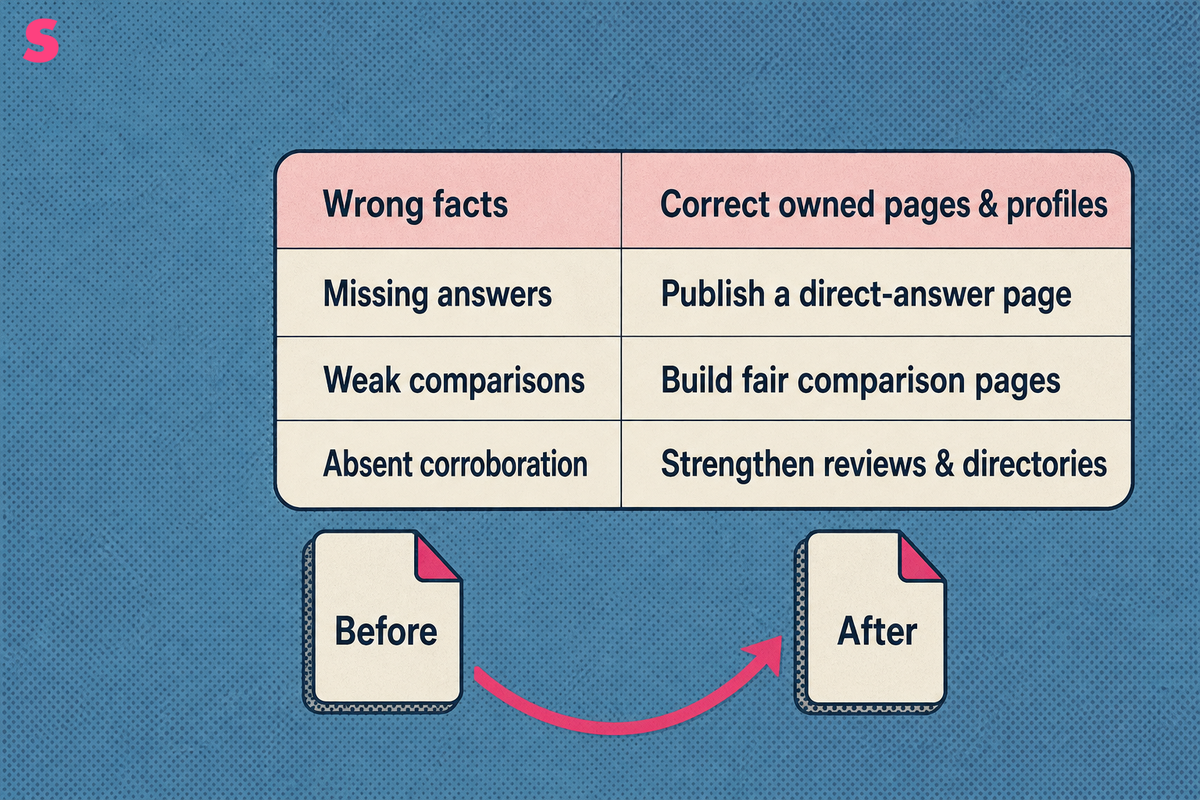
Improve branded-question results by correcting source gaps, publishing direct answers to missing questions, and standardizing brand facts across owned and third-party sources. Step 6 of 6 begins with the scored prompt, then traces the weak answer to the page or profile behind it.
- Wrong facts: Correct owned product, pricing, security, and documentation pages, then update relevant third-party profiles.
- Missing answers: Publish a page that answers the exact branded question in the prompt log.
- Weak comparisons: Create fair comparison, migration, integration, and implementation pages that explain fit without unsupported claims.
- Absent corroboration: Strengthen accurate review, directory, documentation, and knowledge-base coverage.
Anchor each page to one clear question and use explicit query-driven content. A cancellation page should answer cancellation questions. An integration page should name the supported system and implementation context. Do not force one generic product page to answer every prompt.
Set the rerun date before making changes. Run the same prompt list daily after publication, preserve the baseline, and compare direction by engine and journey stage. Sona AI Visibility can connect resulting citations to AI-referred visits, pipeline, and revenue, but content changes still require a documented before-and-after test.
What does a successful branded-question audit look like, and what usually goes wrong?
A successful branded-question audit produces a completed baseline scorecard, a ranked list of gap prompts, named owners, fix dates, and a second run showing directional change. Success is not one positive answer. It is a repeatable operating record that connects prompt evidence to accountable work.
The first common failure is a flattering prompt set. Recover by adding hostile, pricing, security, switching, and competitor-comparison prompts, then rescore every engine. The second failure is treating one run as a result. Recover with repeated daily runs under documented conditions.
The third failure is treating branded strength as overall AI visibility. Add unbranded category, problem, and solution queries in the next audit layer. Branded questions show how an engine describes a company when asked directly. Non-branded prompts show whether the company is discovered at all.
Use the scorecard to assign an owner to each weak prompt, source page, and factual correction. Review the full pattern quarterly, including pages that improved and pages that regressed after a product, pricing, or positioning change.
What should you look for in a tool that tracks branded questions over time?
A branded-question tracking tool should preserve prompt history, separate engines, retain answer evidence, and support the workflow from citation to commercial outcome. Manual spreadsheet logging works for a first 30–50 prompt audit. Automated tracking becomes necessary when the daily prompt list, engine coverage, and follow-up workload expand.
Compare tools on prompt limits, engine coverage, refresh frequency, source capture, integrations, reporting, attribution, and export options. Vendors define prompts, credits, and responses differently, so compare on a per prompt-engine run basis rather than a plan label or headline allowance. Pricing comparisons belong in a separate buying guide.
Mention and competitor tracking are the baseline. Sona AI Visibility connects prompts and citations to pipeline and revenue, and tracks AI crawler and agent activity as the front of that same path. Its prompt data can show the questions buyers ask, the pages tied to those answers, and the commercial value attached to AI-referred activity.
Choose a system that supports an operating rhythm your team can sustain. The value is not a dashboard score. It is a prompt log, a consistent scoring rule, and a queue of fixes assigned to content, web, product marketing, and demand generation owners.
What are the frequently asked questions?
What is a branded question in AI search?
A branded question is a prompt that names your company or product, such as “Is [brand] worth it?” or “[brand] vs. [competitor].” It differs from a branded keyword, which is a short search term, and from an unbranded category query that does not name the brand.
How many branded prompts should an audit include?
Use roughly 30–50 prompts across discovery, category fit, competitor comparison, integrations, security, pricing, implementation, renewal, and switching. Stage balance matters more than raw count because a large set of discovery questions can still miss commercial objections that influence a purchase decision.
How often should branded prompts be rerun?
Rerun branded prompts daily with the same location, wording, language, and engines. Daily runs reveal patterns that a weekly sample can miss between observations. Rerun after major content changes or visible model updates, and retain timestamps so answer variability remains interpretable.
Are branded questions enough to measure AI search visibility?
No. Branded questions are a diagnostic layer that shows how answer engines describe a company when asked directly. Category, problem, solution, and competitor queries show whether the brand is found without being named, so they belong in the next audit layer.
Which AI engines should a branded-question audit cover?
Start with ChatGPT, Perplexity, Claude, Gemini, Google AI Overviews, and other answer engines. Add Copilot or Google AI Mode when buyers use those answer surfaces. Log each engine separately because answer format, citations, positioning, and wording can differ for the same prompt.
Does a brand mention in an AI answer lead to revenue?
Not on its own. A mention can be inaccurate, uncited, unlinked, or absent from high-intent comparisons. Separate mention rate from recommendation rate, citation quality, qualified traffic, and pipeline influence. Attribution determines whether AI-referred visits contribute to commercial outcomes.
Summarize this article with AI: ChatGPT · Claude · Perplexity · Google AI Mode
Last updated: October 2026