


SEO visibility measures how likely users are to encounter your site in organic search, based on the rankings and search volume of tracked keywords. In AI search, the comparable indicator is whether responses mention or cite your brand, meaning each requires separate measurement. Monitor Google rankings and clicks with a fixed prompt set repeatedly sampled across engines, focusing on trends rather than individual checks.
What is SEO visibility?
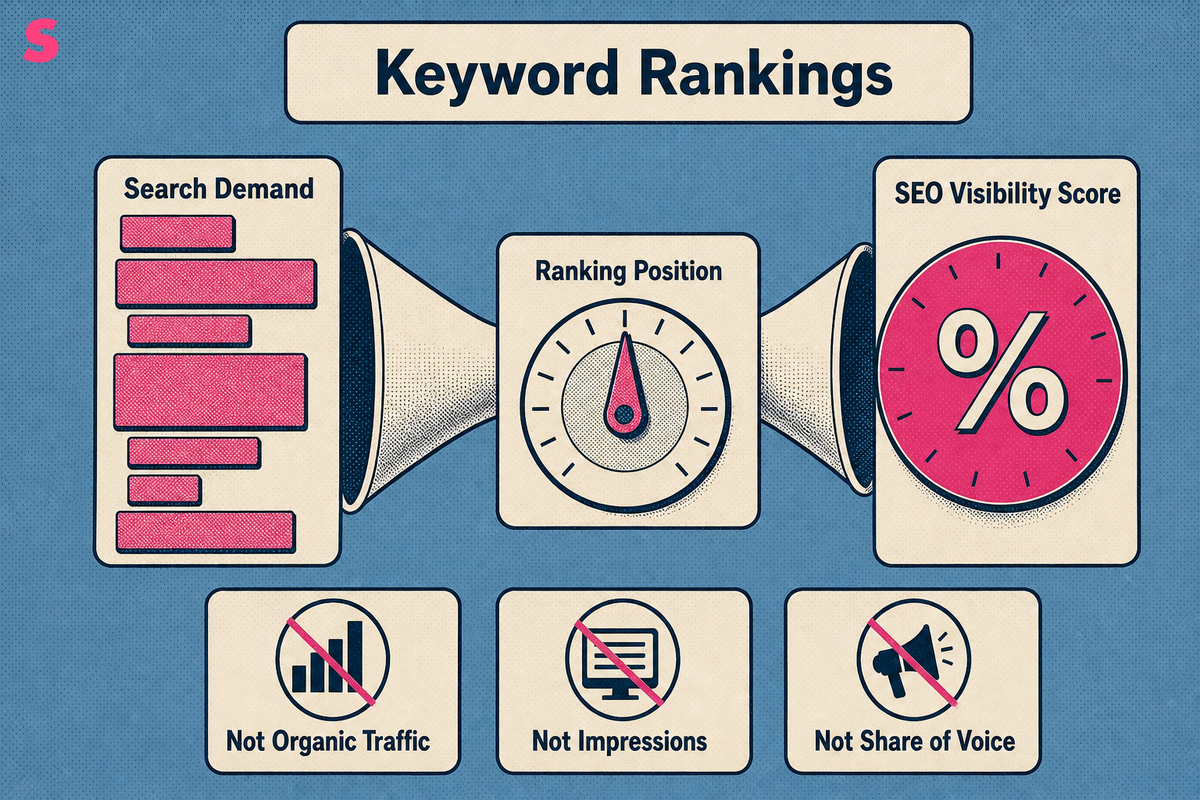
SEO visibility is the percentage of potential organic-search clicks a website could receive from rankings across a tracked keyword set. It combines ranking position with search demand to show whether the site is gaining or losing prominence over time.
The metric turns many keyword rankings into one directional score. A high ranking for a high-demand query contributes more than a high ranking for a query with little search demand. The score represents likely exposure across the keyword portfolio rather than one isolated ranking.
SEO visibility is not organic traffic, which counts visits that occurred. It is not impressions, which count appearances in search results, or share of voice, which compares a brand with named competitors. A visibility score estimates opportunity from rankings, not guaranteed clicks or pipeline.
Why does SEO visibility matter if you have a pipeline target to hit?
SEO visibility is an upstream indicator. Rankings and estimated click opportunity often move before traffic, form fills, demos, and pipeline appear in reporting. A declining score gives a demand-generation team time to investigate before revenue targets are affected.
The metric becomes actionable when the keyword set reflects commercial priorities. A B2B SaaS team should separate awareness queries from comparison, pricing, migration, and implementation queries. A gain on a high-intent category page means something different from a gain on a broad educational article.
A brand-level score is not a work item. Teams need to know which prompts, pages, and cited sources produce the result. Sona AI Visibility connects citations and prompts to pipeline and revenue, while showing the pages and sources associated with AI search performance.
Use the score as a diagnosis, not a target alone. The useful operating record is a trend segmented by keyword group, country, device, and funnel stage, with changes traced to specific pages.
How is SEO visibility calculated from rankings and search volume?
SEO visibility weights each tracked keyword by its search demand and the estimated click opportunity associated with its ranking position. Exact click curves differ across platforms, but stronger positions on more valuable queries contribute more to the overall score.
Consider this hypothetical keyword set. “Enterprise attribution software” has a monthly search volume of 1,000 and sits at position 8. “Marketing attribution platform” has a monthly search volume of 900 and sits at position 3. “Attribution reporting template” has a volume of 30 and ranks at position 2.
Assign illustrative click-opportunity weights of 5% to position 8, 25% to position 3, and 35% to position 2. The weighted opportunities are 50, 225, and 10.5 potential clicks. If position 1 carries an illustrative maximum weight of 40%, the maximum opportunity for the same 1,930-search keyword set is 772. The observed opportunity is 285.5, so the normalized SEO visibility score is about 37%.
If the first keyword moves from position 8 to position 3, its illustrative opportunity rises from 50 to 250. That single change outweighs ten new position-2 rankings on keywords with a volume of 30. Small keywords still matter, but the score should reflect economic importance rather than keyword count.
How does SEO visibility differ from rankings, organic traffic, brand visibility and AI visibility?
SEO visibility estimates potential organic-search exposure, while rankings, traffic, reach, share of voice, brand visibility, and AI visibility answer different measurement questions. Separating them prevents teams from treating impressions, clicks, citations, and mentions as interchangeable evidence.
| Metric | What it measures | How it is measured | What decision it informs |
|---|---|---|---|
| SEO visibility | Potential organic click opportunity across tracked queries | Ranking positions weighted by estimated click opportunity and search demand | Which keyword groups and pages are gaining or losing search exposure |
| Keyword rankings | A page’s position for a specific query | Observed placement in a search-results list | Which page needs work for one query or intent cluster |
| Organic reach | The audience exposed to unpaid search results, whether or not those users visit | Search-result impressions, estimated unique exposure, or platform reach reporting | Whether organic search is reaching a broader relevant audience |
| Organic traffic | Visits that arrived from unpaid search results | Analytics sessions and search reporting clicks | Whether search exposure produced visits |
| Share of voice | A brand’s presence relative to selected competitors | Comparative rankings, mentions, or appearances across a fixed query set | Where competitors dominate a category or buying stage |
| Brand visibility | How often a brand appears across search, publishers, reviews, and discussions | Mentions, branded searches, citations, and third-party references | Whether market awareness supports demand creation |
| AI visibility | Whether a brand or source appears in AI-generated answers | Prompt sampling, answer inclusion, citations, and mentions by engine | Which buyer questions produce citations, AI-referred visits, and commercial interest |
Rankings are page-level placements. Impressions show that a result appeared. Clicks show that a person visited. Citations show that an AI answer named or linked to a source. Mentions show that a brand appeared in an answer without a cited page. Each metric belongs in its own report.
How does visibility in traditional search differ from visibility in AI search?
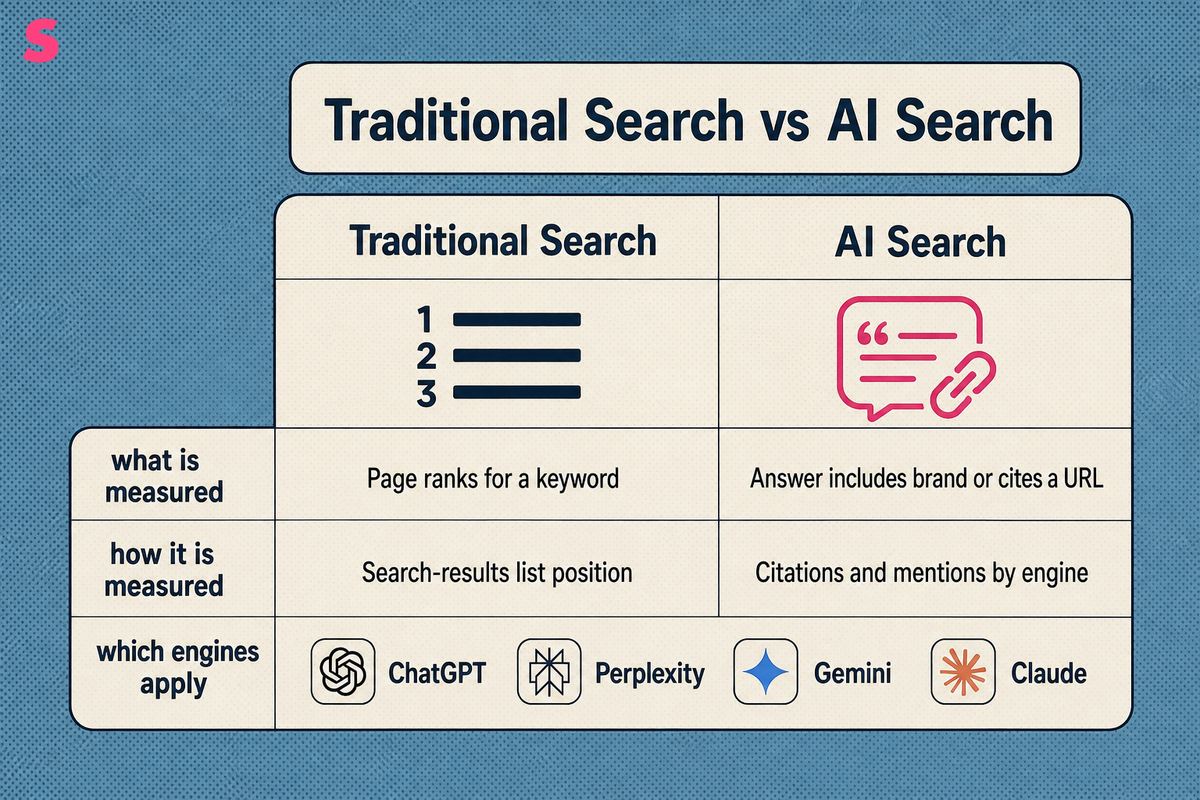
Traditional search visibility measures where pages rank in results lists. AI search visibility measures whether a brand, page, or source appears inside an answer. Google AI Overviews illustrates the difference: a user can receive a synthesized response with cited sources before selecting a traditional blue link.
The channels overlap in important ways. Crawlable pages, server-rendered HTML, clear information architecture, strong topical coverage, and credible evidence help search systems discover and assess content. A weak canonical tag, blocked crawler, or thin category page can damage performance in both environments.
The measurement layer differs. Traditional search asks whether a page ranked for a keyword. AI search asks whether an answer included the brand, cited a particular URL, featured a competitor, or changed by model. ChatGPT, Perplexity, Gemini, Claude, and other answer engines can produce different responses to the same prompt.
Traditional SEO remains necessary, but it does not fully measure AI answers. Sona AI Visibility tracks citations and AI crawler activity, so teams can relate page access and answer inclusion to measurable visitor and revenue outcomes.
Which technical, content and authority factors affect SEO visibility most?
SEO visibility depends on whether search systems can crawl, index, interpret, and trust pages that address valuable queries. The main factors are crawlability, intent match, entity coverage, technical quality, and independent evidence from credible third parties.
- Crawlability and indexing: robots.txt rules, canonical tags, internal links, status codes, and server-rendered HTML determine whether a page can enter the index.
- Intent match: the page format must answer the searcher’s task, whether that task is comparison, implementation guidance, pricing research, or category education.
- Entity and topic coverage: pages should explain the relevant product, category, use cases, concepts, and relationships without forcing unrelated keywords into the copy.
- Authority signals: backlinks, expert reviews, original research, customer evidence, and third-party mentions support credibility.
- Technical quality: structured data, metadata, page performance, accessibility, and security headers affect how reliably systems can parse and serve a page.
Technical reviews should identify crawl, indexing, on-page, and structured-data issues that can affect search visibility. The resulting backlog should distinguish conditions that block discovery from conditions that reduce relevance or weaken a page’s evidence.
Crawl access matters because a page that retrieval systems cannot reach has little chance of becoming a cited source.
How can you improve SEO visibility, and what does each tactic change?
Improving SEO visibility requires changes to the pages, evidence, and technical conditions that affect high-value query groups. Publishing more content alone will not improve performance. Intent alignment and original evidence matter more than a larger archive of overlapping articles.
- Fix crawl and index access. Resolve blocked resources, incorrect canonical tags, broken internal links, and JavaScript dependencies. This expands the set of pages search systems can discover and evaluate.
- Match one page to one primary search intent. Give comparison queries comparison pages, implementation queries implementation pages, and category queries category pages. This reduces ambiguity about which URL should rank.
- Cover entities with first-party evidence. Add methodology, product documentation, customer context, examples, data definitions, and named constraints. Evidence makes a page more useful than generic summary content.
- Earn third-party mentions and links. Reviews, expert analysis, integrations, partner material, and cited research strengthen the external evidence surrounding a brand and its pages.
- Structure pages answer-first. Put the direct answer near the beginning, then support it with definitions, examples, tables, and caveats. This helps readers and creates passages that AI answers can quote.
Use a monthly technical review to prioritize recurring defects and a quarterly positioning review to reassess target topics. A severity-ranked fix attached to each affected page turns a visibility trend into an operational backlog.
How do you measure SEO visibility across Google Search, Google AI Overviews, ChatGPT and Perplexity?
Measure visibility across Google Search, Google AI Overviews, ChatGPT, and Perplexity with a fixed query and prompt set, reported separately by platform. Do not merge search rankings, answer inclusion, citations, and brand mentions into one unsupported score.
Build the set around buyer personas and funnel stages. Include awareness questions, category comparisons, vendor-evaluation prompts, implementation questions, and purchase-stage requests. Assign every query an owner page, business priority, and named competitor set before measurement begins.
- Tracked-query demonstration. Input a fixed keyword set with search volume, country, device, and page ownership. Display the ranking-weighted click opportunity, maximum potential opportunity, and normalized SEO visibility percentage by keyword group. Use the output to identify the pages and commercial query clusters behind a visibility change.
- AI-answer demonstration. Input the same buyer prompt across each selected answer engine and preserve the full answer, included brands, cited URLs, and run date. Display answer inclusion and citation records by prompt. Use the output to identify missing evidence, competing sources, and pages that require revision.
Run the same prompt list daily. Daily measurement reveals patterns that a weekly snapshot can hide. Answers shift with retrieval indexes, model updates, and newly published competitor material, so a change that holds for four days is a trend while a one-day spike is noise.
Consider a hypothetical example. A software company ranks in Google’s top results for a category comparison query, but repeated AI sampling shows a competitor cited across ChatGPT and Perplexity for the same buying-stage prompt. The team can inspect the cited competitor sources, compare the missing evidence, and assign a page revision instead of assuming Google performance solved the problem.
Sona AI Visibility shows prompts buyers ask and the sources AI cites. Report prompt results daily, review the narrative monthly, and reassess the target prompt set quarterly. The output is a comparable log, not merely a score.
When do you need a visibility platform, and how should you compare prompt limits, engine coverage and price?
A visibility platform becomes useful when manual checks no longer provide repeatable evidence across several engines, regions, competitors, and buyer prompts. Compare plans by prompt allowance, refresh cadence, answer-engine coverage, regional support, and whether the sampling method remains consistent over time.
Prompt caps require prioritization. Start with the prompts closest to pipeline, then expand into adjacent comparison and research questions. A small daily set with stable methodology is more useful than an unstructured list that changes every week.
Sona AI Visibility connects AI citations and prompts to pipeline and revenue on one account timeline, and tracks AI crawler activity. Its Starter plan begins from $75/month billed annually, with about 56 prompts tracked daily across 3 engines, as of October 2026.
The comparison below lists published entry-plan details as of October 2026. Read each engine count alongside the plan tier, prompt allowance, and cadence, because coverage varies by product and plan.
| Tool | Starting price | Agency Plans? | # of Answer Engines Tracked | Answer Engines | # of Daily Tracked Prompts (entry plan) | Cost per Daily Tracked Prompt | Differentiation |
|---|---|---|---|---|---|---|---|
| Sona AI Visibility | From $75/month, billed annually | Yes | Up to 11 (3 on Starter) | Not published | 5,000 credits/month, about 56 daily tracked prompts across 3 engines | $0.45 per daily tracked prompt | Connects AI citations and prompts to pipeline and revenue on one account timeline |
| Otterly.ai | From $29/month | Yes | Up to 7 (4 on Lite, 3 as paid add-ons) | ChatGPT, Google AI Overviews, Perplexity, Microsoft Copilot | 15 prompts daily | $0.48 per daily tracked prompt | AI search visibility tracking with optional engine add-ons |
| Peec AI | From $95/month | Yes | Up to 13 (3 of 6 on Starter, plus add-ons) | Not published | 50 prompts daily | $0.63 per daily tracked prompt | Prompt tracking across selected answer engines |
| Profound | Custom pricing | Yes | Up to 9 (3 on free Trial) | ChatGPT, Gemini, Google AI Overviews | 50 prompts daily during the 7-day trial | No comparable public entry-plan figure | AI answer and prompt analysis for brands and agencies |
| Scrunch AI | From $250/month | Yes | Up to 9 (4 on Core) | ChatGPT, Perplexity, Google AI Overviews, Microsoft Copilot | 125 prompts, refresh cadence not published | No refresh cadence published | AI search analytics and content intelligence |
| AthenaHQ | From $295/month | Yes | 11 | Not published | 3,600 credits/month, unlimited prompts, refresh cadence not published | No refresh cadence published | AI visibility monitoring with credit-based response tracking |
| PromptWatch | From $95/month | Yes | Not published | Not published | 50 prompts daily | $0.48 per daily tracked prompt | Prompt and response monitoring across supported models |
What are the frequently asked questions?
What is a good SEO visibility score?
There is no universal benchmark. The score depends on the tracked keywords, their search demand, the countries measured, and the weighting model. Compare your score against named competitors using the same keyword set, then judge progress against your own trend.
Is SEO visibility the same as organic traffic?
No. SEO visibility estimates the click opportunity created by rankings, while organic traffic counts visits that reached the site. Visibility often moves first because ranking changes occur before users generate clicks and sessions.
Does SEO visibility include ChatGPT and Google AI Overviews?
The classic score is built from traditional search rankings. Some platforms also track appearances in ChatGPT, Gemini, Google AI Overviews, and other answer engines. Citations, brand mentions, and answer inclusion should remain separate metrics because they measure AI-answer performance rather than ranked-search exposure.
How often should you check SEO visibility?
Review ranking-based visibility on a steady weekly or monthly cadence and judge the trend rather than a single movement. Run the same AI prompt list daily, because repeated samples distinguish durable change from answer variation caused by retrieval, model updates, or new source material.
Do you need a paid tool to measure SEO visibility?
No. Google’s own search reporting can show impressions, clicks, and positions without a paid platform, and a small fixed prompt set can be checked manually. A platform becomes worthwhile when a team needs repeatable sampling across several answer engines, competitors, regions, and prompt groups.
Can publishing more content raise SEO visibility?
Only when new pages match a real search intent and add information missing from existing results. Content volume alone does not change rankings, citations, or brand mentions. Strong pages combine a defined audience task, technical accessibility, original evidence, and clear page structure.
Summarize this article with AI: ChatGPT · Claude · Perplexity · Google AI Mode
Last updated: October 2026







