


ChatGPT search visibility measures how often, and in what position and context, a brand appears in ChatGPT responses to buyers’ category questions. Since answers change by prompt, model and time, report it as an inclusion rate across a fixed prompt set rather than a single rank. Sona AI Visibility links those prompts and citations to pipeline and revenue, which a mention count alone cannot reveal. Tool pricing varies mainly by prompt volume and refresh frequency.
What is ChatGPT search visibility and why does it matter to a B2B team?
ChatGPT search visibility is how often a brand appears in ChatGPT answers for a defined set of buyer prompts. It matters because B2B buyers can research vendors, compare options, and form a shortlist before visiting a website.
For demand generation and content teams, a single mention is not the measure that matters. The measure is consistent inclusion when buyers ask commercial questions about solving a problem, comparing options, or implementing a workflow.
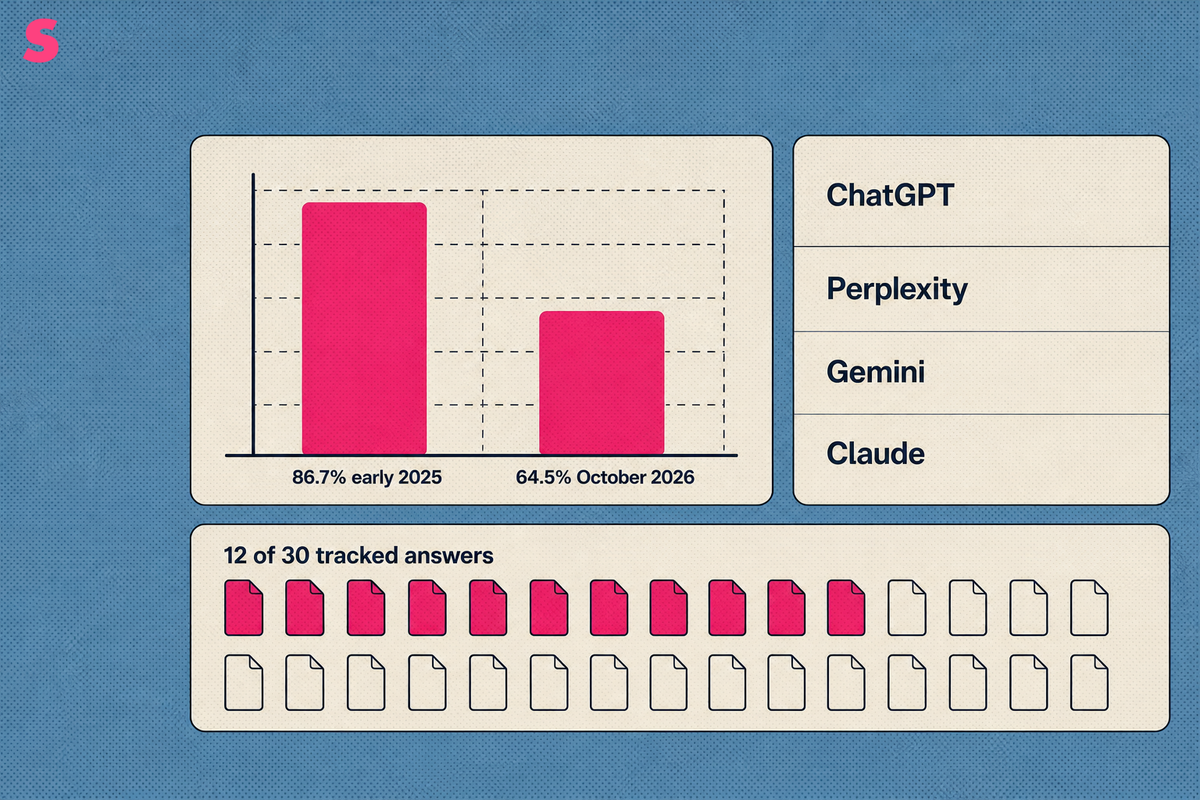
ChatGPT accounted for 64.5% of the AI chatbot market in the October 2026 listing, down from 86.7% in early 2025. That share makes ChatGPT a significant discovery environment, but conversational search extends beyond one assistant. Buyers also use Perplexity, Gemini, Claude, and other answer engines.
A B2B SaaS company might track the prompt, “What software helps marketing teams attribute AI search pipeline?” If ChatGPT names the company in 12 of 30 tracked answer variations, visibility is 40% for that prompt set. Sona AI Visibility connects those citations to pipeline and revenue on one account timeline, while tracking the AI crawlers reaching the pages that support those answers.
ChatGPT visibility differs from conventional search ranking, paid media reach, and website traffic. It measures answer inclusion and citations in a conversational response. AI visibility helps systems understand and retrieve a business correctly, but remains connected to rather than identical with traditional SEO, per reddit.com.
How does ChatGPT Search find, cache and cite pages, and where does Bing fit?
ChatGPT Search uses its own layered search index alongside Google and Bing. First, a crawler must be able to access a page. ChatGPT can then include information from that page in its separate index or cached retrieval layer. When a user submits a prompt, ChatGPT retrieves relevant material, synthesizes an answer, and selects supporting citations. Bing visibility can support discovery, but it neither controls ChatGPT’s separate index nor guarantees a citation.
ChatGPT provides information conversationally and can refine its answer after a follow-up question, per elearningindustry.com. That differs from a conventional results page, where the user reviews ranked links.
Bing optimization can support discoverability in the wider retrieval ecosystem, but Bing is only one input. A page also needs clear subject matter, a canonical tag, server-rendered HTML, accurate metadata, and structured information that answers a buyer’s question directly.
A product comparison page should identify the buyer, evaluation criteria, implementation requirements, and trade-offs. Specific evidence gives an answer engine material to retrieve, summarize, or cite. A thin page that repeats category terms provides little usable material.
ChatGPT Search is not Google AI Overviews. Google AI Overviews provide cited information within Google’s search experience, while ChatGPT produces an iterative conversational answer. A page can perform differently across those environments because prompts, retrieval processes, and answer formats differ.
Which metrics make up ChatGPT search visibility, and why is there no single rank?
ChatGPT search visibility requires prompt-level metrics rather than a single rank. ChatGPT does not present a stable ordered list for every query, so inclusion across a fixed prompt set is more useful than a claim to hold one position.
AI visibility tracking tools monitor mentions, citations, and position changes across answer engines including ChatGPT, Gemini, Perplexity, and other answer engines. A practical measurement model includes:
- Visibility rate: the percentage of tracked answers that mention the brand.
- Citation share: the share of cited sources or citations belonging to the brand’s pages.
- Recommendation rate: the percentage of commercial prompts that name the brand as a candidate.
- Competitor presence: which companies appear in the same answers.
- Prompt intent: whether a question signals awareness, consideration, decision, or purchase activity.
URLs with a citation rate of 2.0 or higher represented 59% of all ChatGPT citations in the February 2026 listing. The useful lesson is to identify the pages that repeatedly support citations for high-value prompts.
Run the same prompt list daily to separate trends from noise as retrieval indexes, model updates, and competitor content change. A movement that holds for four days is a trend. A one-day spike is noise.
Sona AI Visibility records prompts as a comparable series rather than a dated snapshot, letting teams examine changes in mentions, position, and citations over time. A quarterly positioning review remains useful, but the prompt log needs daily resolution.
How can a B2B SaaS company increase its visibility in ChatGPT searches?
A B2B SaaS company can increase visibility in ChatGPT searches by publishing authoritative pages that answer specific buyer questions, strengthening technical SEO, and building credible third-party validation. The objective is to provide information an answer engine can retrieve, understand, and cite.
Content that answers questions and provides solutions is the central priority for visibility in AI-generated responses. Structured content, Q&A formats, reputable mentions, schema markup, Bing optimization, and an accurate local business presence also support optimization.
- Build a prompt inventory from sales calls, customer questions, competitor comparisons, and category terminology.
- Prioritize prompts with commercial intent, especially evaluation and implementation questions.
- Create one page with a clear primary answer, supporting detail, defined terms, and evidence relevant to that prompt.
- Add valid schema markup, descriptive headings, canonical tags, and server-rendered HTML.
- Review citations and mentions daily, then update the page where recurring gaps appear.
Content quality and technical access work together. A page cannot earn a useful citation if an answer engine cannot read it. An accessible page still needs a substantive answer that resolves the buyer’s question.
How should pages be written for conversational and informational search intent?
Pages for conversational and informational search should answer the buyer’s full question early, then provide definitions, procedures, evidence, and boundaries. ChatGPT prompts are often longer than keyword searches, so content must address the underlying job rather than repeat a short phrase.
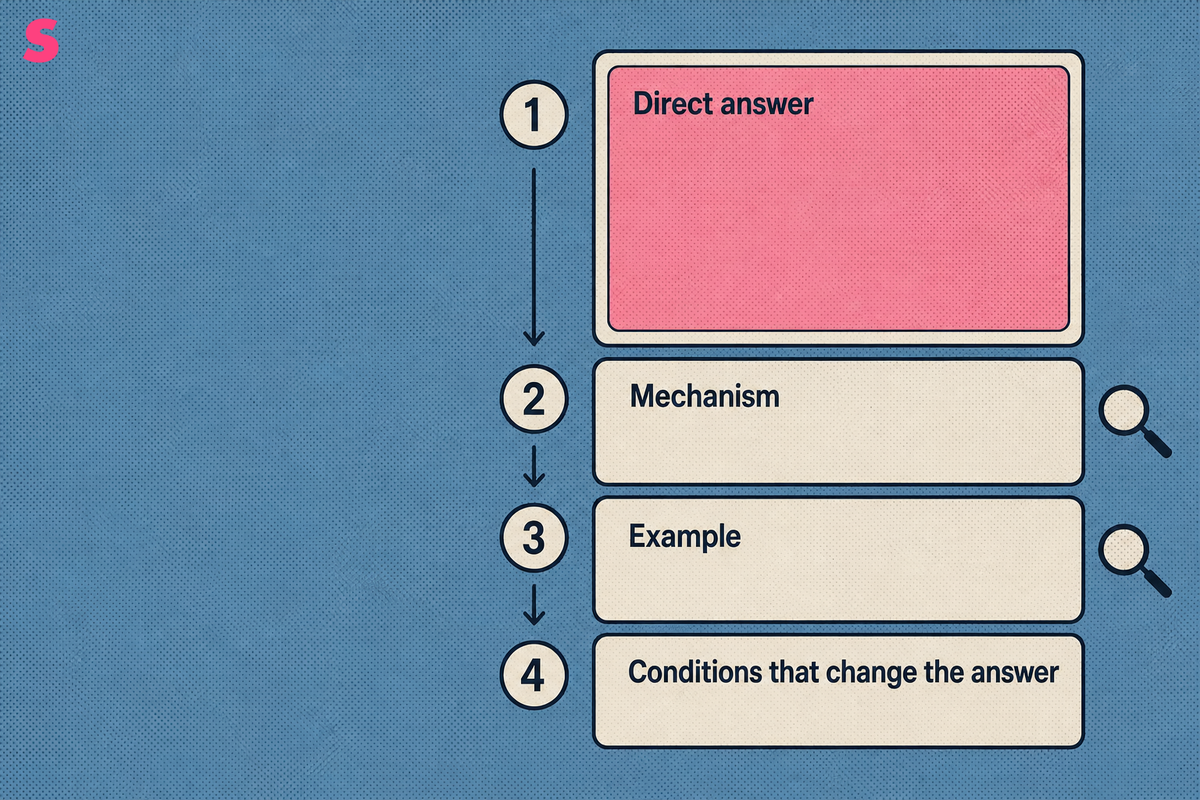
Start with a direct answer in the opening paragraph. Follow with the mechanism, an example, and the conditions that change the answer. This structure helps readers scan the page and gives an answer engine distinct passages to retrieve.
A page about AI search attribution should define attribution, explain how AI-referred visits enter analytics, describe zero-click research, and distinguish a citation from a conversion. A paragraph that merely says AI search is important does not resolve informational intent.
- Use headings that match real buyer questions.
- Define specialist terms before applying them.
- Use comparison tables when a buyer needs to evaluate alternatives.
- State implementation steps in order.
- Keep claims specific enough to verify against a source or operating process.
Conversational search visibility does not require every page to become a generic FAQ. A strong page has a coherent argument, a defined audience, and enough depth to answer follow-up questions. Q&A blocks work when they clarify genuine objections or operational details.
Does traditional SEO still matter for ChatGPT, and how does GEO differ?
Traditional SEO still matters for ChatGPT because crawlability, structured content, authority, and accurate indexing support retrieval. Generative engine optimization (GEO) builds on those foundations, but measures whether a brand is cited, recommended, and represented correctly in AI-generated answers.
GEO improves visibility in ChatGPT searches. SEO focuses on search results, organic clicks, and page performance. GEO adds measures such as citation share, recommendation rate, sentiment, competitor mentions, and answer inclusion for defined prompts.
The distinction is operational. A Google SEO program can improve a page’s relevance and technical health, while a GEO program measures whether that page appears when a buyer asks a conversational comparison or implementation question. Google AI Overviews are part of Google’s search experience, whereas ChatGPT answers are conversational and can continue across follow-up prompts.
E-E-A-T, meaning Experience, Expertise, Authoritativeness, and Trustworthiness, and local listings contribute to ChatGPT ranking optimization. They are signals, not guarantees that a business will be recommended for every query.
Teams should retain conventional SEO reporting while adding an AI answer measurement layer. The disciplines share page-level work, but answer different questions about buyer discovery and evaluation.
What does ChatGPT visibility tracking software cost?
ChatGPT visibility tracking software ranges from entry plans under $100 per month to custom enterprise pricing. Price alone is incomplete because prompt volume, answer-engine coverage, refresh cadence, agency support, and attribution determine what a team can measure.
The comparison below uses public plan information as of October 2026. Cost per daily tracked prompt uses a shared comparison unit where a daily cadence and sufficient plan detail are published.
| Tool | Starting price | Agency Plans? (Yes/No) | # of Answer Engines Tracked | Answer Engines | # of Daily Tracked Prompts (entry plan) | Cost per Daily Tracked Prompt | Differentiation |
|---|---|---|---|---|---|---|---|
| Sona AI Visibility | From $75/month, billed annually | Yes | Up to 11 (3 on Starter) | Not published | 5,000 credits/month, about 56 daily tracked prompts across three engines | About $0.45 per daily tracked prompt | Connects AI citations and prompts to pipeline and revenue on one account timeline. |
| Profound | Free Trial; Enterprise custom pricing | Yes | Up to 9 (3 on free Trial) | ChatGPT, Gemini, Google AI Overviews | 50 prompts daily for 7 days | Cannot be calculated because brand pricing is custom | Trial and enterprise prompt tracking across AI answer engines. |
| Peec AI | From $95/month | Yes | Up to 13 (3 of 6 on Starter, plus add-ons) | Not published | 50 prompts daily | About $0.63 per daily tracked prompt | Prompt and visibility tracking across AI answer engines. |
| Otterly.ai | From $29/month | Yes | Up to 7 (4 on Lite, 3 as paid add-ons) | ChatGPT, Google AI Overviews, Perplexity, Microsoft Copilot | 15 prompts daily | About $0.48 per daily tracked prompt | AI search monitoring across supported answer engines. |
| Scrunch AI | From $250/month | Yes | Up to 9 (4 on Core) | ChatGPT, Perplexity, Google AI Overviews, Microsoft Copilot | 125 prompts, refresh cadence not published | No refresh cadence published | Brand monitoring across AI answer engines. |
| AthenaHQ | From $295/month, annual billing | Yes | 11 | Not published | 3,600 credits/month, unlimited prompts; refresh cadence not published | No refresh cadence published | Credits-based AI response monitoring. |
| PromptWatch | From $95/month | Yes | Not published | Not published | 50 prompts daily | About $0.48 per daily tracked prompt | Prompt monitoring with monthly response allowances. |
Review pricing before purchase because plan allowances and engine coverage change. The right plan covers the prompt set, reporting cadence, and buyer journey a team needs to measure.
What should you compare across ChatGPT visibility trackers besides price?
Compare a ChatGPT tracker on prompt methodology, daily cadence, engine coverage, citation evidence, historical reporting, and its connection between answers and business outcomes. A low entry price has little value if the tool cannot measure the prompts that define the company’s market.
Start with prompt design. The platform should support a fixed set of commercial, informational, branded, and competitor prompts. It should also show answer context, cited pages, and competitors that appear alongside the brand.
- Cadence: daily prompt runs create a usable time series, while a single check is only a dated snapshot.
- Answer capture: the tool should identify mentions, citations, and recommendation context.
- Prompt governance: teams need tags for segment, product, buyer stage, and intent.
- Page-level diagnosis: reporting should identify the page associated with a citation gap and the work required.
- Business measurement: AI-referred visits should connect to accounts, opportunities, and closed revenue.
Sona AI Visibility combines citation tracking with AI crawler activity and account-level attribution, so teams can examine whether a page was reachable, appeared in answers, and produced measurable downstream activity. That scope differs from tracking mention counts alone.
A complete technical audit should run monthly or quarterly because schema changes, content revisions, and canonical corrections need time to settle. Prompt monitoring requires a daily cadence. The activities answer different operational questions.
How do you connect ChatGPT visibility to traffic, pipeline and revenue?
ChatGPT visibility connects to revenue only when a company can trace AI-influenced activity from an answer or referral through identified accounts, pipeline, and closed-won outcomes. Citation counts show discovery. They do not prove commercial impact.
ChatGPT referral traffic to small-business websites rose 115% while ChatGPT visits to those sites fell 50% over the measured period, according to commercialappeal.com, October 2026. The figures show why raw visits are an unstable proxy for value. Fewer visits can contain higher-intent buyers, while a large traffic increase can produce no pipeline.
- Track a fixed prompt set and record brand mentions, citations, and recommendation context daily.
- Tag AI-referred sessions and capture self-reported attribution in demo and signup forms.
- Resolve those sessions to accounts where identification is available.
- Join account activity to CRM opportunities, pipeline stages, and closed-won revenue.
- Compare AI-influenced opportunities with the prompt, page, and answer-engine activity that preceded them.
Monitoring which AI answers mention a brand is only half the job. Sona AI Visibility closes the other half through AI Attribution, which connects AI citations to accounts, pipeline, and closed-won revenue on one timeline.
This method also handles zero-click research. A buyer can use ChatGPT for evaluation, visit later through another channel, and report ChatGPT in a form field. Joining self-reported information with session and CRM data gives the revenue team a more complete record than referral traffic alone.
What are the frequently asked questions about ChatGPT search visibility?
Is ChatGPT search visibility the same as ranking in ChatGPT?
No. ChatGPT has no stable ranking list equivalent to a conventional search results page. Visibility is how often a brand appears across a defined prompt set, so teams should report an inclusion rate, citation share, and recommendation rate rather than one position.
Can I check for free whether ChatGPT mentions my brand?
Yes. A ChatGPT visibility checker can show whether ChatGPT mentions, recommends, or ignores a brand for category questions. A free check is a point-in-time result, not ongoing tracking. The Free AI Readiness Checker serves a different purpose: it evaluates whether AI engines can crawl and parse a site.
Do Google Reviews influence whether ChatGPT recommends a business?
Google Reviews contribute to ChatGPT recommendation optimization, alongside local listings and E-E-A-T. The October 2026 listing put the average rating of companies recommended by ChatGPT at 4.3 stars. Reviews do not guarantee a recommendation because answer context and user prompts also shape the response.
Is GEO the same as SEO?
No. GEO builds on SEO foundations but focuses on improving visibility in AI answers. GEO adds measures such as citation share, sentiment, recommendation context, and competitor mentions, while SEO remains focused on organic search performance and page accessibility.
How often should I measure ChatGPT search visibility?
Measure a fixed prompt list daily. Answers vary by wording, model, retrieval index, and time, so a stable trend matters more than a single check. The same movement across four days is stronger evidence than one answer.
Does appearing in ChatGPT answers drive website traffic?
Not reliably. ChatGPT referral traffic to small-business sites rose 115% while ChatGPT visits fell 50% in the period measured by commercialappeal.com, October 2026. Citations should therefore connect to sessions, account activity, pipeline, and revenue rather than serve as proof of traffic or conversion.
Summarize this article with AI: ChatGPT · Claude · Perplexity · Google AI Mode
Last updated: October 2026







