To calculate share of voice, divide your brand’s metric by the total market metric for the same competitor set, then multiply by 100. Since metrics vary by channel, specify them: PR and social mentions, SEO estimated clicks, paid-media impressions or spend, and AI-search mentions or citations from repeated prompt runs. Keep the competitor set, date range, and geography constant for comparable percentages over time.
How do you calculate share of voice, and what is the formula?
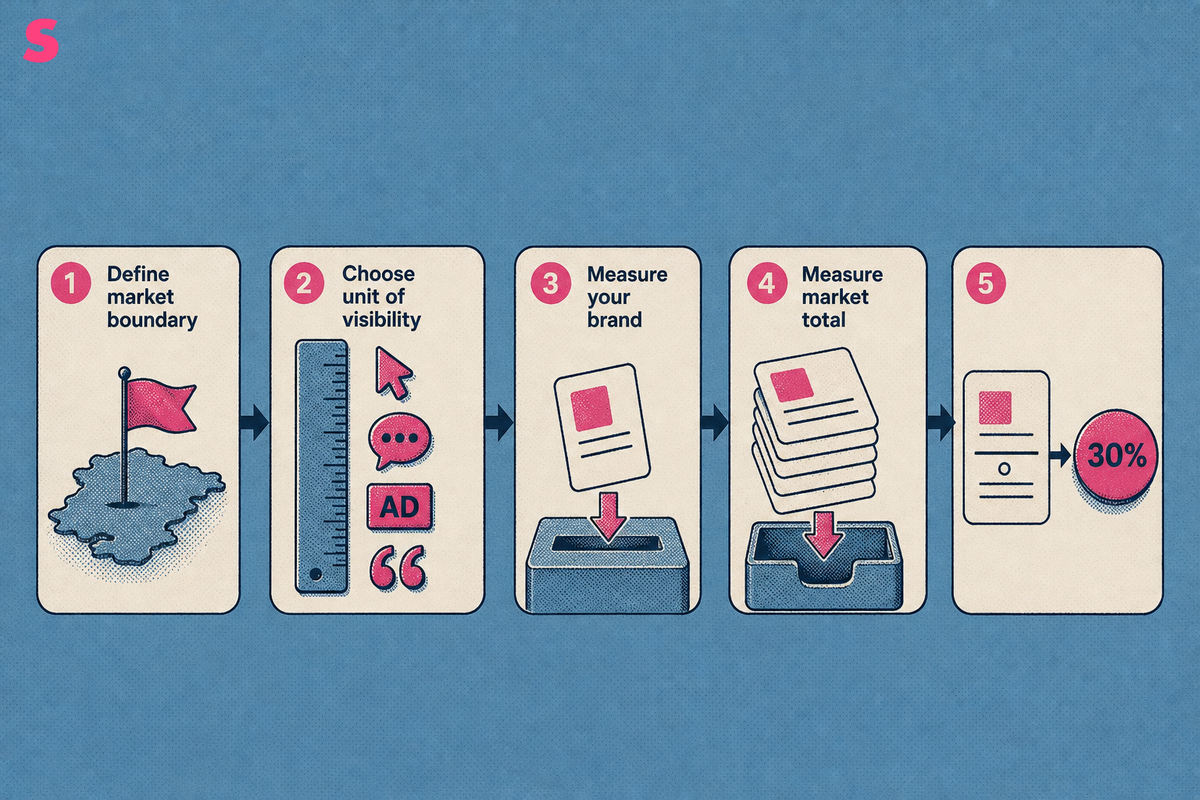
To calculate share of voice, divide your brand’s measured visibility by total visibility across every brand in the defined market, then multiply by 100. The core formula is Your Brand Metric ÷ Total Market Metric × 100. The metric changes by channel, but the denominator must include the same competitor set.
Share of voice shows how much attention a brand receives relative to competitors in its industry, per youtube.com. It is a relative metric. A brand can gain mentions, impressions, or rankings while its share falls if the market grows faster.
Prerequisite: define the market boundary before step one. Name the brands, date range, geography, channel, audience, and metric. Without a consistent boundary, the numerator and denominator describe different markets.
- Choose the unit of visibility. Use estimated clicks for SEO, mentions for social and PR, impressions for paid media, or mentions and citations for AI search.
- Measure your brand. Count the selected metric within the defined period and market boundary.
- Measure the market total. Add the same metric for your brand and every included competitor.
- Calculate the percentage. Divide your number by the total, then multiply by 100.
For example, a brand that captures 15,000 of an estimated 50,000 monthly clicks across a keyword set has 30% SEO share of voice, per the October 2026 listing. Both values use the same keyword set and monthly period.
What do you need to decide before you calculate share of voice?
Before calculating share of voice, decide the competitor set, measurement window, geography, audience segment, channel, and unit of visibility. These choices define the denominator. A precise calculation with an unstable denominator creates a misleading trend.
Start with a stable core competitor list. Include brands that buyers genuinely compare, rather than every business appearing in a single search result or social conversation. Keep that core set unchanged for trend reporting, then create separate wider-market views when category expansion matters.
- Market: category, product line, or use case.
- Audience: enterprise buyers, small businesses, developers, or another defined segment.
- Geography and language: do not combine result sets from different countries.
- Time period: use a fixed week, month, or quarter for every brand.
- Metric: clicks, impressions, mentions, reach, citations, or another channel-appropriate measure.
The share-of-voice metric changes by channel, per the October 2026 listing. Organic keywords, impressions, reach, media mentions, and hashtags can support valid calculations when they match the reporting goal, per the October 2026 listing.
A sound setup produces a measurement brief another analyst can repeat without interpretation. It should state the exact keyword list, named competitors, reporting geography, and reporting period. Use that brief as the control document for later calculations.
How do you calculate SEO share of voice from rankings, search volume and click-through rates?
Calculate SEO share of voice by estimating the clicks each brand receives across a fixed keyword set, then dividing your estimated clicks by total estimated clicks for all measured brands. Rankings alone are insufficient. A position-one result on a low-demand query has less traffic potential than a position-three result on a high-demand query.
- Build the keyword set. Include category, comparison, problem, and solution terms that represent the market you want to measure.
- Record each brand’s ranking. Use the same country, device, language, and search date for every domain.
- Assign demand and click estimates. Multiply each keyword’s search volume by the click-through rate associated with each observed ranking.
- Add estimated clicks by brand. This produces one visibility total per domain.
- Divide your total by all brands’ totals. Multiply the result by 100 for SEO share of voice.
For Google search, the calculation can use weighted impressions or visibility points divided by total visible impressions across competitors, multiplied by 100, per the October 2026 listing. Every competitor needs the same keyword universe, weighting model, and date range.
Sona AI Visibility can connect the keyword, prompt, page, account, and revenue chain, helping teams distinguish broad search demand from questions that generate commercial buyer activity. A share-of-voice percentage remains a visibility measure, not proof of pipeline contribution.
An SEO share-of-voice calculation is auditable when a ranking move changes the weighted click estimate in a reproducible model. If a report cannot show the keywords, ranking positions, volumes, and click-through assumptions behind the percentage, the figure is a presentation metric rather than an auditable calculation.
How do you calculate social and PR share of voice from brand mentions?
Calculate social and PR share of voice by dividing your brand’s qualifying mentions or earned-media coverage by total qualifying mentions or coverage for all included brands, then multiplying by 100. The formula is the same for both channels, but the inclusion rules differ.
For PR measurement, divide your brand’s earned media coverage by total media coverage and multiply by 100, per the October 2026 listing. For social measurement, count mentions, posts, reach, or hashtags only after defining rules for owned posts, reposts, replies, spam, and ambiguous brand names.
- Write the listening query. Include brand names, product names, common misspellings, and relevant hashtags.
- Apply exclusions. Remove unrelated uses of the brand term, duplicate coverage, spam, and internal company posts if the goal is earned attention.
- Classify each mention. Tag brand, channel, geography, publication type, and sentiment where available.
- Calculate the denominator. Add all qualifying mentions or coverage across the defined competitor set.
- Calculate each brand’s share. Divide brand mentions by total qualified mentions, then multiply by 100.
A mention count measures volume, not quality. Report share of voice alongside reach, sentiment, publication authority, and message theme. A brand with fewer mentions can still lead the conversations that matter most to a defined buying audience.
A common error is mixing owned and earned content without labeling either category. Rebuild the report with separate earned, owned, and partner categories. The revised comparison shows whether share came from independent attention or publishing activity under the brand’s control.
How do you calculate paid-media share of voice from impressions, spend or impression share?
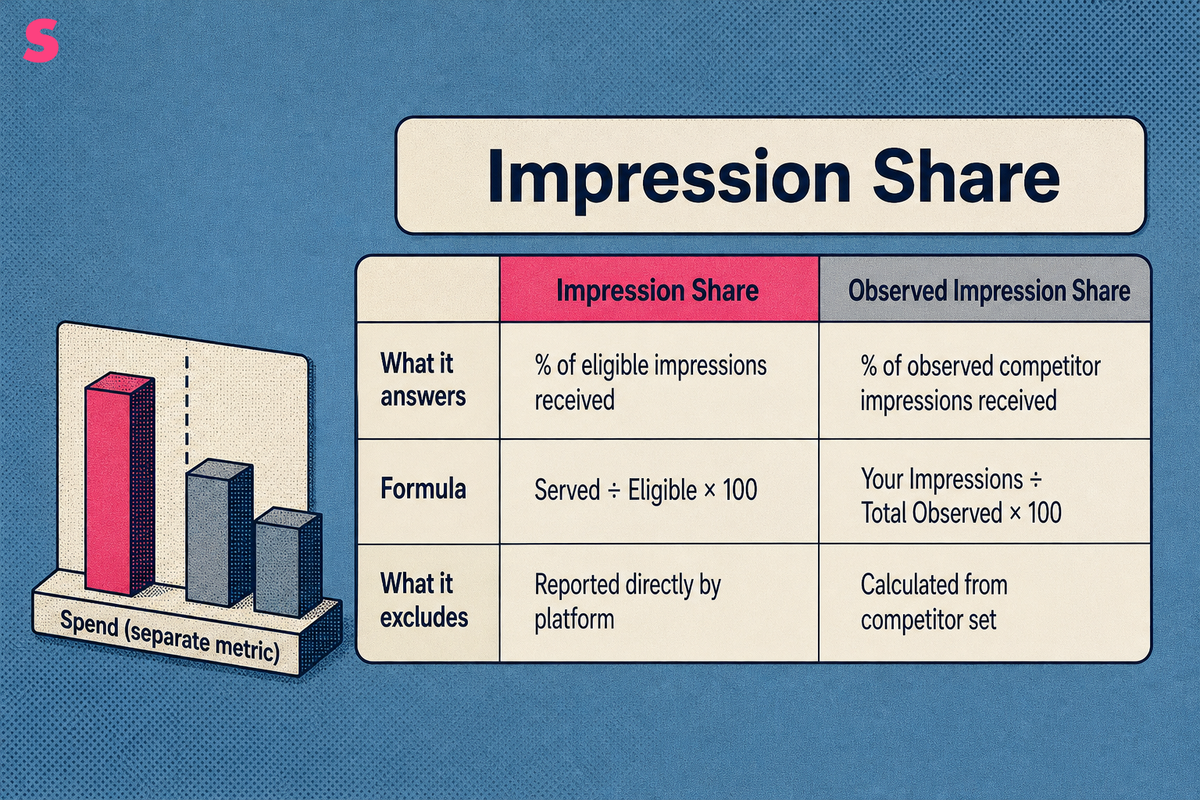
Calculate paid-media share of voice with impression share when the advertising platform provides it, or with your brand’s impressions divided by total observed competitor impressions when it does not. Spend supports budget analysis, but spend share is not the same as visibility share.
Impression share answers a specific question: what proportion of eligible ad impressions did your campaigns receive? Observed impression share answers another question: what proportion of measured competitive impressions did your brand receive within a selected auction, publisher, or media set?
- Select the inventory. Define the search campaigns, publishers, audiences, placements, or auction insights data included in the report.
- Use one reporting period. Align every advertiser’s impression data to the same dates and geography.
- Choose the calculation method. Use the platform-reported impression-share percentage directly, or divide served impressions by estimated eligible impressions and multiply by 100.
- Calculate observed competitor share separately. Divide your served impressions by observed impressions for every included advertiser, then multiply by 100.
- Separate visibility from efficiency. Report share of voice with spend, cost per click, conversions, and pipeline as distinct metrics.
A paid-media share-of-voice report must identify whether the percentage represents eligible inventory, observed competitor inventory, or budget. Treating these measures as one creates false comparisons because each uses a different denominator.
A common failure is comparing impression share from one campaign structure with spend share from another. Choose one visibility measure for the trend line, then show spend in a supporting column. This preserves the distinction between buying more exposure and winning more available exposure.
How do you calculate share of voice in AI search from mentions and citations?
Calculate AI search share of voice by running a fixed prompt set across a consistent set of answer engines, counting each brand’s mentions or citations, then dividing each brand’s total by all qualifying brand occurrences. Report mention share and citation share separately because being named differs from being cited as a source.
- Build a prompt set. Include category, problem, comparison, implementation, and purchase-intent prompts.
- Fix the collection rules. Use the same answer engines, geography, language, prompt wording, and competitor list for every run.
- Code each answer. Record brand mentions, cited domains, answer position, source type, and sentiment.
- Calculate separate denominators. One denominator covers all brand mentions, while another covers all citations.
- Calculate the shares. Divide your mention or citation count by the corresponding total, then multiply by 100.
A brand-level AI visibility score is not an action plan. Prompt-level results show which prompts produce a citation, which sources answer engines select, and which pages need attention. Sona AI Visibility connects citations to pipeline and revenue on one account timeline, while AI Search Insights shows tracked prompts and the sources AI cites.
Run the same prompt list daily to identify patterns that a weekly snapshot can obscure. Answers change with retrieval indexes, model updates, and new competitor content. Confirm movement across repeated runs before treating it as a trend.
Sona AI Visibility tracks 11 AI engines, per Sona product documentation, October 2026. That coverage does not remove the need for a disclosed methodology. A credible AI share-of-voice report states the prompt set, engine set, run dates, coding rules, and sample size.
Which share-of-voice calculation fits which channel?
The right share-of-voice calculation uses the visibility unit native to each channel. Use weighted clicks for SEO, qualified mentions for social and PR, impressions for paid media, and separate mention and citation counts for AI search. Combining those units into one percentage obscures what each channel measures.
| Channel | Primary numerator | Market denominator | Calculation | What success looks like |
|---|---|---|---|---|
| SEO | Estimated clicks or weighted visibility points | Total estimated clicks or visible impressions across tracked domains | Brand SEO visibility ÷ market SEO visibility × 100 | A reproducible percentage tied to a fixed keyword set |
| Social | Qualified brand mentions, reach, or hashtags | Qualified competitor mentions, reach, or hashtags | Brand social metric ÷ total social metric × 100 | A trend that separates earned and owned attention |
| PR | Earned media coverage | Total earned media coverage | Brand coverage ÷ total coverage × 100 | A defensible view of media attention by topic or publication type |
| Paid media | Served or eligible impressions | Observed competitor impressions or eligible impressions | Brand impressions ÷ total impressions × 100 | A clear distinction between inventory share and budget share |
| AI search | Brand mentions or citations | Total qualifying mentions or citations across brands | Brand occurrences ÷ total occurrences × 100 | Prompt-level evidence of where the brand appears and why |
| Scenario | Inputs | Direction of share of voice | Interpretation |
|---|---|---|---|
| SEO example | 15,000 estimated clicks out of 50,000 total monthly clicks | 30% | The brand captures 30% of visibility in the defined keyword market, per the October 2026 listing. |
| Brand visibility rises, but market visibility rises faster | Your numerator increases while the denominator increases by more | Falls | The brand gained visibility in absolute terms but lost relative attention. |
| A competitor joins the denominator | Your numerator stays constant while total market visibility expands | Falls | The percentage changed because the market definition changed, not necessarily because brand visibility declined. |
| The ratio remains unchanged | Your numerator and market denominator grow at the same rate | Stable | A stable percentage shows maintained relative visibility, even when total category attention changes. |
The formula remains constant, but the business question changes. SEO share estimates discoverability through search results. Paid share measures available ad exposure. AI share measures visibility inside generated answers. Keep channel calculations separate before comparing their strategic implications.
Why does share of voice matter?
Share of voice matters because it benchmarks competitive visibility, detects changes in relative attention, diagnoses channel-level performance, and provides a comparison point for market performance. It shows whether a brand is gaining or losing attention within a defined market, but it does not itself prove revenue, pipeline, or market share.
A share-of-voice number is accurate and comparable when every reporting run uses the same market boundary, competitor set, collection rules, weighting model, and date window. Accuracy comes from controlled inputs, not a more precise-looking percentage.
Create a calculation log with the keyword list or prompt list, sources, inclusion rules, exclusions, geography, language, device, reporting dates, and formula version. When a number changes, the log shows whether market visibility moved or the measurement design changed.
- Keep the denominator stable: retain a core competitor set for trend reporting.
- Version the input set: label added keywords, prompts, or channels instead of silently replacing them.
- Audit outliers: inspect unusual jumps for duplicate mentions, ranking-data changes, or prompt-response variance.
- Match cadence to the source: run AI prompt lists daily, while competitive benchmark reviews can run quarterly.
A score is a dated snapshot. A comparable series of scores reveals the trend. Sona AI Visibility keeps prompt history across tracked prompts, allowing teams to compare changes rather than treating one answer-engine result as a durable market position.
What goes wrong when you calculate share of voice, and how do you fix it?
Share-of-voice calculations fail when the numerator and denominator use different rules, competitors change without disclosure, or teams mix visibility metrics with commercial outcomes. Document the market boundary, rebuild the denominator, and report each metric separately.
Failure: using a changing competitor set. Adding a new competitor makes every existing brand’s percentage smaller even if no brand lost visibility. Keep a stable core set for the trend line, then label a wider market view as a separate report.
Failure: counting incomparable events. A social report that mixes posts, reach, and impressions has no single unit of visibility. Choose one numerator per calculation. Build additional calculations when leadership needs reach and engagement alongside mention share.
Failure: treating a score as an action plan. A single brand-level percentage identifies a measurement outcome but does not identify the content, query, page, or source behind the movement. Review the underlying keyword, prompt, publication, or placement rows.
Failure: running AI prompts once. Generated answers vary. Use a fixed prompt list, consistent engines, repeated runs, and disclosed sample size. Sona AI Visibility also tracks which AI crawlers reach pages, which matters because a page that is not reached cannot contribute to a citation opportunity.
The recovery standard is simple: another analyst should be able to reproduce the result from saved inputs. If they cannot identify the brands, data period, source records, and formula, the percentage should not drive a budget or strategy decision.
What are the frequently asked questions about share of voice?
What is the difference between share of voice and share of market?
Share of voice measures attention or visibility against competitors through mentions, clicks, impressions, or citations. Share of market measures actual sales or revenue. The metrics can show whether visibility aligns with commercial performance, but they are not interchangeable.
Can you calculate share of voice in a spreadsheet?
Yes. A spreadsheet works for categories with few competitors and a small keyword or prompt set. Use one row per brand, one column per metric, and one total for the denominator. Manual tracking stops scaling when prompt variation, multiple geographies, daily collection, or large mention volumes require repeatable data collection. Manual spreadsheet tracking is suitable for less competitive categories, per reddit.com.
How many times should you run each prompt to calculate AI share of voice?
Run each prompt more than once because AI answers vary between runs. Use fixed prompts, a consistent set of answer engines, repeated runs, and a reported sample size. Run the same prompt list daily to distinguish sustained movement from one-day answer variation.
Is mention share the same as citation share in AI search?
No. Mention share counts how often a brand is named in generated answers. Citation share counts how often a brand’s pages are cited as sources. Report both measures separately, alongside answer position and sentiment, because a brand can receive a mention without a source citation.
How often should you recalculate share of voice?
Recalculate share of voice on a fixed schedule that matches the channel’s data source, using the same competitor set, date range, geography, and collection rules each time. Consistent cadence matters more than a frequent but changing methodology. AI prompt lists require daily tracking, while broader competitive reviews can run quarterly.
Does adding or removing competitors change your share of voice?
Yes. Competitors make up the denominator, so adding or removing a brand changes every participant’s percentage. Keep a stable core competitor set for trend reporting, and label any wider market set as a separate view rather than presenting both calculations as one continuous series.
Summarize this article with AI: ChatGPT · Claude · Perplexity · Google AI Mode
Last updated: October 2026