


For AI-assisted keyword research, ask an AI model to turn seed topics into potential keywords, then validate each one using actual search volume, difficulty and search results before setting priorities. Chat models do not contain keyword databases, so any volume and difficulty numbers they generate without input may be made up. Supply the model with customer wording, product context and an exported dataset, then have it categorize intent and group terms into clusters. Prioritize the remaining keywords according to business value rather than volume by itself.
What do you need before you start keyword research with AI?
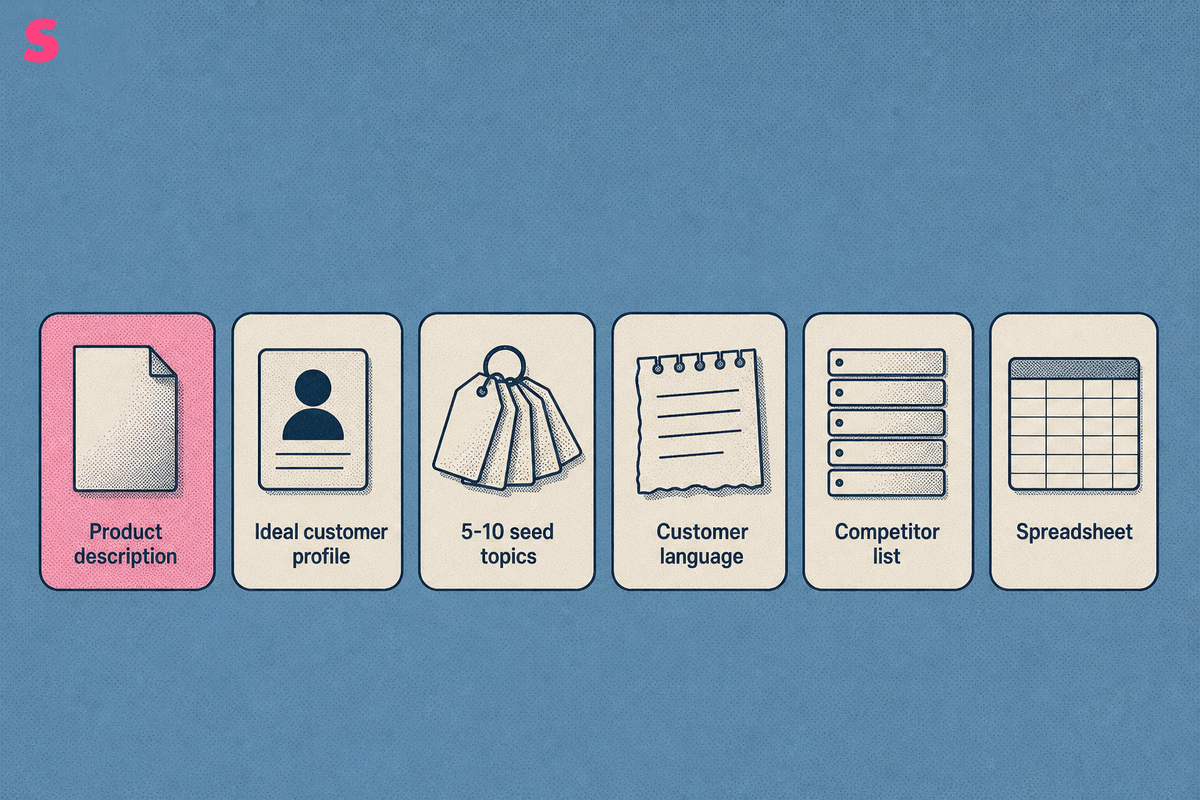
To learn how to do keyword research using AI, prepare the inputs before opening a chat model. Write a one-paragraph product description, define the ideal customer profile, list 5 to 10 seed topics, collect customer language, identify competitors, and open a spreadsheet for the working list.
- A product description that explains the problem, buyer, use case, and differentiation.
- An ideal customer profile, including company type, role, and buying trigger.
- Five to 10 seed topics drawn from product categories, jobs to be done, and sales conversations.
- Real wording from sales calls, demo notes, support tickets, and objection handling.
- A competitor list, Google Search Console access, Google Keyword Planner access, and a spreadsheet.
AI-assisted research and traditional keyword research serve different purposes. A chat model generates hypotheses, expands topics, classifies intent, and clusters related phrases. Google Search Console, Keyword Planner, and commercial keyword databases provide the volume, difficulty, ranking, and SERP evidence needed to decide which terms deserve pages.
AI speeds up early research. It can surface long-tail and semantically related phrases, compare a supplied competitor list with current coverage, and organize a large export into usable groups. Sanity.io notes that AI tools can identify patterns and discover long-tail keywords and semantic phrases. The model still needs search data before a team assigns work.
How do you use ChatGPT to generate a keyword list from a topic, audience and search intent?
Use ChatGPT as a structured idea generator, not as a keyword database. Give the model product context, customer language, and a defined output format, then treat the resulting list as hypotheses for validation. Generic prompts produce generic keywords because the model lacks information that distinguishes your market.
- Build the prompt brief. Include product, audience and role, buying stage, customer phrases, competitors, search intent wanted, and output format.
- Generate and expand. Request seed keywords first, then ask for sub-topics and long-tail variations within each sub-topic.
Prompt: You are supporting B2B SaaS keyword research. Product: [description]. Audience and role: [ICP]. Buying stage: [awareness, consideration, decision, or purchase]. Customer phrases: [phrases]. Competitors: [list]. Search intent wanted: [intent]. Return 30 keyword ideas in a table with keyword, parent topic, intent, buyer stage, and rationale. Do not provide search volume, keyword difficulty, or traffic estimates.
For sub-topic expansion, use a two-pass pattern described by Search Engine Journal. First ask: Generate an answer for the 3 most popular sub-topics related to [Topic]. Then request related keywords, questions, comparison terms, and implementation queries for each sub-topic. This produces a broader list without combining every intent in one prompt.
ChatGPT supports three distinct tasks: generating ideas, analyzing an imported keyword list, and supporting related work such as content briefs or intent labels. The output remains a hypothesis list. ChatGPT has no native keyword database, and any unprompted volume, difficulty, or SERP figure is unverified.
How do you check AI keyword ideas against real search volume and difficulty?
Validate every AI-generated keyword against a real data source before prioritizing it. “ChatGPT has no keyword database of its own, so any volume, KD, or SERP figures it generates unprompted are fabricated,” wrote the Ahrefs editorial team, April 30, 2026.
- Use Google Search Console for owned-query impressions, clicks, and positions.
- Use Keyword Planner for demand estimates and advertiser competition.
- Use an SEO keyword database for its modeled organic difficulty metric.
- Review the live SERP for intent, ranking page types, authority, ranking feasibility, and the companies already competing.
- Estimate traffic potential from the topic and ranking landscape, not volume alone.
- Compare the term against competitor coverage and your existing pages.
The table uses price bands from October 2026 listings. Entry-level keyword research products were listed between $20 and $60 per month, while full SEO suites were listed above $100 per month in October 2026. A chat model can accelerate analysis, but validation requires a source containing observed search data.
| Data source category | Where the numbers come from | Intent and clustering role | Cost band |
|---|---|---|---|
| Chat model alone | Model-generated language, without a native keyword database. | Generates ideas, labels intent, and proposes semantic groups. | Free or low-cost access varies by model. |
| First-party Google sources | Search Console performance data and Keyword Planner estimates. | Validates existing demand and informs manual intent review. | Account access required. |
| SEO suite with a proprietary database | Provider-maintained keyword, ranking, and SERP datasets. | Supports keyword expansion, difficulty review, and competitor analysis. | More than $100 per month for full suites, per October 2026 listings. |
| SERP-aware clustering specialist | Keyword data combined with observed ranking-page overlap. | Groups terms by shared SERP intent and page type. | $20 to $60 per month at entry level, per October 2026 listings. |
Use the chat model after importing validated columns. Provide the keyword, volume, modeled organic difficulty, current rank, target country, and page URL where available. The model can explain patterns without inventing the measurements behind the decision.
How do you use ChatGPT with an exported keyword CSV?
Use ChatGPT with an exported CSV after the file has real volume and difficulty columns. Export data from Google Search Console, Keyword Planner, or a keyword tool, remove malformed rows, and upload or paste only the fields needed for analysis.
- Export keywords with volume, difficulty, clicks, impressions, current position, and URL when available.
- Remove empty rows, duplicate headers, unrelated countries, and formatting errors.
- Upload the cleaned file or paste a controlled sample into the chat.
- Ask for normalization, deduplication, relevance review, and coverage gaps.
Prompt: Analyze this keyword CSV. Keep the supplied volume and difficulty values unchanged. Deduplicate exact matches, normalize plural and singular variants, flag branded terms, flag irrelevant terms, assign informational, commercial, transactional, or navigational intent, and return a cleaned table.
Prompt: Compare this cleaned keyword list against these current page titles and URLs. Identify content gaps where a relevant keyword has no clear page owner. Return keyword, parent topic, proposed page type, existing coverage, and gap rationale.
Do not upload customer data, confidential account lists, unredacted sales notes, or private pipeline information. Keyword exports should contain search and content fields only. Sona AI Visibility can connect a keyword, prompt, page, account, and revenue workflow, but private account-level data belongs in approved systems with appropriate access controls.
How do you classify search intent and cluster keywords without causing cannibalization?
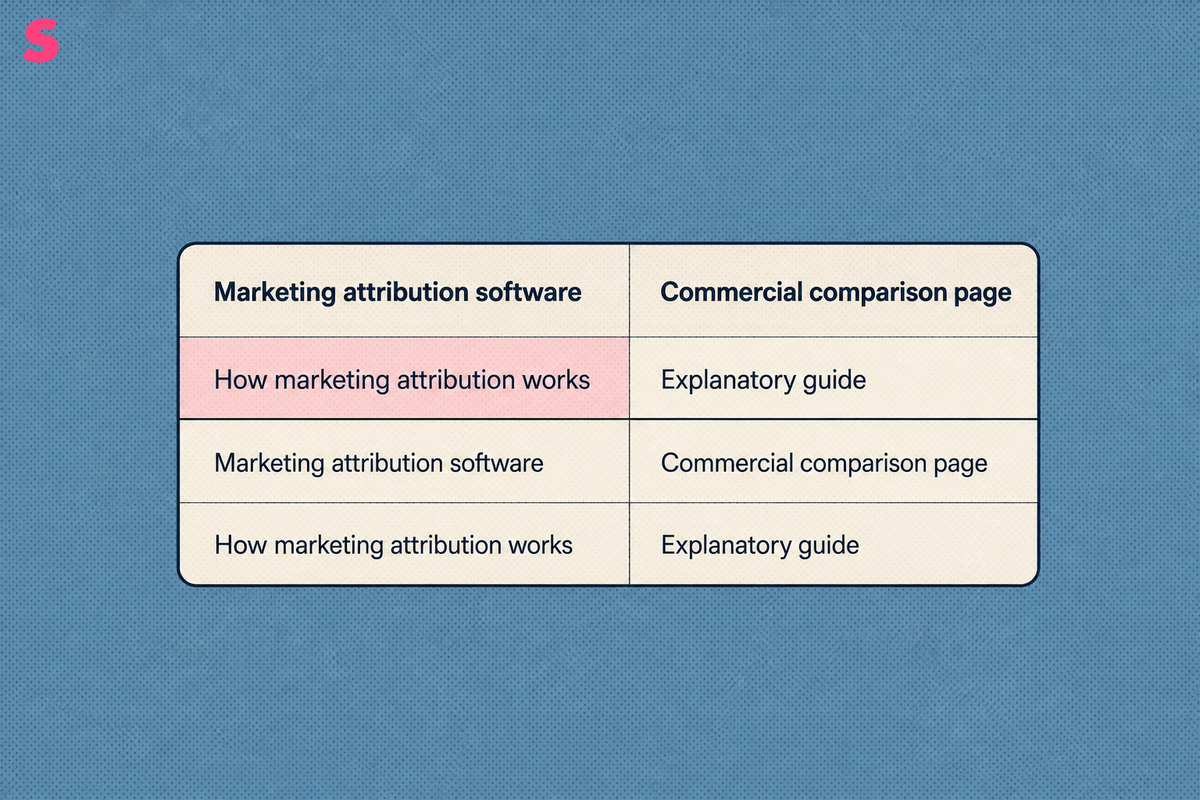
Classify keywords by intent, then cluster only terms that deserve the same page. Use AI to draft informational, commercial, transactional, and navigational labels, but require a SERP review before merging terms. If two keywords return different page types or target different audiences, they need separate pages.
Prompt: Group these keywords into parent topics. Label each keyword with search intent, buyer stage, recommended page type, and primary keyword. Do not merge keywords unless the same page can satisfy both search intents. Mark uncertain clusters for SERP review.
AI clustering can merge terms that sound related but require separate pages. “Marketing attribution software” and “how marketing attribution works” share a topic, yet one can require a commercial comparison page while the other requires an explanatory guide. Specialist SERP-aware clustering is useful because it groups keywords with ranking-page evidence rather than semantic similarity alone.
Apply a manual rule: one primary keyword, one page owner, and one confirmed intent. Review the top results for every cluster boundary. Split the cluster when dominant results differ by audience, funnel stage, format, or product category. This prevents two internal pages from competing for the same query.
A brand-level visibility score is a dated snapshot, not a work item. Sona AI Visibility uses AI Search Insights to show the prompts buyers ask, the sources AI cites, and page-level performance, so a team can identify the prompt and page requiring attention rather than treating one domain score as an action plan.
How should a B2B SaaS team prioritize AI-generated keywords?
A B2B SaaS team should prioritize validated keywords by business relevance, buying-stage intent, competition, traffic potential, and conversion value. A weighted rubric directs the team toward terms that support pipeline goals, not merely phrases with high search volume.
Use a 100-point model: business relevance, 30 points; buying-stage intent, 25 points; competition and winnability, 20 points; traffic potential, 15 points; and conversion value, 10 points. Rate each field from 1 to 5, then calculate each contribution as (rating ÷ 5) × weight. Define competition as winnability, where 5 means the strongest ability to rank and 1 means the weakest.
| Keyword | Business relevance | Buying-stage intent | Winnability | Traffic potential | Conversion value | Priority score |
|---|---|---|---|---|---|---|
| marketing attribution software | 5 of 5, 30 points | 4 of 5, 20 points | 3 of 5, 12 points | 4 of 5, 12 points | 5 of 5, 10 points | 84 of 100 |
| what is marketing attribution | 3 of 5, 18 points | 2 of 5, 10 points | 3 of 5, 12 points | 4 of 5, 12 points | 3 of 5, 6 points | 58 of 100 |
A low-cost stack can combine a free or low-cost chat model, Google Search Console, Keyword Planner, and a limited SEO-tool plan. October 2026 listings placed entry-level keyword products between $20 and $60 per month. Fund validation first, because a polished keyword list without reliable metrics creates false certainty.
Add proprietary customer insight, product knowledge, and original data to the prompt brief. Sona AI Visibility supports a keyword-to-prompt-to-page workflow, which helps a team prioritize terms by buyer question and page opportunity rather than keyword inclusion alone.
How can you test an AI keyword research workflow so the results are reproducible?
Test an AI keyword research workflow with fixed inputs, named approaches, repeated runs, and pre-registered scoring rules. Compare a structured single-pass prompt with a two-pass sub-topic expansion workflow, using three independent runs and 50 candidates from each run for each approach.
Use this exact single-pass test prompt: You are supporting B2B SaaS keyword research. Product: software that connects B2B marketing touchpoints to pipeline and revenue. Audience and role: United States demand generation managers at B2B SaaS companies. Buying stage: consideration. Customer phrases: multi-touch attribution, marketing sourced pipeline, attribution reporting. Competitors: none supplied. Search intent wanted: commercial. Return exactly 50 keyword ideas in a table with keyword, parent topic, intent, buyer stage, and rationale. Do not provide search volume, keyword difficulty, or traffic estimates.
For the two-pass workflow, use the same fixed inputs. First request three sub-topics for B2B marketing attribution software. Then request exactly 50 commercial keyword ideas across those sub-topics with the same output columns. Archive both prompt texts and the unchanged input file before testing. Record the model and version, run date, available settings, country, data source, and input-file version for every run.
| Protocol step | Fixed input | Scoring criterion | Decision rule |
|---|---|---|---|
| Choose approaches | Single-pass structured prompt and two-pass sub-topic expansion | Three runs and 50 candidates per run for each approach | Reject tests with changed inputs or incomplete runs |
| Score relevance | Same product, ICP, country, and buying stage | Relevant suggestions ÷ 50. Relevant means a United States demand generation manager could plausibly search the phrase when evaluating attribution software. | Median relevance rate must reach 70%, with two of three runs meeting the threshold |
| Validate data | Same keyword database or Google source | Suggestions mapping to a database entry ÷ 50 | Median mapping rate must reach 60%, with two of three runs meeting the threshold |
| Check intent | Same country and live SERP review | Correct intent labels ÷ validated suggestions. Correct means the label matches the dominant page type among the first 10 organic results. | Median agreement must reach 80%, with two of three runs meeting the threshold |
Two reviewers should label relevance and intent independently. A third reviewer resolves disagreements, and the adjudicated label becomes the recorded result. Track duplicates as duplicate suggestions ÷ 50 and off-topic suggestions as off-topic suggestions ÷ 50. Report all six runs, not only the strongest result, because repeated model runs can vary.
After publishing pages, run the same prompt list daily when monitoring AI answers. Daily observations reveal patterns that weekly snapshots can obscure. A change that persists for four days is a trend; a one-day spike is noise.
What does it look like when AI keyword research has worked, and how do you recover when it has not?
AI keyword research has worked when every final keyword has validated volume and difficulty, confirmed SERP intent, one assigned page, and a documented priority score. The deliverable is a ranked editorial and product-content backlog that a team can execute.
- Invented metrics: Re-run the idea list against Keyword Planner, Search Console, or a keyword database. Replace model-generated numbers with exported values.
- Generic keywords: Add customer phrases, product context, competitor names, and funnel stage to the prompt. Request terms that match a defined buyer role and use case.
- Merged clusters: Review the SERP and split keywords when top results differ in intent, audience, or page type.
Use a simple quality-control sheet with keyword, validated volume, difficulty, intent, page owner, priority score, source, and review date. The review date matters because rankings and SERPs change. A score is a snapshot with a date attached.
Sona AI Visibility can carry the work from a prioritized prompt list into tracked prompt history and page-level visibility, while the keyword research spreadsheet remains the operating record for editorial decisions. Keep the keyword plan focused on pages your team can build, improve, and measure.
How do you track whether your chosen keywords earn citations in AI answers?
Track selected keywords as buyer-style prompts after the related pages ship. The keyword list becomes a prompt list for ChatGPT, Perplexity, Gemini, Claude, Google AI Overviews, and other answer engines. This lets the team monitor whether pages are cited and whether the answer changes over time.
Most tracking stops at mention counts; Sona AI Visibility connects the prompts and citations behind a page to pipeline and revenue on one account timeline, and it tracks AI crawler and agent activity that precedes that path. That separates a visible citation from a measurable marketing outcome.
Run the prompt list daily and review the pattern quarterly. Daily observations show whether a citation change holds across retrieval updates, model changes, and new competitor content. Quarterly review supports positioning changes, content investment decisions, and assessment of the broader competitive pattern.
What are the frequently asked questions about AI keyword research?
Can ChatGPT do keyword research on its own?
ChatGPT can generate keyword ideas, classify intent, and cluster a list you supply. It has no native keyword database, so any volume or difficulty figure it gives without supplied data remains unverified until checked against a real source.
Is there a free way to do keyword research using AI?
Yes. Pair a free or low-cost chat model with Google Search Console and Keyword Planner. Free AI keyword suggestion tools also exist that require a short description and no login, but every metric should come from Google sources or a validated database.
What should a keyword research prompt include?
A keyword research prompt should include a product description, audience and role, buying stage, real customer phrases, competitors, the search intent wanted, and the output format. Missing inputs commonly cause generic keyword lists.
Why are AI-generated keywords often generic?
The model only has the context in the prompt. Without customer language, product detail, competitor context, and funnel stage, it returns common phrasing for the broad topic. Specific inputs improve relevance and reduce irrelevant suggestions.
Can I trust AI keyword clusters?
Use AI keyword clusters as a first draft. Check the search results for each cluster, then split any group where the top results differ in intent, audience, or page type. Those terms need separate pages and separate page owners.
How long should a keyword list be before I prioritize it?
There is no fixed number. Keep the list long enough to cover each persona and buying stage, then remove every term without real volume data, confirmed intent, or a clear page that can own the topic.
Summarize this article with AI: ChatGPT · Claude · Perplexity · Google AI Mode
Last updated: October 2026







