AI searchability is how reliably AI engines find your brand, understand it, and name or cite it when buyers ask relevant questions. It is measured across repeated prompt runs, not single answers, and it supplements SEO rather than replacing it. Sona AI Visibility ties the prompts and citations that mention a brand to pipeline and revenue, and tracks the AI crawler activity that comes before them. Visibility counts only matter when they connect to qualified visits and deals.
What is AI searchability, and how does it differ from SEO?
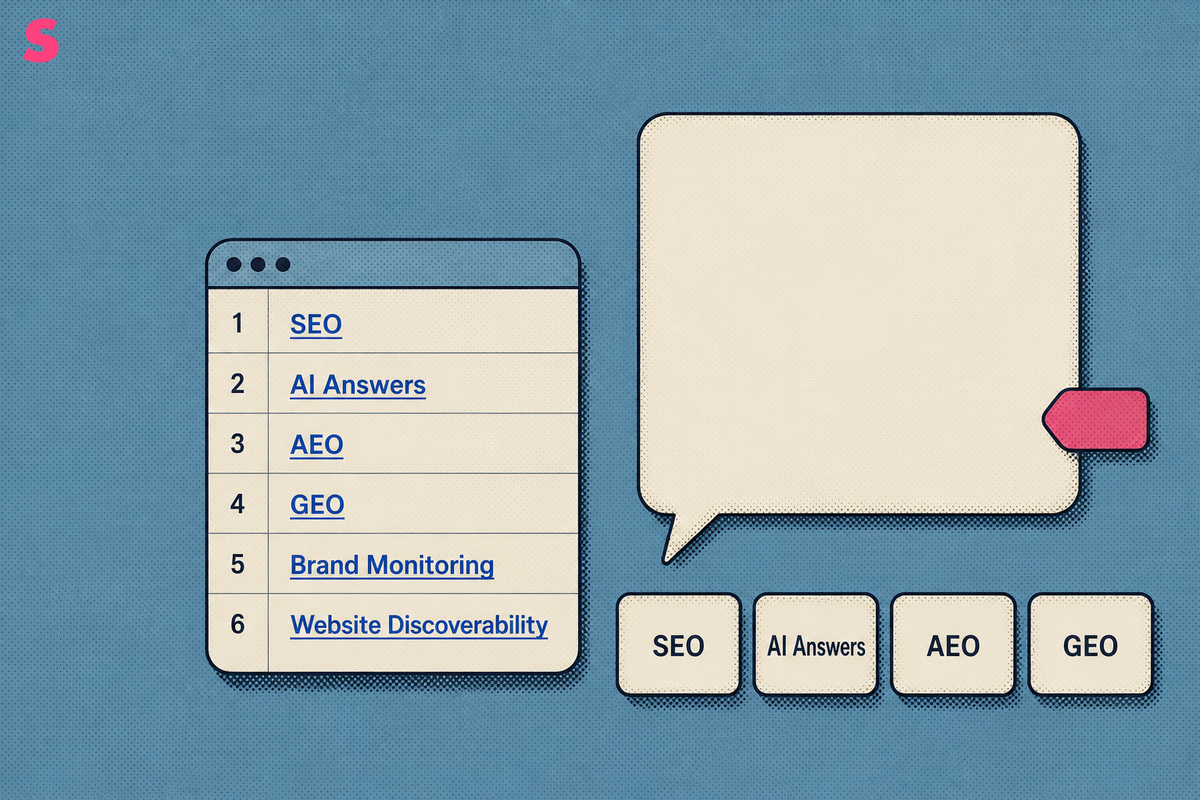
AI searchability is the degree to which AI engines can find, understand, and name or cite a brand when users ask questions it should answer. It is measured per prompt and per engine, not per keyword ranking.
SEO earns clicks from a ranked list of links. Presence in AI answers earns a place inside a synthesized response, often with no click at all. SEO remains an input, because engines retrieve and cite web content, but the output is different: a mention, a recommendation, or a citation.
Five neighboring terms get confused with it:
- SEO: rankings and organic clicks on search result pages.
- AEO (answer engine optimization): structuring content so answer engines can extract and quote it. It is a set of tactics within the broader goal.
- GEO (generative engine optimization): the same family of tactics, aimed at generative engines that compose responses.
- Brand monitoring: tracking mentions across the web and social channels, not the answers an engine generates.
- Website discoverability: whether crawlers can reach and read a page. It is necessary, but not sufficient.
Why does AI searchability matter for a B2B SaaS team?
Buyers shortlist vendors inside AI answers before they visit any site. A brand absent from that answer is absent from the shortlist, and marketing rarely sees the loss.
AI searchability supports three jobs a marketing leader already owns:
- Shortlist presence: appearing when a buyer asks an engine which tools solve a problem.
- Category defense: comparison prompts name competitors directly, so a missing brand cedes the framing.
- Pipeline explanation: AI-referred visitors often land in analytics as direct or unattributed traffic, so demand generation needs another way to show where discovery happened.
The buyer who reaches the site has already formed a view. A team that tracks only rankings and organic sessions sees the final visit and misses the research that produced it.
Which AI engines decide whether a SaaS brand gets discovered?
Seven engines matter for tracking: ChatGPT, Google AI Overviews, Google AI Mode, Perplexity, Gemini, Microsoft Copilot, and Claude. Sona's own AI visibility data, September 2026, covers eight answer surfaces: ChatGPT, Google AI Overviews, Perplexity, Google AI Mode, Gemini, Mistral, Qwen and Claude. That figure counts the surfaces measured, not their relative influence.
Each engine rewards a slightly different emphasis:
- ChatGPT: a consistent product description across your site and third-party profiles, with retrieval crawlers allowed in robots.txt.
- Google AI Overviews: strong organic fundamentals and pages that answer the question in the opening sentences, since the feature sits on Google results.
- Perplexity: citable pages with specific, dated facts, because the engine shows its sources beside each answer.
- Gemini: accurate Schema.org markup and consistent business details across Google-indexed properties.
- Microsoft Copilot: crawlable pages and accurate listings on the review and directory sites it retrieves.
Google AI Mode rewards pages that cover related follow-up questions. Claude rewards the same clear, corroborated product facts.
What makes an AI engine mention, recommend, or cite a SaaS brand?
Four factors decide it: crawl access, entity clarity, first-party evidence, and third-party corroboration. An engine names a brand when it can reach the pages, recognize the product, find specific claims, and see other sources agree.
The trace below uses a hypothetical prompt: "Which customer data platform works best for a mid-market B2B SaaS company on HubSpot?"
- Query expansion: the engine splits the prompt into sub-queries such as "customer data platform HubSpot integration" and "CDP pricing mid-market". Sona AI Visibility tracks these as fanout variations of each prompt.
- Retrieval: the engine fetches pages for each sub-query: vendor documentation, review profiles, comparison articles, community threads. A page blocked to its crawler never enters the pool.
- Synthesis: the engine drafts an answer and favors vendors whose claims are specific and consistent across the retrieved pages.
- Citation: the engine attaches sources to the claims it used. A brand can be mentioned without a citation, or cited without being recommended.
Entity clarity means the engine sees one product with one description everywhere. Corroboration means reviews and third-party profiles confirm what the vendor's own pages say.
How do you make product pages, docs, and comparison pages easier for AI engines to cite?
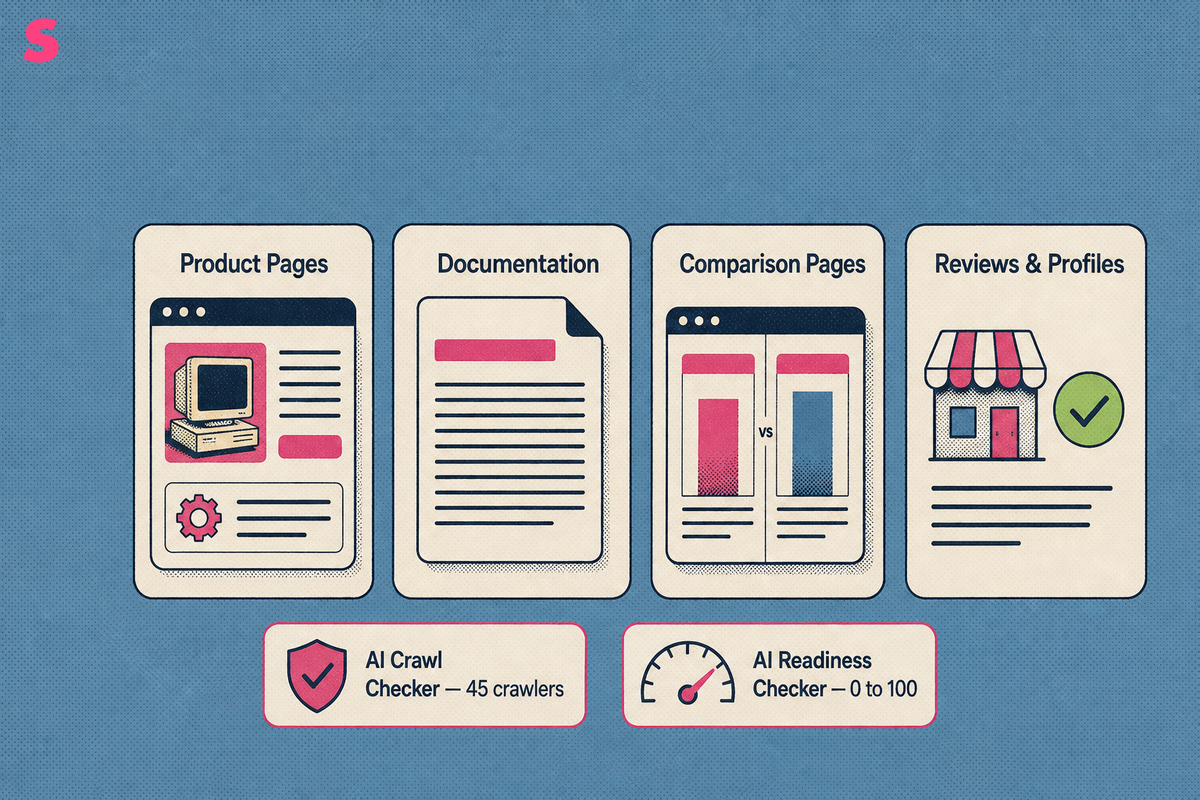
Publish accurate, specific first-party content on each page type and keep it crawlable. Engines quote claims they can verify; formulaic text written to trigger citations gives them nothing to verify.
- Product pages: state what the product does, for whom, and which integrations it supports, in plain sentences with Schema.org markup.
- Documentation: serve server-rendered HTML, one topic per page, with limits and supported versions stated and kept current.
- Comparison pages: use transparent criteria, include where a competitor is stronger, and date the page.
- Reviews and third-party profiles: keep directory and review-site descriptions identical to the product facts on your own site.
Check access before editing copy. The Sona AI Crawl Checker tests whether 45 AI crawlers can reach a page. The Free AI Readiness Checker runs 35 checks across six categories and returns a 0 to 100 score for technical readiness. Neither tool shows whether a brand appears in answers.
How do you measure AI searchability when answers change on every run?
Treat every answer as one sample, and report seven metrics as distributions over repeated runs of a fixed prompt set:
- Prompt coverage: the share of tracked prompts where the brand appears at all.
- Mention rate: the share of runs that name the brand.
- Citation rate: the share of runs that cite a brand-owned page.
- Competitor share of voice: your mentions against rivals on the same prompts.
- Sentiment: whether the surrounding language is positive, neutral, or negative.
- Source quality: which sites the engine cites beside you.
- Position: where the brand sits within the answer.
Run the prompt list daily. An engine's answer to the same prompt shifts with the retrieval index, model version, location, language, and whatever a competitor published last week. A change that holds four days running is a trend; a one-day spike is not. A weekly snapshot would average that pattern away, and a comparable daily series is worth more than any single score.
A brand-level score is not a work item. Sona AI Visibility works at the prompt level: it shows, page by page, the prompts a site should appear in but does not, and each prompt row carries visibility, intent, and buying stage.
How do you connect AI searchability to qualified visits and revenue?
Treat mentions and citations as intermediate metrics, then follow them through AI-referred visits, branded demand, signups, assisted conversions, and sales conversations. A citation count proves exposure, not value.
The path runs in order:
- An AI crawler or agent reaches the page. Without that, nothing downstream happens.
- The engine cites or mentions the brand in an answer.
- A buyer visits, or searches the brand name later.
- The visit becomes a signup or demo request.
- The account enters pipeline and closes.
Sona AI Visibility connects those citations to pipeline and revenue on one account timeline, and tracks which AI crawlers are reaching your pages, so a mention becomes a measurable input to pipeline rather than a number to report. Within that, AI Attribution credits AI search rather than last click and captures zero-click research, where an engine cited the brand but sent no visit.
How should you compare AI searchability tracking tools?
Compare them on equal terms. Prompt caps, engine coverage, refresh rate, geography, API access, seats, and add-ons all differ, so a monthly price alone misleads. Entry-level AI visibility tools generally start between $30 and $99 a month, and enterprise platforms run to several hundred dollars monthly, as of August 2026.
The table normalizes cost to one prompt, on one model, checked once a day. Prices were read from each vendor's own pricing page between August and October 2026.
| Tool | Starting price | Agency Plans? (Yes/No) | # of Answer Engines Tracked | Answer Engines | # of Daily Tracked Prompts (entry plan) | Cost per Daily Tracked Prompt | Differentiation |
|---|---|---|---|---|---|---|---|
| Sona AI Visibility | Brands from $75/month, agencies from $199/month, both billed annually. 14-day free trial, no credit card. Unlimited seats and API/MCP access on every plan | Yes | 11 | ChatGPT, Gemini, Google AI Mode, Google AI Overviews and Perplexity on standard, plus Claude, DeepSeek, Grok, Copilot, Qwen and Mistral on premium | 5,000 credits/month on Starter 5K, about 166 daily tracked prompts on one model or 56 across three. 1 credit = 1 AI answer | $0.45 per daily tracked prompt | Connects citations and prompts to pipeline and revenue on one account timeline; tracks AI crawler activity from server logs or an edge worker, with no JavaScript tag |
| Peec AI | From $80/month (Starter), $205 (Pro), $420 (Advanced), Enterprise custom, billed annually | Not published | 6 | ChatGPT, Google AI Mode, Google AI Overviews, Microsoft Copilot, Perplexity and Gemini | 50 prompts on Starter, 150 on Pro, 350 on Advanced | No refresh cadence published | Prompt tracking across six engines; unlimited users on every plan |
| Otterly.ai | From $29/month (Lite), $189 (Standard), $489 (Premium) billed monthly, or $25, $160 and $422 a month billed annually; Enterprise custom | Not published | 4 | ChatGPT, Google AI Overviews, Perplexity and Microsoft Copilot | 15 prompts on Lite, 100 on Standard, 400 on Premium, checked daily on every plan | $0.48 per daily tracked prompt | Daily prompt checks on every plan; unlimited team members |
| Profound | Quote-only, no public pricing. 7-day free trial | Not published | 3 | ChatGPT, Gemini and Google AI Overviews | 50 prompts run daily on the 7-day trial; Enterprise allowances are custom | No refresh cadence published | Custom-quoted tracking; the trial runs 50 prompts daily |
| Scrunch AI | From $250/month (Starter) or $300 monthly, $417 (Growth) or $500 monthly, Enterprise custom | Not published | 6 | ChatGPT, Claude, Gemini, Perplexity, Google AI Mode and Google AI Overviews, and Meta | 350 custom prompts plus 1,000 industry prompts on Starter; 700 plus 2,500 on Growth | No refresh cadence published | Separates custom prompts from industry prompts |
| AthenaHQ | From $295/month (Starter) billed monthly, 17% off annually; Enterprise custom | Not published | Not published | Not published | 3,600 credits on Starter, where 1 credit is 1 AI response. 300 credits on the free Essential tier | $2.46 per daily tracked prompt | Credit-based AI responses; free Essential tier |
| PromptWatch | Essential $95/month, Professional $245, Business $579. Agency plans from $199/month (Kick-off) | Yes | 4 | ChatGPT, Claude, Gemini and Perplexity | 50 prompts and 6,000 responses/month on Essential, with 500 agent credits | $0.48 per daily tracked prompt | Published agency plan alongside brand plans |
Read the cost column as a unit price, not a ranking. Where a vendor publishes no refresh cadence, the figure cannot be derived without inventing one.
What does a 30-, 60-, and 90-day AI searchability program look like?
A 90-day program runs in three phases: baseline and prompt set in the first 30 days, content and third-party fixes by day 60, and measurement tied to pipeline by day 90.
- Days 1–30, baseline: build a fixed prompt set from buyer questions, grouped by intent and buying stage. Run the Free AI Readiness Checker and the Sona AI Crawl Checker on key pages. Start daily runs in Sona AI Visibility or another tracker, and record each engine's mention and citation rates.
- Days 31–60, fixes: correct product pages, documentation, and comparison pages where gap prompts appear. Align third-party profiles and review listings with the product facts on your site. Fix crawl blocks first, because an unreachable page cannot be cited.
- Days 61–90, measurement: connect AI-referred visits, signups, and assisted conversions to the tracked prompts. Add self-reported attribution to demo forms. Report trends from the daily series, not single runs.
Two other clocks run alongside the daily prompt list. Re-audit technical readiness monthly, and review positioning and competitor benchmarks quarterly. Organic rankings still feed the retrieval pool, so SEO work continues throughout.
Frequently Asked Questions
What is AI searchability in one sentence?
AI searchability is the degree to which AI engines can find, understand, and name or cite a brand when users ask questions the brand should answer.
Is AI searchability the same as SEO?
No. SEO supports it, because AI engines retrieve and cite web content. AI searchability also covers answer inclusion, citation quality, recommendation context, and prompt-level monitoring, none of which a keyword ranking reports.
How often should a team check AI searchability?
Run a fixed prompt set daily and read the results as distributions over repeated runs. A single answer varies by model, location, language, and timing, so a weekly sample cannot separate a real move from noise. Audit technical readiness monthly and review positioning quarterly.
Can AI searchability be tied to revenue?
Partly. Mentions and citations are intermediate metrics. Connect them to AI-referred visits, signups, assisted conversions, and sales conversations wherever attribution allows. Zero-click research needs self-reported attribution before it can be credited.
Why can't AI visibility tools be compared on monthly price alone?
Plans differ in prompt caps, engine coverage, refresh frequency, geography, API access, seats, and add-ons. Compare cost per daily tracked prompt on one denominator: one prompt, one model, once a day. Among vendors that publish a refresh cadence, entry plans range from $0.45 to $2.46 on that basis.
Does optimizing for AI answers mean writing more content?
No. Prioritize accurate product information, first-party evidence, transparent comparisons, and technically accessible pages over volume. Formulaic text written to trigger citations adds words without adding anything an engine can verify.
Summarize this article with AI: ChatGPT · Claude · Perplexity · Google AI Mode
Last updated: October 2026