




Most free competitor analysis tools were built for Google, not ChatGPT. The ones that work for AI search fall into two categories: free tiers of established SEO tools that surface structural signals, and zero-cost manual methods using direct chatbot queries. Neither replaces a paid AI visibility platform, but a five-tool free stack covers the basics if you know exactly where each tool breaks down.
> "3 in 4 websites are partially or fully invisible to AI engines, yet no free tool tracks LLM rankings directly — making manual prompt-based querying the only zero-cost method for measuring competitor visibility inside ChatGPT, Gemini, and Perplexity."
Which free tools actually give you competitor data relevant to AI search?
Five free tools surface competitor signals that matter for AI search: Google Alerts, Similarweb free, Semrush free, Ubersuggest, and Sona AI Visibility. None track LLM rankings natively, but each covers a distinct slice of the intelligence picture.
Google Alerts enables unlimited news and content monitoring at no cost, making it the only zero-cost tool with no query cap for competitor mention tracking, as documented by Visualping's tool comparison. It tells you how fast a competitor publishes. It tells you nothing about whether that content earns citations in AI answers.
- Google Alerts: Unlimited, free, no LLM data. Surfaces competitor content velocity and brand mention frequency across the web.
- Similarweb free: Basic traffic estimates and source breakdowns. No AI search data. Useful for sizing a competitor's audience, not their AI presence.
- Semrush free: Keyword gap analysis, domain overview, limited PPC insights. Capped daily queries. Strong structural snapshot, zero LLM visibility.
- Ubersuggest free: Domain analysis, backlink checker, competitor keyword data. Limited daily searches. Covers SEO fundamentals, not conversational AI presence.
- Sona AI Visibility: 17-check audit covering crawlability, schema markup, content structure, and freshness. Free. Built specifically for how AI engines read and decide which pages to cite. Scans up to 15 pages in roughly 30 seconds.
Sona AI Visibility is the only tool in this stack that runs structured checks against the signals AI engines actually use. The others give you inputs. Sona gives you a readiness score.
Do Semrush, Ahrefs, or other SEO free tiers offer any LLM-specific tracking?
No free tier from Semrush, Ahrefs, or any traditional SEO platform tracks LLM visibility. Their free plans cover keyword gaps and backlinks — useful structural inputs, not AI search outputs.
According to Bestever.ai's hands-on testing, Semrush's free plan includes the keyword gap tool, domain overview, and limited PPC insights. It does not tell you how often a competitor appears in ChatGPT answers for your category queries.
ToolWhat It Gives YouWhat It Misses for AI SearchSemrush freeKeyword gaps, organic rankings, domain overviewConversational LLM presence, citation trackingAhrefs Webmaster ToolsFree Site Explorer access for your own domain onlyAny competitor data, LLM visibility entirelyUbersuggest freeCompetitor keyword analysis, backlink checkerAI citation tracking, prompt-based visibilitySpyFu free15 years of PPC keyword history for ad intelligenceLLM mention share, AI answer inclusion
These tools were engineered to reverse-engineer Google's ranking signals. AI engines use different signals: schema structure, content freshness, crawlability, and topical authority as interpreted by language models. Traditional SEO free tiers measure none of that directly.
How do you manually track competitor visibility in ChatGPT, Gemini, and Perplexity for free?
Direct chatbot querying is the only zero-cost method for measuring competitor presence inside LLMs. It works if you run the same prompts consistently, log results in a spreadsheet, and track share of mention across engines.
GrowthOS benchmarks 12 AI tools for tracking competitors across ChatGPT, Perplexity, and Gemini. Manual prompting remains the baseline method that even paid tools replicate at scale. Here is the workflow that produces reliable data:
- Define 5 to 10 category-level queries your buyers type into AI engines. Conversational questions a real buyer would ask, not branded queries or keywords.
- Run each query in ChatGPT (GPT-4o), Gemini, and Perplexity on the same day each week.
- Log which competitors appear, in what position, with what framing, and whether sources are cited.
- Track your own brand's presence in the same queries.
- Record in a shared spreadsheet: date, engine, query, brands mentioned, your brand mentioned (Y/N), source URLs cited.
Copy these prompt templates directly into each engine:
- `"What are the best [category] tools for [use case]? List the top options with pros and cons."`
- `"Which companies are considered leaders in [category] for [ICP description]?"`
- `"I'm evaluating [category] solutions. What should I look for and which vendors do most teams use?"`
Run the same prompts, in the same engines, on the same day each week. Drift in any of those variables and your trend data becomes unreliable.
What does a replicable free-tool stack for AI search competitor analysis look like?
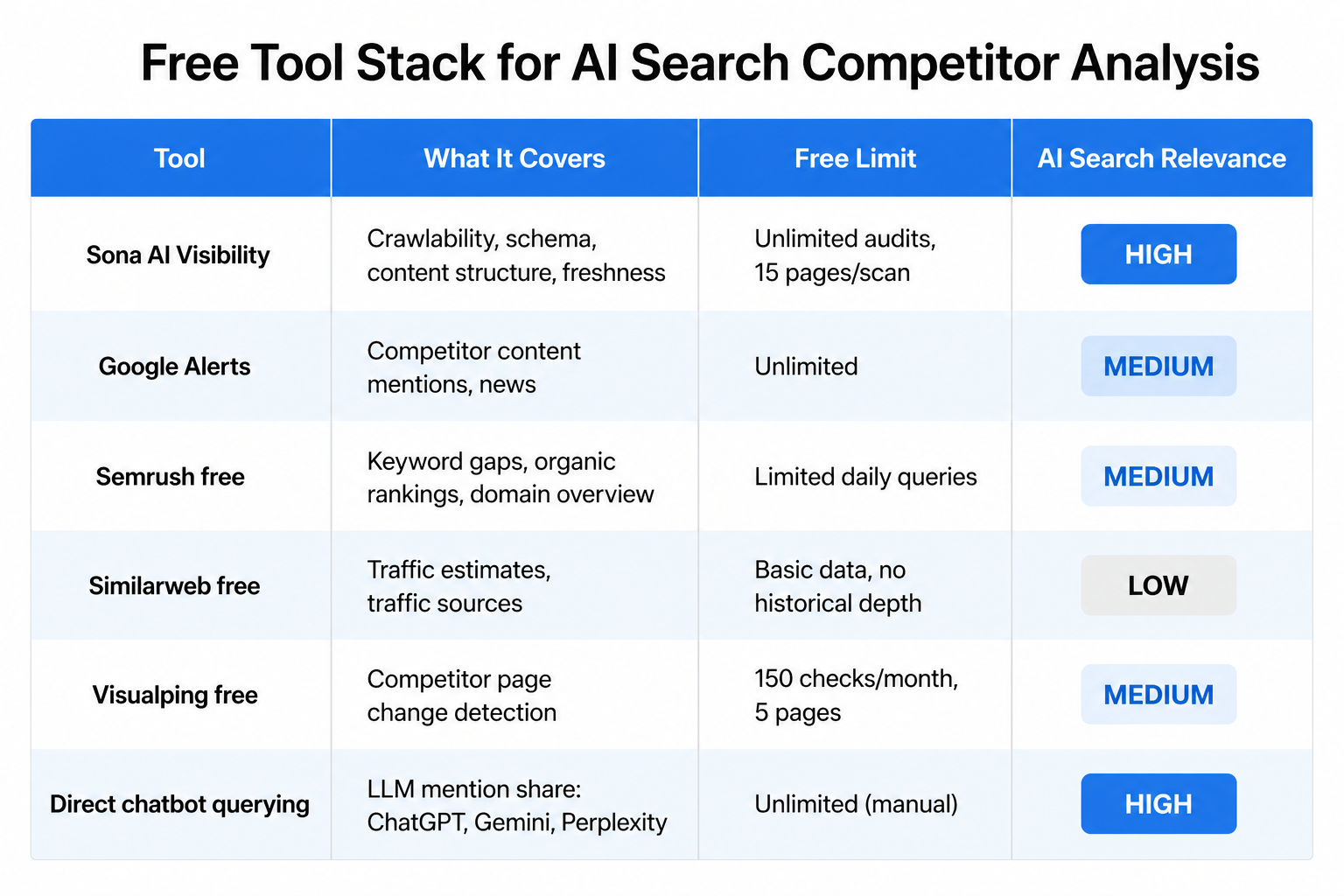
Stack five zero-cost tools in sequence: Sona AI Visibility for structural audits, Google Alerts for content monitoring, Semrush free for keyword gaps, Similarweb free for traffic context, and direct chatbot querying for LLM presence.
Visualping's free tier covers 150 checks per month across 5 competitor pages, making it useful for detecting content changes that signal a competitor is updating pages to improve AI citation rates.
ToolWhat It CoversFree LimitAI Search RelevanceSona AI VisibilityCrawlability, schema, content structure, freshnessUnlimited audits, 15 pages per scanHigh: built for AI engine readabilityGoogle AlertsCompetitor content mentions, newsUnlimitedMedium: signals content velocitySemrush freeKeyword gaps, organic rankings, domain overviewLimited daily queriesMedium: structural signals onlySimilarweb freeTraffic estimates, traffic sourcesBasic data, no historical depthLow: no LLM dataVisualping freeCompetitor page change detection150 checks/month, 5 pagesMedium: detects content refresh signalsDirect chatbot queryingLLM mention share across ChatGPT, Gemini, PerplexityUnlimited (manual)High: only direct LLM visibility method
Run this stack weekly. Start with Sona AI Visibility to audit your pages and a competitor's pages for structural readiness. Use Google Alerts and Visualping to monitor content changes. Pull Semrush free for keyword gap updates. Run your manual prompt set across all three AI engines. Log everything in one shared spreadsheet.
Where do free tools break down for AI search competitor analysis?
Free tools break down in three specific places: they cannot query LLMs at scale, they cannot track citation sources inside AI answers, and they cannot tell you why a competitor ranks in an AI response.
HITLSEO.ai's analysis of 21 AI competitor tools found that paid AI tools save 20 to 50 hours per analysis cycle while surfacing insights human reviewers miss. Here is where free methods fail concretely:
No LLM-native data. Semrush and Ahrefs free tiers track Google rankings, not AI answer inclusion. A competitor can rank first in ChatGPT for your category and be completely invisible in traditional SEO tools.
Manual prompting is inconsistent. Prompt phrasing changes AI outputs. "What are the best tools for X?" and "Which vendors lead in X?" produce different results in the same engine on the same day. Without standardized templates run at fixed intervals, your data is noisy.
No citation source tracking. When Perplexity cites a competitor, it links to a source page. Free tools do not capture which pages earn those citations or what signals triggered inclusion. You can see a competitor appearing in AI answers. You cannot reverse-engineer what to fix on your own pages to compete.
Query caps kill scale. Semrush free limits daily searches. Visualping free caps at 150 checks on 5 pages. For teams tracking 10 or more competitors across three AI engines weekly, free tiers run out fast.
For the full strategic overview, see our guide on the best competitor analysis tools for AI search and LLMs in 2025.
How is free AI search competitor analysis different from free traditional SEO competitor analysis?
Traditional SEO competitor analysis measures rankings, backlinks, and keyword gaps. Free tools handle those reasonably well. AI search competitor analysis measures conversational presence, citation authority, and schema readability. No free SEO tool was built to track those signals.
Zero-click searches now account for a majority of Google queries, accelerating the shift to AI-generated answers where competitor visibility operates on entirely different signals than keyword rankings.
DimensionTraditional SEO (Free Tools Cover This)AI Search (Free Tools Miss This)Ranking signalKeyword position in SERPsMention frequency in LLM answersCompetitor data sourceSemrush, Ahrefs, Moz free tiersManual chatbot querying onlyContent signalBacklinks, on-page keywordsSchema markup, content structure, freshnessTracking cadenceWeekly rank checksWeekly manual prompt runsCitation trackingBacklink analysisNo free tool tracks AI citation sourcesAudit toolScreaming Frog, Ahrefs freeSona AI Visibility (17 checks, free)
Backlinks tell you which pages the web trusts. They do not tell you which pages AI engines pull from when constructing answers. Klue's analysis of AI competitor tools confirms that free tools built for SEO keyword intelligence fall short on the deal-specific and conversational tracking that AI search demands.
When should you upgrade from free tools to a paid AI search competitor analysis platform?
Upgrade when manual prompting exceeds two hours per week, when you are tracking more than five competitors across multiple AI engines, or when you need to prove to leadership that your AI search strategy is working.
Visualping's tool comparison documents that paid monitoring tools start at $10 to $39 per month and unlock full check history, automated alerts, and AI-depth tracking that free tiers structurally cannot replicate. Four triggers that signal it is time to upgrade:
- You are tracking five or more competitors and running out of free query limits every week.
- You need to report AI search share of voice to a CMO or board. Manual spreadsheets do not hold up in that conversation.
- A competitor is gaining ground in AI answers and you cannot identify which pages or signals are driving it.
- Your team spends more than three hours per week on manual prompt runs and logging.
Free stacks cover discovery and baseline benchmarking. They do not cover scale, automation, or attribution. HITLSEO.ai's analysis of 21 AI competitor tools puts the time savings from paid AI tools at 20 to 50 hours per analysis cycle, which shifts the cost calculation fast for any team running competitive analysis monthly.
Frequently asked questions
Can I track competitor rankings in ChatGPT for free?
Yes, but only manually. Run standardized prompts in ChatGPT, Gemini, and Perplexity on a fixed schedule and log which competitors appear. No free tool automates this process. Paid platforms like GrowthOS track LLM mention share automatically across engines and over time.
Does Semrush free work for AI search competitor analysis?
Partially. Semrush free gives you keyword gaps and organic rankings, which are useful structural inputs. It does not track whether your competitors appear in AI-generated answers. Use it alongside direct chatbot querying, not as a replacement for it.
What is the best completely free tool for AI search visibility?
Sona AI Visibility runs 17 checks across crawlability, schema markup, content structure, and freshness. Those are the exact signals AI engines use to decide which pages to cite. It scans up to 15 pages in roughly 30 seconds and is free to use.
How often should I manually query ChatGPT to track competitors?
Weekly, at minimum. Run the same 5 to 10 prompts across ChatGPT, Gemini, and Perplexity every Monday. Log results in a shared spreadsheet. Consistency matters more than frequency. Inconsistent prompting produces noise, not intelligence.
Are free SEO tools like Ahrefs or Moz useful for AI search competitor analysis?
For structural signals, yes. Ahrefs Webmaster Tools (free, own site only) and Moz's free tier surface technical issues that affect AI readability: thin content, missing schema, slow load times. They do not track LLM presence or citation frequency for competitors.
What is the biggest limitation of free competitor analysis tools for AI search?
They cannot tell you why a competitor appears in an AI answer. You can see that they appear through manual prompting, but you cannot identify which pages earn citations, what schema signals triggered inclusion, or how to replicate it. That gap is where paid tools earn their cost.
Last updated: April 2026









