To appear in People Also Ask boxes, identify questions your pages almost answer, then add a direct 40-60 word response beneath a corresponding heading on a page that already ranks. Reaching page one helps, yet a February 2026 compilation found that 74% of answers originated outside the top 10, making a top-20 ranking a useful filter rather than a requirement. Schema can support this effort but does not guarantee selection.
What do you need in place before you try to rank in People Also Ask boxes?
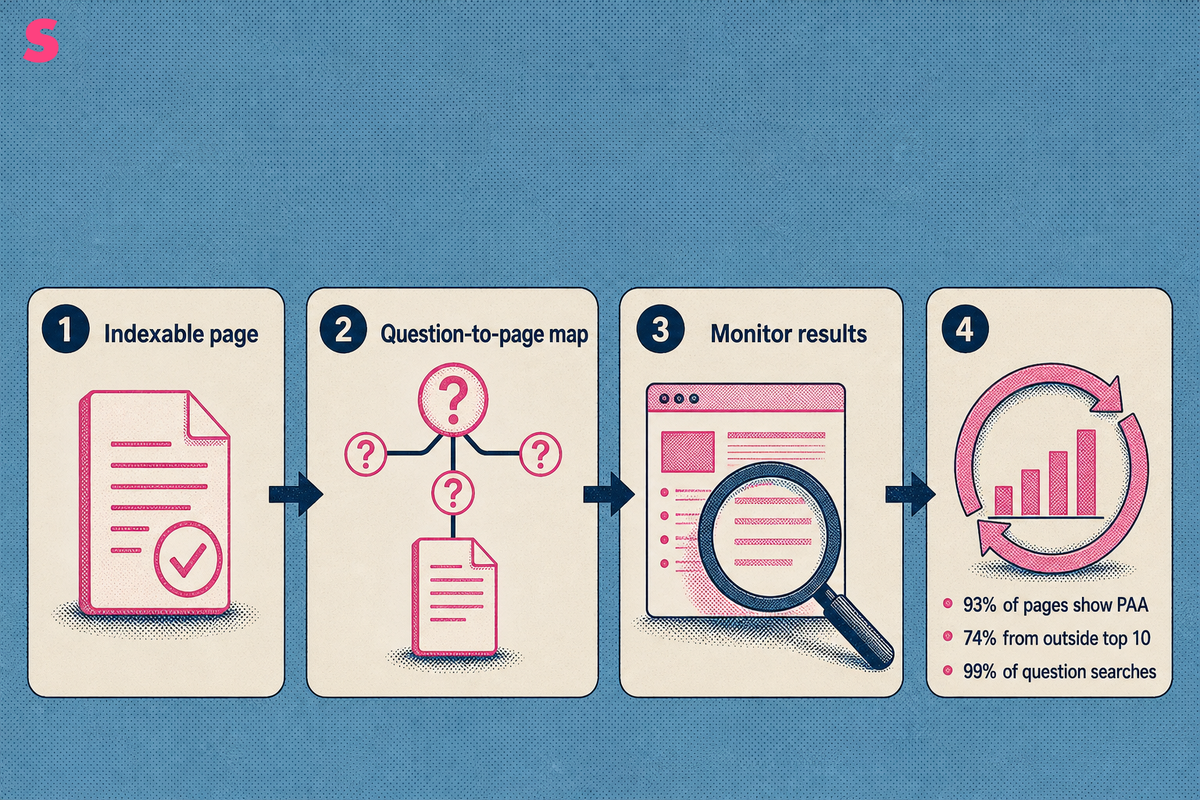
To rank in People Also Ask boxes, you need an indexable page with clear relevance to a related search, a question-to-page map, and a repeatable way to monitor results. A People Also Ask box contains related questions on Google’s results page. Each question expands to show a short answer and a link to the source page.
People Also Ask matters for SEO because it creates an additional SERP placement and source-link opportunity for related questions. A September 2026 test of 200 live US Google result pages across 100 queries found People Also Ask on 93% of reviewed result pages, while a February 2026 compilation reported that 74% of People Also Ask answers came from pages outside the traditional top 10.
You do not need a new FAQ page. Start with pages that already earn impressions or rankings for relevant commercial, informational, or comparison searches. People Also Ask boxes often draw from visible results, so existing relevance and rankings can improve the likelihood of selection.
- Confirm that Google can crawl, render, and index the page.
- Identify the keyword or query theme the page already addresses.
- Check whether that search triggers a People Also Ask box on the device, location, and language you serve.
- Assign each target question to one existing page before writing new copy.
Question-shaped searches are productive starting points. A September 2026 test of 200 live US Google result pages across 100 queries found People Also Ask on 99% of question-style and “best X” searches. The same test found the feature on 93% of reviewed result pages, making it a recurring SERP element rather than an edge case.
How does Google decide which pages appear in People Also Ask boxes?
Google does not publish a complete People Also Ask selection formula. A People Also Ask answer is drawn from a ranking page, but the staged model below separates published facts, observed patterns, and editorial inference rather than presenting optimization signals as disclosed ranking factors.
Google first associates related questions with the search, then identifies candidate pages relevant to those questions. It may identify answer passages within those pages, assess candidate sources and passages against the query, then render a selected short answer with its source link. Existing relevance and rankings create productive opportunities, but Google has not published a fixed organic-position cutoff.
| Observable selection signal | What Google needs to identify | What to implement on the page | What to avoid |
|---|---|---|---|
| Question association | Editorial inference: a related question connected to the original search | Research the questions Google shows for the query theme and map them to relevant pages | Targeting questions unrelated to the page’s primary subject |
| Candidate-page retrieval | Published fact and observed pattern: a relevant ranking page, with page-one visibility often preferred | Improve the page’s topical relevance, internal links, and search intent match | Treating a top-10 position as a published eligibility rule |
| Passage identification | Observed pattern: a concise passage, list, table, or definition that directly answers the question | Place the answer directly below the heading in plain HTML | Burying the answer inside tabs, scripts, or long paragraphs |
| Candidate-source assessment | Editorial inference: a source and passage whose relevance and context fit the question | Add useful detail, examples, and related subtopics after the answer | Publishing thin pages built only from disconnected questions |
| Final rendering | Published fact: a short answer displayed alongside a link to the source page | Keep the answer clear enough to stand alone when extracted | Writing a broad introduction before answering |
Answer format matters because Google needs a passage it can display. A February 2026 compilation found an average People Also Ask answer length of 41 words. Use that figure as an editorial reference, not a rule that overrides relevance or accuracy.
Step 1: How do you find the People Also Ask questions worth targeting?
Find opportunities by starting with keywords where important pages already rank, then checking which searches trigger People Also Ask. This prioritizes questions where your site already has topical relevance instead of producing an unmanageable list of generic queries.
- Export keywords and queries that already send impressions or clicks to important pages.
- Search each core query in Google using your target location, device, and language.
- Record the initial People Also Ask questions, then expand relevant questions to reveal deeper branches.
- Group duplicate or closely related questions into one intent cluster.
- Prioritize questions that reinforce a page’s existing purpose and conversion path.
People Also Ask questions can recur across different keywords, so do not create a separate page for every wording variation. Consolidate near-duplicates into one strong question heading and answer. This prevents keyword cannibalization while preserving coverage of the underlying intent.
A May 2026 workflow recommended mining People Also Ask trees for 50 target keywords and collecting 200–500 related questions. That volume can inform research, but the publishing backlog should be much smaller. Sona AI Visibility can help teams identify prompts buyers ask and compare page performance through AI Search Insights, which shows tracked prompts and the pages associated with them.
Step 2: How do you match each question to a page you already have?
Match every People Also Ask question to the existing page that answers it best. The right page is not always the page with the highest ranking. It is the page whose central topic, audience, and search intent make the answer credible.
Create a mapping sheet with four fields: the People Also Ask question, the target page, the page’s current query theme, and the section where the answer belongs. A how-to question belongs on a procedural guide. A pricing question belongs on a pricing or comparison page. A definition belongs on a foundational resource.
- Keep the question on the existing page when it is a natural subtopic of the page’s main intent.
- Create a new page when the question represents a separate problem, audience, or buying stage.
- Merge questions when several phrasings seek the same answer.
- Redirect editorial effort when a question does not support a meaningful business topic.
Analyze the pages already appearing in People Also Ask for the target query. Review their page type, heading structure, answer format, and topical scope. The goal is not to reproduce their copy. It is to identify the content format Google has associated with that search intent.
Sona AI Visibility connects AI citations to pipeline and revenue on one account timeline, while also tracking AI crawler activity from server logs. Marketing teams can therefore prioritize pages around buyer questions and business outcomes rather than raw question volume.
Step 3: How should you write and structure the answer on the page?
Write the exact or near-exact People Also Ask question as a heading, then answer it directly in roughly 40–60 words before adding detail. A May 2026 playbook recommended that range, and a February 2026 compilation found an average answer length of 41 words.
Lead with a definition, decision, or instruction. Use the next sentence to add the condition, mechanism, or exception that completes the answer. Readers and search systems should not need to infer the answer from a long setup paragraph.
- Write the question as an H2 or H3 that matches the user’s language.
- Answer in the first sentence with a complete statement.
- Add one or two sentences of qualification, process, or context.
- Use a numbered list when the answer is procedural.
- Continue with deeper supporting content after the direct answer.
For example, a question asking whether FAQ schema helps should receive a direct explanation first, followed by implementation detail. Do not begin with a history of structured data. For comparison questions, establish the decision criteria before discussing edge cases.
Sona AI Visibility helps connect the question, the page, and the downstream account journey. A page can win a People Also Ask source link without contributing to a commercially meaningful research path.
Step 4: Does FAQ schema help a page get into People Also Ask?
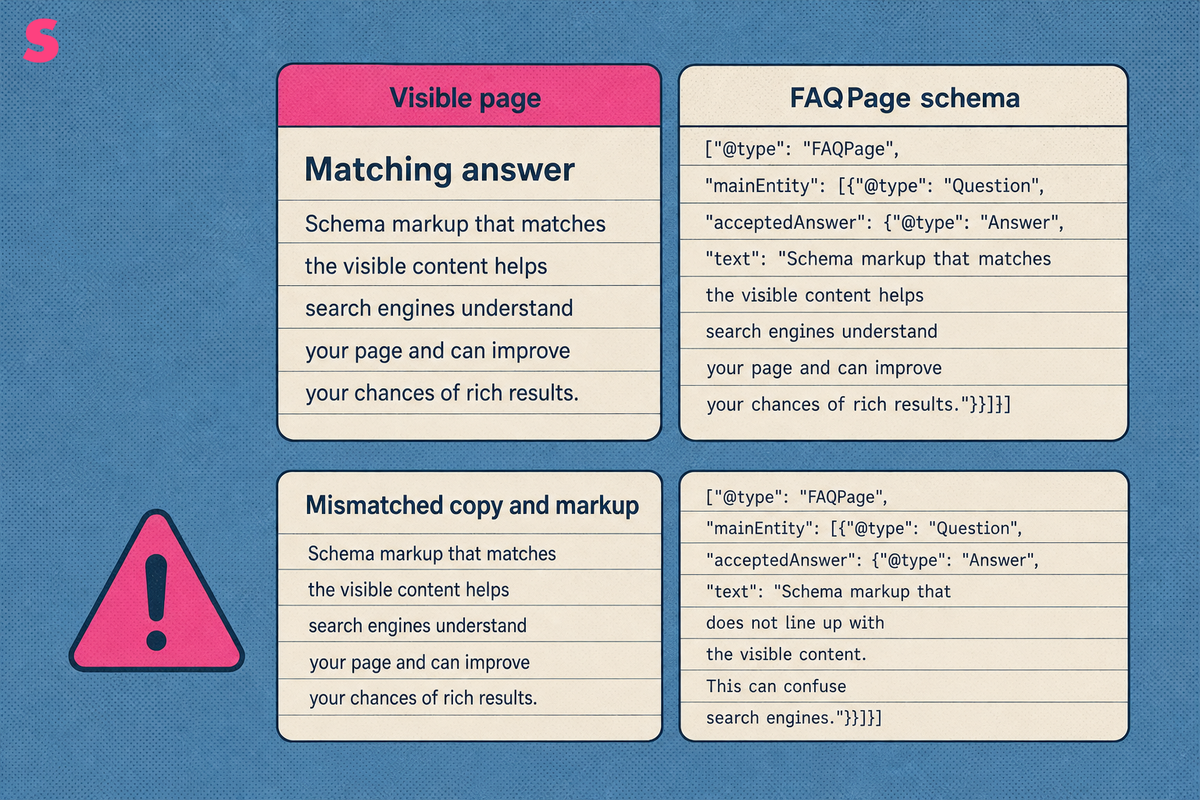
FAQ schema does not establish a causal path into People Also Ask boxes. It can make question-and-answer content machine-readable, but a direct answer on a relevant ranking page does the substantive work.
Add FAQPage schema only when the visible page contains the same questions and answers. Structured data should describe the page, not create a separate version for crawlers. Mismatched copy and markup add maintenance work without improving the reader experience.
- Use FAQPage schema for genuine FAQs that readers can see on the page.
- Keep the marked-up answer consistent with the visible answer.
- Use HTML headings and paragraphs even when schema is present.
- Prioritize crawlability, relevance, and answer clarity before markup.
The more important technical check is whether Google can access the page and its content. Canonical tags, indexability, server-rendered HTML, internal links, and a clean heading hierarchy affect whether a page can compete in search results. A page with no demonstrated relevance for the related query is unlikely to become a productive People Also Ask target.
The Free AI Readiness Checker evaluates whether AI engines can crawl and parse a site, returning a technical-readiness assessment. That assessment is a technical-readiness snapshot, not evidence that a page appears in People Also Ask.
How can you tell your People Also Ask work succeeded?
People Also Ask work has succeeded when Google repeatedly displays your page as the source for a target question across a defined query set. A single screenshot is not proof because results vary by device, location, language, query wording, and time.
Build a tracking sheet with the exact query, People Also Ask question, source URL shown by Google, device, country, date, and whether your page appears. Record the page’s organic ranking alongside the People Also Ask result to distinguish a feature change from broader ranking movement.
Run the same prompt list daily. Define a sustained-appearance rule before monitoring, then distinguish repeated appearances from isolated observations. Retrieval indexes, model updates, and competitor publishing can all change the answer set.
Sona AI Visibility tracks brand appearances across 11 AI engines as of October 2026 and connects AI-referred visits to pipeline and revenue. That visibility log can sit beside People Also Ask monitoring when a team needs to assess how search-result exposure and AI-answer exposure move across the same topic cluster.
Why is your page still missing from People Also Ask, and how do you recover?
A page is usually missing from People Also Ask because it has weak relevance for the related query, does not answer the question directly, or targets a question that belongs on another page. Diagnose which condition applies before rewriting the content.
First, search the exact question and the parent query. If the page does not rank, improve topical relevance and internal linking before changing the answer format. If the page ranks but does not appear in People Also Ask, compare its heading, direct answer, and coverage with the source pages Google displays.
- Failure: The answer appears halfway through a long section. Recovery: Move a direct answer under a descriptive heading.
- Failure: Several pages target the same question. Recovery: Consolidate or differentiate page intent.
- Failure: The page answers a related but different question. Recovery: Map the query to the page that owns the topic.
- Failure: The page has technical indexing issues. Recovery: Review crawlability, canonicalization, and rendered content.
Use a quarterly content review for broader topic consolidation and competitive benchmarking. Prompt checks need a daily cadence, while page architecture changes need time for crawling, indexing, and evaluation in standard search results.
Sona AI Visibility shows page-level performance and prompts a site should appear in but does not, giving teams a structured way to turn a missing appearance into a page-level work item rather than an isolated visibility score.
Does ranking in People Also Ask help your brand get cited in AI answers?
Ranking in People Also Ask can strengthen answer-focused content that supports citations in AI answers, but it does not guarantee citation by ChatGPT, Perplexity, Gemini, Claude, and other answer engines. Google’s People Also Ask system and AI answer systems retrieve and present sources differently.
The overlap is practical: both environments favor pages that answer specific questions clearly, use descriptive structure, and demonstrate topical relevance. Google AI Overviews also surface synthesized answers in Google Search, but they are not the same feature as People Also Ask and require separate monitoring.
Monitoring which AI answers mention a brand is only half the job. Sona AI Visibility connects AI citations and AI-referred visits to accounts, pipeline, and revenue on one account timeline, helping marketing teams determine whether visibility contributed to measurable commercial outcomes.
Use People Also Ask research as an editorial input for broader AEO and GEO work. The goal is a durable library of pages that answer buyer questions precisely, earn organic rankings, and give answer engines useful material to retrieve and cite.
Frequently asked questions about ranking in People Also Ask boxes
Do you need to rank in the top 10 to appear in People Also Ask?
No. Page-one visibility is useful, and many workflows use the top 10 as an initial filter, but it is not a strict requirement. A February 2026 compilation reported that 74% of People Also Ask answers came from pages outside the traditional top 10, meaning relevant pages beyond that range can still appear.
How long should an answer be to rank in People Also Ask boxes?
Aim for roughly 40–60 words directly below the question heading. A February 2026 compilation reported an average People Also Ask answer length of 41 words, while a May 2026 playbook recommended a 40–60 word range. Answer completeness matters more than an exact word count.
Does FAQ schema make a page appear in People Also Ask?
No causal link has been established. FAQ schema makes question-and-answer content machine-readable, but a clear, direct answer on a relevant page does the substantive work. Use schema to describe visible content accurately, not as a substitute for relevance, crawlability, and useful on-page structure.
How is People Also Ask different from a featured snippet?
A featured snippet is one answer shown above standard results. People Also Ask is a set of expandable related questions, each with a short answer and source link. A page can appear in either feature, both features, or neither feature for a given query.
Why do People Also Ask results change between searches?
People Also Ask results vary by device, location, language, query wording, and time. Check a fixed query set repeatedly rather than trusting one screenshot. A daily observation log separates a sustained result from a temporary variation in Google’s search results.
Can a new page rank in People Also Ask?
Yes. Existing relevance and rankings can improve the likelihood of selection, but Google has not published a fixed organic-position cutoff. Build topical relevance, ensure the page is indexable, answer the question directly, then monitor whether Google selects the page as a People Also Ask source.
Summarize this article with AI: ChatGPT · Claude · Perplexity · Google AI Mode
Last updated: October 2026