To appear in AI answers, create pages that begin with a clear, self-contained response to a real buyer question, keep them crawlable and organically visible, and gain corroboration on third-party sites. There is no ranking position to chase, because AI answers cite a few pages and the selection changes with almost every query. Measure using a fixed prompt set, repeated runs, and a written scoring rule. Sona AI Visibility links those prompts and citations to pipeline and revenue, starting with AI crawler and agent activity.
What do you need in place before you try to rank in AI answers?
To rank in AI answers, start with pages that AI systems can crawl, render, index and assess, plus a repeatable record of what each engine returns. Organic visibility helps, but it does not guarantee inclusion. AI answers draw on a small set of cited pages and named brands rather than a single traditional ranking ladder.
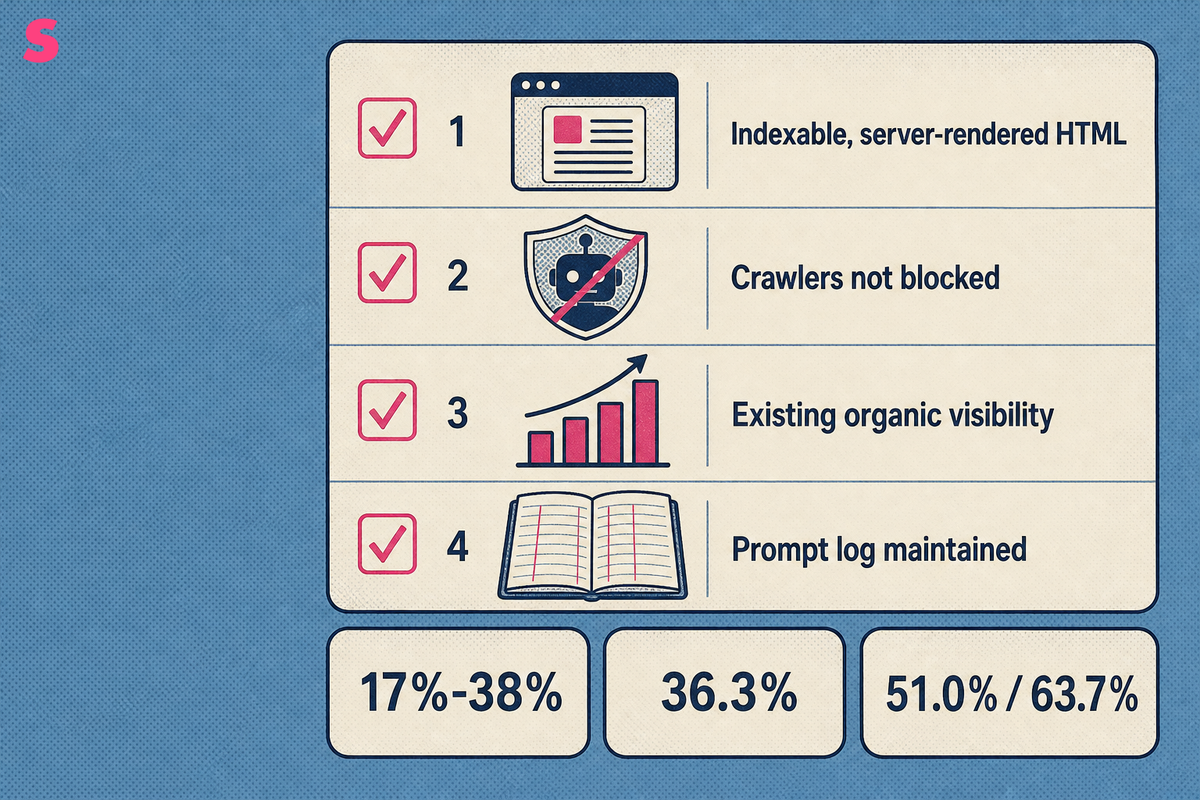
Confirm four prerequisites before changing content:
- Your target pages are indexable, canonicalised correctly and available as server-rendered HTML.
- Robots directives, CDN rules and bot controls do not block relevant AI crawlers.
- Your site already has some organic visibility for the topic, because organic ranking provides evidence of relevance.
- You have a prompt log that records prompt wording, engine, date, citations and brand mentions.
Traditional SEO is a useful foundation, not a complete answer. An October 2026 synthesis found that 17%–38% of Google AI Overview citations came from Google’s organic top 10, while an October 2026 study found 36.3% at the domain level. A separate October 2026 analysis from desmoinesregister.com found 51.0% of citations pointed to top-10 URLs and 63.7% pointed to top-10 domains. The differences reflect datasets and measurement methods, not a settled ranking factor.
No universal AI ranking factor exists, and no checklist guarantees inclusion. Improve the evidence an answer engine can retrieve, then measure whether the changes increase citations across repeated runs.
How do you build the list of buyer prompts worth ranking for?
Step 1: build a fixed prompt universe of 20–50 questions your buyers ask before, during and after vendor evaluation. June 2026 workflow guidance recommends that range for repeated testing across major answer engines. Use conversational questions, not shortened keyword fragments.
Write prompts in the language a buyer uses when seeking an answer, recommendation or comparison. Label each prompt by buying stage: Awareness, Consideration, Decision or Purchase. The labels distinguish category education from questions that signal active evaluation.
- Collect questions from sales calls, customer research, site search and existing search-query data.
- Rewrite each question as a complete prompt, such as What is the best attribution platform for B2B SaaS teams?
- Remove duplicate intent, then preserve the exact wording of the remaining prompts.
- Assign each prompt a page that should provide the best answer.
Prioritise informational prompts first. Google AI Overviews are more commonly triggered by informational questions than transactional queries, according to an October 2026 listing. Commercial prompts still matter, but early-stage questions often offer the clearest chance to earn a citation before the buyer narrows the field.
How should a B2B SaaS page be written to get cited in AI answers?
Step 2: write each important B2B SaaS page so its first sentence answers the buyer’s question directly, followed by context, proof and useful detail. This structure gives ChatGPT, Google AI Overviews, Perplexity and other answer engines a self-contained passage to retrieve and cite.
Open key pages with a 30–60 word answer. October 2026 implementation guidance recommends that length because the passage can stand independently when extracted from the page. Follow with definitions, trade-offs, implementation detail and examples that support the opening answer.
An October 2026 University of Toronto study tracked 158,099 AI answers and 468,037 citations across two 90-day periods in 2026. Pages with titles that better matched the user question received 14.1% more citations per standard deviation, and pages with a strongest paragraph matching the question received 15.5% more citations per standard deviation.
Use concrete facts that a buyer can verify. Prices, model names, service areas and product limits improve citation chances, per facebook.com. Put FAQs on the individual service or product page where the answer belongs, rather than relying on a broad sitewide FAQ.
Before: Our attribution platform helps marketing teams understand performance across channels.
After: B2B SaaS attribution software connects marketing touchpoints to accounts, opportunities and revenue, so demand generation teams can identify which channels influenced pipeline rather than reporting lead volume alone.
The revised opening answers a specific category question, identifies the intended reader and states the outcome. The following paragraphs should substantiate that answer with implementation detail.
Which technical settings decide whether AI engines can read and quote your page?
Step 3: make target pages crawlable, indexable, renderable and structurally explicit before expecting citations. A well-written answer cannot be retrieved when robots directives block access, JavaScript prevents reliable rendering or the canonical tag points elsewhere.
- Check robots.txt, meta robots directives and CDN or WAF rules for crawler access.
- Confirm the canonical tag identifies the intended URL and the page is indexable.
- Provide server-rendered HTML for core answer content, headings and supporting facts.
- Use structured data to clarify entities, page type, FAQs and relationships.
- Audit internal links so the target page is discoverable from relevant site sections.
Implement schema markup by selecting the page type and entities represented in visible page content, then adding matching JSON-LD. Connect relevant entities and URLs, validate the markup, deploy it and keep it synchronized with the facts shown on the page. Schema markup clarifies entities and content. It does not replace authoritative information, crawlability, useful answers or third-party corroboration. Structured data supports a page that already answers a real buyer question.
Sona AI Visibility can confirm whether AI crawlers reach target pages through server logs or a lightweight edge worker, without a JavaScript tag that ad blockers can hide. That evidence separates a content problem from an access problem. Run prompt tests daily, but review a full technical audit monthly or quarterly because the tasks answer different questions.
Which third-party sites help AI engines recommend your SaaS brand?
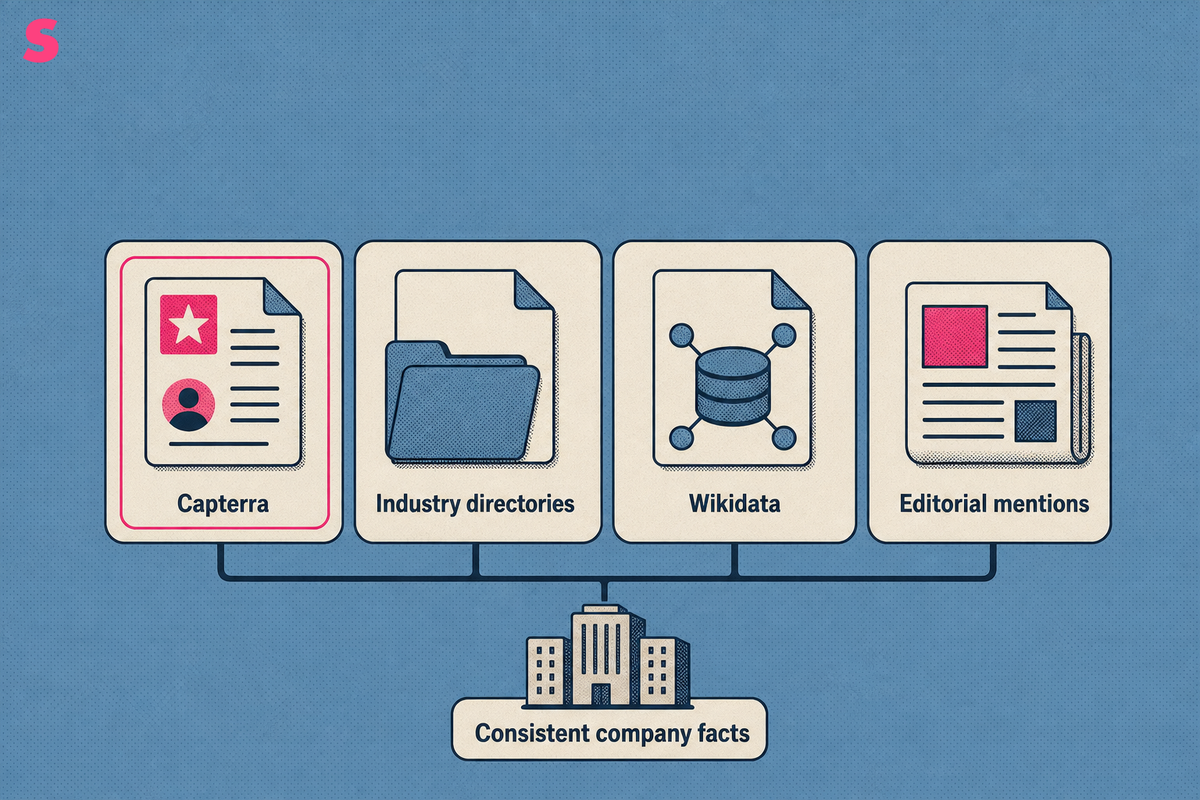
Step 4: make the facts about your SaaS company consistent across your own site and reputable third-party sources. AI models are selective about sources and prefer trusted, high-authority sources, according to an October 2026 listing. Recommendation questions require corroboration, not only a polished product page.
Review the places where a buyer or answer engine could verify your company’s identity, offering and category position:
- Software review profiles, including Capterra, with accurate category, product description and current details.
- Industry directories and association listings relevant to the market you serve.
- Wikidata entries where the company qualifies for a maintained entity record.
- Authoritative editorial mentions, partner pages and customer evidence that use consistent naming.
Match the same core facts across those sources: company name, product names, category, service area, target customer, pricing language and factual claims. Clear structured information plus strong domain authority supports recommendation visibility, according to an October 2026 listing. Do not manufacture mentions or inflate listings. Contradictions create uncertainty for buyers and retrieval systems alike.
How do you design a prompt test that shows a tactic actually worked?
Step 5: define the prompt set, engines, scoring rules and control pages before publishing a change. A prompt test demonstrates a result when treated pages outperform comparable untouched pages across repeated runs, not when one answer happens to mention the brand.
Fix the wording of every prompt. Record the date, engine, account state, location where relevant, cited URLs, source order and brands named in each answer. Answers change with model updates, retrieval indexes, timing, location and prompt wording. Running the same prompt list daily reveals patterns that a weekly snapshot would average away.
- Select matched page groups with comparable organic visibility.
- Rewrite the opening answer and supporting FAQ on the treated pages.
- Leave matched control pages unchanged during the test period.
- Run the fixed prompts daily across the selected answer engines.
- Score every response using the same rubric, then compare the treated and control groups.
For example, test the prompt How should a B2B SaaS company measure AI search attribution? across ChatGPT, Google AI Overviews and Gemini through repeated daily runs. Compare citations for the treated page against matched control pages, then investigate any sustained difference. The result does not prove causation, because search visibility, source freshness and external mentions can move at the same time.
Sona AI Visibility uses AI Search Insights to show the prompts buyers ask and which sources AI answers cite. A brand-level visibility score is a dated snapshot, not a work item. Prompt-level evidence identifies the question that produced the result and the source a team needs to address.
What scoring rubric should you use to count citations and answer presence?
A prompt test needs a written rubric that turns varied AI answers into comparable observations. Score each scheduled engine-prompt run consistently, aggregate results across the fixed prompt set and set the decision rule before reading the outcome. Define success as a predeclared improvement over matched controls across repeated runs.
| Metric | How it is scored per run | How it is aggregated across the prompt set | What counts as a positive result |
|---|---|---|---|
| Brand named in answer | Score 1 when the brand name appears in the answer body, excluding source labels and citation text. Score 0 for no answer, a failed response or no body mention. | Divide named runs by all scheduled runs, including failed or missing responses. | Treated pages exceed controls across repeated daily runs. |
| Own page cited | Score 1 when a target URL, its redirect destination or its canonical-equivalent URL appears in citations. Count duplicate citations to the same page once. Score 0 for no answer, a failed response or no qualifying citation. | Divide cited runs by all scheduled runs, including failed or missing responses. | Higher citation share for the treated group. |
| Source position | Record the first citation position for the target page. Record no position for uncited, failed or missing responses. | Calculate median position among cited runs and report the cited-run count beside it. | A lower median position with more total citations. |
| Competitor mentions | Count distinct named competing brands in the answer body, excluding source labels and citations. | Calculate average mentions per scheduled run. | Use as a diagnostic measure for answer composition, not as the decision criterion. |
| Share of answer | Classify a brand as substantive when the answer recommends or describes it in relation to the prompt; classify a passing mention when it appears only in an unsupported list or reference; classify no presence when it does not appear. Failed or missing responses are no presence. | Calculate the share of substantive-presence runs across all scheduled runs. | A predeclared improvement over controls across repeated daily runs. |
Keep raw answers in the log so the team can audit disputed scores. Two reviewers should apply the written rules independently. Where classifications differ, a preassigned adjudicator should review the raw answer and assign the final score using the same definitions.
What does it look like when ranking in AI answers has worked?
Ranking in AI answers has worked when treated pages are cited more often than comparable control pages, the brand appears for the targeted prompts and AI-referred visits connect to pipeline outcomes. A citation is the visibility signal. Revenue evidence determines whether that visibility matters commercially.
Success does not require appearing in every answer. AI answers draw from a changing set of cited pages, so one absence proves little. Look for a durable pattern across daily runs: more own-page citations, more substantive brand mentions and stronger performance than untouched pages responding to similar buyer questions.
Zero-click answers can reduce visits, but citations still create brand exposure and can send high-intent referrals. An October 2026 listing reported that organic click-through rate on Google AI Overview queries rose from 1.3% in December 2025 to 2.4% in February 2026. Treat that 85% increase as indicative, not a forecast for any individual site.
Sona AI Visibility connects prompts and citations to pipeline and revenue on one account timeline, starting with AI crawler activity and AI-referred visits. Mention tracking remains baseline category functionality. The relevant question is whether the cited page influenced a signup, opportunity or closed-won revenue.
What should you do if your page still is not cited in AI answers?
If a page is still not cited in AI answers, diagnose access, answer quality, organic-to-AI gaps, corroboration and test noise in that order. Make one targeted recovery change and rerun the same fixed prompt set daily. Changing prompts during recovery makes before-and-after comparisons unreliable.
- Page blocked or not indexed: check robots.txt, meta robots directives, canonical tags, server responses and rendering. Use the Sona AI Crawl Checker to test whether relevant AI crawlers can reach the page.
- Opening answer is weak: rewrite the first 30–60 words so they answer the exact prompt without requiring surrounding context.
- Organic ranking but no Google AI Overviews citation: treat the query as a gap prompt and strengthen the page’s direct answer, structure and supporting evidence.
- No corroboration: correct inconsistent facts across review sites, directories and authoritative third-party mentions.
- Apparent absence is noise: repeat the unchanged prompt before concluding that the page is excluded.
Keep the recovery test narrow. AI answers cite only a few pages, and the selected list changes from query to query. A consistent absence across repeated runs is evidence. A single missed citation is one observation.
What are the frequently asked questions?
Can you guarantee your site will appear in AI answers?
No. Answer engines differ in retrieval, source selection, freshness and answer generation, so no checklist guarantees inclusion. Improve crawlability, answer quality, structured information and corroboration, then test the result against a fixed prompt set across repeated daily runs.
Does ranking in Google’s top 10 get you into Google AI Overviews?
Ranking in Google’s top 10 helps, but it is not enough. An October 2026 synthesis placed the share of Google AI Overview citations from top-10 results at 17%–38%, while an October 2026 analysis from desmoinesregister.com found 51.0% at the URL level. The gap largely reflects methodology and dataset differences.
Will adding schema markup make AI engines cite your pages?
No. Schema markup clarifies entities, relationships and page content, but cited pages still need authoritative answers, crawlable access and corroboration from other sites. Treat structured data as support for a useful page, not as a substitute for one.
How many prompts should you track, and how often?
Start with 20–50 buyer questions, following June 2026 workflow guidance, and run each prompt repeatedly across the answer engines that matter to your audience. Run the prompt list daily because a weekly snapshot cannot distinguish a lasting change from answer-level noise.
How do you tell a real gain from random variation in AI answers?
Use a fixed prompt set, repeated runs, a written scoring rule and an untouched control group of pages. Count a change only when treated pages beat comparable controls across repeated daily observations. Keep the raw answers, citations and dates so another reviewer can inspect the scoring.
Are AI answers worth pursuing if they reduce clicks?
Often, yes. A citation can build brand exposure and category consideration even when the answer satisfies the search without a click. AI-referred traffic can also represent active research. Measure the channel through pipeline and revenue, not clicks alone.
Summarize this article with AI: ChatGPT · Claude · Perplexity · Google AI Mode
Last updated: October 2026