


To perform well in ChatGPT, view ranking as measurable visibility: create answer-led pages for questions your buyers pose, ensure crawlers can access them, win mentions on credible third-party sites, and measure mention rate and citations across a fixed prompt list. ChatGPT offers no fixed number-one position, so outputs must be sampled across repeated runs. Sona AI Visibility links those prompts and citations to pipeline and revenue, ensuring efforts are assessed by business outcomes instead of mention totals.
What does it mean to rank on ChatGPT when there is no position one?
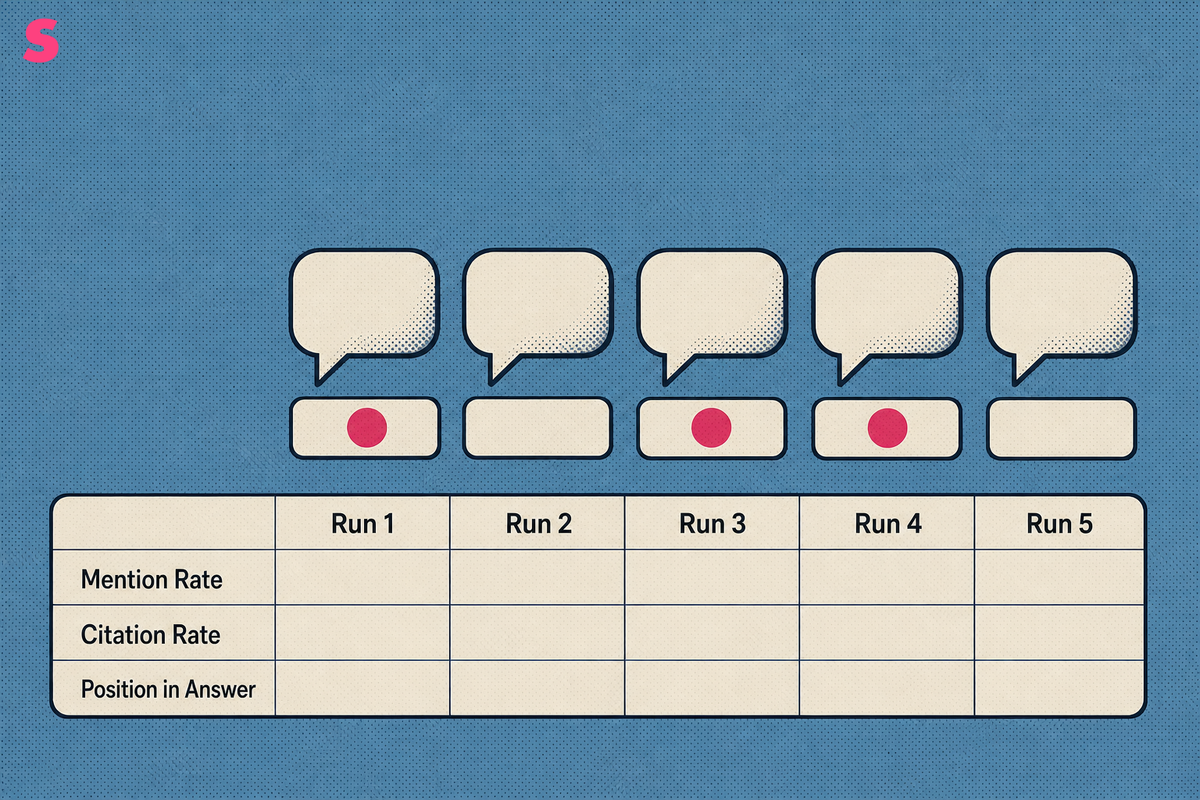
To rank on ChatGPT means appearing reliably in answers that matter to buyers, not holding a fixed position one. Measure mention rate, citation rate, inclusion in product recommendations, and position within a response across repeated runs of the same prompt.
ChatGPT answers vary with prompt wording, user context, location, freshness, search settings, and model. One response records a single event. A repeated prompt set creates a visibility record that shows whether a brand, page, or product appears more often.
Much of the work overlaps with SEO: crawlability, useful content, topical authority, trusted reviews, and strong third-party evidence. The operational difference is prompt-level measurement and pages written so an answer engine can extract an accurate response without reconstructing the point from a long introduction.
ChatGPT, Google AI Overviews, Perplexity, and other answer engines have different ranking factors and require separate strategies, per youtube.com. Treat each answer engine as its own measurement environment, beginning with a fixed prompt baseline.
How do you build a baseline prompt set before changing anything?
Build a baseline prompt set before making site changes, because a later visibility increase has meaning only when the original answers were recorded. Prompt research, which identifies the questions an ideal customer profile asks ChatGPT, is a core first step, per linkedin.com.
Collect site editing access, access to robots.txt and analytics, a spreadsheet or tracking system, buyer attributes, and the questions each ideal customer profile asks at different buying stages. Separate questions for technical evaluators, business buyers, existing customers, and procurement teams.
- List prompts by buyer attribute and stage. Include informational, comparison, implementation, pricing, and vendor-selection prompts.
- Run every prompt without changing the wording. Record the full answer, brands mentioned, cited sources, answer position, date, model, location, and search setting.
- Tag each prompt to a page opportunity. Identify the owned page that should answer the prompt, or the missing page that needs creation.
Per Perplexity research, 88.6% of queries reportedly produce exactly two fan-out sub-queries. Document related questions around each core prompt rather than treating one wording as the entire opportunity.
A useful baseline prompt might be: which marketing measurement platform connects AI search activity to pipeline for B2B SaaS? Record whether the brand appears, where it appears, which sources ChatGPT cites, and whether the answer accurately describes the product.
How do you make your site crawlable and eligible for ChatGPT Search?
Make ChatGPT Search eligibility a technical prerequisite: allow relevant OpenAI crawlers, serve key pages with clean 200 responses, render meaningful server-rendered HTML, and maintain Bing indexing. A page cannot become a reliable citation candidate when answer engines cannot fetch and parse its content.
ChatGPT source inclusion follows a sequence rather than a stable position-one ranking: source discovery, fetch and index eligibility, query or fan-out retrieval, source selection, answer extraction, and citation. Crawl controls affect eligibility, direct page structure affects extraction, and trusted third-party evidence can affect which sources are selected. The result is variable source inclusion across repeated answers.
Check robots.txt, CDN rules, WAF rules, and server logs for crawler access. Test product pages, comparison pages, documentation, and high-intent articles individually. Confirm that canonical tags point to the intended URL and that the primary answer is available without a JavaScript-dependent interaction.
Several guides connect ChatGPT Search discoverability with Bing indexing and submission through Bing Webmaster Tools. No official OpenAI documentation appeared in the supplied research, so confirm current crawler names, access rules, and Search behavior in OpenAI’s own documentation before changing production controls.
FAQ schema and llms.txt are sensible hygiene experiments, not proven citation factors. Test each change against the baseline prompt set and retain the version that produces sustained improvement. Sona AI Visibility can track AI crawler activity from server logs or a lightweight edge worker, which distinguishes an inaccessible page from a page that is accessible but not selected.
How should you structure a page so ChatGPT can extract an accurate answer?
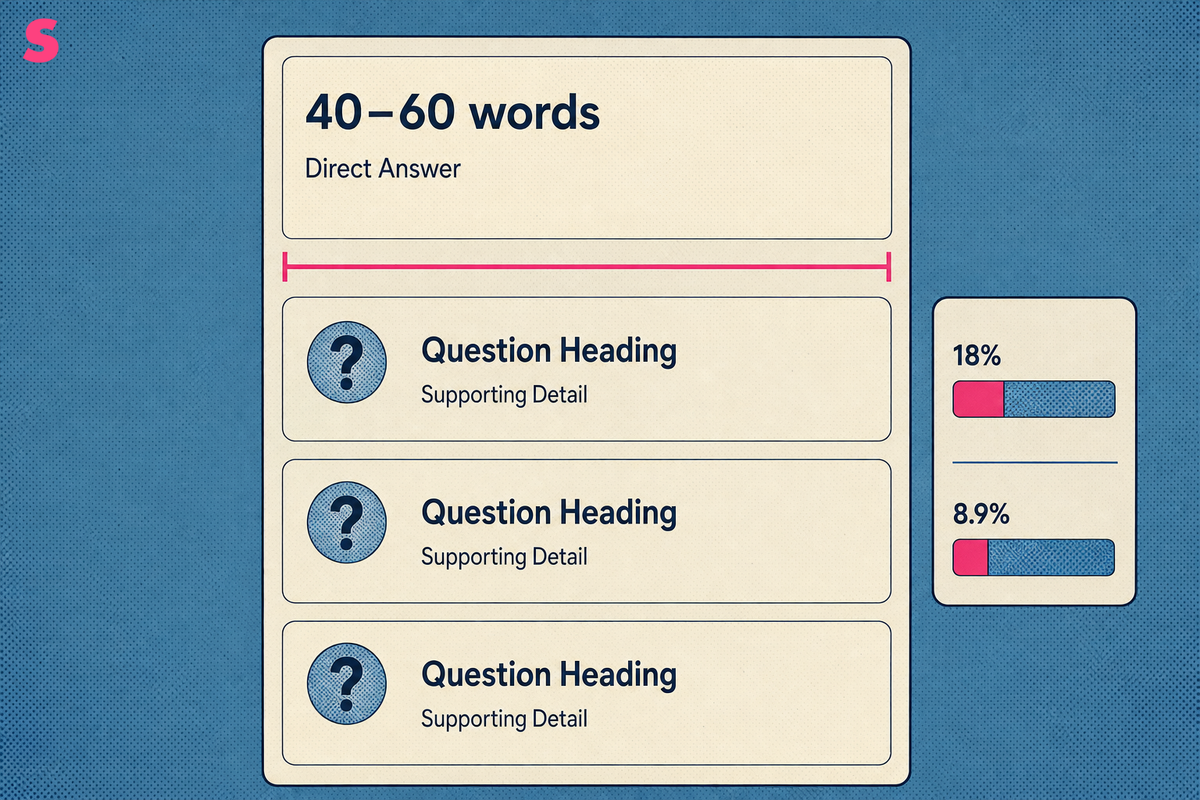
Structure every target page to answer the buyer’s question immediately, then support that answer with evidence, detail, and related context. Core answers or definitions should appear in the first 40–60 words of a section, per reddit.com, rather than after a long setup.
Guidance published in October 2026 recommends opening a page with a direct answer of 40–60 words. Separate guidance from August 2026 recommends a 40–50-word opening answer. A B2B playbook from June 2026 recommends answering the target query within the first 150 words. These are writing guidelines, not controlled evidence of ranking causation.
Use question-formatted headings where the page genuinely answers a question. Question-formatted headings were reported to receive citations at 18%, compared with 8.9% for other headings, in March 2026. Keep each section self-contained, with a definition, direct answer, and supporting specifics.
- Create one primary page for each buyer attribute or decision problem.
- State what the product, service, or concept does before explaining process details.
- Build topical authority through connected pages that answer related questions.
- Refresh material when facts, product details, or buyer concerns change.
High-quality content that directly answers user questions is required for ChatGPT visibility. Topical authority across related subjects is also a documented strategy. A workflow published in May 2026 recommends updating at least one page per week, a practical freshness cadence for an active content program.
How do you earn the brand mentions and reviews ChatGPT draws on?
Earn brand mentions through credible third-party coverage, customer reviews, accurate comparison content, and useful community participation. Strong mentions across trusted sites are a key factor in ranking higher in ChatGPT, while unsupported promotional claims give an answer engine little dependable evidence to reuse.
Identify three to five authoritative review or aggregator sites in your category, following a workflow published in May 2026. Prioritize profiles that accurately state your product category, audience, pricing model, product capabilities, and customer evidence. Inconsistent descriptions confuse buyers and answer engines.
Multiple review platforms matter, with Google Reviews particularly significant, per reddit.com. For B2B companies, relevant sources also include category publications, comparison pages, implementation partners, analyst coverage, and community discussions such as Reddit. Monitor those sources for factual accuracy. Do not manufacture discussion.
Third-party mentions can be manipulated, which makes authenticity essential. Ask customers for genuine reviews, disclose commercial relationships, correct outdated facts, and avoid undisclosed affiliate placements or astroturfed posts. Editorial independence and specific customer evidence carry more weight than a large volume of vague praise.
How can a SaaS company get its product recommended and listed in ChatGPT?
A SaaS company improves its chance of appearing in ChatGPT recommendations by publishing clear product facts, maintaining consistent third-party listings, and testing buying-intent prompts. The supplied research contains no official OpenAI product-data or shopping documentation, so no verified process guarantees a product listing.
Product pages should state what the product does, who it serves, the buyer problem it addresses, major constraints, and public pricing where available. A buyer comparing vendors needs factual distinctions, not generic category copy. Comparison pages should describe alternatives accurately and update claims when products change.
- Publish a complete product page. Put the core use case and audience near the top.
- Standardize business facts. Keep names, product descriptions, and pricing consistent across review sites and third-party listings.
- Test commercial prompts. Run the baseline buying-intent prompts and log whether the product appears, where it appears, and how ChatGPT describes it.
Sona AI Visibility connects citations and AI-referred visits to pipeline and revenue, allowing a B2B team to evaluate whether product recommendations produce commercial outcomes rather than only brand exposure. Confirm current product-data requirements in OpenAI’s own documentation before implementing feeds or structured submissions.
How do you test whether your ChatGPT changes actually worked?
Test ChatGPT changes with a fixed prompt set, repeated runs, controlled edits, and a dated log. Use the four published prompts below, run once each day for four weeks before a change, then run the same four prompts once each day for four weeks after the change. Each measurement window contains 112 scheduled answers.
Use the same selected ChatGPT model, search setting, location, account state, and prompt wording throughout both windows. Capture the timestamp, full response, mentioned brands, cited pages, and source domains for every scheduled answer. If a run fails, retry once on the same day. If the retry fails, retain the scheduled observation as a failed answer with all binary fields scored zero. Score duplicate outputs as separate scheduled observations.
| Prompt group | Fixed prompt | Evidence to record | Change under test |
|---|---|---|---|
| Category research | What is marketing measurement for AI search? | Mentions, citations, answer position | New explanatory page |
| Vendor comparison | What platform connects AI citations to revenue? | Brands, cited sources, product description | Comparison-page revision |
| Technical evaluation | How can a team track AI crawler activity? | Cited pages, source changes, referred visits | Server-rendered documentation update |
| Purchase intent | Which tool should a B2B SaaS team use for AI search attribution? | Recommendation inclusion and conversion path | Product-page clarification |
Change one meaningful variable at a time, then begin the four-week follow-up window after the change has had four to six weeks to take effect, following guidance published in October 2026. Monitor the broader record for three to six months, per linkedin.com. Daily prompt tracking is the operating rhythm. Run a full technical re-audit or positioning review monthly or quarterly.
Sona AI Visibility supports prompt-level tracking across answer engines and connects resulting citations to pipeline and revenue. Its value is a comparable record, not an isolated answer captured after a site edit.
How do you score ChatGPT answers so results are comparable over time?
Score ChatGPT answers by separating brand mentions from citations to your pages, then calculating the same metrics across the fixed prompt set. Guidance published in October 2026 distinguishes ChatGPT brand mentions from citations to a company’s pages because they answer different questions.
| Metric | What it counts | How to calculate it | What a good change looks like |
|---|---|---|---|
| Mention rate | Answers that name the brand | Answers with a brand-mention field of 1 divided by 112 scheduled answers | Higher rate across repeated runs |
| Citation rate | Answers that cite at least one owned URL | Answers with an owned-page-citation field of 1 divided by 112 scheduled answers | Higher rate across repeated runs |
| Cited pages | Owned URLs cited in answers | Count distinct owned URLs, then report the URLs and their citation counts by prompt group | More relevant owned pages cited |
| Source mix | Owned, earned, and other domains cited | Count every cited domain by source type, then divide each type count by all cited domains in the 112-answer sample | Trusted owned and earned sources gain presence |
| Answer position | Order of the brand or product in a response | For recommendation prompts, record the ordinal position among named products, with absent scored as 0 | More prominent placement in relevant answers |
| Recommendation inclusion | Answers that recommend or include the product in a vendor list | Answers with a recommendation-inclusion field of 1 divided by 112 scheduled answers | Higher rate across repeated runs |
| Exact-quote match | Answers containing an exact string from the target owned page | Answers with an exact-quote-match field of 1 divided by 112 scheduled answers | More exact matches when wording is strategically important |
| Referred outcomes | Visits and conversions following AI referrals | Compare tagged or attributed visits with conversion events | Qualified visits and conversions increase |
For each scheduled answer, record binary fields for brand mention, owned-page citation, recommendation inclusion, and exact-quote match. Compare rates across the complete 112-answer baseline sample and complete 112-answer follow-up sample, with prompt-group results reported as diagnostic detail. ChatGPT optimization guidance from October 2026 recommends tracking mention rate, cited pages, and changes in cited sources. Verbatim quote matches are an optional additional check, based on guidance from August 2026, when a team needs to determine whether ChatGPT reused exact wording from an owned page.
A brand-level visibility score is a dated snapshot, not a work item. A prompt-level view identifies the prompts behind the score, the sources that shaped the answer, and the pages requiring revision. Sona AI Visibility connects prompts and citations to pipeline and revenue; AI Attribution connects AI citations to accounts, pipeline, and closed-won revenue on one timeline.
Rank tracking tools monitor brand visibility, AI citations, and performance across AI search engines. The useful output is a log that makes changes comparable over time, with page-level findings attached to the pages that moved.
What does it look like when ChatGPT optimization worked, and what do you do when it did not?
ChatGPT optimization worked when repeated runs show a higher mention rate, new relevant owned pages among citations, a stronger source mix, and qualified referred visits. Success is a sustained pattern across the baseline prompt set, not a favorable response from one isolated prompt run.
The most common failure is no movement after four to six weeks. Start with access: check crawler controls, clean 200 responses, server-rendered HTML, and Bing indexing. Then inspect the page. If the direct answer is absent from the first 40–60 words, rewrite the opening before adding supporting detail.
- Crawler or Bing access is blocked: correct robots.txt, CDN, WAF, response, or indexing issues, then rerun the unchanged prompt set.
- The answer is buried: move the direct definition or recommendation into the opening 40–60 words.
- Third-party evidence is weak: improve accurate review profiles, customer evidence, and editorial coverage.
- A single run was treated as a trend: return to daily tracking and compare a sustained series.
- Mentions appear without citations: strengthen the owned page that should support the claim and verify source coverage.
Use a dated technical review to check robots.txt, CDN and WAF rules, response status, server-rendered HTML, and indexing. Prioritize the blocking issue, repair the affected page, then measure whether the repaired page enters the cited-page record.
Copy this operating checklist: define buyer attributes, build fixed prompts, capture a baseline, verify crawlability, write direct answers, earn trustworthy mentions, run prompts daily, score mentions and citations separately, and review referred outcomes after the testing window.
Frequently Asked Questions
Does ChatGPT actually rank websites?
ChatGPT does not rank websites through a fixed position-one results page. Measure ChatGPT visibility through mention rate, citation rate, recommendation inclusion, and position within an answer across repeated runs of the same prompt. Answers vary by prompt, context, search setting, and model.
How long does it take to see changes in ChatGPT answers after optimizing?
Guidance published in October 2026 recommends rerunning prompts after four to six weeks. Monitoring ChatGPT results over three to six months is also part of the optimization process, per linkedin.com. Keep the prompt set fixed, run it daily, and document each site change so the comparison remains fair.
Do I need llms.txt or FAQ schema to appear in ChatGPT?
No controlled evidence in the supplied research shows that llms.txt or FAQ schema causes ChatGPT citations. Both are low-cost hygiene experiments. Implement one change at a time, retain the same prompt baseline, and measure whether citation rate or cited pages change over repeated runs.
How do I get my products listed on ChatGPT?
Make product pages crawlable and explicit about what the product does, who it serves, and how it is priced. Keep facts consistent across review sites and third-party listings, then test buying-intent prompts. No official OpenAI product-data documentation appeared in the research, so confirm current requirements in OpenAI’s own documentation.
Is optimizing for ChatGPT just SEO under a new name?
ChatGPT optimization overlaps with SEO in crawlability, authority, reviews, and useful content. The difference is measuring prompt-level outcomes and writing pages that answer questions in extractable form. A page can rank in traditional search while remaining absent from relevant ChatGPT answers.
Will the same tactics work for Google AI Overviews and Perplexity?
Not automatically. ChatGPT, Google AI Overviews, Perplexity, and other answer engines have different ranking factors and require separate optimization strategies, per youtube.com. Use a distinct prompt set and scoring record for each answer engine, even when the same page supports several visibility programs.
Summarize this article with AI: ChatGPT · Claude · Perplexity · Google AI Mode
Last updated: October 2026







