


To become visible in Gemini, ensure your pages are crawlable, rank strongly on Google, and gain confirming mentions on third-party sites. Gemini bases its answers on Google's search index, so rankings and clear entity signals are the priority. Results differ by user, location, and date, so no method assures inclusion; instead, monitor a consistent panel of buyer-intent prompts. Sona AI Visibility connects the prompts and citations you earn, along with preceding AI crawler activity, to pipeline and revenue.
What does Gemini need to find before it can mention your brand?
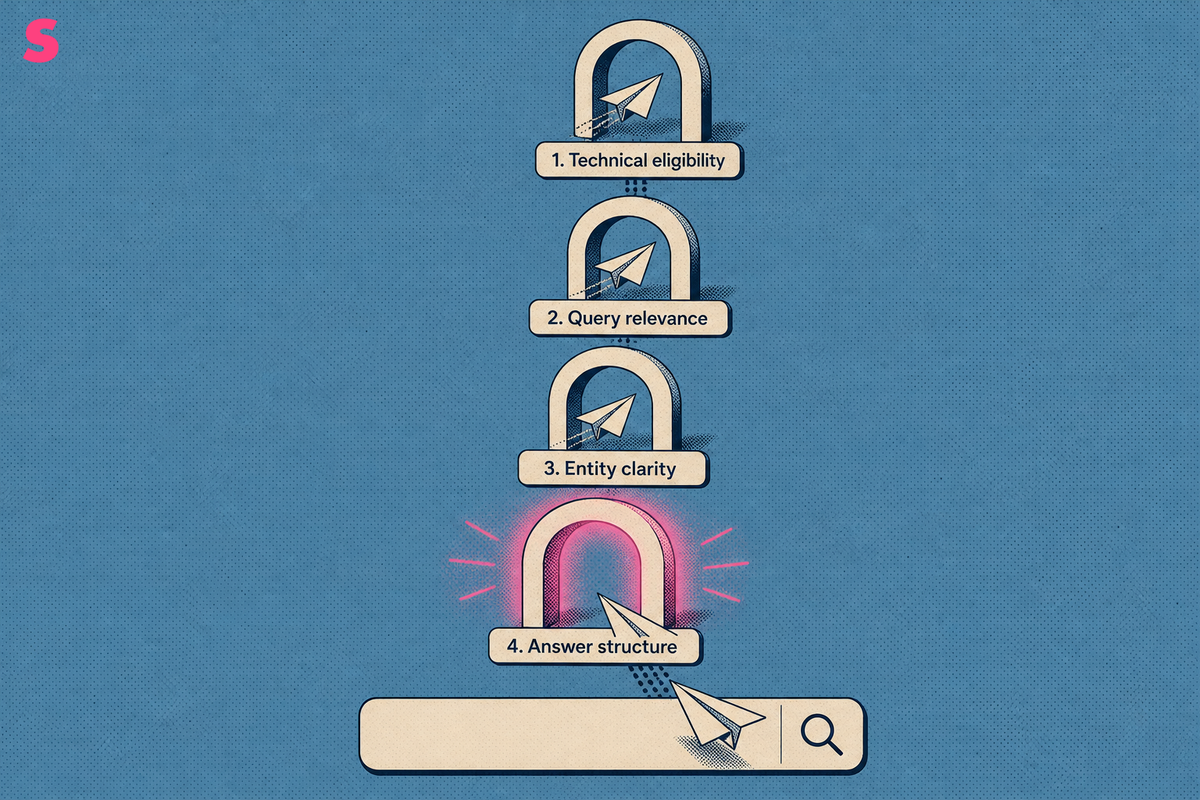
To gain visibility in Gemini, your site must be crawlable, publicly accessible, and clear enough for Gemini to extract a useful answer. As Google Search Central documentation puts it, "s visibility in generative AI search features, ensure your content is crawlable," per developers.google.com, October 10, 2026.
Before changing copy, confirm that priority pages load for crawlers, return useful server-rendered HTML, use correct canonical tags, and are not blocked by robots.txt, a firewall, or inconsistent redirects. Gemini grounds answers in Google’s search index, so visibility for target Google queries remains the foundation for Gemini visibility.
Crawlability alone is insufficient. Gemini also needs a page that answers the buyer’s question with identifiable entities, clear claims, supporting evidence, and extractable structure.
- Technical eligibility: Google can crawl, render, index, and understand the page.
- Query relevance: the page directly addresses a buyer-intent question.
- Entity clarity: the brand, product category, use case, and proof points are explicit.
- Answer structure: headings, concise definitions, tables, FAQs, and schema make the answer easier to retrieve.
How do you build a buyer-intent prompt panel and record a Gemini baseline?
Build a fixed panel of buyer-intent prompts, run it in Gemini daily, and record every mention, citation, source, position, and competitor named. A repeatable panel turns Gemini visibility into a measurable operating metric. An October 2026 listing recommends testing 20–50 buyer-intent prompts across Gemini and other AI platforms.
Start with a documented ideal customer profile, core categories, alternatives, use cases, and buying objections. Do not rely on branded prompts alone. Branded prompts measure recognition, while category and comparison prompts show whether Gemini associates your company with the problem a buyer needs solved.
- Collect buyer questions. Pull questions from sales calls, customer interviews, Search Console queries, site search, comparison pages, and support conversations.
- Classify the prompts. Label each prompt as awareness, consideration, decision, or purchase intent. Keep the wording conversational because Gemini users ask full questions rather than isolated keywords.
- Set a fixed prompt panel. Use 25–50 prompts tracked repeatedly over time, per the October 2026 listing. Include category, comparison, implementation, pricing, and replacement questions.
- Record the baseline. Log the date, exact prompt, Gemini response, brand mention, cited pages, named competitors, and answer framing.
Sona AI Visibility can track prompts and citations across 11 AI engines and connect AI-referred visits to pipeline and revenue. For Gemini work, it provides a daily record of whether priority prompts mention the brand, which sources Gemini cites, and whether those visits become measurable buyer activity.
Run the same prompt list daily. Daily records expose shifts that a weekly snapshot can average away. Gemini responses change with retrieval updates, model changes, and new competitor content. Require a change to persist across repeated runs before treating it as meaningful, and treat isolated movement as inconclusive.
How do you audit why your brand is or isn't appearing in Gemini today?
Audit Gemini visibility by separating outcome evidence from page-level causes. Identify prompts where Gemini mentions competitors, cites third-party sources, or omits your brand. Then inspect the pages that should answer those prompts for crawlability, content structure, schema, freshness, and entity evidence.
A visibility score shows the outcome, while a technical audit identifies the page-level issue affecting eligibility. Sona AI Visibility uses AI Search Insights to score a page out of 100 across six categories, rank findings as critical or medium with the fix attached, and re-run the audit on a watch so teams can verify that the fix landed.
| Audit area | What to inspect | What a failure means | Recovery action |
|---|---|---|---|
| Crawlability | robots.txt, canonicals, indexability | Gemini’s underlying search systems cannot reliably reach or select the page | Remove unintended blocks and correct canonical conflicts |
| Performance | Server-rendered HTML, JavaScript dependency, page delivery | Important answer content is difficult to render or retrieve | Expose core copy and structured content in rendered HTML |
| Content structure | Headings, metadata, FAQPage JSON-LD, semantic markup | The page lacks extractable answer units | Add descriptive headings, concise answers, and valid schema |
| Content quality | Completeness, recency, evidence, use-case specificity | The page does not provide a strong answer for the target prompt | Expand missing decision criteria and update stale claims |
Use the audit to create specific work items, not a generic optimization backlog. For each missing Gemini prompt, name the page that should own the answer, the finding that prevents extraction, the fix, and the retest date. Sona AI Visibility also shows page-level prompt gaps, linking an omitted question to the page that needs coverage.
Which technical fixes make a site eligible for Gemini visibility?
The technical requirements for Gemini eligibility are crawlability, indexability, server-rendered content, correct canonical tags, valid structured data, and reliable page delivery. Traditional SEO practices and comprehensive schema markup still apply because Gemini depends on Google’s search index.
Prioritize fixes by severity. A blocked page or incorrect canonical tag can prevent selection entirely. Missing FAQPage schema or a weak heading hierarchy does not guarantee exclusion, but it makes the page harder to interpret as a direct answer.
- Test crawler access. Check robots.txt directives, firewall rules, rate limits, and response codes for priority URLs.
- Confirm indexability. Review canonical tags, noindex directives, duplicate pages, and redirect chains.
- Reduce JavaScript dependency. Ensure core page copy, product facts, pricing details, and FAQs appear in server-rendered HTML.
- Validate structured data. Use schema where it accurately represents the page, especially FAQPage, Organization, Product, and Review markup.
- Re-audit on a separate clock. Run a full technical review monthly or quarterly, then monitor the prompt panel daily.
How should a B2B SaaS company structure pages so Gemini can extract a clear answer?
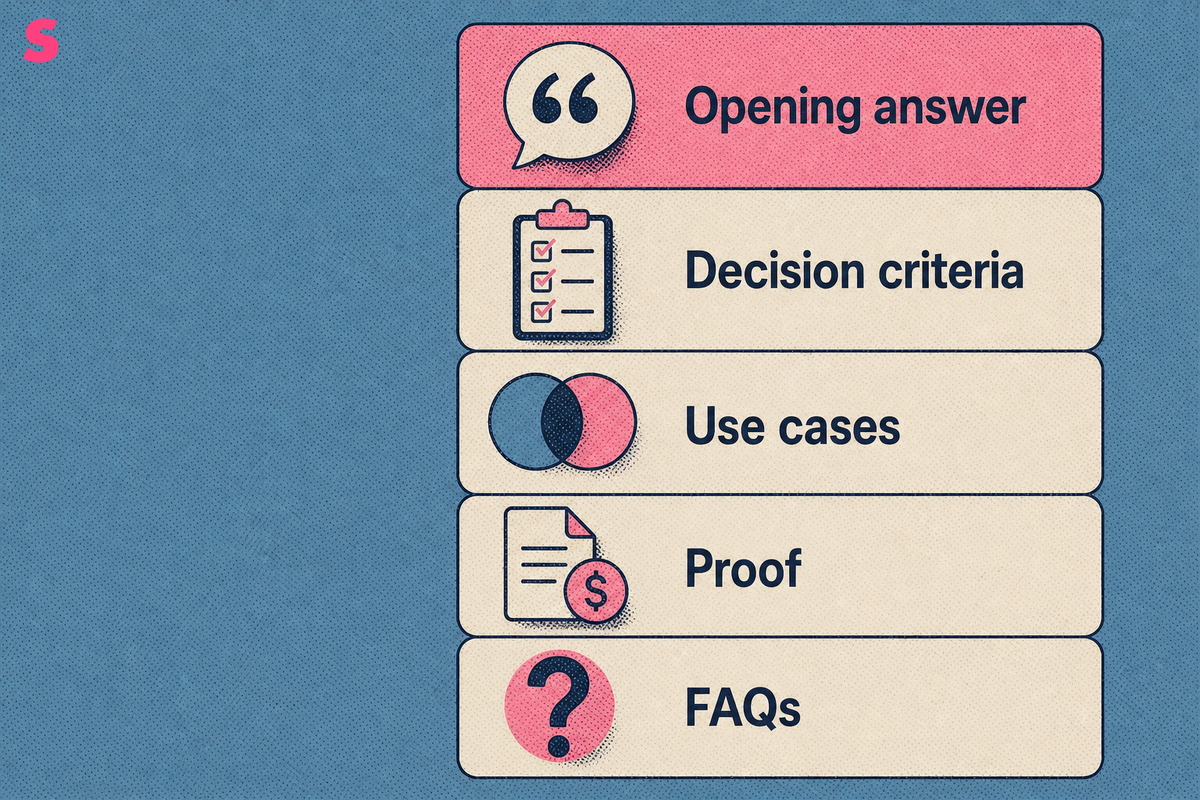
A B2B SaaS page should answer one buyer question before expanding into proof, implementation detail, and objections. Gemini needs extractable content units, not vague product language. Build pages around conversational prompts such as category comparisons, implementation questions, pricing criteria, integration requirements, and buyer outcomes.
Use a consistent page architecture: define the problem, answer the core question, explain the product’s role, show decision criteria, provide evidence, and address objections. Comprehensive topic clusters, conversational queries, and answer-optimized structures are established tactics for AI search visibility.
- Opening answer: provide a direct definition or recommendation in the first paragraph.
- Decision criteria: explain the requirements buyers should compare.
- Use cases: describe who the product serves and what job it performs.
- Proof: include transparent pricing, reviews, implementation details, and product documentation where relevant.
- FAQs: answer objections using the language buyers use in sales conversations.
Transparent pricing pages, dedicated FAQ pages, reviews, and social proof strengthen the factual surface Gemini can evaluate. Do not bury those facts in downloadable assets or image-only layouts. Place the relevant answer in plain HTML near the claim it supports.
Sona AI Visibility helps teams identify which prompt a page should answer but does not, then compare that opportunity with the page’s traditional organic position and AI crawler indexing activity. The result is a practical page brief: the buyer question, the missing answer, the page owner, and the evidence required for revision.
How do entity clarity and third-party mentions change what Gemini says about you?
Entity clarity tells Gemini what your company is, while third-party corroboration helps Gemini assess whether that description is credible. Keep the company name, category, audience, product capabilities, pricing model, and differentiators consistent across the website and external references.
One secondary compilation reported that 85% of AI brand mentions originate from third-party pages rather than owned content, per the October 2026 listing. Treat that figure as directional rather than universal. Owned pages define your claims, while independent pages help corroborate them.
Audit your entity footprint across review sites, partner pages, analyst coverage, customer stories, comparison articles, directories, and business profiles. Gemini can connect to Google Business Profile context that includes reviews, customer questions, and business information, per the October 2026 listing. Keep business details consistent across those surfaces.
Prioritize relevant mentions over generic coverage. A third-party article that accurately states your category, target buyer, use case, and product evidence gives Gemini a clearer entity relationship than a generic brand reference. Focus on pages that answer the same commercial questions in your prompt panel.
For B2B SaaS, the strongest external evidence supports a precise claim: which team uses the product, what workflow it supports, what integrations matter, and what buying stage it serves. That specificity reduces ambiguity in Gemini responses and improves the chance of appearing in comparison-oriented answers.
How do you test whether your changes improved Gemini visibility?
Test Gemini improvements by re-running the same daily prompt panel, comparing the response log against the baseline, and isolating the changed pages that correspond with changed mentions or citations. Do not introduce new prompts after every edit. A stable prompt panel distinguishes meaningful movement from randomness.
One 2026 report found an average Gemini visibility increase of 12.1 percentage points after web-content changes, per the October 2026 listing. The report does not establish a guaranteed outcome for any website. Measure the prompts, pages, dates, and response changes relevant to your category.
| Measurement | Baseline record | Success signal | Review cadence |
|---|---|---|---|
| Brand mentions | Whether Gemini names the brand | The brand appears for more priority prompts | Daily prompt log |
| Citations | Whether Gemini cites an owned or third-party source | Relevant pages support the answer | Daily prompt log |
| Answer framing | How Gemini describes the company | Category, use case, and differentiation are accurate | Weekly review |
| Page health | Technical findings and page score | Critical findings are resolved and re-audited | Monthly or quarterly audit |
A 2026 visibility study reported an 83.7% Gemini brand-mention rate and an approximately 21.4% citation rate, per the October 2026 listing. A mention and a citation are different metrics. Track both because a brand can appear in an answer without a supporting source, recommendation, link, or buyer decision.
Sona AI Visibility connects citations and AI-referred visits to pipeline and revenue on one account timeline. That measurement shows whether improved Gemini presence produced identifiable buyer activity rather than only a higher mention count.
What usually goes wrong when you try to gain Gemini visibility, and how do you recover?
The common failure is treating Gemini visibility as a copywriting task instead of a measurement and eligibility problem. Teams rewrite pages before confirming whether Google can crawl them, whether the page answers a real buyer prompt, or whether Gemini prefers different source types.
Another failure is measuring one impressive prompt once. Gemini answers vary by user, location, date, and model state. A one-time result is anecdotal. A daily prompt log shows whether a change persists across repeated checks.
- Failure: tracking only branded prompts. Recovery: add category, comparison, use-case, and pricing prompts.
- Failure: optimizing a homepage for every question. Recovery: assign each high-value prompt cluster to a dedicated page.
- Failure: publishing generic thought leadership. Recovery: add clear definitions, criteria, examples, and buyer-facing evidence.
- Failure: treating mentions as revenue. Recovery: connect AI-referred traffic to account, pipeline, and closed-won outcomes.
- Failure: refreshing every page at once. Recovery: prioritize pages that map to decision-stage prompts and visible technical findings.
Keep the recovery loop narrow: fix one defined issue, re-run the relevant technical audit, and continue the same prompt panel. Sona AI Visibility records prompt changes over time, allowing teams to test whether a page revision altered visibility for the buyer questions that mattered.
What should a Gemini visibility audit worksheet record?
A Gemini visibility audit worksheet should record the prompt, response, brand mention, citation, competing brands, candidate page, technical issue, owner, and retest date. The worksheet turns a volatile AI answer into an accountable operating record for content, SEO, demand generation, and product marketing teams.
| Worksheet field | What to record | Why it matters | Owner |
|---|---|---|---|
| Prompt | Exact buyer-intent question and intent stage | Preserves a repeatable test condition | SEO or content lead |
| Gemini response | Full answer, date, mention status, citations, and competitors | Shows the outcome without relying on memory | Marketing operations |
| Target page | URL that should answer the prompt | Assigns one page responsibility for the opportunity | Content owner |
| Audit finding | Critical or medium issue, category, and proposed fix | Turns a visibility gap into a technical or editorial task | SEO or web team |
| Business outcome | AI-referred visit, account, pipeline, or revenue evidence | Connects Gemini visibility to commercial impact | Demand generation or RevOps |
Review the worksheet weekly for execution, but retain the daily prompt record. The output is a log, not a score. A score is a dated snapshot, while a comparable series shows whether a change held across repeated Gemini responses.
Refresh flagship comparison and how-to pages at least quarterly, per the October 2026 listing. After each refresh, preserve the same buyer-intent prompts and compare the new response pattern with the prior period. This process shows whether Gemini began mentioning the brand, citing a relevant page, or describing the company more accurately.
Frequently Asked Questions
Can you optimize for Gemini directly, or only influence it?
You can only influence Gemini visibility. Gemini answers vary by user, location, date, and model state, so no tactic guarantees inclusion. Improve crawlability, answer quality, entity clarity, and third-party corroboration, then measure the same prompts repeatedly.
Is Gemini visibility different from ranking in Google AI Overviews?
Gemini and Google AI Overviews are separate surfaces that share the same groundwork. Crawlable, well-ranked, clearly structured pages help both. Track Gemini and Google AI Overviews with separate prompt records because each surface can produce different answers, citations, and brand mentions.
How many prompts should you track to measure Gemini visibility?
Use a repeatable panel of roughly 20–50 buyer-intent prompts sampled on fixed dates. An October 2026 listing recommends 20–50 prompts across Gemini and other AI platforms. A separate October 2026 listing recommends 25–50 prompts tracked repeatedly. The right panel covers your category, use cases, comparisons, pricing questions, and implementation objections.
Is a brand mention in Gemini the same as a citation?
No. One 2026 study reported an 83.7% Gemini brand-mention rate and an approximately 21.4% citation rate, per the October 2026 listing. A mention does not mean Gemini recommends the brand, cites the company website, links to a page, or influences a buyer’s final selection.
Does traditional SEO still matter for Gemini visibility?
Yes. Traditional SEO is the foundation because Gemini grounds in Google’s search index. Strong rankings alone are insufficient. Entity clarity, third-party corroboration, structured answers, schema markup, and crawlable public content also shape whether Gemini can identify and use a page.
How often should you refresh pages aimed at Gemini prompts?
Refresh flagship comparison and how-to pages at least quarterly, per the October 2026 listing. Continue running the same prompt panel daily after publication. Daily tracking reveals whether the revised page changed Gemini mentions or citations, while quarterly refreshes keep core buyer-facing evidence current.
Summarize this article with AI: ChatGPT · Claude · Perplexity · Google AI Mode
Last updated: October 2026







