


A search visibility score is a percentage estimating the clicks a website receives from its organic positions across a tracked keyword set. Tools weight each position by search volume and expected click-through rate, so scores from different tools cannot be compared directly. An AI visibility score extends this concept to AI responses as a vendor-defined 0 to 100 composite built from sampled prompts. Evaluate any score against your own trend and named competitors within the same tool.
What is a search visibility score and what does it measure?
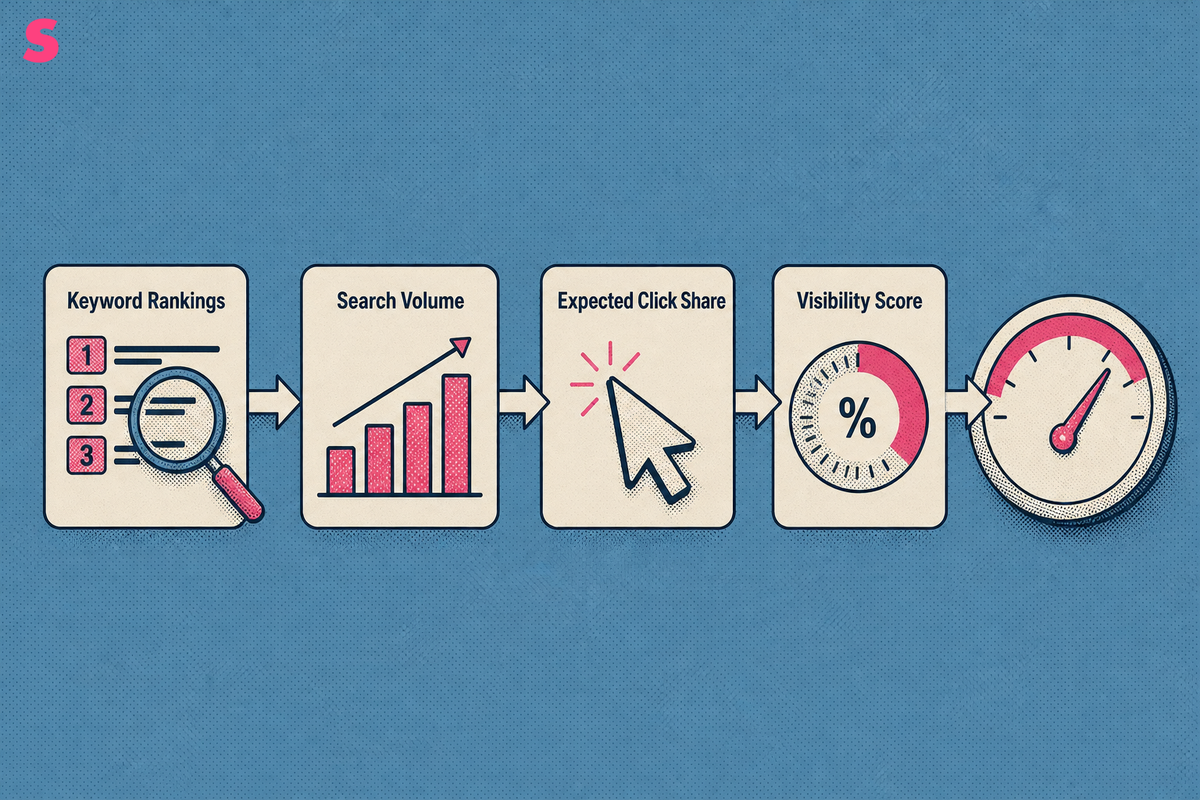
A search visibility score is a percentage that estimates the share of organic clicks a site could capture from rankings across tracked keywords. It combines keyword rankings, search volume, and expected click share into one directional measure.
Rank-tracking tools calculate the score by aggregating keyword data. A higher score signals greater potential to attract organic traffic, build brand awareness, and generate leads, but it does not prove that those outcomes occurred.
The term is not a universal standard. Each platform uses its own keyword set, click-through-rate model, and weighting rules. A visibility score has meaning only within the tool that produced it, using the same settings and comparison set.
For a marketing leader, the value is prioritisation. One percentage can show whether a site’s organic presence is improving across commercially relevant terms before the team examines individual rankings, landing pages, and conversion outcomes.
How is a search visibility score calculated from rankings and keywords?
A visibility score estimates the clicks a domain could receive from its rankings, weighted by keyword demand. The calculation assigns an expected click share to each ranking position, weights that share by search volume, then compares the total with the clicks available from first position for every tracked term.
Illustrative example, not observed data: a site tracks two keywords. Keyword A has 1,000 monthly searches and the site ranks first, with an assumed 30% click share. Keyword B has 500 monthly searches and the site ranks fifth, with an assumed 5% click share. The estimated captured clicks are 325, while first position for both keywords would produce 450 estimated clicks. The resulting score is 72%.
The simplified formula is estimated clicks from current rankings divided by estimated clicks at first position, multiplied by 100. Real tools use larger keyword sets and more detailed click-through-rate curves, but the underlying logic remains the same.
- Tracked keywords: Adding high-volume terms can materially change the score.
- Country and language: Rankings and demand differ by market.
- Device: Mobile and desktop result pages produce different click behaviour.
- Competitor set: Relative visibility depends on the included domains.
How is a search visibility score different from rankings, click-through rate and share of voice?
A search visibility score is an estimated-click model across a tracked keyword set. It differs from measured traffic, average ranking position, and share of voice because each metric answers a different operational question.
The score estimates opportunity from tracked keywords rather than recording site visits. Analytics platforms measure traffic after visitors arrive. Search visibility estimates the potential created by rankings before a visit occurs.
| Metric | What it measures | Where the data comes from | What it cannot tell you |
|---|---|---|---|
| Average ranking position | Mean search position across tracked keywords | Rank-tracking data | How much demand or click opportunity sits behind each ranking |
| Impressions | How often a page appeared in search results | Search performance data | Whether searchers clicked or converted |
| Click-through rate | Clicks divided by impressions | Search performance data | Total market opportunity across a keyword portfolio |
| Organic traffic | Visits attributed to organic search | Web analytics | Whether rankings improved across the monitored keyword set |
| Share of voice | Relative prominence against selected competitors | Rank or visibility tracking data | Measured clicks, leads, or revenue |
| Search visibility score | Estimated click share from rankings across tracked keywords | Rankings, search volume, and click-share assumptions | Actual traffic, conversion quality, or pipeline |
A strong reporting set uses these metrics together. Rankings show placement, click-through rate shows result-page appeal, analytics shows visits, and the visibility percentage summarises estimated organic opportunity.
What is a good search visibility score?
A traditional visibility score of 35% to 45% for target keywords is often treated as strong because it reflects substantial estimated click share. The range provides context, not a universal operating target.
No single threshold applies to every business. A narrow keyword set containing branded terms can produce a high percentage quickly. A broad category set with competitive, high-volume queries can produce a lower percentage while creating more qualified demand.
Use a consistent comparison: the same keyword set, country, device, and click model over time. Compare named competitors within the same tool, where each domain is subject to the same calculation.
A score is a dated snapshot. Monthly or quarterly reporting shows whether organic visibility is moving in a durable direction rather than reacting to one ranking change.
What is an AI visibility score and how is it calculated?
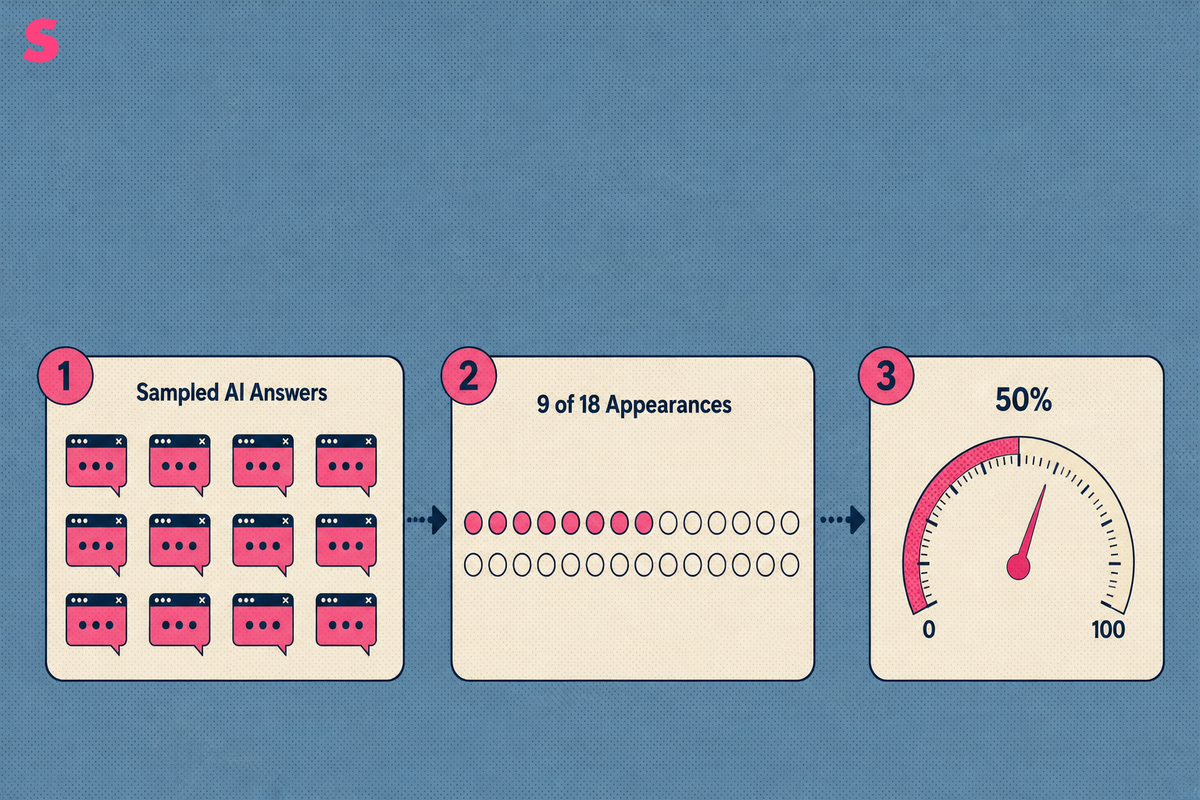
An AI visibility score measures how frequently and prominently a brand appears in AI-generated answers across answer engines. It is often expressed as a 0 to 100 metric against industry competitors, and AEO platforms also use the term brand visibility score for the same concept.
Illustrative example, not observed data: if a business appears in 9 of 18 sampled AI answer instances, its appearance rate is 50%. More developed models can also weight recommendation frequency, source citations, sentiment, and answer position.
A Q4 2026 AI Visibility Index queried 25 questions 5 times across 4 engines and converted the observations into a weighted 0–100 composite, per finance.yahoo.com, October 2026. That design shows why an AI score is more than a count, but the weighting belongs to the index publisher.
An AI visibility index or leaderboard ranks brands under a fixed prompt set and scoring method. Treat a leaderboard as a methodological artefact, not authoritative market truth. Validate the questions, engine coverage, geography, repetition count, and weighting before using its rankings for strategy.
Sona AI Visibility connects citations and prompts to pipeline and revenue on one account timeline, rather than treating a brand-level appearance score as the final outcome.
How do you compare AI visibility across ChatGPT, Google AI Overviews, Perplexity, Gemini, and other answer engines?
Compare AI visibility with one fixed prompt set across ChatGPT, Google AI Overviews, Perplexity, Gemini, and other answer engines. Report each engine’s appearance rate before calculating any blended figure. Engine-level reporting prevents strong results in one engine from concealing weak coverage elsewhere.
Illustrative example, not observed data: a B2B software company runs 20 buyer prompts five times each. The brand appears in 60% of ChatGPT responses, 45% of Google AI Overviews, 35% of Perplexity responses, and 50% of Gemini responses. The engine-level results identify where the brand appears, while a blended percentage only summarises the set.
- Build prompts from real buyer questions, including comparison, implementation, pricing, and category queries.
- Fix the engine list, country, language, and collection rules before the first run.
- Repeat each prompt because the Q4 2026 index repeated every question 5 times, per finance.yahoo.com, October 2026.
- Run the same prompt list daily. Daily tracking reveals patterns that a weekly snapshot can obscure.
AI answers are nondeterministic. Model versions, location, retrieval state, personalisation, timing, and newly published material can change a response. Fifteen or 25 prompts can create false confidence in a large category. A mention is not necessarily a recommendation, and scores from different tools are not directly equivalent.
A brand score is not a work item. Sona AI Visibility uses AI Search Insights to show the prompts buyers ask and the sources AI cites, giving teams a prompt-level view of the questions and pages that require attention.
What does a change in visibility score mean for traffic and pipeline?
A visibility-score change indicates a change in estimated search opportunity or AI-answer presence, not a guaranteed traffic or pipeline result. Revenue analysis requires referral, conversion, account, and CRM data alongside the score.
For home-services companies, an AI appearance rate of 34.9% or higher represented the top quarter, per cheers.tech. That is a category-specific reference point, not a benchmark for B2B SaaS, ecommerce, or another market.
Illustrative walk-through, not observed data: a site’s traditional visibility percentage rises from 20% to 25% across a fixed keyword set. If the model estimates that the extra 5 points represent 500 additional monthly clicks, and 2% of those clicks become leads, the result is 10 leads. If 20% of those leads become qualified pipeline opportunities worth $10,000 each, the estimated pipeline is $20,000.
The assumptions determine the outcome. Appearing in an answer does not mean being recommended, selected, or trusted. An estimated-click score is not measured traffic. Sona AI Visibility connects AI-referred visits to accounts, pipeline, and closed-won revenue, so teams can test whether AI-answer exposure produces commercial outcomes.
Which tools measure AI visibility, and how do their engines and prompt limits differ?
AI visibility tools differ in engine coverage, prompt definitions, refresh cadence, and pricing models, so product tables are not direct comparisons. Free AI visibility checkers can provide a first reading, while a manual count of answers naming a business is a practical free fallback.
The table reflects published listings as of October 2026. A tool can appear with different engine counts across comparisons, which makes the named engine list and measurement design more useful than a headline count.
| Tool | Starting price | Agency Plans? (Yes/No) | # of Answer Engines Tracked | Answer Engines | # of Daily Tracked Prompts (entry plan) | Cost per Daily Tracked Prompt | Differentiation |
|---|---|---|---|---|---|---|---|
| Sona AI Visibility | From $75/month | Yes | Up to 11 (3 on Starter) | ChatGPT, Gemini, Google AI Overviews | 5,000 credits/month, about 56 daily tracked prompts across 3 engines | $0.45 per daily tracked prompt | Connects AI citations and prompts to pipeline and revenue on one account timeline, and tracks AI crawler activity from server logs or a lightweight edge worker without a JavaScript tag. |
| Profound | Not published | Not published | Up to 9 (3 on free Trial) | Not published | Not published | No refresh cadence published | Focus: tracking where a brand is cited in AI answers. |
| Peec AI | Not published | Not published | Up to 13 (3 of 6 on Starter, plus add-ons) | Not published | Not published | No refresh cadence published | Focus: tracking brand visibility across AI answer engines. |
| Otterly.ai | $29/month | Not published | Up to 7 (4 on Lite, 3 as paid add-ons) | Not published | 15 tracked prompts | No refresh cadence published | Focus: tracking where a brand is cited across AI engines. |
| Scrunch AI | $250/month | Not published | Up to 9 (4 on Core) | Not published | 350 tracked prompts | No refresh cadence published | Focus: tracking brand appearance and citations in AI answers. |
The Free AI Readiness Checker provides a separate technical reading of whether AI engines can crawl and parse a site. It runs 35 checks across 6 categories and returns a 0–100 score with a letter grade, per Sona product documentation, October 2026. It does not measure whether a brand appears in AI answers.
How can a B2B SaaS team raise its search and AI visibility score?
B2B SaaS teams raise traditional and AI visibility by improving crawlability, publishing authoritative answers to buyer questions, earning credible third-party mentions, and maintaining structured data. Rankings drive traditional search visibility, while mentions and citations drive AI visibility.
Technical SEO remains foundational. Search engines and AI retrieval systems need accessible pages, server-rendered HTML where appropriate, a sound canonical tag strategy, and clear internal linking. Structured data and well-organised page sections help systems interpret the subject, entity, and supporting evidence on each page.
Content should answer questions buyers ask during awareness, consideration, decision, and purchase stages. A page built for a commercial comparison prompt serves a different purpose than a category explainer. Track the prompt set daily, then schedule a full technical re-audit and competitive benchmark review quarterly.
Third-party mentions and digital PR matter because AI answers often assemble information from sources beyond a company’s site. Sona AI Visibility can show which sources AI cites and which prompts a brand appears in, helping teams prioritise content, source coverage, and technical fixes.
What are the frequently asked questions?
What is a good search visibility score?
For target keywords, a score of 35% to 45% is often treated as strong because it represents substantial estimated click share. There is no universal benchmark. Compare the same keyword set against your own trend and named competitors inside the same tool.
Is a search visibility score the same as an AI visibility score?
No. A traditional visibility score estimates organic clicks from rankings across tracked keywords. An AI visibility score, often expressed from 0 to 100, measures how often and how prominently a brand appears in AI-generated answers.
Can I get an AI visibility score for my website for free?
Yes. Free AI visibility checkers provide a first reading, and teams can count how many answers from a fixed prompt sample name the business. Treat either result as indicative because it reflects a bounded sample rather than every buyer question.
Why does my AI visibility score change between runs?
AI answers are nondeterministic. The same prompt can return different results because of model version, location, retrieval state, personalisation, timing, and newly available sources. Repeated runs per prompt reduce the risk of treating a one-off response as a trend.
What is an AI visibility index or leaderboard?
An AI visibility index or leaderboard is a published brand ranking built from a fixed method. The Q4 2026 index queried 25 questions 5 times across 4 engines and produced a weighted 0–100 score, per finance.yahoo.com, October 2026. Check the method before trusting the ranking.
How many prompts do I need to track for a reliable AI visibility score?
There is no fixed number. The prompt set should reflect real buyer questions and be large enough for the category. Fifteen or 25 prompts can create false confidence in a broad market, so expand coverage across intents, products, competitors, and buyer stages.
Summarize this article with AI: ChatGPT · Claude · Perplexity · Google AI Mode
Last updated: October 2026







