


AI brand visibility factors are the signals that determine how frequently ChatGPT, Google AI Overviews, Perplexity, and other answer engines mention, recommend or cite a brand in generated answers before anyone reaches a website. Off-site signals, including third-party mentions, reviews and branded search, typically carry more weight than on-site signals. Sona AI Visibility connects those prompts and citations to pipeline and revenue, allowing teams to assess visibility through commercial outcomes instead of mention counts alone.
What is AI brand visibility, and how is it different from SEO rankings and brand awareness?
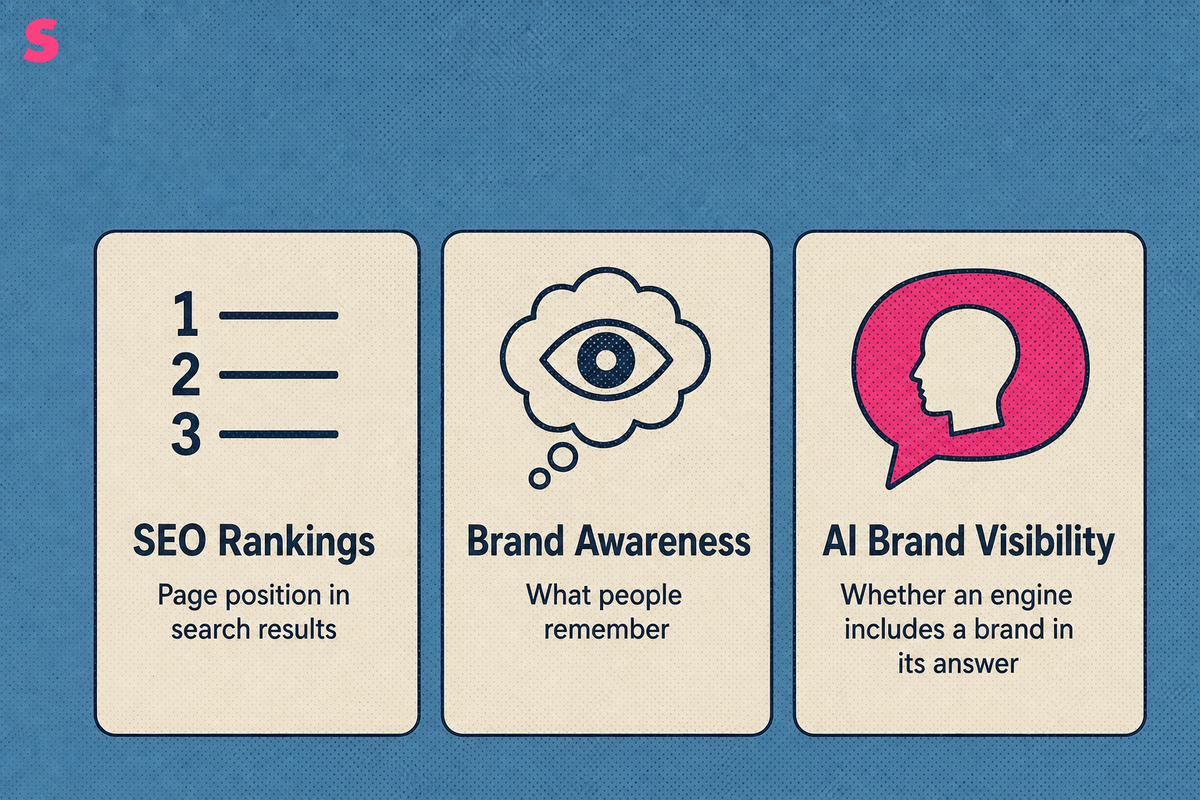
AI brand visibility measures how often, how favourably, and in what context AI engines mention, recommend, or cite a brand in generated answers. Buyers can form a vendor shortlist in ChatGPT, Google AI Overviews, Perplexity, Gemini, Claude, and other answer engines before visiting a website.
AI brand visibility is not a Google ranking position, brand-awareness survey result, or website-traffic measure. SEO rankings show where a page appears in search results. Brand awareness measures what people remember. AI visibility measures whether an engine includes a brand in response to a specific prompt.
Consider a buyer asking, “What are the best customer data platforms for B2B SaaS?” An answer may name three vendors, describe one as enterprise-focused, cite an analyst report, and link to a comparison page. Each named vendor has visibility, but the recommendation, wording, and cited source determine the commercial value of the appearance.
The leading measured signals are off-site text signals: web mentions, anchor text, and branded search volume. This shifts the usual SEO assumption that backlinks and traffic alone determine presence. Backlinks and traffic can support discovery and authority indirectly, but neither guarantees a mention, recommendation, category association, or citation in an AI-generated answer. AI brand visibility factors also include whether an engine can identify what the company does, find credible third-party confirmation, and extract a useful answer from a page.
Which factors decide whether an AI engine mentions, recommends, or cites a brand?
AI engines evaluate four layers: recognizing a brand, recommending it, citing a source, and associating the brand with the correct category. The practical signals are citation, specificity, and association. These signals depend on entity clarity, third-party authority, and answer extractability.
Entity clarity tells an engine who the company is and what problem it solves. Third-party authority shows whether credible independent sources describe the brand consistently. Answer extractability depends on a page containing a direct, structured passage that supports an answer without extensive interpretation.
Content freshness means maintaining current, retrievable evidence, rather than publishing frequently for its own sake. Product changes, pricing, category language, documentation, and third-party references should remain accurate enough for an engine to retrieve and use without relying on outdated claims.
| Layer | What it means | Driving factor | Metric to track |
|---|---|---|---|
| Mentioned | The brand appears in an answer. | Entity clarity and branded references | Mention rate by prompt and engine |
| Recommended | The brand is presented as a viable choice. | Third-party authority and review sentiment | Recommendation rate and sentiment |
| Cited | A source about the brand or its category supports the answer. | Credible citations and extractable pages | Citation rate and cited URLs |
| Associated with the right category | The engine links the brand to the intended use case. | Specificity and category-consistent coverage | Category association by prompt set |
A well-known brand can still fail the category-association test. When third-party pages describe the company with vague or conflicting language, an answer engine has less evidence to connect the brand with the buyer’s problem. Prompt-level measurement therefore provides more useful evidence than a single domain-level score.
Why do off-site signals like third-party mentions and reviews outweigh a brand's own content?
Off-site signals outweigh owned content because AI engines assemble answers from evidence distributed across the web, not from a brand’s website alone. Brand mentions ranked as the top measured factor at 94%, followed by reviews and sentiment at 91%, in an October 2026 analysis.
Third-party mentions establish citation and category association. Reviews provide a second form of evidence, describing product experience, service quality, industry fit, and local relevance in language that does not originate with the brand. A study of 800,000 AI responses found that review profiles materially shape brand presence in AI search results.
Service, product, and location reviews each contribute different evidence. A product review can explain capabilities, a service review can explain delivery quality, and a location review can reinforce regional relevance. A complete review footprint gives answer engines more specific evidence to retrieve.
YouTube mentions showed the strongest measured correlation with AI visibility, approximately 0.737, across a 75,000-brand study. Correlation does not establish cause. It does indicate that brands discussed in video ecosystems often have broader third-party coverage than brands relying only on owned articles.
Owned content still matters. A company needs accurate product pages, category pages, documentation, and comparison material. Owned content alone, however, cannot create independent validation. The stronger model makes the brand easy to understand on-site and consistently referenced off-site.
How does page structure affect whether an AI engine cites a page?
Page structure affects citation because an AI engine must locate a concise, defensible passage that answers the prompt. An April 2026 analysis found that ChatGPT cited roughly 15% of pages it retrieved, while 44.2% of citations came from the first 30% of a page.
That pattern favours pages that state the answer early, use descriptive headings, and support claims with specific evidence. A page should establish its subject, audience, scope, and conclusion before the supporting detail begins. Dense introductory copy forces an engine to infer too much.
The Princeton GEO study found that adding statistics increased generative-search visibility by up to 40%, while adding citations and quotations increased visibility by up to 41%, per the Princeton researchers’ July 2026 study. These findings support evidence-rich writing rather than decorative formatting.
Publishing frequency is not itself a demonstrated citation factor. The available evidence supports structure and substance, not volume. A quarterly technical review can identify problems in rendered HTML, schema, canonical tags, and content structure, while a daily prompt list shows whether citation behaviour changed.
The Free AI Readiness Checker evaluates crawlability, rendered HTML, and page structure. It returns a dated snapshot that helps teams identify page-level technical issues before testing whether those pages receive citations.
How do citation patterns differ across ChatGPT, Google AI Overviews, Perplexity, and Claude?
ChatGPT can retrieve pages without citing most of them, while Google AI Overviews, Perplexity, and Claude should be measured separately because their outputs can differ for the same commercial prompt. The available evidence does not establish a universal source hierarchy or citation rule across all four engines. Instead, source selection and citation presentation vary by engine, topic, and time.
For ChatGPT, an April 2026 analysis found that it cited roughly 15% of the pages it retrieved, while 44.2% of citations appeared in the first 30% of a page. Google AI Overviews, Perplexity, and Claude can each produce different brand mentions, recommendations, and source selections from the same prompt, so a result in one engine cannot stand in for the others.
Google AI Overviews should be assessed for whether a brand or supporting source appears in its generated search response. Perplexity should be assessed for the sources attached to its answer. Claude should be assessed for whether it mentions or recommends the brand and how it frames category association. ChatGPT should be assessed for both its answer wording and the relatively selective use of retrieved-page citations.
A 2026 analysis of 3.9 million chatbot citations collected between May and August 2026 found that citation preferences vary by topic, per urbangeekz.com, August 2026. Citations appeared in approximately 1.6% of U.S. ChatGPT prompts in June 2025 and roughly 6.8% in May 2026, a more than fourfold increase in one year. Sector patterns also varied: travel and hospitality prompts included citations about 23% of the time, while automotive prompts did so about 20% of the time, in the July 2026 analysis.
These figures do not establish a universal engine weighting. They show that citation behaviour changes across sectors and time periods. Teams should test a fixed prompt set across ChatGPT, Perplexity, Gemini, Claude, and other answer engines rather than treating one engine’s output as the market.
Running the same prompt list daily reveals patterns that a weekly snapshot can obscure. Retrieval indexes change, models update, and competitors publish new material. Treat movement as a trend only after repeated observations across multiple runs. A one-day spike is noise.
Why do SaaS companies need to track AI brand visibility now?
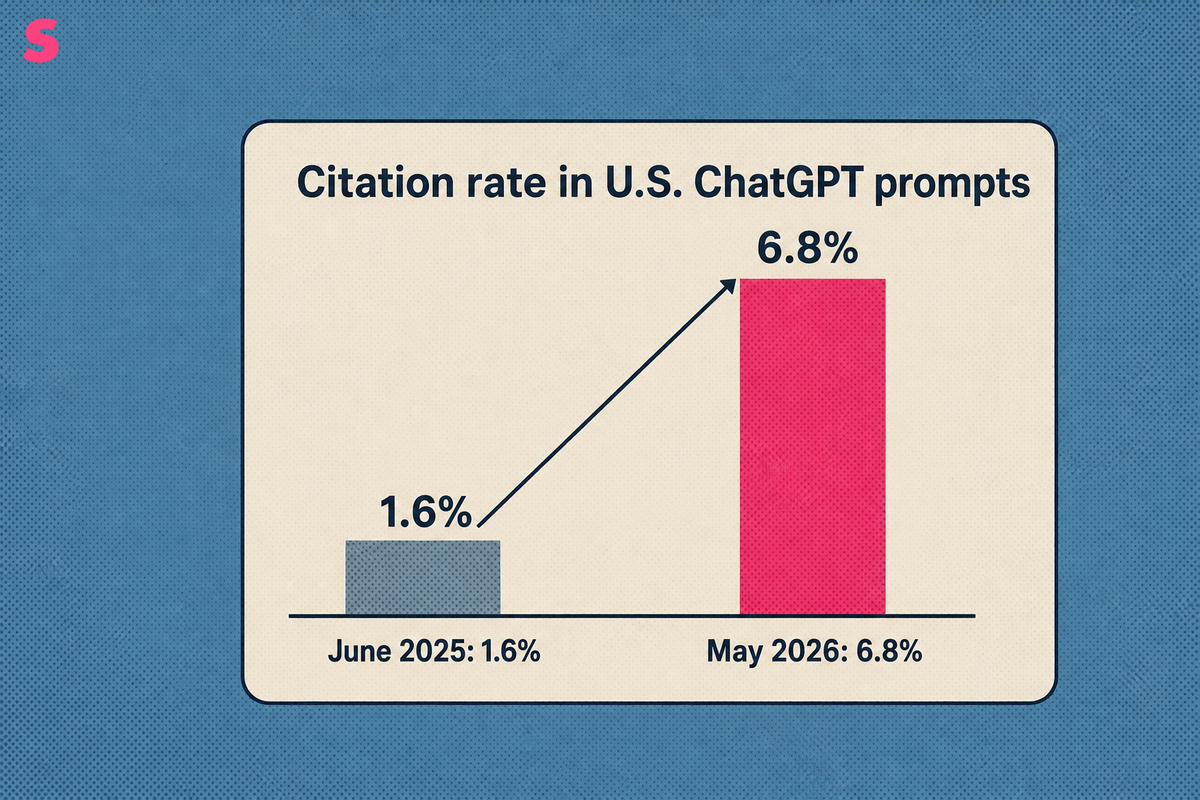
SaaS companies need AI brand monitoring because vendor discovery begins inside generated answers, often before a buyer visits a product page. Citation frequency in U.S. ChatGPT prompts rose from about 1.6% in June 2025 to about 6.8% in May 2026, according to the July 2026 analysis.
This change affects demand generation and category positioning. Short AI-generated vendor lists can concentrate exposure among a few named brands, creating winner-take-all effects for commercially important prompts. An established brand may have accumulated third-party references, while an emerging company can build visibility through specific, credible coverage of a narrow use case. Conventional web analytics alone cannot show either outcome.
LinkedIn reported that 81% of surveyed parties saw improved brand recognition and sales from AI visibility, while 21% of consumers trusted AI-generated ads. The survey indicates commercial interest, not a guaranteed revenue effect. Teams should measure the channel rather than treat every mention as pipeline.
Sona AI Visibility connects citations and AI-referred visits to pipeline and revenue on one account timeline, and tracks AI crawler activity from server logs or a lightweight edge worker. This measurement distinguishes an answer that merely names a brand from an answer that precedes a meaningful buyer journey.
Which metrics belong in an AI brand visibility competitive analysis, and how far can they be trusted?
An AI brand visibility competitive analysis should track mention rate, recommendation rate, share of model, citation rate, cited URLs, competitors named, and sentiment. These metrics show where a brand appears, how an engine describes it, and which sources support the result.
- Mention rate: the share of tracked prompts that name the brand.
- Recommendation rate: the share of prompts where the brand is presented as a choice.
- Share of model: the brand’s presence relative to competitors across the same prompt set.
- Citation rate: the share of answers citing a brand page or third-party source about the brand.
- Cited URLs: the pages engines reference most often.
- Sentiment: whether the answer frames the brand positively, negatively, or neutrally.
These metrics require discipline. Outputs vary by wording, location, and model updates, so one prompt run is not a benchmark. A high citation count can reflect content volume or engine preference rather than authority. Mentions also do not equal pipeline, so visibility data should be paired with attribution, branded-search trends, demo forms, and self-reported source data.
A brand-level score is not a work item. Sona AI Visibility uses AI Search Insights to show prompts buyers ask and the sources AI engines cite, allowing a team to identify the prompt and page behind a movement rather than react to an aggregate number.
What can AI visibility tools measure, and why are their numbers hard to compare?
AI visibility tools measure prompt-level mentions, citations, rankings, competitors, cited sources, and changes over time. Their numbers are difficult to compare because prompt allowances, answer engines, refresh cadence, countries, and citation definitions differ across plans.
The comparison below uses published entry-plan details as of October 2026. Buyers should run identical prompts in the same countries and on the same schedule before comparing outputs. A daily prompt count is not equivalent when tools apply different engine coverage or response units.
| Tool | Starting price | Agency Plans? (Yes/No) | # of Answer Engines Tracked | Answer Engines | # of Daily Tracked Prompts (entry plan) | Cost per Daily Tracked Prompt | Differentiation |
|---|---|---|---|---|---|---|---|
| Sona AI Visibility | From $75/month, billed annually | Yes | Up to 11 (3 on Starter) | Not published | 5,000 credits/month, about 56 daily tracked prompts across three engines | $0.45 per daily tracked prompt | Connects AI citations and prompts to pipeline and revenue, and tracks AI crawler activity from server logs or a lightweight edge worker. |
| Peec AI | From $95/month | Yes | Up to 13 (3 of 6 on Starter, plus add-ons) | Not published | 50 prompts daily | $0.63 per daily tracked prompt | AI visibility tracking across self-serve and agency plans. |
| Otterly.ai | From $29/month | Yes | Up to 7 (4 on Lite, 3 as paid add-ons) | ChatGPT, Google AI Overviews, Perplexity, Microsoft Copilot | 15 prompts daily | $0.48 per daily tracked prompt | Prompt tracking across supported AI engines, with additional engine options. |
| Scrunch AI | From $250/month | Yes | Up to 9 (4 on Core) | ChatGPT, Perplexity, Google AI Overviews, Microsoft Copilot | 125 prompts, refresh cadence not published | No refresh cadence published | AI search visibility tracking for brand and agency users. |
| PromptWatch | From $95/month | Yes | Not published | Not published | 50 prompts daily | $0.48 per daily tracked prompt | Prompt and response tracking with agency plan options. |
Sona AI Visibility is useful when visibility reporting must connect to commercial outcomes because it follows AI-referred visits through accounts, pipeline, and closed-won revenue. The comparison remains directional. A meaningful evaluation uses the same prompt set, country settings, and sustained daily tracking period.
Which AI brand visibility factor should a team fix first?
The first factor to fix is the weakest one blocking a commercially important prompt: entity clarity, third-party authority, or answer extractability. Teams should triage the problem through three decisions rather than launch a broad visibility program without evidence.
- Is the brand visible in any AI engine today? Run a fixed set of category, comparison, problem, and branded prompts. Separate prompts where the company is absent from prompts where it is cited without recommendation.
- Which evidence layer is weakest? If the brand is misclassified, improve entity clarity. If credible third-party discussion is scarce, build authority. If engines retrieve pages but fail to cite them, improve extractability.
- Which factor affects the highest-value prompts? Prioritize the issue attached to commercial and decision-stage questions, not the issue with the largest raw prompt volume.
Sona AI Visibility can connect prompt performance to buyer intent and revenue outcomes, helping teams prioritize a commercial prompt over a broad informational query. The output should guide a next action, such as clarifying category language, improving a cited page, or addressing missing third-party coverage.
Track prompts daily, review the narrative quarterly, and keep technical audits on a separate periodic cycle. A score is a dated snapshot. Repeated prompt results reveal the movement worth investigating.
What are the frequently asked questions about ai brand visibility factors?
What are the main AI brand visibility factors?
The main AI brand visibility factors are third-party brand mentions, reviews and sentiment, branded search demand, anchor text, YouTube mentions, entity clarity, content freshness, and extractable on-site answers. Off-site signals lead the measured evidence, while page structure helps an engine turn supporting material into a citation. The four practical layers are being mentioned, recommended, cited, and associated with the correct category.
Is AI brand visibility the same as brand awareness?
No. Brand awareness describes what people recognize or recall about a company. AI brand visibility describes how often answer engines mention, recommend, or cite the brand in generated answers. It can be measured by prompt and engine, while brand awareness is commonly measured through surveys or market research.
Why does citation authority matter for generative engine optimization?
Citation authority matters because answer engines use credible third-party sources to assemble and support answers. Independent product coverage, reviews, category references, and expert discussion strengthen the evidence connecting a brand to a use case. Citation count alone remains a weak proxy for authority because it can reflect content volume or engine preference.
How often do AI chatbots cite sources in their answers?
Citations appeared in about 1.6% of U.S. ChatGPT prompts in June 2025 and about 6.8% in May 2026, according to the July 2026 analysis. Citation frequency also varied by sector, reaching about 23% for travel and hospitality prompts and about 20% for automotive prompts in that analysis.
Can a brand be mentioned in AI answers and still get no pipeline?
Yes. A mention can create awareness without producing a click, qualified account, demo request, or revenue. Teams should pair visibility metrics with attribution, branded-search trends, demo forms, CRM data, and self-reported source data. That combination separates interesting exposure from commercial impact.
How many prompts should a team track to measure AI visibility reliably?
A single prompt run is not reliable because answers vary with wording, location, retrieval indexes, and model updates. Track a fixed prompt set daily and compare the resulting series over time. The right set covers the company’s highest-value buyer questions rather than a generic allowance target.
Summarize this article with AI: ChatGPT · Claude · Perplexity · Google AI Mode
Last updated: October 2026







