


A website AI search engine is a search field that finds content by meaning and provides a direct, cited response rather than a ranked link list. For a B2B SaaS company, the decision depends on content type, indexing and query limits, permissions, and total usage costs, so test every tool with your own queries before purchasing. Separately, Sona AI Visibility handles the opposite direction by monitoring external AI engine citations and linking them to pipeline and revenue. Keep these two purchases separate.
What is an AI search engine for websites, and how does it differ from keyword search?
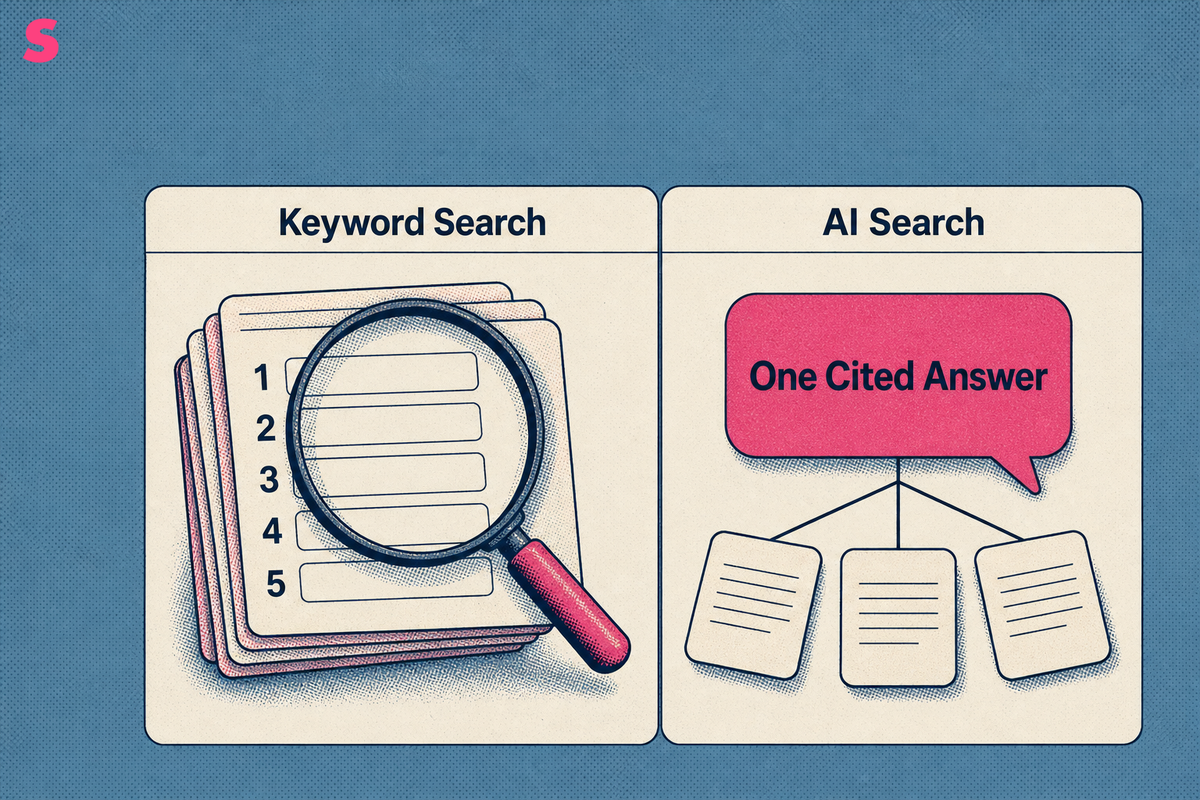
An AI search engine for websites lets visitors ask natural-language questions and receive answers grounded in the site’s content. Traditional keyword search matches terms and returns a ranked list of pages.
The difference matters when a buyer arrives with a problem rather than a known document title. AI search interprets context and recommends relevant material, while traditional search ranks pages for the visitor to review.
Consider a help-center visitor who types, “Why does our SSO configuration fail after a domain change, and which settings should we update first?” Keyword matching may return pages containing “SSO,” “domain,” and “settings.” Meaning-based retrieval can identify the relevant setup guide, troubleshooting article, and release note, then produce one answer with citations to those sources.
The retrieval vocabulary matters. Full-text search matches words and phrases. Semantic search matches meaning. Vector search retrieves content represented as embeddings. Hybrid retrieval combines full-text and semantic signals, then ranks the combined results.
Traditional search remains useful for structured catalogs, error codes, plan names, and exact-match documentation lookups. AI website search is more useful when a visitor’s question includes context that a short keyword query cannot express.
Is AI search on your own website the same as tracking how AI engines cite your brand?
No. On-site AI search serves visitors who have already reached your website, while AI search visibility measures how external answer engines mention and cite your brand. The purchases solve different jobs, use different data, and often have different owners.
Embedded search is typically owned by product, support, documentation, or web teams. Its central question is whether a visitor found a correct answer. External visibility is typically owned by marketing, SEO, demand generation, or RevOps teams. Its central question is whether answers in ChatGPT, Perplexity, Gemini, Claude, and other answer engines lead to qualified visits and commercial outcomes.
Sona AI Visibility connects prompts and citations to pipeline and revenue, and tracks AI crawler activity from server logs or a lightweight edge worker with no JavaScript tag. Mention and competitor tracking across answer engines is the baseline in this category. The measurement question is whether citations create measurable commercial value.
| Tool | Starting price | Agency Plans? (Yes/No) | # of Answer Engines Tracked | Answer Engines | # of Daily Tracked Prompts (entry plan) | Cost per Daily Tracked Prompt | Differentiation |
|---|---|---|---|---|---|---|---|
| Sona AI Visibility | From $75/month, billed annually, as of October 2026 | Yes | Up to 11 (3 on Starter) | ChatGPT, Gemini, Google AI Mode, Google AI Overviews, Perplexity, Claude, DeepSeek, Grok, Copilot, Qwen, Mistral | 5,000 credits/month, about 56 daily tracked prompts across three engines | $0.45 per daily tracked prompt | Connects AI citations and prompts to pipeline and revenue on one account timeline, while tracking AI crawler activity from server logs or a lightweight edge worker. |
| Otterly.ai | From $29/month, as of October 2026 | Yes | Up to 7 (4 on Lite, 3 as paid add-ons) | ChatGPT, Google AI Overviews, Perplexity, Microsoft Copilot | 15 prompts daily | $0.48 per daily tracked prompt | AI visibility tracking across its entry-plan answer engines. |
| Profound | Free Trial; Enterprise custom pricing, as of October 2026 | Yes | Up to 9 (3 on free Trial) | ChatGPT, Gemini, Google AI Overviews | 50 prompts daily for seven days | Not published | Daily prompt tracking during its trial and custom enterprise prompt plans. |
External comparison snapshots can differ from current product packaging. Treat them as dated screening inputs rather than substitutes for current procurement review.
Which AI search engine for a website is best for a B2B SaaS company?
The best AI search engine for a B2B SaaS company depends on the content being searched and the team responsible for operating it. Full-text retrieval suits exact documentation lookups, semantic retrieval suits conversational questions, and hybrid retrieval suits most public help centers and product knowledge bases.
Developer documentation benefits from full-text search when users know an API endpoint, parameter, error code, or SDK version. Conversational answers help when an implementation question requires evidence from several pages. Help centers benefit from hybrid retrieval because support questions often use language that differs from article titles.
Product and marketing pages need semantic retrieval when buyers ask comparison, implementation, or fit questions. Internal and customer knowledge bases need hybrid retrieval plus permission-aware results, because a correct answer must come from content the user is allowed to access.
| Approach | Best-fit content type | Retrieval method | Who operates it |
|---|---|---|---|
| Managed edge or CDN-based AI search | Public help centers and product documentation | Semantic, vector, or hybrid retrieval | Web or platform team, using Cloudflare AI Search |
| Hyperscaler cloud search service | Large knowledge bases and controlled enterprise content | Hybrid retrieval with governed indexing | Cloud engineering and data teams, using Azure AI Search or Google Vertex AI Search |
| Developer search API | Documentation portals, in-product search, and support experiences | Full-text, semantic, or hybrid retrieval | Product engineering team, using Algolia |
| Open-source build | Search as a differentiated product capability | Custom hybrid retrieval and ranking | Dedicated search, platform, and machine-learning engineers |
Choose a managed service when launch speed and operational simplicity matter. Choose a developer API when search belongs inside the product experience. Build when search quality, infrastructure control, or data residency is a product requirement rather than a support capability.
How should you test and score an AI website-search tool before buying?
Test an AI website-search tool with the same indexed content, query set, and scoring rubric for every option. Produce a repeatable scorecard rather than a vendor ranking, because results vary by content set, permissions model, and visitor intent.
Build a query set that reflects real website-search work. Include exact-match queries for error codes and plan names, long natural-language questions, ambiguous questions, questions with no answer in the content, and questions about recently changed pages. The no-answer set exposes zero-result handling and hallucination behavior.
| Criterion | Suggested weight | What to score | Why it matters | Test evidence |
|---|---|---|---|---|
| Relevance | 25% | Whether the answer resolves the visitor’s task | An answer that misses the user’s intent creates support work | Reviewer score per query |
| Citation quality | 15% | Whether citations point to the supporting source | Visitors need a path to verify important claims | Source-to-answer review |
| Hallucination risk | 20% | Whether the answer adds unsupported statements | Incorrect product guidance creates commercial and support risk | No-answer and edge-case queries |
| Latency | 10% | Time from query submission to usable answer | Slow search discourages repeat use | Timed test runs |
| Freshness and crawl frequency | 10% | How quickly changed content appears in results | Stale pricing and product details erode trust | Recently changed-content queries |
| Permissions handling | 10% | Whether answers respect user access levels | Customer, partner, and internal content must stay separated | Role-based test accounts |
| Analytics and zero-result reporting | 5% | Whether the team can find failed searches | Search logs guide documentation work | Admin reporting review |
| Total cost at expected volume | 5% | Expected ingestion, storage, and query charges | Usage pricing needs a forecast before rollout | Volume model |
Run every query through every candidate, record a score per query, and repeat the full test after content changes. During a pilot, run the same prompt list daily to expose changes that a weekly snapshot can obscure.
What do AI website-search tools cost, and why can usage-based pricing become unpredictable?
AI website-search costs range from free allowances to enterprise usage contracts. Bills rise with ingestion volume, storage, semantic queries, vector queries, hybrid queries, and visitor traffic rather than with a single seat-based subscription.
| Approach | Listed pricing | Included allowance | Usage model |
|---|---|---|---|
| Cloudflare AI Search | Billing scheduled to begin November 1, 2026 | 5 million ingestion tokens, 10 GB-month storage, 1,000 semantic queries, and 1,000 full-text queries per month | $0.75 per million base-ingestion tokens, $0.75 per 1,000 semantic, vector, or hybrid queries, and $0.10 per 1,000 full-text queries beyond the allowance |
| Azure AI Search | $73.73 per month per search unit | Not published | Pay-as-you-go with no upfront costs |
| Google Vertex AI Search | $4,000 per month for a site with 1 million monthly basic-search queries | Not published | Usage-based example |
| Algolia | Free offering includes 10,000 requests, per the August 2026 listing | 10,000 requests | Usage expands beyond the free offering |
| Custom-built system | $120,000 to $500,000 or more before stable production, as of October 2026 | Not applicable | Engineering, infrastructure, evaluation, and operations costs |
Cloudflare documentation listed Cloudflare AI Search’s allowance and overage rates in October 2026. Azure documentation listed $73.73 per month per search unit, pay-as-you-go, with no upfront costs. Google documentation gave the $4,000 monthly basic-search example for 1 million queries in October 2026.
Project monthly cost from four inputs: pages or documents to ingest, average document size, stored index size, and expected monthly query volume by query type. Model conservative, expected, and high-traffic scenarios. The high scenario matters because successful search adoption increases query volume.
Which indexing limits, query limits and integrations should B2B SaaS buyers compare?
B2B SaaS buyers should compare indexing volume, ingestion cost, query allowances, crawl frequency, content types, integrations, and permissions before choosing AI website search. A listed allowance matters only when it matches the size and change rate of the company’s content estate.
Cloudflare AI Search’s stated allowance includes 5 million ingestion tokens, 10 GB-month of storage, 1,000 semantic queries, and 1,000 full-text queries per month, per Cloudflare documentation, October 2026. Use those figures for sizing: estimate how many HTML pages, PDFs, help-center articles, and API-reference pages require indexing, then estimate how often they change.
- CMS integration: determines whether new product and marketing pages are discoverable without manual reindexing.
- Help-desk integration: determines whether support articles and release notes stay current in answers.
- CRM and analytics integration: determines whether search sessions can be connected to account activity and conversion reporting.
- Developer-documentation integration: determines whether API references, changelogs, and versioned guides are indexed correctly.
- Permissions: determine whether customers, partners, and employees retrieve only content they are authorized to view.
Verify each integration with a live proof of concept. Ask the vendor to index HTML, PDFs, help-desk articles, and API references from the systems your team uses. Ask how webhooks, scheduled crawls, canonical tags, deleted pages, and role-based access changes affect the index.
Sona AI Visibility can provide a related operational signal for external discovery by tracking AI crawler activity from server logs or a lightweight edge worker. That evidence helps marketing and web teams see which pages answer engines reach, but it does not replace visitor-facing site search.
How do you stop an AI website search from returning wrong or stale answers?
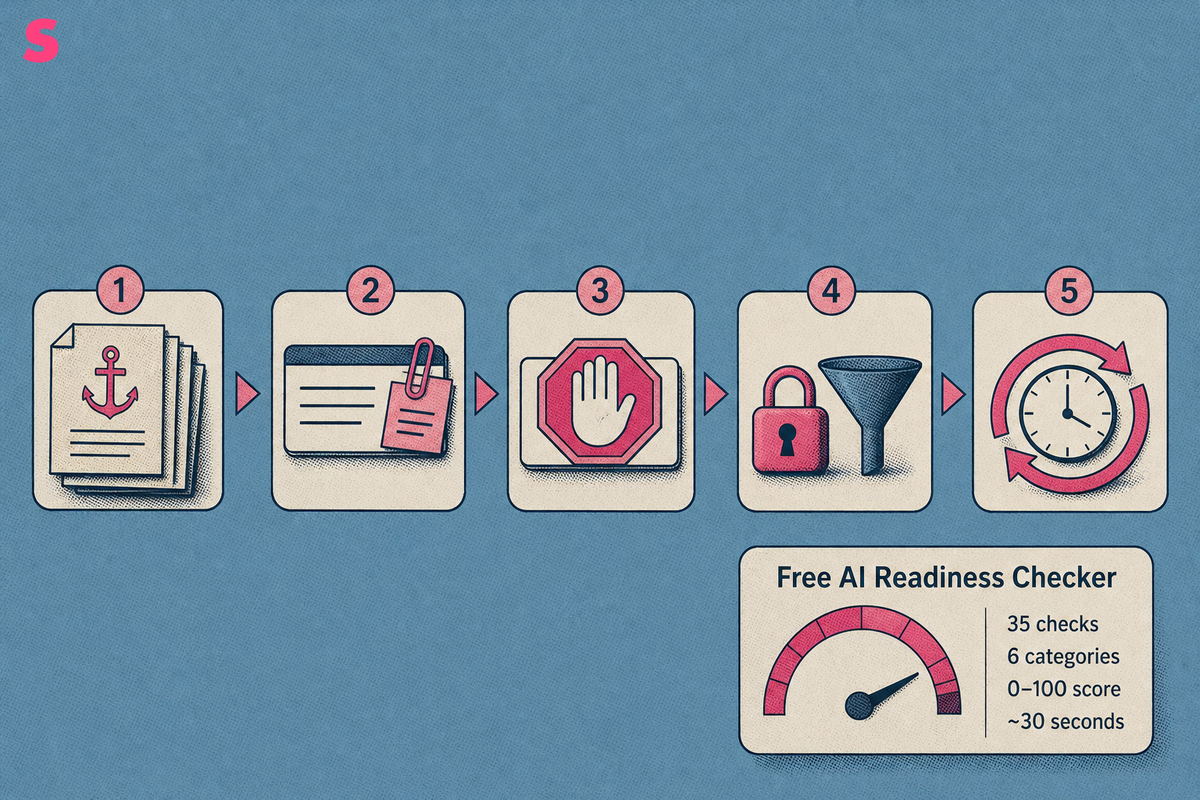
Require grounded retrieval, visible citations, refusal behavior, permission-aware retrieval, and a freshness process tied to crawls or webhooks. Generative answers need these controls because fluent wording is not evidence.
- Ground answers in retrieved pages: require the answer layer to use indexed source material rather than unsupported general knowledge.
- Show a citation on every answer: let visitors open the article, documentation page, or release note behind the claim.
- Refuse unsupported questions: when no relevant source exists, return a clear no-answer response instead of inventing guidance.
- Apply permissions before retrieval: do not retrieve restricted content and filter it afterward.
- Refresh the index: connect product, pricing, and documentation updates to crawl schedules or webhooks.
Monitor the search experience after launch. Review zero-result searches, low-click answers, and thumbs-down feedback weekly. Re-run the structured scorecard after a large content release, documentation migration, or material pricing change.
The Free AI Readiness Checker checks whether AI can crawl and parse a site through 35 checks across 6 categories, returning a 0–100 score and letter grade in about 30 seconds. It checks technical readiness, not whether a brand is cited in AI answers.
When should you buy AI website search instead of building it on open source or an LLM API?
Buy AI website search when the company lacks search engineers, content changes weekly, and launch speed matters. Build when search is a product differentiator, data residency is strict, or sustained query volume makes managed usage charges exceed the cost of operating the stack.
A self-hosted stack reduces vendor lock-in and gives engineering teams flexibility. It also creates an operating obligation: crawling, chunking, embeddings, ranking, evaluation, monitoring, permissions, upgrades, and incident response become internal work.
Custom AI search systems cost $120,000 to $500,000 or more before stable production, as of October 2026. Managed services shift that expense toward pay-as-you-go pricing. Azure AI Search lists $73.73 per month per search unit, per Azure documentation, while Cloudflare AI Search lists query and ingestion charges after its allowance, per Cloudflare documentation, October 2026.
Use a two-year operating model rather than comparing entry prices alone. Include implementation time, engineering ownership, content change frequency, expected queries, permissions complexity, and the cost of search errors. Building is justified when control creates a measurable business advantage, not simply because an LLM API is available.
How can you tell whether AI search is paying back in traffic and revenue?
Measure on-site AI search and external AI visibility separately. On-site search pays back through search success rate, zero-result rate, deflected support tickets, and conversion from search sessions. External visibility pays back through citations, AI-referred visits, pipeline, and revenue.
Measurement remains immature. iPullRank reported in October 2026 that 46% of respondents attribute only 0–5% of site revenue to AI search, while 35% cannot measure AI search contribution. Set a baseline before launch, assign one metric per owner, and keep support, product, marketing, and RevOps reporting separate where their responsibilities differ.
- Support owner: zero-result rate and deflected support tickets.
- Product owner: search success rate and conversion from search sessions.
- Content owner: failed queries and content gaps.
- Marketing owner: citations and AI-referred visits.
Monitoring which AI answers mention a brand is only half the job. Sona AI Visibility closes the other half with AI Attribution, which connects citations to accounts, pipeline, and closed-won revenue on one account timeline.
What are the frequently asked questions?
What is the difference between AI search on my website and AI search visibility?
On-site AI search answers questions from visitors already on your website. AI search visibility measures whether outside answer engines mention and cite your brand. The tools serve separate buyers, budgets, data sources, and success metrics.
Is keyword search still enough for a documentation site?
Keyword search is often enough for exact-match lookups such as error codes, API names, and plan names. It works well for those tasks. Hybrid retrieval, which combines keyword and semantic matching, helps when visitors ask longer natural-language questions.
Are there free AI search options for a website?
Yes. Cloudflare AI Search lists an included monthly allowance of 5 million ingestion tokens, 10 GB-month of storage, 1,000 semantic queries, and 1,000 full-text queries, per Cloudflare documentation, October 2026. Billing is scheduled to begin November 1, 2026. Algolia’s free offering includes 10,000 requests, per the August 2026 listing. Check every allowance against page count and query volume.
How much does a custom-built AI search system cost?
Custom-built AI search systems cost $120,000 to $500,000 or more before stable production, as of October 2026. Managed alternatives use pay-as-you-go pricing, such as Azure AI Search at $73.73 per month per search unit, per Azure documentation, or usage charges after Cloudflare AI Search’s included allowance.
Can AI website search make up answers about my product?
Yes, if the generative layer is not grounded in retrieved pages. Require citations on every answer, a refusal when no relevant source is found, permission-aware retrieval, and a freshness mechanism connected to crawls or webhooks.
How are AI search prompts different from keyword queries?
AI search prompts contain context, constraints, and intent for the system to interpret. Keyword queries usually provide a smaller set of terms to match.
Summarize this article with AI: ChatGPT · Claude · Perplexity · Google AI Mode
Last updated: October 2026







