


ChatGPT selects sources by determining if a question requires web search, breaking it into more specific queries, fetching pages via Bing, and citing the pages that most strongly support its final response. OpenAI describes the overall process but not a ranking formula, making most factor lists speculative. Test your own pages using repeated, dated prompt runs rather than generic advice. Sona AI Visibility connects those citations and their underlying prompts to pipeline and revenue.
What do you need before you trace how ChatGPT picks its sources?
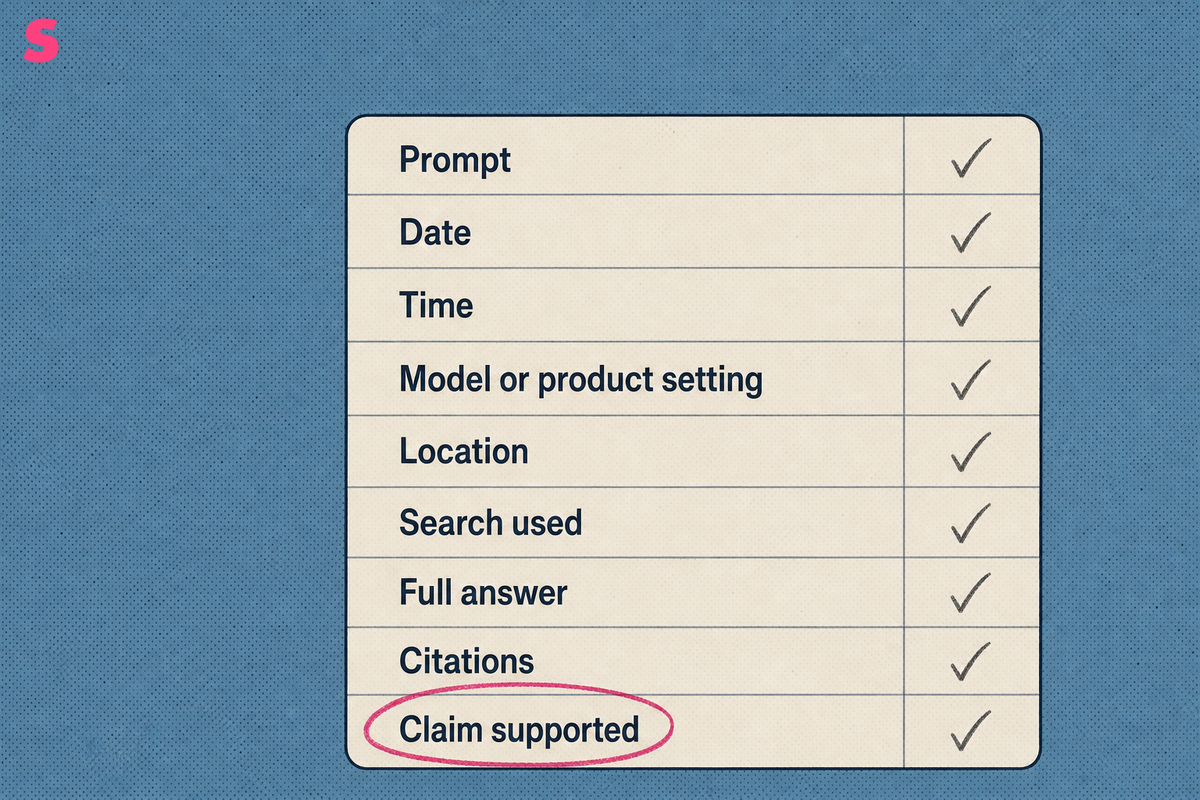
To trace how ChatGPT chooses its sources, use a stable prompt, preserve each answer, and access ChatGPT search when available. The aim is not to reverse-engineer a published ranking formula, because OpenAI does not publish one. Instead, observe which claims receive citations, which pages appear, and how the answer changes over time.
Create a trace sheet before running the prompt. Record the full prompt, date, approximate time, model or product setting, location if known, whether search was used, the complete answer, every citation, and the claim each citation supports. OpenAI’s ChatGPT Search documentation, October 26, 2026, states that search responses can include citations and warns that results and citations can be incomplete, outdated, or incorrect.
- Use a question with a clear factual scope, such as a product comparison, a policy question, or a technical procedure.
- Choose a question where you can assess whether a cited page directly supports the answer.
- Save the answer before clicking away, including inline citations and the source list.
- Run the same prompt on separate days rather than treating one response as a pattern.
Avoid broad requests, such as asking for everything about a market. Broad prompts produce broad synthesis and make source selection difficult to assess. A narrower question gives you a testable unit: a claim, a cited page, and the relationship between them.
How can you trace ChatGPT's source selection step by step on a real prompt?
Trace ChatGPT source selection by running one tightly scoped prompt, identifying every factual claim in the answer, and checking whether each citation supports that claim. Separate observable evidence from any inference about undisclosed internal searches.
The following trace uses a prompt run with search enabled on October 26, 2026. Exact prompt: Can ChatGPT search responses include citations, and what caution does OpenAI give about those citations?
| Claim in the answer | Cited page | Supporting passage or section | Classification |
|---|---|---|---|
| ChatGPT search responses can include citations. | OpenAI’s ChatGPT Search help documentation, October 26, 2026 | The documentation explains that search responses can include citations. | Direct support |
| Search results and citations can be incomplete, outdated, or incorrect. | OpenAI’s ChatGPT Search help documentation, October 26, 2026 | The documentation warns that search results and citations may be incomplete, outdated, or incorrect. | Direct support |
The trace supports two factual claims with one first-party documentation page. It does not show every search query, retrieved page, or ranking signal involved before the answer, because visible citations reveal evidence selected for the final response rather than the complete retrieval process.
A second run of the same prompt should receive its own trace sheet, even when the cited page and claim classifications remain unchanged. Record any difference in answer wording, citation placement, cited pages, or source support. If a later run cites a page that discusses citations generally but does not support the warning about incomplete or incorrect results, classify that citation as background or mismatch rather than direct support.
- Write a bounded prompt. Ask one question with a defined entity, condition, and time frame.
- Run the prompt with search enabled. Preserve the complete response, inline citations, and source list.
- Split the response into claims. Mark statements that assert facts, dates, definitions, or recommendations based on external evidence.
- Open each cited source. Record the page title, publisher, page type, publication date if shown, and the exact supporting passage or section.
- Classify the citation. Label it as direct support, partial support, background context, or mismatch. A citation that discusses the topic without supporting the specific statement is a mismatch.
- Repeat the same prompt daily. Daily runs reveal changes that a weekly snapshot can conceal. Treat recurring patterns differently from one-day changes.
How tooling operationalizes the trace: Sona AI Visibility connects AI citations and AI-referred visits to pipeline and revenue on one account timeline, while tracking AI crawler activity reaching site pages. AI Search Insights gives teams prompt-level evidence about the sources AI cites, so they can preserve, classify, and investigate the cited pages behind commercially relevant research.
What does a successful trace look like, and what do you do when the citations change between runs?
A successful ChatGPT source trace produces a dated log of cited claims, supporting pages, and recurring source patterns. It does not require identical citations in every run. It requires enough evidence to explain variation without treating one answer as a stable result.
A strong trace sheet gives each material claim a support label, classifies each citation, and timestamps every run. Compare the same prompt daily, then review the pattern across several runs. Prompt wording, model version, location, search index conditions, recency, and personalization can alter the retrieved material.
The common error is treating the first answer as final evidence. Preserve the initial response, rerun the unchanged prompt on later days, and separate recurring sources from one-off sources. OpenAI’s ChatGPT Search documentation, October 26, 2026, warns that search results and citations can be incomplete, outdated, or incorrect, so manual source review remains necessary.
How does ChatGPT decide whether to search the web or answer from memory?
OpenAI does not publish a complete decision rule for when ChatGPT searches the web rather than answers from parametric memory. In practice, ChatGPT may search for current or web-dependent information, and users can explicitly request search and citations. Otherwise, ChatGPT may answer from parametric memory without a live source trail.
Parametric memory is knowledge encoded during training rather than retrieved from a live page. It can help ChatGPT explain stable concepts or synthesize familiar material, but it does not provide a verifiable citation trail by itself. Browsing mode is powered by Bing and can retrieve material from pages with citations attached to the generated answer. Bing ranking alone does not determine whether ChatGPT cites a page.
Visible citations are an observable clue that search contributed to the response, not definitive proof of the complete retrieval process. Request current, source-backed information when you need a traceable answer. Include a date boundary and ask for citations supporting factual claims. OpenAI’s ChatGPT Search documentation, October 26, 2026, says citations can appear in search responses and warns that results and citations can contain errors.
How does ChatGPT turn one question into several searches?
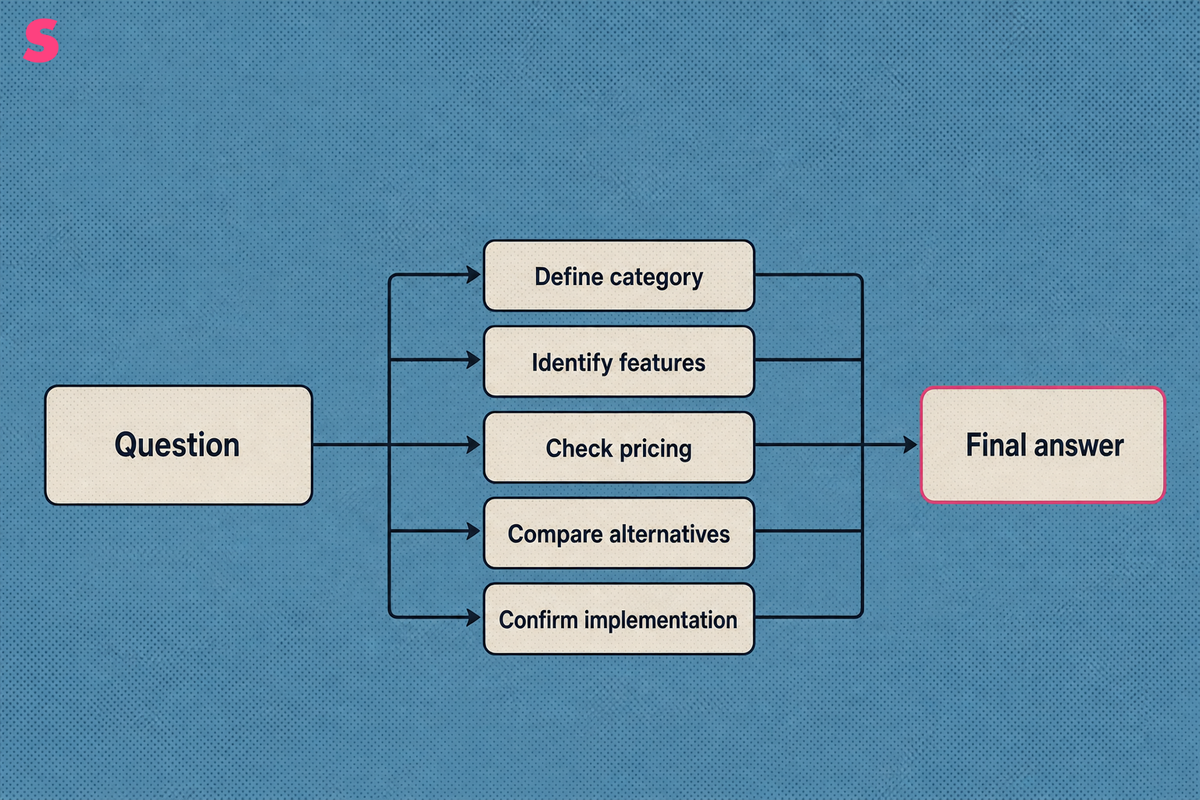
ChatGPT can break a prompt into narrower research tasks, review multiple pages, and cite sources that support the final answer. The process is closer to retrieval and synthesis than a single keyword search followed by one winning page.
A request about a software category can require separate research tasks: defining the category, identifying relevant features, checking current pricing, comparing alternatives, and confirming implementation details. Trace those subtopics by comparing the answer’s sections with the cited pages beside them.
Do not infer an exact internal query list from citations alone. A cited source shows what supported the final answer, not every page retrieved or every search variation considered.
Which factors decide whether a retrieved page earns a ChatGPT citation?
ChatGPT citations reflect the relationship between the prompt, retrieved pages, and claims in the final answer. Practical evaluation criteria include query fit, recency, credibility, direct factual support, and whether the page is easy to parse. ChatGPT can cite several pages side by side instead of selecting one universal winner.
- Query fit: The page answers the specific question, not only the broader subject.
- Claim support: The page contains evidence for the sentence ChatGPT needs to make.
- Freshness: Recent material is more useful for a time-sensitive question.
- Credibility: A source with clear authorship, evidence, primary-source status, topical fit, and corroboration provides stronger material for review.
- Parseability: Pages with clear structure and dense factual detail are easier for LLMs to process.
OpenAI does not publish domain authority as a formal ChatGPT citation factor. Domain-level reputation may be visible through authority signals such as primary-source status, identifiable authorship, evidence quality, topical relevance, and corroboration, but those signals do not establish a disclosed scoring rule.
Technical conditions can also affect whether a page is available for retrieval and usable as citation evidence. Crawl access, indexability, stable URLs, readable HTML, clear headings, and extractable factual passages make a page easier to discover and parse. These conditions improve retrieval readiness, but they do not guarantee a citation.
These factors are a practical model, not a published OpenAI formula. OpenAI’s available ChatGPT Search documentation, October 26, 2026, confirms that citations can appear but does not disclose a ranking equation, source threshold, or citation quota. The available research set contains multiple URL variants for the same help content, per help.openai.com, October 26, 2026, making source deduplication part of a careful trace.
How does ChatGPT's source selection differ from Google's ranking?
Google ranking orders pages in a search result, while ChatGPT source selection supports claims inside a generated answer. Google AI Overviews also generate summarized answers, but a page ranking in Google and a page cited by ChatGPT are separate observations. Treat them as related evidence, not interchangeable measurements.
| Question | Google search results | ChatGPT search response | What to trace |
|---|---|---|---|
| Primary output | An ordered set of result pages | A synthesized answer with possible citations | Whether a cited page supports a specific claim |
| Unit of evaluation | Page relevance for a query | Evidence usefulness for the generated answer | Prompt, claim, citation, and cited passage |
| Evidence visible to the reader | Result title, snippet, and position | Inline citations and source pages when search is used | Whether the citation is direct, partial, or mismatched |
| Effect of a new run | Results can change over time | Queries, retrieved pages, and citations can change over time | A daily log rather than a one-time screenshot |
Do not treat page-one ranking as either required or sufficient for a ChatGPT citation. Google rank and ChatGPT citation patterns answer different questions and require separate measurement.
How do large language models associate a brand with a topic?
Large language models associate a brand with a topic through repeated, retrievable evidence connecting the brand, subject, and supporting facts. The association is not a permanent ranking or a single score. It appears in the sources retrieved for a specific prompt and the wording those sources support.
Build that association with pages that answer defined questions, use consistent terminology, and include verifiable factual detail. A product page, documentation page, independent reference, and expert explanation can provide different forms of evidence. Make the relationship explicit without repeating unsupported claims.
No verified study in the available evidence quantifies how often a particular brand is cited for a topic by an LLM, per help.openai.com, October 26, 2026. Avoid assigning a universal citation probability to content formats, domains, or brand mentions. Test the association through a prompt set and preserve the resulting citations.
How do answer engines decide which sources to cite?
Answer engines can cite sources that directly answer the question rather than pages that only cover the broader topic. Evaluate each citation against the specific claim it supports, not the source’s general authority alone.
Trace answer-engine citations with the same method used for ChatGPT: preserve the exact prompt, copy the full response, list every citation, identify the sentence each source supports, and evaluate directness.
Do not infer precise source-ranking thresholds from a visible citation list. Compare citation patterns only when the prompt, date range, and evaluation criteria remain constant.
Use the same prompt across answer engines only when the question and evaluation rules remain constant. The result is a comparative log of evidence patterns, not proof that any engine has a fixed source hierarchy.
What are the frequently asked questions about ChatGPT sources?
Does ChatGPT always cite sources?
No. Citations can appear when ChatGPT uses search, while answers drawn from parametric memory do not provide citations to live sources. OpenAI’s ChatGPT Search documentation, October 26, 2026, states that search responses can include citations and warns that search results and citations can be incomplete, outdated, or incorrect.
Does ranking on page one of Google guarantee a ChatGPT citation?
No. Google rank is neither required nor sufficient for a ChatGPT citation. A page can rank well in Google without supporting the specific claim ChatGPT generates, while another page can provide stronger evidence for that claim.
Is there a published ChatGPT ranking formula?
No. OpenAI’s available ChatGPT Search documentation, October 26, 2026, documents that search responses can include citations but does not publish a ranking formula. Separate documented behavior from practitioner inference when assessing source selection.
Why does ChatGPT cite different sources for the same prompt?
Prompt wording, model version, location, search index conditions, recency, and personalization can change the retrieved material. ChatGPT can also run different narrower searches for the same broad question. Repeated, timestamped daily runs reveal which citations recur and which are one-off results.
Can technical SEO and structured content improve my chances of being cited?
Technical SEO and structured content can improve the conditions for citation, though this is not a documented OpenAI rule. Clear, parsable content with factual detail is easier to evaluate, and a page must be accessible to a retrieval system before it can be cited.
How many times should you run a prompt to judge whether a page is cited?
Run each prompt on separate days, log the date and model setting, and classify every cited source. This is a recommended method, not a researched threshold. Repeated runs help distinguish recurring citation patterns from one-day anomalies.
Summarize this article with AI: ChatGPT · Claude · Perplexity · Google AI Mode
Last updated: October 2026







