


To track brand mentions in ChatGPT, use a fixed set of 10 buyer prompts three times each in a logged-out or incognito session, noting whether your brand appears, where it appears, and how it is described. Repeat the set monthly to turn mention rate into a trend rather than an anecdote. When manual logging becomes slow, an automated tracker handles the repetition, while Sona AI Visibility goes further by linking those prompts and citations to pipeline and revenue.
How do I check whether ChatGPT mentions my brand right now?
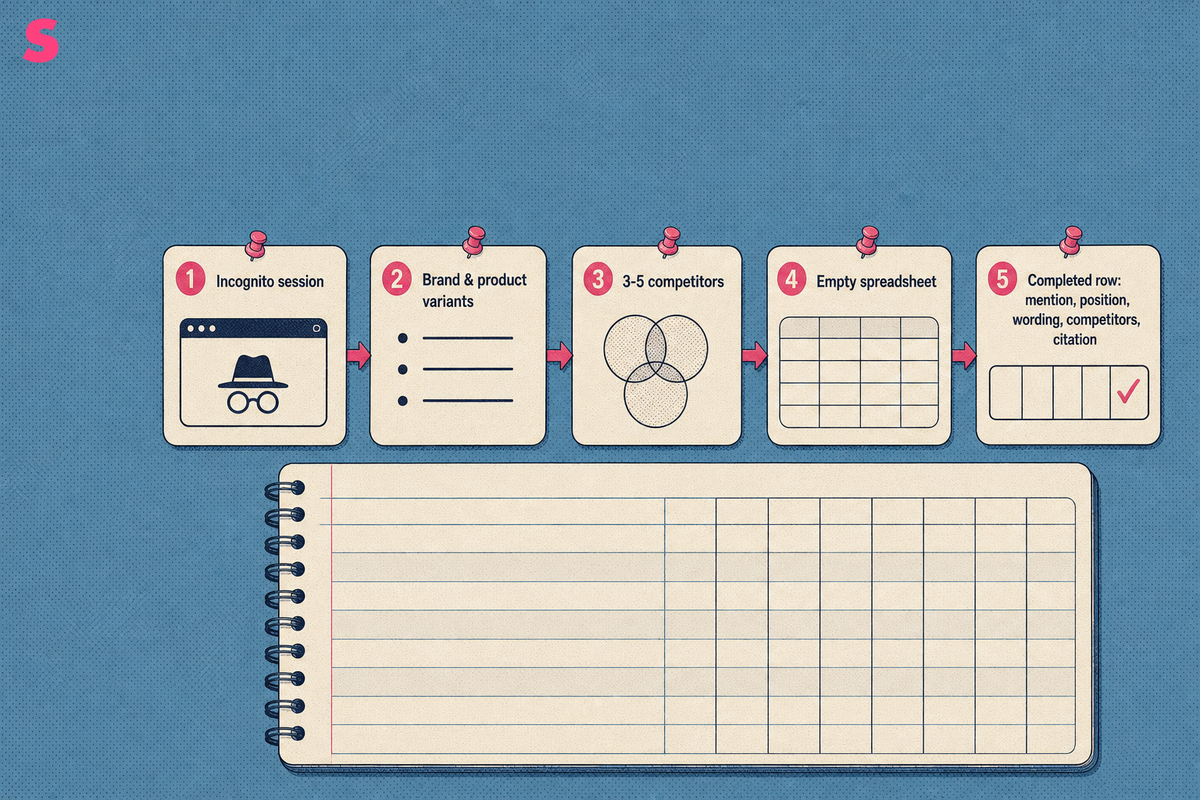
Run three buyer prompts in a clean ChatGPT session and record each answer exactly. Before starting, prepare a logged-out or incognito browser session, a list of brand and product-name variants, three to five named competitors, and an empty spreadsheet.
- Open a fresh logged-out or incognito ChatGPT session. Record the date, location, available model, and session type in the spreadsheet.
- Choose three high-intent buyer prompts, such as a category question, a comparison question, and an alternative question.
- Run each prompt once without adding your brand name unless the prompt is explicitly branded.
- Copy the answer into the spreadsheet. Record whether the brand appeared, its position in any list, the exact wording, competitors named, and any source links.
- Repeat the process for brand-name variants, product names, and common misspellings that matter to buyers.
A mention means the brand name appears in answer text. A citation means ChatGPT attaches a source link. A recommendation means ChatGPT presents the brand as a suitable choice rather than merely naming it. Log all three separately because an answer can mention a brand without citing or recommending it.
The first check should produce one completed row for each prompt run: mention status, position, wording, competitors named, and citation status. It creates an initial evidence set and identifies prompts where buyers encounter, or fail to encounter, the brand.
Which prompts should I track to reflect how buyers actually ask ChatGPT?
Track prompts that represent buying decisions, not only prompts containing your company name. Start with 10 prompts spanning category, comparison, alternative, pricing, and use-case questions. A manual benchmark can use 10–15 buyer prompts and run each prompt three times per platform, per 01net.com, September 15, 2026.
Build prompts from product details, the ideal customer profile, category research, vendor evaluation, and purchase intent.
| Prompt type | Audit prompt 1 | Audit prompt 2 | What a gap tells you |
|---|---|---|---|
| Category | What are the best AI visibility platforms for B2B SaaS? | How do teams measure brand visibility in AI answers? | ChatGPT does not associate the brand with the category. |
| Comparison | Compare [Brand] with [Competitor]. | Which platform is better for AI search measurement? | The brand may lack clear differentiation or accurate category framing. |
| Alternative | What are alternatives to [Competitor]? | What tools replace manual AI brand monitoring? | The brand is missing from an established buying path. |
| Pricing | How much does AI visibility tracking cost? | What is the price of an AI search analytics platform? | Pricing information may be unclear, inconsistent, or absent from accessible sources. |
| Use-case | How can I attribute pipeline to AI search? | How do I track AI-referred visits for B2B demand generation? | The brand is not connected to the business problem buyers need solved. |
Exact 10-prompt audit set: the 10 prompts in the table are the definitive audit set. Before the first run, replace [Brand] with the audited brand’s public name and [Competitor] with one named competitor, then keep those substitutions unchanged. Run every listed prompt three times under the recorded conditions.
Keep the initial prompt set stable throughout the benchmark period. Add prompts only when a new product, audience, category, or competitor creates a material buying question. A changing prompt list prevents a clean comparison between measurement periods.
What testing method and rubric should I use to classify ChatGPT mentions?
A reproducible ChatGPT brand audit uses 10 fixed prompts, three fresh-session runs per prompt, and 30 answers collected during one stated week. Record the model, location, date, prompt version, and answer text for every run. This protocol controls the test conditions while preserving evidence of normal answer variation.
Create one spreadsheet row for each answer. Use these columns: audit week, run ID, date, location, model, prompt ID, prompt version, prompt text, brand mentioned, position, recommendation status, citation status, cited source, description accuracy, competitors named, confused or unverifiable reference, exact wording, and reviewer notes.
| Classification | Decision rule | What to record |
|---|---|---|
| Not mentioned | The brand name and product variants do not appear. | Position blank, mention status no. |
| Mentioned | The brand appears in text without an explicit endorsement. | Exact wording and list position. |
| Recommended | ChatGPT presents the brand as a suitable option for the stated need. | Recommendation phrase and position. |
| Cited with link | A source link is attached to the brand or supporting claim. | Source name and link status. |
| Described accurately | The answer matches approved product, pricing, and category facts. | Accurate yes and supporting wording. |
| Described inaccurately | The answer contains a material error about the brand, product, or offering. | Error type and corrected fact. |
The 30-answer result excerpt should retain the three rows for each prompt and show mention status, position, recommendation status, citation status, description accuracy, and exact wording. Aggregate those rows only after every answer has been classified under the same rubric.
Add a short flag for a confused or unverifiable reference when ChatGPT appears to merge the brand with another company or makes a claim the reviewer cannot validate. Preserve the answer text and document the fact requiring validation.
Which metrics measure brand visibility in ChatGPT, and how are they calculated?
Measure ChatGPT brand visibility through rates and positions rather than a single mention count. Use the 30-run audit as the denominator, then calculate mention rate, average position, share of voice, citation rate, and accuracy rate. Each metric shows whether the brand appears and how ChatGPT frames it.
| Metric | Formula | 30-run example | Question answered |
|---|---|---|---|
| Mention rate | Answers naming the brand ÷ total runs | 18 ÷ 30 = 60% | How often does ChatGPT name the brand? |
| Average position | Total list positions ÷ answers where the brand appeared in a list | 36 ÷ 18 = position 2 | How prominently does the brand appear? |
| Share of voice | Brand mentions ÷ all tracked brand and competitor mentions | 18 ÷ 60 = 30% | How much of the named-brand conversation belongs to the brand? |
| Citation rate | Answers citing the brand ÷ total runs | 6 ÷ 30 = 20% | How often does ChatGPT attach a source link? |
| Accuracy rate | Accurate descriptions ÷ answers mentioning the brand | 15 ÷ 18 = 83.3% | Does ChatGPT describe the brand correctly? |
A mention does not equal pipeline. Treat mention rate as a leading indicator, then compare its trend with branded search, referral traffic, assisted conversions, demo requests, and influenced revenue. The useful question is whether stronger visibility on high-intent prompts corresponds with buyer activity.
Sona AI Visibility connects prompts and citations to pipeline and revenue, while AI Search Insights shows the prompts and pages behind that visibility. Teams can use that evidence to identify questions and sources that require attention.
How do I track ChatGPT brand mentions and rankings over time?
Treat the first 30-run audit as a baseline, then run the same fixed prompt list daily and review the trend monthly. Keep prompt wording, location, model selection, competitors, and classification rules stable. Log every intentional change under a new prompt version.
Daily runs expose patterns that a weekly snapshot can obscure. ChatGPT answers can shift when retrieval sources change, models update, or competitors publish new material. Treat repeated movement across identical runs as directional evidence only after comparing the recorded model, prompt, location, and change log.
- Maintain a prompt register with prompt ID, version, owner, purpose, and start date.
- Maintain a change log for new pages, product updates, pricing changes, structured-data work, and major content revisions.
- Review the daily log monthly, then refresh the strategic prompt set quarterly.
- Compare monthly visibility trends with branded search, referral traffic, assisted conversions, and demo requests.
Recurring monthly reviews allow the team to plot mention rate, average position, and share of voice as trend lines instead of relying on isolated answers. The output supports directional analysis, not a score that claims to explain buyer behavior by itself.
Why do ChatGPT results change between runs, and how do I fix an unreliable audit?
ChatGPT results change because account state, location, model version, retrieval context, prompt wording, and ordinary answer variation can differ between runs. A single answer cannot reliably rank a brand. Repeated runs of fixed prompts produce directional evidence when the model, location, date, and prompt version are recorded.
| Failure cause | Recognizable symptom | Recovery |
|---|---|---|
| Logged-in personalization | Results differ sharply between employees. | Use logged-out or incognito sessions. |
| Location variation | Different offices see different local recommendations. | Record location and keep the test market fixed. |
| Model variation | One model names the brand while another does not. | Record the model and avoid mixing results. |
| Reworded prompts | Small wording changes produce different vendor lists. | Lock prompt text and issue version numbers. |
| Too few runs | Mention rate swings by more than a few points between identical runs. | Add runs and preserve the protocol. |
Do not delete inconvenient results. Keep every run, classify it consistently, and investigate sustained movement only after it repeats. Daily monitoring provides resolution, while a monthly review informs operating decisions.
How can I track what ChatGPT says about my industry, not only my brand?
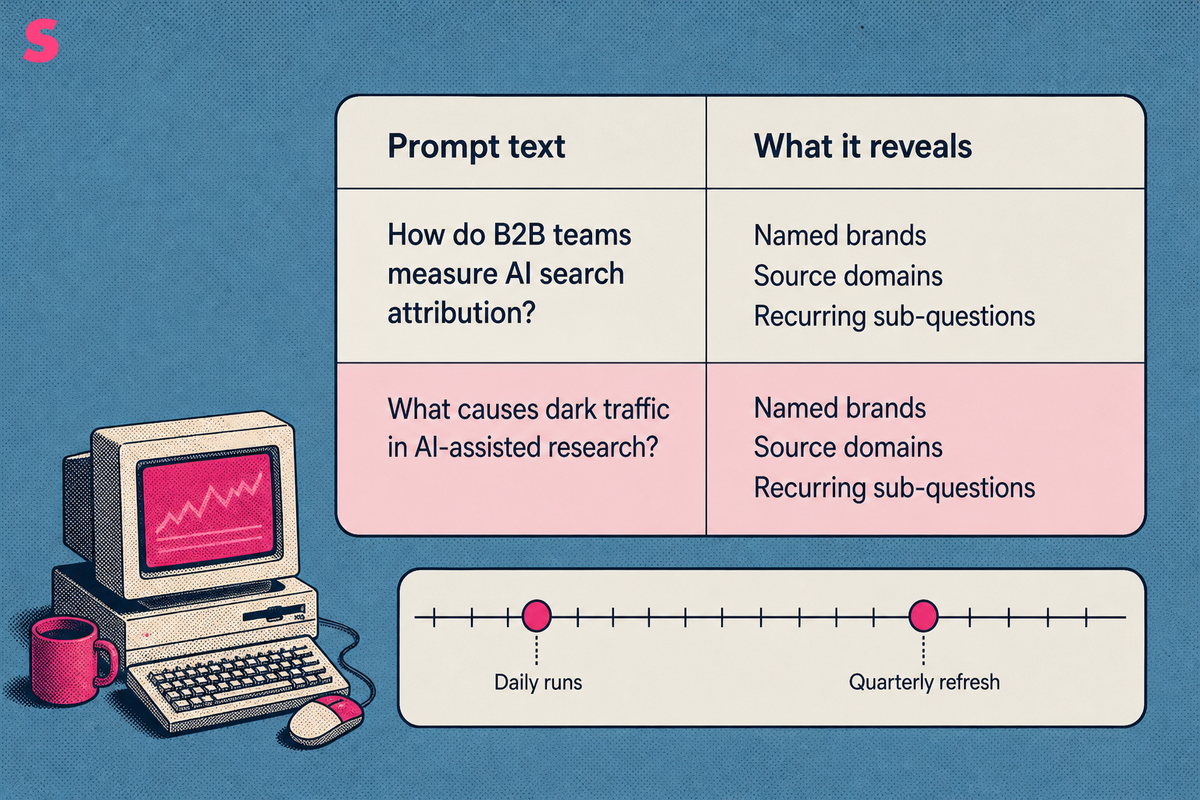
Track industry discussion with unbranded category and problem-led prompts alongside brand prompts. Log the brands ChatGPT names, the sources it cites, and recurring sub-questions. This reveals the language buyers use before choosing a vendor.
Use prompts such as “How do B2B teams measure AI search attribution?” or “What causes dark traffic in AI-assisted research?” Do not insert the company name. Record named brands, recurring objections, source domains, and new terms that appear across several answers.
- Run unbranded prompts daily with the same location and model controls.
- Tag recurring sub-questions as category, problem, implementation, pricing, or comparison themes.
- Refresh the industry prompt list quarterly after reviewing repeated topics and changed positioning.
This workflow identifies industry questions that deserve new pages, updates, or stronger evidence because ChatGPT repeatedly frames them as buyer concerns.
When is a paid ChatGPT mention tracker worth it over a manual spreadsheet?
A paid ChatGPT mention tracker becomes worthwhile when the audit expands beyond one brand and fewer than 15 prompts, or when the team needs daily monitoring across regions and answer engines. AI brand monitoring tools are also called answer engine optimization (AEO) tools or generative engine optimization (GEO) tools.
| Scenario | Recommended method | Trigger | Operating rule |
|---|---|---|---|
| One brand, under 15 prompts | Manual spreadsheet | One market and one reviewer | Run the fixed prompt set daily and review monthly. |
| Many prompts | Automated tracking | Prompt volume makes manual collection inconsistent | Preserve prompt versions and audit classifications. |
| Several regions | Automated tracking | Location-specific results require separate records | Segment reporting by market. |
| Several answer engines | Automated tracking | ChatGPT-only data misses cross-engine behavior | Compare the same prompts across engines. |
| Executive reporting | Automated tracking | Leadership needs a recurring trend and revenue context | Pair visibility metrics with demand and pipeline signals. |
ChatGPT-only tracking misses buyers who use other answer engines. Cross-engine coverage is preferable when budget justifies it. Tools can track mention frequency, wording, links, and competitor performance without requiring a team to collect every answer manually.
| Tool | Starting price | Agency Plans? (Yes/No) | # of Answer Engines Tracked | Answer Engines | # of Daily Tracked Prompts (entry plan) | Cost per Daily Tracked Prompt | Differentiation |
|---|---|---|---|---|---|---|---|
| Sona AI Visibility | From $75/month, billed annually | Yes | Up to 11 (3 on Starter) | Not published | 5,000 credits/month, about 56 prompts tracked daily across three engines | $0.45 per daily tracked prompt | Connects AI citations and prompts to pipeline and revenue, and tracks AI crawler activity from server logs or a lightweight edge worker without a JavaScript tag. |
| Profound | Custom pricing | Yes | Up to 9 (3 on free Trial) | ChatGPT, Gemini, Google AI Overviews | 50 prompts daily during the 7-day trial | Not calculable from custom pricing | Daily prompt tracking with trial and enterprise options. |
| Peec AI | From $95/month | Yes | Up to 13 (3 of 6 on Starter, plus add-ons) | Not published | 50 prompts daily | $0.63 per daily tracked prompt | AI visibility tracking across selectable answer engines. |
| Otterly.ai | From $29/month | Yes | Up to 7 (4 on Lite, 3 as paid add-ons) | ChatGPT, Google AI Overviews, Perplexity, Microsoft Copilot | 15 prompts daily | $0.48 per daily tracked prompt | AI search monitoring across four engines on Lite. |
| Scrunch AI | From $250/month | Yes | Up to 9 (4 on Core) | ChatGPT, Perplexity, Google AI Overviews, Microsoft Copilot | 125 prompts, refresh cadence not published | No refresh cadence published | AI visibility monitoring across named answer engines. |
| AthenaHQ | From $295/month | Yes | 11 | Not published | 3,600 credits/month, unlimited prompts, refresh cadence not published | No refresh cadence published | Credit-based AI response monitoring with named answer-engine coverage. |
| PromptWatch | From $95/month | Yes | Not published | Not published | 50 prompts daily | $0.48 per daily tracked prompt | Monitors brand mentions inside ChatGPT answers and other supported models. |
Prices and plan facts in the comparison table are current as of October 2026. A tracker does not replace review discipline. It reduces collection work, preserves history, and simplifies comparison between daily answer changes and the team’s recorded content, product, and revenue events.
How do I improve my brand mentions and appear in ChatGPT answers?
Measure the current mention rate across high-intent prompts, then address the specific gaps the audit identifies. Publish pages that answer absent prompts directly, correct inaccurate descriptions, and strengthen evidence where competitors appear instead.
- For absent prompts, create or improve pages that answer the buyer’s exact question with clear category, use-case, pricing, or comparison information.
- For inaccurate descriptions, make brand facts consistent across the website and relevant third-party profiles.
- For weak citations, make key information crawlable, structured, current, and easy to verify.
- For competitor-heavy answers, identify the claim or evidence gap rather than copying competitor language.
This work extends beyond traditional SEO. Traditional discoverability still matters, but AI visibility measures inclusion, answer position, wording, competitors, citations, and accuracy. The audit identifies where an answer is weak or incomplete for a buyer.
Sona AI Visibility connects prompts and citations to pipeline and revenue, then uses Agent Analytics to show which AI crawlers reach pages and how often. That evidence helps teams prioritize pages where a prompt gap, crawler activity, and commercial relevance identify the same work item.
What are the frequently asked questions about how to see brand mentions in chatgpt?
Can I just ask ChatGPT how often it mentions my brand?
No. A single reply is one sample, not a measured rate. Run a fixed prompt set several times in a clean session and log the results to calculate mention rate across the full set.
How many prompts and runs are enough for a reliable ChatGPT audit?
A manual benchmark can use 10–15 buyer prompts and run each prompt three times per platform, per 01net.com, September 15, 2026. Start with 10 prompts and three runs, then add runs when results swing between identical tests.
What is the difference between a brand mention and a citation in ChatGPT?
A mention is the brand name appearing in answer text. A citation is a source link attached to the answer. Log both in separate columns because an answer can contain one without the other.
How often should I re-run a ChatGPT brand mention audit?
Run the fixed prompt list daily so the team can distinguish sustained movement from answer noise. Review results monthly, and log every change to prompts, model, location, and classification rules so the team can explain shifts in the numbers.
Do ChatGPT brand mentions lead to pipeline?
Not by themselves. Treat mention rate as a leading indicator and compare its trend with branded search, referral traffic, assisted conversions, demo requests, and influenced revenue.
Are AEO and GEO tools the same as ChatGPT mention trackers?
Mostly. AI brand monitoring tools are also called answer engine optimization (AEO) or generative engine optimization (GEO) tools. Many track ChatGPT alongside other answer engines.
Summarize this article with AI: ChatGPT · Claude · Perplexity · Google AI Mode
Last updated: October 2026







