


Search AI, also called AI search, uses large language models to understand a question’s meaning and provide a synthesized, cited response rather than a ranked links list. AI search supplements traditional search instead of replacing it: Google drove 190 times more website traffic than ChatGPT, according to businesswire.com, 2026-05-27. AI answer visibility is tracked through mentions and citations, not rankings. Sona AI Visibility links those prompts and citations with pipeline and revenue.
What is AI search, and how does it differ from traditional search?
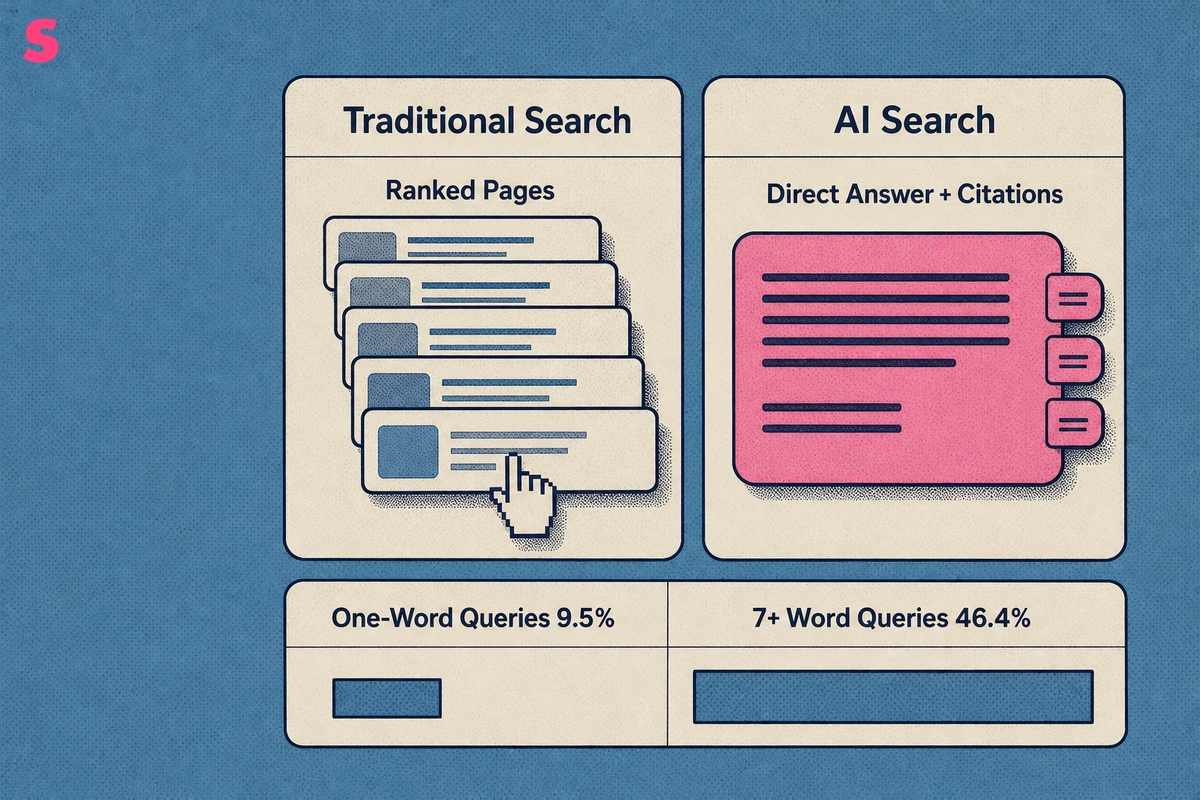
AI search uses artificial intelligence to interpret a question’s meaning and deliver a direct answer, often with cited sources. Traditional search primarily ranks webpages and asks the user to choose which result to open.
The difference matters because a B2B SaaS team can be visible without receiving a conventional blue-link click. A buyer who asks for “the best enterprise billing platform for usage-based pricing” may receive a synthesized recommendation, a short vendor list, and citations before visiting any website.
AI-driven search uses semantic understanding alongside keyword signals. Traditional SEO remains essential because pages, technical accessibility, and topical authority supply much of the material answer engines retrieve. AI search is neither a replacement for SEO nor merely a chatbot. It is a search interaction where the system interprets intent, retrieves evidence, and produces an answer.
Google AI Overviews appeared for 21% of keywords across 146 million search-results pages, per businesswire.com, 2026-05-27. The rate was 9.5% for one-word queries and 46.4% for queries with seven or more words, making conversational, specific queries especially relevant to AI search measurement.
How does LLM search work, from the query to the cited answer?
LLM search turns a natural-language question into an answer by interpreting intent, retrieving relevant material, synthesizing a response, and selecting sources to cite. The output is an answer with evidence rather than a ranked page of links alone.
- Interpret the query. The model identifies the topic, constraints, and implied task. “Compare payroll platforms for a 500-person global company” contains category, company size, and geographic requirements.
- Retrieve candidate sources. The system searches available web material or an index for pages that address the question.
- Synthesize a response. The model combines retrieved information into a concise explanation, comparison, or recommendation.
- Present citations. The answer may attach cited pages to factual statements or recommendations, giving the reader a route to inspect the evidence.
A cited answer does not mean the engine has permanently ranked a page first. Retrieval can change when indexes update, sources change, or prompt wording changes. That distinction separates LLM search from conventional rank tracking.
For a marketing team, the practical path is query to source to answer to visit. A product page might be retrieved for a comparison question, cited in an answer, then visited by a buyer. The work is to identify which prompts create that path and whether the resulting visits become pipeline.
Which AI search engines exist, and how do their answers differ?
Google AI Overviews presents generated summaries within search results, while Google AI Mode supports follow-up questions and topic exploration using Gemini 2.0, per search.google. ChatGPT, Gemini, Claude, and other answer engines can search the web to answer questions through conversational interactions.
Search-result experiences combine generative answers with search results, ads, maps, and other search features. Conversational assistants prioritize a synthesized response, citations, and follow-up conversation. Enterprise search products apply similar retrieval and generation patterns to internal company knowledge.
- Search-result experiences combine generative answers with search results, ads, maps, and other search features.
- Answer engines prioritize a synthesized response, citations, and follow-up conversation.
- Enterprise search products apply similar retrieval and generation patterns to internal company knowledge.
Sona’s own AI visibility data, September 2026, covers eight answer surfaces, including ChatGPT, Google AI Overviews, Google AI Mode, and Gemini. A measurement program should define the engines that matter to its buyers rather than treating AI search as one uniform channel.
Is AI search the same as AI website search or AI visibility?
AI search, AI website search, and AI visibility are related but distinct jobs. AI search answers questions across the web. AI website search helps visitors find information within one company’s site. AI visibility measures whether a brand or page appears in external AI-generated answers.
| Concept | Primary user | Primary question | Useful output |
|---|---|---|---|
| AI search | Web searcher or assistant user | What is the answer to this question? | A synthesized answer and cited sources |
| AI website search | Website visitor | Where is the product, support, or documentation answer? | Relevant on-site content or product discovery |
| AI visibility | Marketing, SEO, and revenue teams | When do answer engines mention or cite our brand? | Prompt, citation, source, and competitor data |
| AI search attribution | Marketing operations and revenue teams | Did AI-driven research create pipeline or revenue? | Account, opportunity, and revenue evidence |
AI website search is commonly confused with AI visibility work because both use language models. The boundary is simple: an on-site assistant improves discovery within a controlled property, while AI visibility concerns what external answer engines say about the brand.
Sona AI Visibility connects citations to pipeline and revenue on one account timeline, and tracks which AI crawlers are reaching pages. That makes AI visibility a measurement problem rather than an on-site search implementation.
What does visibility in AI-generated search results mean, and how is it measured?
Visibility in AI-generated search results means a brand, product, or source page appears in an answer produced for a relevant prompt. Measurement should record the prompt, answer surface, brand mention, cited source, and the position or context of the appearance.
A useful measurement set separates branded prompts from category, comparison, problem, and buying-stage prompts. “What is Acme?” measures branded recognition. “Best customer-data platform for B2B SaaS” measures whether the brand enters an active consideration set.
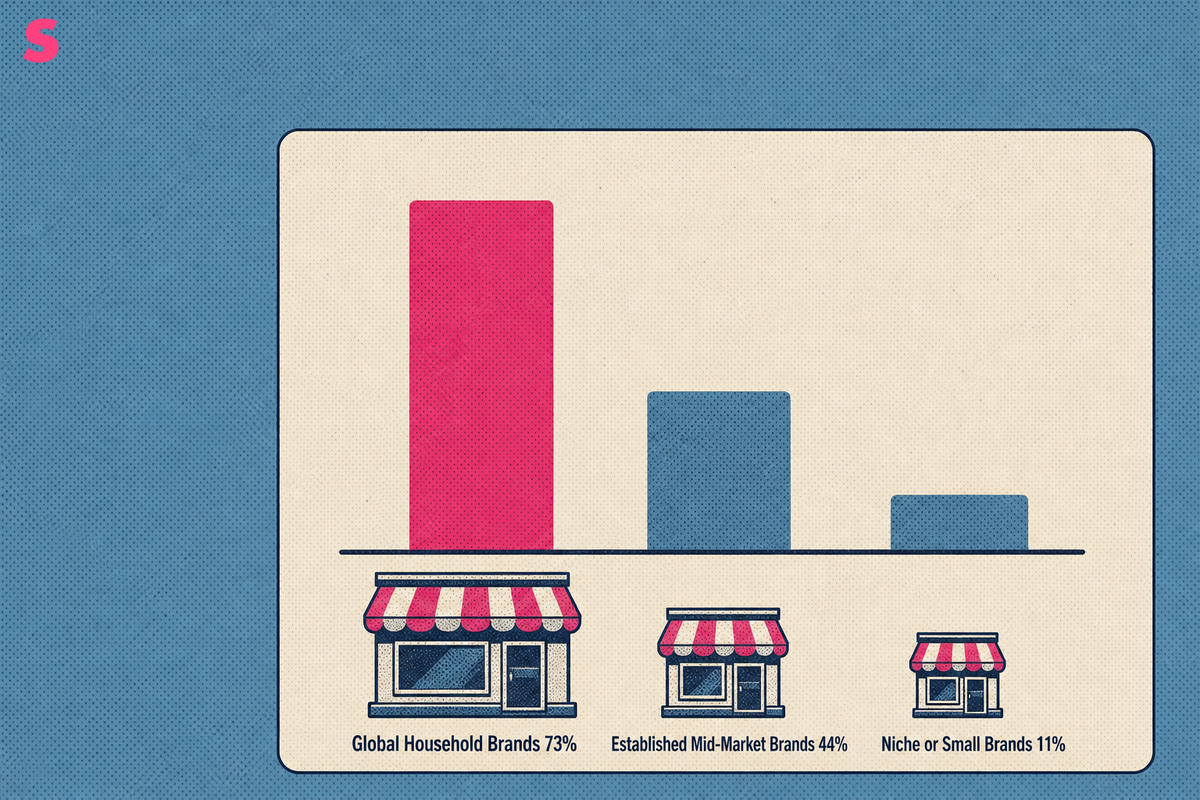
Global household brands appeared in 73% of relevant AI answers, established mid-market brands in 44%, and niche or small brands in 11%, per arxiv.org, 2026-06-18. The finding shows why a generic brand-level share can conceal important differences between prompt groups.
A brand score is not a work item. A prompt-level view identifies which prompts produce visibility and which sources support that appearance. Sona AI Visibility uses AI Search Insights to show buyer prompts and the sources AI cites, helping a team connect a visibility result to a specific page or content decision.
Which content and brand signals decide who appears in AI answers?
AI answers select sources that address the query clearly, credibly, and in enough detail to support a response. Content relevance, source accessibility, entity clarity, and evidence that supports a recommendation all affect visibility in AI-generated search results.
Corporate websites received approximately 78% of cited sources in a study of more than 100,000 prompt responses across more than 100 brands from March through May 2026, per arxiv.org, May 2026. Owned pages remain a central asset for AI search, even when third-party validation influences recommendations.
- Prompt alignment: pages should answer the buyer’s actual question, including comparison criteria and implementation concerns.
- Structured evidence: clear headings, factual claims, definitions, and sourceable details help retrieval systems interpret a page.
- Technical accessibility: crawlers need to reach, render, and parse the page.
- Independent validation: ranked best-of listicles represented about 21% of citations in the same study, per arxiv.org, 2026-06-18.
More pages and more backlinks do not guarantee inclusion. AI search engines focus on what to recommend rather than ranking based on backlinks and keyword density, per medium.com. The stronger operating question is whether a specific page answers a specific high-value prompt better than the alternatives an engine retrieves.
How can you test and monitor AI search visibility reliably?
Reliable AI search monitoring uses a fixed prompt list, repeated runs, source capture, and trend analysis. A single result is a dated snapshot. Repeated observations show whether a brand appearance is persistent, volatile, or tied to an unusual answer.
A tool benchmark is separate from routine customer monitoring. A reproducible benchmark should publish a complete prompt appendix, label every prompt by intent group, state the answer surfaces and test period, disclose runs per prompt per day, and define its aggregation method before results are compared.
AI-search source sets overlapped by only 34–42% between consecutive days, per arxiv.org, 2026-08-23. Compare repeated observations across a declared monitoring window rather than treating a one-day change as a decision rule.
- Publish the exact prompt set, its intent labels, and the sample size for each intent group.
- State the tested answer surfaces, test period, and runs per prompt per day.
- Capture brand detection, citation presence, cited domains, answer context, source correctness, answer consistency, and failed retrievals for every run.
- Aggregate repeated runs at the prompt level, then report results by intent group and answer surface.
- Use the benchmark protocol for tool evaluation, while using a separate fixed prompt list for routine customer monitoring.
Monitoring research estimated that stable brand-detection estimates required at least 7 runs per prompt per day, and source-level coverage required 8 runs, per arxiv.org, 2026-08-23.
| Tool | Starting price | Agency Plans? (Yes/No) | # of Answer Engines Tracked | Answer Engines | # of Daily Tracked Prompts (entry plan) | Cost per Daily Tracked Prompt | Differentiation |
|---|---|---|---|---|---|---|---|
| Sona AI Visibility | From $75/month, billed annually, as of October 2026 | Yes | 11 | Not published | 5,000 credits/month, about 56 prompts tracked daily on 3 engines | $0.45 per daily tracked prompt | Connects AI citations and prompts to pipeline and revenue on one account timeline |
| Profound | Custom pricing, as of October 2026 | Yes | 9 | ChatGPT, Perplexity, Google AI Mode, Gemini, Microsoft Copilot, DeepSeek, Claude, Google AI Overviews, Exa Search | Custom prompt plan, daily | Custom pricing prevents calculation | Daily prompt tracking across AI answer engines |
| Peec AI | From $95/month, as of October 2026 | Yes | 3 | Not published | 50 prompts daily | $0.63 per daily tracked prompt | AI visibility tracking across self-serve and agency plans |
| Otterly.ai | From $29/month, as of October 2026 | Yes | 4 | ChatGPT, Google AI Overviews, Perplexity, Microsoft Copilot | 15 prompts daily | $0.48 per daily tracked prompt | Prompt monitoring across AI search engines |
Is AI search too small, too unstable or too unreliable to act on?
AI search is not a reason to abandon traditional SEO, but it is established enough to measure and manage. Its volatility requires a disciplined method rather than dismissal. Teams should treat answer-engine visibility as an emerging channel alongside organic search.
Ahrefs researchers said, “Google sends 190x more traffic to websites than ChatGPT.” The analysis covered 76,000 websites, per businesswire.com, 2026-05-27. The same analysis estimated ChatGPT at about 12% of Google’s search volume. Traditional search remained the larger source of website traffic in that evidence set.
AI answers change because retrieval indexes, model behavior, source availability, and prompt phrasing change. A B2B SaaS team needs repeated prompt observations, clear segmentation, and the discipline to treat one answer as evidence rather than a verdict.
Sona AI Visibility treats AI search as a measurable channel by connecting citations and AI-referred visits to accounts, pipeline, and closed-won revenue. That framing lets marketing leaders assess commercial value without assuming every mention creates demand.
How should a B2B SaaS team choose between AI search, website search and AI visibility tools?
A B2B SaaS team should choose the tool category that matches its operating question. Choose AI website search when visitors cannot find product or documentation answers. Choose AI visibility tooling when the team needs to know whether external answer engines mention the brand, cite its pages, or influence pipeline.
- Choose AI website search for on-site support deflection, documentation discovery, and product navigation.
- Choose an AI visibility tracker for prompt monitoring, citations, competitor context, and answer-engine coverage.
- Choose attribution-oriented AI visibility measurement when leadership needs evidence that AI-sourced activity contributes to accounts, opportunities, and revenue.
Tool selection should start with the decision the team needs to make. A content team needs prompt and source evidence to prioritize pages. A demand generation leader needs account and pipeline evidence. A technical team needs crawler and page-accessibility evidence.
Sona AI Visibility is appropriate when the requirement extends from prompt and citation tracking to pipeline and revenue measurement. Its Growth plan starts from $249/month billed annually, as of October 2026, and adds page-level insights, Agent Analytics, company-level visitor identification, and AI search attribution. Sona AI Visibility Starter begins from $75/month billed annually, as of October 2026.
What are the frequently asked questions about AI search?
What is AI search in simple terms?
AI search uses large language models to understand the intent behind a question and answer it directly, often with cited sources, rather than only listing ranked links. It is designed for questions, summaries, comparisons, and multi-part research tasks.
Is AI search replacing Google?
AI search is not replacing Google on current evidence. Google sent 190 times more traffic to websites than ChatGPT in an analysis of 76,000 websites, per businesswire.com, 2026-05-27. AI search complements SEO because buyers use both conventional search results and AI-generated answers during research.
What is the difference between AI search and LLM search?
AI search is the broad category of search that uses AI to interpret and answer queries. LLM search is a mechanism within that category, where a language model interprets the question, retrieves sources, synthesizes an answer, and presents citations.
What is AI website search?
AI website search is AI on a company’s own website that interprets visitor questions to improve product discovery, support, and documentation lookup. It serves a different job from AI visibility, which measures whether a brand appears in external answers from ChatGPT, Gemini, and other answer engines.
Why do AI search results change so much from day to day?
AI search results change because retrieval indexes, available sources, prompt wording, and model behavior change. Source sets overlapped by only 34–42% between consecutive days, per arxiv.org, 2026-08-23. Visibility monitoring therefore needs repeated runs and rolling averages rather than one-off checks.
Do more backlinks and pages guarantee visibility in AI answers?
No. Backlinks and page volume are inputs to traditional SEO, but AI search engines focus on what to recommend rather than ranking based on backlinks and keyword density, per medium.com. Strong AI search visibility depends on whether accessible, credible pages answer the prompt clearly enough for an answer engine to retrieve and cite them.
Summarize this article with AI: ChatGPT · Claude · Perplexity · Google AI Mode
Last updated: October 2026







