


A laundromat lives or dies by foot traffic, and Google Ads is the most direct way to capture the person searching "laundromat near me" right before they walk in the door. Done well, it bridges an online search and an offline visit, targets by neighborhood and need, and reports back on ROI instead of leaving owners to guess. Many laundromats already deliver reliable, well-run service but still struggle to reach nearby customers or to tell which of their marketing efforts are actually working.
How to Generate Laundromat Leads with Google Ads: A Step-by-Step Guide
Laundromats thrive by attracting high-intent customers from their local area, and Google Ads offers a direct path to reach these individuals at the moment of need. By tailoring campaigns to real search behaviors and optimizing every touchpoint, laundromats can convert online interest into repeat, in-store visits while maximizing marketing efficiency. Laundromat Google Ads tips provides additional insights on local strategies that drive real-world results.
This step-by-step guide unpacks the essential tactics, keyword research, precise audience targeting, compelling ad creative, conversion-focused landing pages, and ongoing optimization, to generate reliable laundromat leads. Each stage is designed for modern marketers who value data-backed decisions, granular attribution, and scalable, automated workflows.
- Keyword Research: Identify terms such as "laundry service ads," "express laundry service Google Ads," and "eco-friendly laundromat ads" that resonate with your audience while reflecting customer intent to avoid ads that go unnoticed. Rather than settling for broad, low-intent keywords, focus on queries that signal urgent laundry needs and local searches. Incorporating dynamic keyword tracking allows marketers to detect shifts in demand, ensuring campaigns remain aligned with real-time market movements. With advanced platforms, you can surface not only which keywords drive clicks, but which lead to in-store conversions, connecting online interest to offline revenue. For a deeper dive into optimizing your paid campaigns, explore the Google Ads ROAS guide.
- Audience Targeting: Use location modifiers like city names and "near me" to hone in on the geographic radius that actually drives laundromat visits, especially if local traffic has been thin. Segmenting users by intent, recent site activity, or even the business behind a visit lets marketers prioritize high-value neighborhoods or nearby office districts. As demand shifts, such as a spike in searches for "laundry pickup in [city]," audiences update automatically so ads keep reaching the people most likely to convert.
- Ad Design: Craft compelling ad copy that includes incentives like "first-time customer discounts" while highlighting unique offerings or promotions, such as "laundromat loyalty program." This approach can help stand out in competitive searches. Leveraging insights from unified data, marketers can personalize messaging to match the exact stage of the customer journey, increasing relevance and click-through rates. Timely promotions can be synced across platforms, creating a seamless experience from search to conversion.
- Landing Pages: Ensure your landing pages match ad content, focusing on UX principles to drive conversions, addressing the common issue where ad clicks don't convert into foot traffic. Pages should load quickly, highlight benefits, and make it easy for users to take the next step, such as booking a pickup or joining a rewards program. With advanced analytics, every interaction on the landing page can be tracked and tied to the original ad and audience, revealing which creative and offers drive true business impact.
- Track & Optimize: Implement data-driven optimizations using advanced tools that provide insights from online interactions to offline visits, allowing laundromats to adjust strategies based on real customer journeys. Real-time reporting reveals which campaigns deliver not only leads but actual revenue, making it easy to reallocate budget for maximum impact. Tools like Sona Attribution help connect your ad spend to real-world results, ensuring every qualified lead is captured, nurtured, and measured, closing the loop from first click to loyal, repeat customer.
Why Does Google Ads Matter for Laundromats?
Reaching local customers at the exact moment they need laundry services is a major advantage for laundromats using Google Ads. Precision targeting ensures ad spend is invested in high-value prospects that live or work within your service radius, driving a steady stream of in-store visits and repeat business.
With Google Ads, laundromats can rapidly adjust campaigns to capture attention during peak laundry days, special events, or limited-time discounts. This flexibility allows operators to respond instantly to shifts in demand, maximizing ROI even with modest marketing budgets. Google Ads for laundromats provides a deeper look at how local laundromats are leveraging these tactics.
Google Ads bridges the gap between online searches and offline visits by providing tools to track which digital interactions lead to real-world transactions. By leveraging advanced attribution and real-time visitor identification, laundromats no longer rely on guesswork; they see exactly which ads drive foot traffic and new customer signups. For more insights on optimizing campaigns and boosting measurable results, check out our guide on Google Ads ROI.
Integrating enriched audience data enables more relevant promotions, ensuring that every marketing dollar works harder to deliver measurable, local impact.
Common Types of Google Ads Campaigns for Laundromats
- Search Campaigns: Search campaigns are the foundation of laundromat customer acquisition. Targeting high-intent terms such as "laundry service near me" or "wash and fold pickup" intercepts people at the moment they're looking for a solution, often same-day. Refine targeting further by identifying the visitors and companies behind your traffic, so spend concentrates on prospects most likely to convert. Sona's Identity Resolution helps pinpoint which website visitors are most likely to become customers, optimizing budget allocation for higher-quality leads and more efficient PPC for laundromats.
- Display And Video Ads: Display and video ads extend brand presence across relevant digital spaces, making laundromat services stand out in a crowded market. These visually engaging formats are ideal for showcasing facility upgrades, special offers, or unique service features. Dynamic audience segmentation allows laundromat marketers to keep their brand in front of potential customers as they browse local news, social feeds, or related sites. Laundroboost Guide provides a deeper look at how laundromats can leverage display and video campaigns for local visibility.
- Remarketing: Remarketing campaigns are critical for re-engaging users who visited your site but did not take action. These ads serve as reminders for services like laundry pickup or special promotions, nurturing interest until users are ready to become customers. Advanced conversion tracking ties online ad engagement to actual visits or transactions, whether online or in-store, delivering a clear measure of campaign ROI. For more insights on optimizing retargeting, check out our guide on intent retargeting. When audience and CRM data are seamlessly synced, remarketing lists remain fresh, ensuring every touchpoint is timely and tailored for maximum impact in digital marketing for laundromats.
Where to Find Growth Opportunities?
Unlocking new growth for laundromat advertising requires a blend of precise targeting and actionable data. Revenue teams that leverage advanced segmentation and intent signals consistently uncover untapped customer segments and drive efficient customer acquisition.
- Vertical Keyword Targeting: Focused keyword strategies for Google Ads for laundromats help capture high-intent demand beyond generic “laundromat near me” searches. By targeting niche service terms like “wash and fold delivery” or “eco-friendly laundry pickup,” laundromats can fill market gaps that competitors often overlook. This vertical approach surfaces hidden opportunities, especially for operators expanding beyond basic self-service. When combined with dynamic audience insights, marketers can detect shifts in service demand and adjust bids or messaging to align with trending customer needs, improving PPC for laundromats and overall ROI. Google Ads Strategies provides a deeper look at this trend.
- Geographic And Demographic Segmentation: Growth often comes from pinpointing underserved regions or overlooked demographics. Data-driven segmentation highlights zip codes or neighborhoods where ads have underperformed but show high potential based on population density or household composition. Marketers gain an edge by syncing enriched customer profiles and intent data into their audience lists, ensuring Google Ads targeting adapts as leads progress through the funnel. This builds on the strategies outlined in Intent Retargeting.
- Competitive Analysis: Outmaneuvering rivals starts with finding their blind spots. Auction insights reveal when and where competitors go missing from the ad landscape, letting marketers move quickly to fill those gaps. Real-time intent monitoring lets you shift budget toward high-converting accounts as soon as in-market behavior changes. Sona's Audiences helps teams continuously refresh audience pools, so online advertising for laundromats stays ahead of competitors and captures demand as it emerges.
How to Apply Audience Segmentation for Laundromats
Audience segmentation transforms how laundromats engage with potential customers, delivering highly relevant ads that resonate with distinct needs. By leveraging segmentation, laundromat marketers improve ad efficiency, reduce wasted spend, and drive higher conversion rates through tailored messaging.
- Customer Segmentation: Successful laundromat advertising requires differentiating between residential and commercial prospects. Residential customers often seek convenience and affordability, while commercial clients prioritize reliability and volume discounts. Segmentation enables marketers to create separate campaigns with relevant offers and visuals for each audience, increasing the likelihood of meaningful engagement. With unified data platforms, marketers can precisely identify and sync these segments across Google Ads and downstream CRM systems, ensuring every touchpoint reflects current customer status. For more insights on driving results with segmentation, check out our guide on stage segmentation.
- Intent And Behavior Signals: Capturing intent signals, such as urgent laundry needs or eco-friendly preferences, allows for dynamic campaign personalization. For example, ads targeting users searching for “same-day laundry service” can emphasize speed and last-minute availability, while those interested in sustainable practices see messaging focused on green detergents or energy-efficient machines. Real-time behavioral data ensures budget is shifted toward audiences showing high in-market activity, allowing for strategic bid adjustments and more efficient laundromat customer acquisition. Google Ads tips provides a closer look at how ad platforms can help target these in-market segments.
- Custom Ad Groups: Building custom ad groups for each segment keeps every ad aligned with search intent. Test creative variations, a discount for first-time residential customers against contract pricing for a nearby business, to see what actually drives engagement in each group. Linking data from website visitors and offline sources lets dynamic audiences update automatically as leads engage across channels. Sona's Audiences helps marketers build and sync these dynamic segments for better ROI through advanced attribution and closed-loop reporting.
This is also where measurement changes the economics. With Sona Marketing Measurement you can identify the companies and buyers behind your ad clicks, not just anonymous sessions, and segment audiences by who actually becomes a customer. That lets you build bid adjustments and audience signals around the segments that convert and de-prioritize the ones that don't, so you feed Google's algorithms "this click became a paying laundromats customer" instead of just "someone filled out a form."
Keyword Strategy & Sample Target Terms
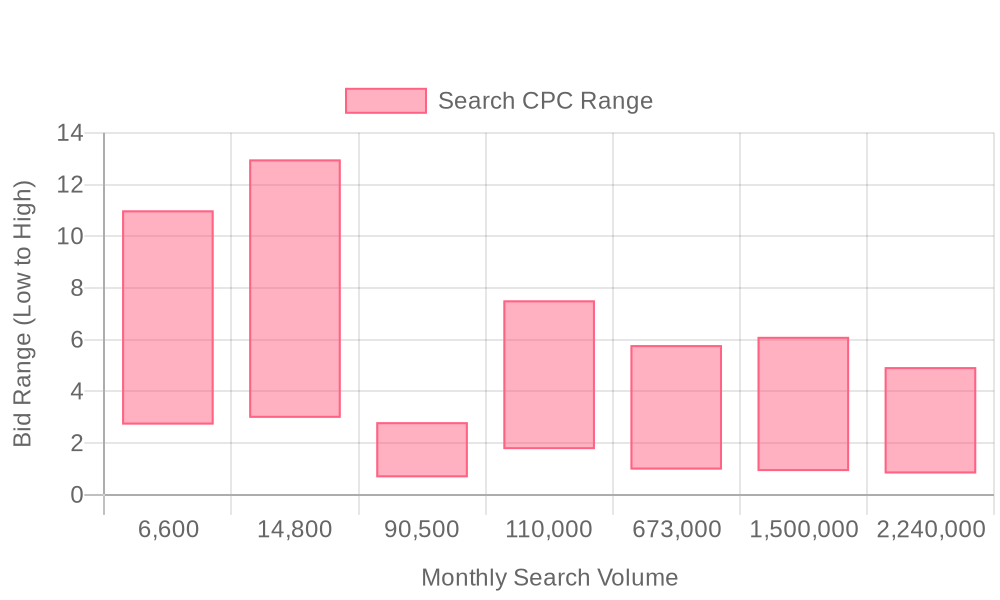
| Industry | Keyword | Monthly Search Volume | Competition Level | Low Bid | High Bid |
| Laundromats | laundry pick up and delivery | 6600 | MEDIUM | 2.72 | 11 |
| Laundromats | laundry pick up and delivery near me | 14800 | MEDIUM | 2.98 | 12.97 |
| Laundromats | coin laundry near me | 90500 | LOW | 0.68 | 2.81 |
| Laundromats | laundry service near me | 110000 | MEDIUM | 1.77 | 7.52 |
| Laundromats | laundry near me | 673000 | LOW | 0.98 | 5.79 |
| Laundromats | laundromats | 1500000 | LOW | 0.92 | 6.11 |
| Laundromats | laundromat near me | 2240000 | LOW | 0.83 | 4.94 |
Precision in keyword selection is a cornerstone of successful laundromat advertising. Revenue teams capture more ready-to-convert customers by prioritizing high-intent search phrases that signal urgent laundry needs or a preference for specific service features. For example, "laundromat near me" and "24/7 laundry services" drive immediate foot traffic from local searchers seeking fast, convenient solutions. Keyword matching options provides a deeper look at this trend.
Expanding the keyword list with niche and value-driven phrases uncovers additional growth opportunities. Phrases like “laundromat loyalty program advertising” or “eco-friendly laundry service deals” attract customers interested in added value, supporting upsell and cross-sell initiatives across multiple service lines. By integrating real-time intent data and dynamically enriching audience profiles, platforms like Sona Audiences enable marketers to continuously optimize keyword targeting. This allows budget and creative strategy to follow the highest-converting search segments, ensuring every dollar is spent on audiences most likely to generate revenue.
In a budget-conscious landscape, aligning keyword strategy with business objectives is vital. Teams can identify not just which searchers are engaging, but also which accounts and buyer personas are showing intent to purchase or upgrade services. For more insights on maximizing returns and fine-tuning campaign efficiency, check out our guide on Google Ads ROAS. Leveraging unified data, marketers sync enriched audiences across CRM and ad platforms, allowing for more granular and effective Google Ads targeting. This level of connectivity and insight transforms keyword research from a static list-building exercise into an active, revenue-driving engine for laundromat customer acquisition and retention.
Step-by-Step Campaign Execution Framework
Laundromats competing in local markets benefit from precise, data-driven advertising strategies that cut wasted spend and maximize new customer acquisition. With today’s digital marketing for laundromats, revenue teams can directly identify high-intent traffic, personalize engagement, and accelerate pipeline velocity.
Step 1: Build Targeted Keyword Lists
Building robust keyword lists is foundational for effective PPC for laundromats. Use local-specific terms, such as “laundry service [city]” or “wash and fold near me,” to capture ready-to-buy searchers. Pair these with negative keywords like “commercial equipment” or “laundry jobs” to filter out irrelevant clicks and preserve budget for users actually seeking laundry service ads. By leveraging unified data from across CRM and web analytics, marketers can pinpoint which search terms drive real conversions and adjust lists in real time. This approach moves beyond generic targeting, allowing teams to prioritize spend on keywords proven to attract customers in their service area. Google Ads guide provides a deeper look at this trend.
The upgrade most laundromats advertisers miss is going beyond raw keyword volume to layer in intent and identity signals. By connecting website-visitor data and CRM records with Sona Marketing Measurement, you can see which specific search terms bring in the accounts and customers that actually convert, and weight your keyword and bidding strategy toward those rather than the terms with the highest search volume alone.
Step 2: Craft High-Trust Ad Copy
Effective google ads for laundromats require ad copy that matches the intent and concerns of each audience segment. Highlighting trust factors, such as “certified eco-friendly” cleaning methods or customer testimonials, builds confidence at first glance. Calls to action like “Book Pickup in Minutes” or “See Why Locals Choose Us” prompt engagement by addressing common decision drivers. Real-time intent data ensures messaging evolves with market trends: as new questions or pain points appear, copy can be refreshed instantly to maintain relevance and outperform local competition. For more insights on maximizing your ad impact, check out our guide on Google Ads ROI.
Step 4: Optimize Continuously with Analytics
Continuous optimization is essential for sustainable laundromat customer acquisition. Advanced analytics inform bidding strategies, showing which keywords, locations, and messages yield the most qualified leads. Offline conversions, such as phone bookings or in-store visits, can be tracked and attributed to digital campaigns, giving a holistic view of true campaign ROI. By syncing enriched lead and account data between Google Ads and CRMs like HubSpot or Salesforce, laundromats can create always-fresh audiences that update as prospects move through the funnel. One analysis in laundromat strategies explores this further. This closed-loop approach enables smarter budget allocation, sharper retargeting, and rapid iteration, ultimately elevating every aspect of online advertising for laundromats.
Sona Marketing Measurement closes the gap between clicks and revenue. It identifies the companies behind your ad clicks using first-party data, ties that activity through UTM capture and ad-platform APIs to the actual record in your CRM, and reports ROAS by keyword and campaign instead of by last-click form fill. Feeding that revenue signal back into Smart Bidding and Performance Max compounds over time: the algorithms optimize toward booked laundromats revenue, not cheap leads.
Tips on Expanding Your Laundromat Presence
Laundromat operators seeking sustained growth need more than basic advertising, they require a framework that blends data-driven outreach with practical, cost-effective marketing tactics. Modern digital marketing for laundromats centers on leveraging smart segmentation, local partnerships, and intent-based retargeting to maximize every campaign dollar and build a loyal customer base.
- Partnerships: Establishing partnerships with local businesses creates powerful cross-promotional opportunities that expand reach without straining marketing budgets. Coffee shops, gyms, and apartment complexes often share overlapping audiences with laundromats. By exchanging guest offers or co-hosting community events, laundromats can tap into new customer pools. Google Ads Partnership provides a deeper look at how these partnerships can impact digital campaigns.
- Content Retargeting: Retargeting is essential for recapturing interest from previous website visitors who didn't convert. Advanced tools pinpoint which content or services drove the most engagement, eco-friendly detergent options, express service, so campaigns can follow up on what actually resonated. Sona's Identity Resolution supports laundromats in identifying high-intent visitors and dynamically adjusting campaign targeting, ensuring leads receive relevant offers as they move through the buying funnel. This creates a self-improving feedback loop where every new campaign is smarter than the last, supporting continuous laundromat customer acquisition and measurable growth.
Beyond Google Ads: Winning the AI Answers Laundromats Buyers Now Trust
Paid search captures demand at the moment someone types a query. But a fast-growing share of laundromats buyers no longer start at Google at all, they ask ChatGPT, Gemini, or Perplexity before they ever run a search, and Google's own AI Overviews increasingly summarize an answer above the traditional results. If your business isn't referenced in those AI answers, you're invisible at the exact moment buyers build their shortlist.
Sona AI Visibility shows where your business shows up across ChatGPT, Gemini, Perplexity, Google AI Overviews, and 10+ engines, and, much like a keyword report, which prompts actually send you buyers, so you can prioritize the ones that convert. Run the two together and you cover the entire buyer path: get cited where buyers research (AI Visibility), then prove which of that demand turns into booked revenue (Marketing Measurement).
Helpful resources
Conclusion
The laundromats that win with Google Ads treat it as a measurement problem as much as a creative one: knowing which keyword, ad, and audience actually turned a click into a paying customer, not just a visit. As AI answers increasingly shape where buyers start their search, the laundromats that show up in both the paid results and the AI-generated summary will be the ones that capture tomorrow's foot traffic.
FAQ
What are the best practices for Google Ads for laundromats?
Laundromats should focus on precise keyword research, audience targeting, compelling ad designs, optimized landing pages, and continuous campaign optimization to effectively use Google Ads.
How can laundromats effectively target local customers with Google Ads?
Laundromats can target local customers by using location modifiers and keywords like 'laundromat near me,' and segmenting audiences based on geographic and demographic data to ensure ads reach those most likely to convert.
What keywords should laundromats use in their Google Ads campaigns?
Laundromats should use high-intent keywords like 'laundry service near me,' 'wash and fold pickup,' and niche terms such as 'eco-friendly laundry service deals' to capture urgent needs and specific service preferences.
How much should laundromats budget for Google Ads?
While the article does not specify an exact budget, it emphasizes aligning ad spend with high-value prospects and adjusting campaigns based on demand shifts to maximize ROI, even with modest budgets.
What are common mistakes laundromats make with Google Ads?
Common mistakes include using broad, low-intent keywords, failing to optimize ad designs and landing pages for conversions, and not continuously tracking and adjusting campaigns based on data-driven insights.







