Ad tracking involves gathering and analyzing campaign data to link ad clicks to conversions; for B2B paid media, the valuable approach follows those clicks through CRM stages into pipeline and closed revenue. Evaluate tools by whether they connect spend to revenue and return offline conversions to LinkedIn and Google Ads, rather than by click totals. Pixel-only systems lose conversions, making first-party and server-side collection more important than polished dashboards. Choose a tool that fits your CRM, sales cycle, and implementation resources. Sona Marketing Measurement is one option for teams that need every channel tied to accounts, pipeline and revenue on one identity graph instead of scattered click data.
What is ad tracking software and how does it work for B2B paid media?
Ad tracking software collects campaign, visitor and conversion data to connect paid-media activity with business outcomes. It records UTMs, click IDs, form submissions, CRM lifecycle changes and closed-won revenue. In B2B, the endpoint is pipeline and revenue, not only a landing-page conversion.
Advertising tracking software combines several methods. Pixels capture browser events, UTMs preserve campaign metadata, server-side events send conversions from backend systems, and CRM integrations connect ad interactions with accounts and opportunities. Together, these methods create a chain from campaign to lead, lead to opportunity and opportunity to revenue.
- Tag paid links with a consistent UTM taxonomy and retain each platform click ID.
- Capture form, demo, signup and product events with first-party identifiers.
- Resolve contacts and accounts in the CRM, then associate lifecycle stages with campaigns.
- Send qualified conversions back to advertising platforms and evaluate revenue credit across the journey.
Marketing tracking software matters most when several people influence one account. A LinkedIn Ads click from one contact and a demo request from another can belong to the same buying group. B2B measurement needs account-level identity resolution, not a report limited to anonymous sessions.
What should B2B teams define before choosing ad tracking software?
B2B teams should assess campaign performance tools by identity resolution, CRM connectivity, offline conversion feedback and pricing transparency. Software that works for a short sales cycle can be a poor enterprise fit when it cannot connect account activity to opportunity stages and closed revenue.
Evaluate paid-channel coverage, HubSpot or Salesforce connections, conversion-data return paths and practical starting prices. These criteria favor measurement systems that inform budget decisions after a lead enters the CRM.
| Criterion | What to verify | Why it matters for B2B | Evaluation signal |
|---|---|---|---|
| Identity resolution | Account and contact matching across sessions | Buying groups create multiple touchpoints before a deal closes | Journey reporting reaches account or opportunity level |
| CRM connection | HubSpot or Salesforce data flow | Pipeline stages and revenue live in the CRM | Campaign data can be associated with lifecycle outcomes |
| Offline conversions | Conversions API, CRM sync or file upload | Ad platforms need downstream outcomes for optimization | Qualified leads and revenue events return to platforms |
| Commercial fit | Published price, quote structure and seat policy | Measurement costs must fit paid-media spend and operations | Pricing and implementation scope are clear before purchase |
Ad attribution software also needs a defined measurement policy. Decide whether the operating question is lead creation, opportunity creation, pipeline influence or closed-won revenue. No platform can correct inconsistent lifecycle definitions, duplicate accounts or missing campaign fields.
How do ad tracking tools compare on ad platforms, offline conversions and starting price?
B2B ad tracking tools combine CRM data with paid-media conversion feedback in different ways. The comparison separates stated ad-platform connections from confirmed conversion return paths. Prices are current as of November 2026.
| Tool | CRM connection | Ad-platform connection | Offline conversion path | Starting price |
|---|---|---|---|---|
| Sona Marketing Measurement | HubSpot and Salesforce data and audience sync | Google Ads, LinkedIn Ads, Meta Ads, Microsoft Ads and ChatGPT Ads | Conversions API sends first-party conversions to five named platforms | Cross-channel attribution on Enterprise, custom pricing; Growth $599/month billed annually |
| Dreamdata | HubSpot and Salesforce | LinkedIn, Google, Meta, Microsoft and OpenAI Ads | Conversion and pipeline sync, including LinkedIn Conversions API | Free $0/month, Advanced custom pricing |
| HockeyStack | HubSpot and Salesforce, with two-way CRM sync | Ad-platform connections | Pushes conversion and attribution data to ad platforms | Custom pricing |
| Factors.ai | HubSpot and Salesforce CRM data ingestion | LinkedIn Ads, Google Ads and Meta Ads | LinkedIn Conversions API and Google Enhanced Conversions | Lite $199/month, Basic $6,000 a year |
| Ruler Analytics | HubSpot and Salesforce source-data write-back | Google Ads and Microsoft Ads | Offline conversions and revenue sent to Google Ads and Microsoft Ads | Small £299/month |
| HubSpot | Native CRM records and lifecycle data | Paid-media data available through connected tools | Conversion return path not stated in the approved integration information | Marketing Hub Professional $800/month, annual commitment |
Sona Marketing Measurement connects HubSpot and Salesforce data with conversion feedback across five named ad platforms. Dreamdata is designed for B2B revenue attribution and growth analytics across marketing channels, per Gartner. Ruler Analytics writes marketing-source data into CRM records and returns revenue events to named ad platforms. HubSpot suits teams whose campaign and lifecycle operations already run in one CRM.
Which ad tracking tools fit different B2B teams, budgets and workflows?
Tool fit depends on the team’s CRM, sales cycle, conversion-return requirements and measurement model. Sona Marketing Measurement supports account journeys, AI search and activation workflows, while Dreamdata, HockeyStack, Factors.ai, Ruler Analytics and HubSpot serve distinct revenue analytics and CRM-centered workflows. Prices below are current as of November 2026.
-
Sona Marketing Measurement
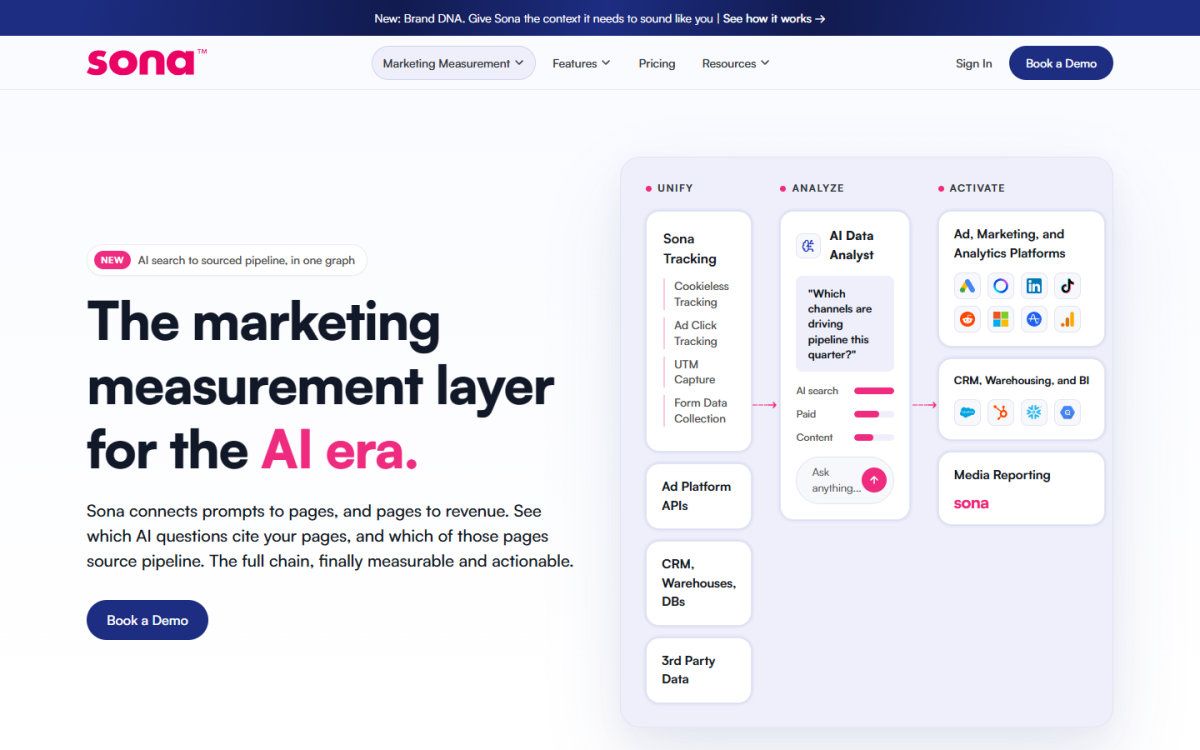
Sona Marketing Measurement homepage, November 2026 What it does: Sona Marketing Measurement was built with AI search as a channel in the same identity graph as paid media, content, email and sales. It resolves anonymous and known traffic into account and contact profiles, and Enterprise attribution weights credit by buyer-stage transition rather than last click.
What it costs: Cross-channel attribution is available on Enterprise with custom pricing. Growth, which covers identity resolution, journeys and intent, costs $599/month billed annually, or $749/month billed monthly. Every plan includes unlimited seats, API and MCP access, and a 14-day free trial with no credit card.
Who it suits: B2B demand generation and RevOps teams that need identity resolution, buyer journeys, intent activation and paid conversion feedback across CRM and advertising systems.
-
Dreamdata
Dreamdata homepage, November 2026 What it does: Dreamdata consolidates B2B marketing and revenue data for attribution and activation. It connects with HubSpot and Salesforce and syncs conversion and pipeline data to LinkedIn, Google, Meta, Microsoft and OpenAI Ads.
What it costs: Dreamdata offers a Free plan at $0/month for 5 seats and 2 months of user history. Advanced attribution and activation use custom pricing.
Who it suits: B2B teams seeking a revenue-attribution platform with a free starting tier and a guided trial for its Advanced product.
-
HockeyStack
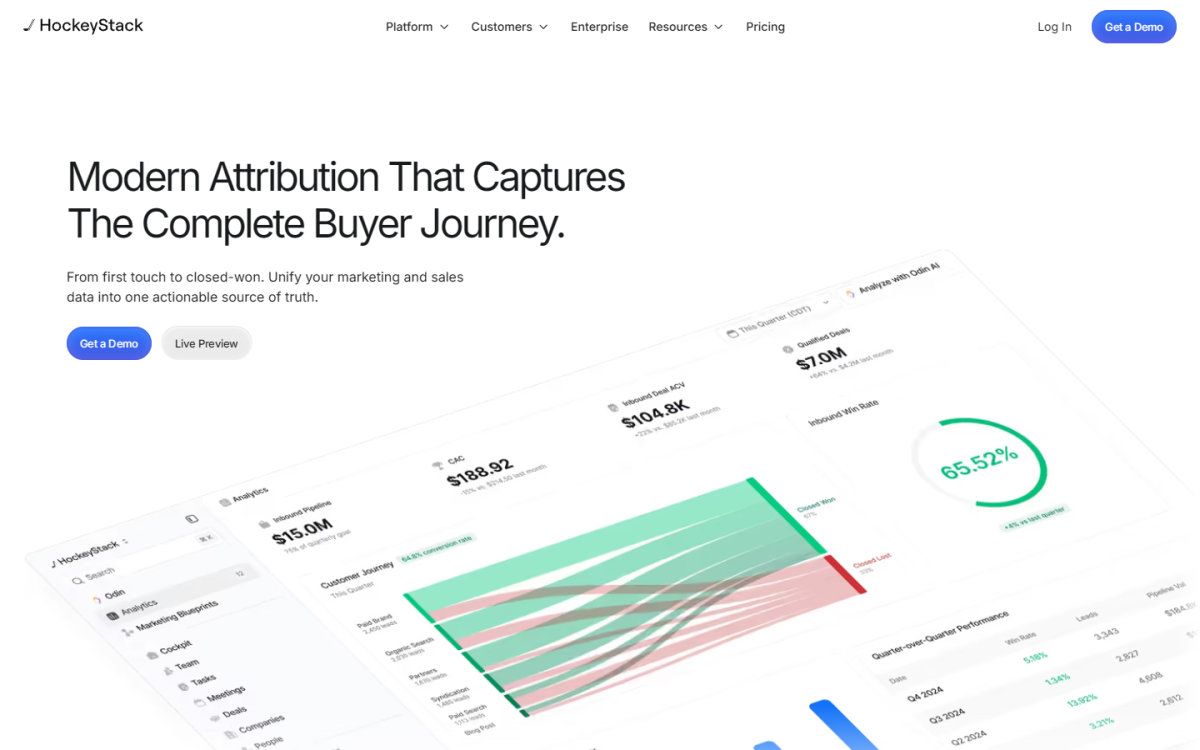
HockeyStack homepage, November 2026 What it does: HockeyStack connects with HubSpot and Salesforce, supports two-way CRM sync and pushes conversion and attribution data back to ad platforms.
What it costs: HockeyStack uses custom pricing and a demo-request sales process.
Who it suits: Enterprise teams that want a sales-led evaluation and require two-way CRM data exchange in their measurement workflow.
-
Factors.ai
Factors.ai homepage, November 2026 What it does: Factors.ai ingests HubSpot and Salesforce data, connects with LinkedIn Ads, Google Ads and Meta Ads, and supports LinkedIn Conversions API plus Google Enhanced Conversions.
What it costs: Lite costs $199/month after a free trial. Basic costs $6,000 a year, while Growth and Enterprise use custom pricing. Advanced attribution is a separately priced add-on.
Who it suits: Teams that want account-level paid-media signals and specific LinkedIn and Google conversion-return workflows.
-
Ruler Analytics
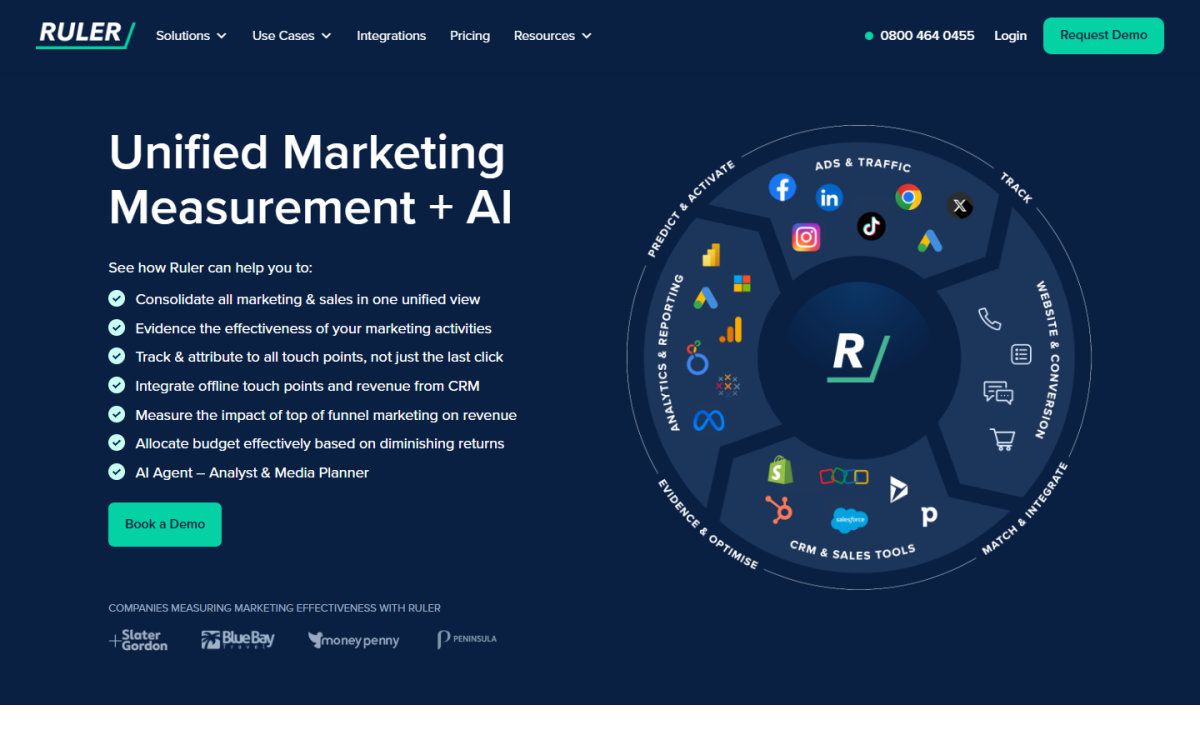
Ruler Analytics homepage, November 2026 What it does: Ruler Analytics writes marketing-source information to HubSpot leads and opportunities and Salesforce records. It sends offline conversions and revenue to Google Ads and Microsoft Ads.
What it costs: Small costs £299/month, or £269/month billed annually. Multi-touch attribution begins on the Small plan.
Who it suits: Teams focused on CRM source-data capture and offline revenue feedback for Google Ads and Microsoft Ads.
-
HubSpot
HubSpot homepage, November 2026 What it does: HubSpot provides CRM-centered campaign and lifecycle reporting. Marketing Hub Professional includes customizable attribution reports, while multi-touch revenue attribution is available in Marketing Hub Enterprise.
What it costs: Marketing Hub Professional costs $800/month with an annual commitment. Marketing Hub Enterprise costs $3,600/month for 5 core seats, plus a one-time $7,000 onboarding fee.
Who it suits: Organizations that already manage demand generation, lifecycle stages and reporting inside HubSpot.
How does LinkedIn offline conversion tracking work, and when should you use Conversions API, CRM sync or CSV upload?
LinkedIn offline conversion tracking connects a later business outcome, such as a qualified opportunity or closed deal, to earlier LinkedIn advertising activity. Use Conversions API for automated server-side event delivery, CRM sync when opportunity stages are the source of truth, and CSV upload for controlled backfills or lower-frequency processes.
Conversions API suits teams that need regular downstream optimization signals. Events move from a server or connected system rather than relying only on a browser pixel. The reported LinkedIn window for Conversions API events runs up to 90 days after the conversion event, per DataCops, October 2026.
- Define the offline conversion, such as sales-qualified opportunity or closed-won revenue.
- Preserve campaign metadata and click identifiers when contacts convert.
- Map CRM stages to a stable conversion-event schema.
- Send events through Conversions API, CRM sync or a CSV upload process.
- Audit event volumes against CRM records before using the signal for optimization.
CSV upload suits teams with low conversion volume or strict review controls, but adds manual work and delays feedback. CRM sync supports recurring lifecycle events, while Conversions API supports event-level automation after identifiers and consent handling are in place.
Should you use first-party tracking, third-party cookies, consent mode or fingerprinting?
B2B teams should use first-party tracking as the measurement foundation, with server-side events for confirmed backend conversions. Third-party cookies, consent mode and fingerprinting solve different problems. Consent mode is a consent-aware behavior layer that can operate alongside first-party or browser-based tracking, rather than an alternative identity method.
First-party tracking uses data collected through a company’s own properties, including forms, authenticated activity and CRM records. Third-party cookies support cross-site browser recognition, while fingerprinting infers a browser or device from technical characteristics. Server-side events describe a conversion-delivery method, not an identity basis.
| Method | Identity basis | Persistence | Consent dependency | Implementation burden | Privacy risk | Measurement limitation and appropriate use |
|---|---|---|---|---|---|---|
| First-party tracking | Forms, authenticated activity and CRM records | Can persist across known account and contact records | Requires consent-aware collection | Moderate | Lower when data is minimized | Supports account, lifecycle and revenue measurement |
| Third-party cookies | Browser identifier set across sites | Dependent on browser policy and device continuity | Requires consent-aware collection | Lower | Higher | Useful for browser-level ad measurement, with reduced continuity |
| Consent mode | Consent states applied to tags and events | Depends on the underlying tracking method | Directly dependent on visitor choices | Moderate | Managed through configured consent states | Controls measurement behavior alongside first-party or browser signals |
| Fingerprinting | Browser and device characteristics | Can change as device settings change | Requires careful consent and privacy review | Higher | Higher | Provides probabilistic recognition where deterministic identifiers are unavailable |
A durable architecture keeps raw conversion definitions stable across methods. Campaign name, source, account identifier and lifecycle stage should reconcile between the ad platform, analytics property and CRM. That discipline matters more than another pixel.
Can ad attribution software prove which B2B ads caused revenue?
Ad attribution software can show which ads influenced pipeline and revenue, but attribution alone cannot establish causation. Attribution assigns credit under a model. Causation requires an incrementality design that compares outcomes against a valid counterfactual, such as a holdout group or geographic test.
Multi-touch models distribute credit among paid, content, email, outbound and sales interactions. They help allocate budget, identify campaign patterns and explain buyer journeys. They do not prove that a specific impression caused a deal, especially when sales cycles span many sessions and stakeholders.
Per Digital Applied, November 2026, 76% of 430 U.S. buy-side decision-makers used incrementality testing, 73% used attribution analysis and 67% used marketing mix modeling; 39% used all three.
What implementation work and CRM data quality does ad tracking software need before it pays off?
An ad tracking program needs a documented UTM taxonomy, preserved click identifiers, consistent CRM lifecycle stages and a conversion-event map before reporting can guide spend. Poor CRM hygiene creates false precision because systems can only connect records with usable identities and reliable outcomes.
Start with a small set of conversion definitions: lead, qualified lead, opportunity, pipeline and closed-won revenue. Assign one owner to approve field names, stage rules and campaign naming. Then validate whether the same conversion count appears where it should across the CRM, analytics system and ad platform.
- Audit required CRM fields, duplicate records and account matching rules.
- Standardize UTMs, campaign naming and click-ID capture across paid channels.
- Map each lifecycle stage to an event and a revenue value where applicable.
- Test conversion return paths using known records before automated optimization.
- Review discrepancies by campaign, platform and CRM stage every reporting cycle.
AI search creates a separate measurement issue. Buyers can research inside AI answers before arriving through a branded search or direct visit, leaving click-only reports with unattributed demand. A complete buyer journey needs self-reported source data and first-party identity resolution alongside platform click data.
Which ad tracking tool should you pick based on your team, CRM and sales cycle?
Choose the tool that matches where revenue data lives and how quickly the team needs to return qualified outcomes to ad platforms. A CRM-centered team can prioritize native reporting, while a demand generation team with account-based sales cycles needs identity resolution, opportunity-level attribution and offline conversion workflows.
- Choose Sona Marketing Measurement when AI search, paid media, content, email and sales need to sit in one identity graph, with intent scores that can trigger CRM syncs or audience pushes.
- Choose Dreamdata when B2B revenue attribution and growth analytics across marketing channels are the primary requirement.
- Choose HockeyStack when two-way CRM synchronization and a sales-led enterprise evaluation fit the buying process.
- Choose Factors.ai when LinkedIn Conversions API and Google Enhanced Conversions are central paid-media workflows.
- Choose Ruler Analytics when Google Ads and Microsoft Ads need offline revenue feedback from CRM records.
- Choose HubSpot when campaign execution, lifecycle operations and reporting already run inside HubSpot.
Sales-cycle length changes the evaluation. A short cycle can emphasize conversion capture and platform optimization.
Frequently Asked Questions
What is ad tracking?
Ad tracking collects and analyzes advertising-campaign data to connect clicks, impressions and other interactions with conversions. In B2B, measurement should continue into the CRM, connecting paid activity with qualified opportunities, pipeline and closed revenue rather than stopping at a form fill.
What is the difference between ad tracking and ad attribution software?
Ad tracking captures campaign interactions, identifiers and conversions. Ad attribution software assigns credit across touchpoints and connects that credit with revenue outcomes. Many B2B platforms perform both functions, but the attribution model determines how credit is distributed among paid media, content, email, outbound and sales activity.
Why do ad-platform numbers differ from CRM numbers?
Ad platforms report conversions they can observe, often leads or event completions. CRMs record pipeline stages and closed deals. Missing click IDs, consent limits, duplicate records, differing attribution windows and inconsistent conversion definitions create gaps between the systems.
Can LinkedIn Ads accept offline conversions?
Yes. LinkedIn Ads can receive offline conversions through Conversions API, CRM integrations or CSV uploads. The reported Conversions API window runs up to 90 days after the conversion event, per DataCops, October 2026. Teams should preserve campaign identifiers and validate returned events against CRM records.
Can ad tracking still work without third-party cookies?
Yes, although browser pixels alone provide less coverage. First-party identifiers, server-side conversion events and CRM data restore much of the measurement signal within the organization’s consent rules. The strongest B2B setup connects known contacts and accounts to lifecycle outcomes rather than relying only on browser activity.
How much does ad tracking software cost?
Pricing varies by category and implementation scope. B2B attribution platforms range from published entry plans, such as Factors.ai Lite at $199/month, to custom enterprise pricing. Review platform connections, CRM requirements and offline conversion support before comparing subscription prices.
Summarize this article with AI: ChatGPT · Claude · Perplexity · Google AI Mode
Last updated: November 2026