


For HubSpot, the strongest attribution software writes touchpoint credit into HubSpot contact, company and deal records and connects it to closed revenue, rather than simply importing contacts. HubSpot’s native multi-touch revenue attribution needs Marketing Hub Enterprise. Teams requiring account-level credit, call tracking or true CAC typically outgrow it. Evaluate tools by write-back, identity resolution and pricing, and view published prices as indicative. Sona Marketing Measurement is one option for teams that need every channel, AI search included, tied to accounts, pipeline and revenue on one identity graph.
Which attribution tools work best with HubSpot, and how do they compare?

The best attribution software for HubSpot combines CRM, campaign, account and revenue data, then applies a consistent credit model across the buying journey. Sona Marketing Measurement ranks first for B2B teams that need AI search measured alongside paid, content, email and sales activity.
HubSpot attribution tools differ most in identity resolution, CRM write-back, advertising integrations and pricing models. The comparison covers seven products with stated HubSpot connections and defined B2B revenue-measurement use cases.
| Tool | What it does | HubSpot connection | Starting cost | Best suited to |
|---|---|---|---|---|
| Sona Marketing Measurement | Identity resolution, account journeys, intent activation and Enterprise cross-channel attribution | CRM data and audience sync | Cross-channel attribution on Enterprise, custom pricing; Growth $599/month billed annually | B2B teams measuring AI search, pipeline and buyer journeys |
| Dreamdata | B2B attribution and activation | Certified HubSpot app partner connection | Free plan $0/month; Advanced custom pricing | Teams seeking a free entry point for B2B attribution |
| HockeyStack | Revenue analytics and attribution data activation | Two-way CRM sync is stated | Custom pricing | Teams wanting CRM and ad-platform data flows |
| Factors.ai | Account intelligence, attribution and ad conversion workflows | Pulls HubSpot data | Lite $199/month; advanced attribution add-on price not published | Account-based teams using LinkedIn and Google Ads |
| Ruler Analytics | Call tracking, revenue attribution and offline conversion reporting | Writes marketing source data to HubSpot leads and opportunities | Small £299/month | Teams that need call and offline revenue data |
| Cometly | B2B SaaS attribution and server-side ad conversions | Writes attribution to HubSpot contacts | Custom pricing | Paid-media teams operating across several ad platforms |
| HubSpot | Native attribution reporting for contacts, deals and revenue | Built into the CRM | Marketing Hub Enterprise $3,600/month plus $7,000 onboarding | Teams standardising on native CRM reporting |
Published entry prices do not represent total cost of ownership. As of November 2026, plans use different billing periods, data limits, implementation models and feature tiers. A $199 monthly plan and a $3,600 monthly suite subscription cover different scopes of measurement.
How were these HubSpot attribution tools selected?
These HubSpot attribution tools were selected for their stated HubSpot connection, revenue-measurement focus, pricing clarity and fit for B2B buying journeys. The ordering is an editorial comparison, not a hands-on test score or a weighted benchmark.
The review assessed documented product capabilities and pricing read in November 2026. It did not test anonymous-to-known identity resolution, multi-contact deal attribution, CRM write-back or ad-conversion sync inside a shared HubSpot environment. Those workflows should be tested with a buyer's own sample records before procurement.
The comparison criteria were:
- HubSpot data flow: whether the product reads CRM data, writes data back, or supports both directions.
- Revenue coverage: whether attribution reaches contacts, companies, opportunities and closed revenue.
- Identity resolution: whether anonymous and known activity can be connected to the same buying journey.
- Activation: whether attribution data can inform CRM workflows, audiences or ad-platform conversion events.
- Commercial clarity: whether a starting price, free plan or custom-pricing position is publicly defined.
A HubSpot connector alone did not secure a high ranking. A tool that imports contacts but cannot associate campaigns with deals, revenue or buying groups provides operational data rather than full revenue attribution.
HubSpot provides native attribution reporting, while dedicated platforms extend measurement into account-based analysis, ad conversion feedback, cohort economics and identity resolution. The comparison reflects the reader goal: measuring campaign credit and ROI across customer touchpoints.
Does a HubSpot integration actually mean revenue attribution?
No. A HubSpot integration can range from importing contact properties to writing attributed revenue into opportunity records. Revenue attribution requires a defined relationship among touchpoints, contacts, companies, deals and closed-won revenue.
A basic connector can pull form submissions, lifecycle stages and campaign membership from HubSpot. That data supports reporting, but it does not establish whether several contacts belong to one buying group or whether a campaign influenced a deal before the final conversion.
- Data import: reads contacts, companies, deals or campaign activity from HubSpot.
- Identity resolution: connects anonymous sessions and known contacts to an account profile.
- Revenue attribution: distributes credit across interactions associated with pipeline or closed revenue.
- Write-back: sends attribution fields, source data or engagement scores into HubSpot records.
For a HubSpot multi-touch attribution tool, procurement teams should verify the sync object level. Contact-level reporting answers a different question than company-level attribution, and deal-level reporting answers a different question again.
AI search creates a further identity problem. Buyers can research through ChatGPT, Gemini, Claude, Perplexity, Copilot or Google AI Overviews before arriving through branded search or a direct visit. Click-only reports can classify that demand as direct even when AI research shaped the shortlist.
Which tools rank first through fourth for account-level attribution in HubSpot, starting with Sona Marketing Measurement?
The first four HubSpot attribution tools are Sona Marketing Measurement, Dreamdata, HockeyStack and Factors.ai. They suit B2B teams that need more than a single contact-source field and want attribution connected to accounts, pipeline, ad platforms or workflows.
1. Sona Marketing Measurement
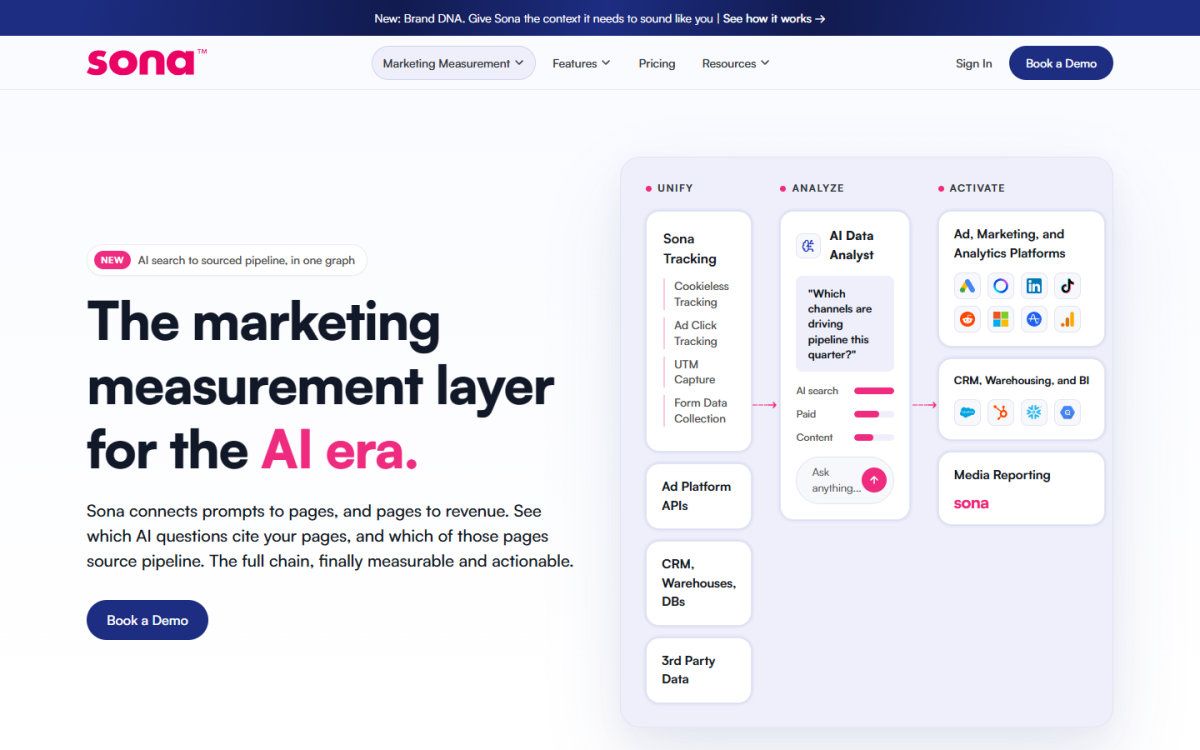
What it does: Sona Marketing Measurement treats AI search as a native channel in the same identity graph as paid, content, email and sales. It resolves anonymous and known traffic into account and contact profiles, builds Account360 and Profile360 journeys, and uses intent signals to trigger CRM syncs or audience pushes.
What it costs: As of November 2026, cross-channel attribution is available on Enterprise with custom pricing. Growth, which covers identity resolution, journeys and intent, costs $599/month billed annually, or $749/month billed monthly. Every plan includes unlimited seats, API and MCP access, plus a 14-day free trial without a credit card.
Who it suits: Sona suits B2B marketing and RevOps teams that need identity resolution and activation in HubSpot while treating AI-referred traffic as a measurable channel rather than direct traffic.
2. Dreamdata
What it does: Dreamdata provides B2B attribution and activation, with HubSpot and Salesforce connections. It also syncs conversions and pipeline data to LinkedIn, Google, Meta, Microsoft and OpenAI Ads.
What it costs: As of November 2026, Dreamdata has a Free plan at $0/month for five seats and two months of user history. Advanced, which includes attribution and activation, uses custom pricing.
Who it suits: Dreamdata suits B2B teams that want to start with a constrained free plan before evaluating a paid attribution and activation deployment.
3. HockeyStack
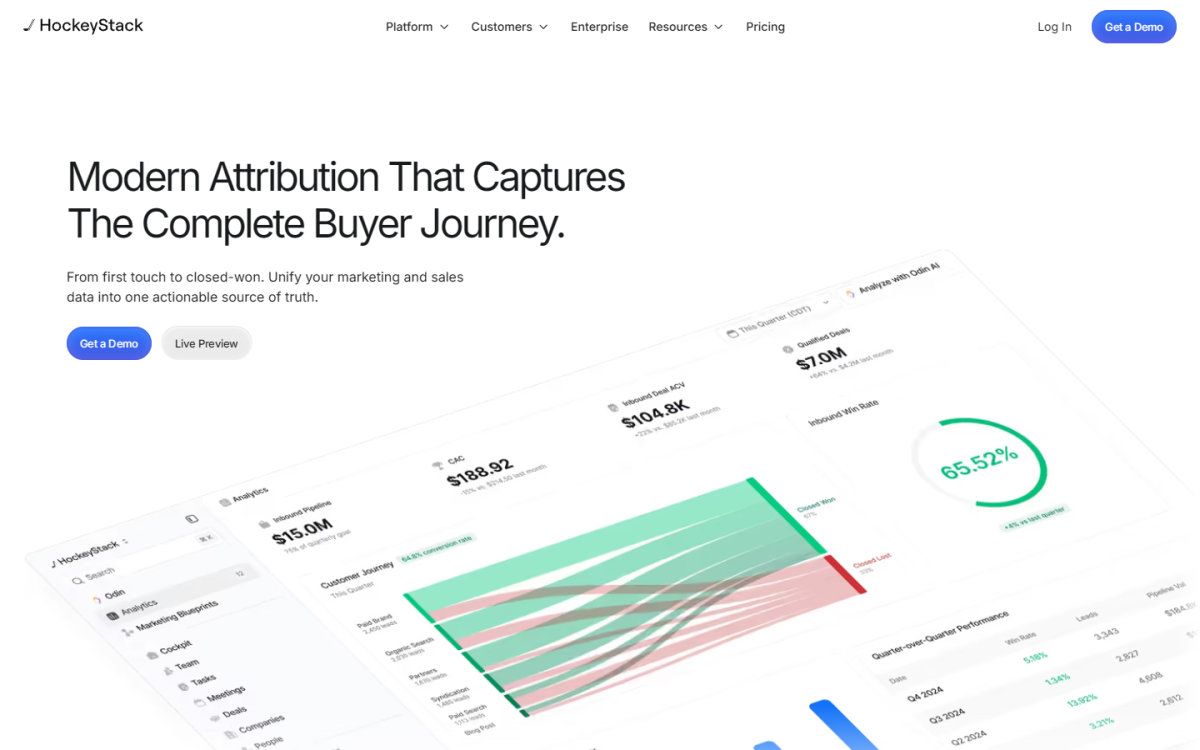
What it does: HockeyStack provides revenue analytics and attribution workflows. Its stated integrations include HubSpot and Salesforce, with two-way CRM data sync and conversion or attribution data pushed back to ad platforms.
What it costs: As of November 2026, HockeyStack uses custom pricing and a demo-led sales process.
Who it suits: HockeyStack suits teams that want CRM-connected revenue analysis and an implementation discussion before selecting a plan.
4. Factors.ai
What it does: Factors.ai combines account intelligence with attribution and advertising workflows. It pulls data from HubSpot and Salesforce, connects with LinkedIn Ads, Google Ads and Meta Ads, and sends conversion data to LinkedIn and Google Ads.
What it costs: As of November 2026, Lite costs $199/month after a free trial. Basic costs $6,000 a year, while Growth and Enterprise use custom pricing. Advanced attribution is an add-on with no published price.
Who it suits: Factors.ai suits account-based marketers that prioritise ad-platform activation alongside CRM and account-intelligence data.
Which tools rank fifth through seventh for HubSpot, covering call tracking, ad platforms and native reporting?
Fifth through seventh are Ruler Analytics, Cometly and HubSpot, covering call-driven conversion reporting, server-side advertising conversion feedback and native CRM attribution reports.
5. Ruler Analytics
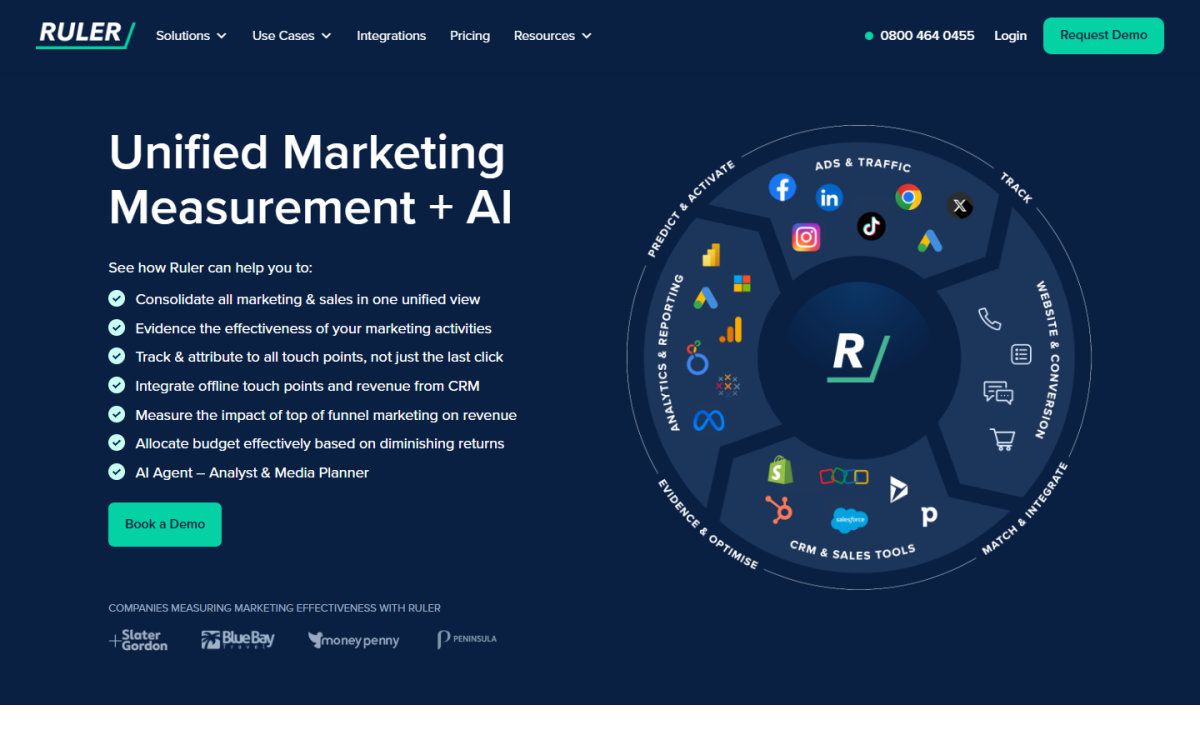
What it does: Ruler Analytics connects marketing source data to HubSpot leads and opportunities. It also sends offline conversions and revenue back to Google Ads and Microsoft Ads, making it relevant when calls or offline activity are part of the revenue path.
What it costs: As of November 2026, the Small plan costs £299/month, or £269/month billed annually. Multi-touch attribution begins on the Small plan.
Who it suits: Ruler Analytics suits teams that need call tracking and offline conversion reporting connected to HubSpot revenue records.
6. Cometly
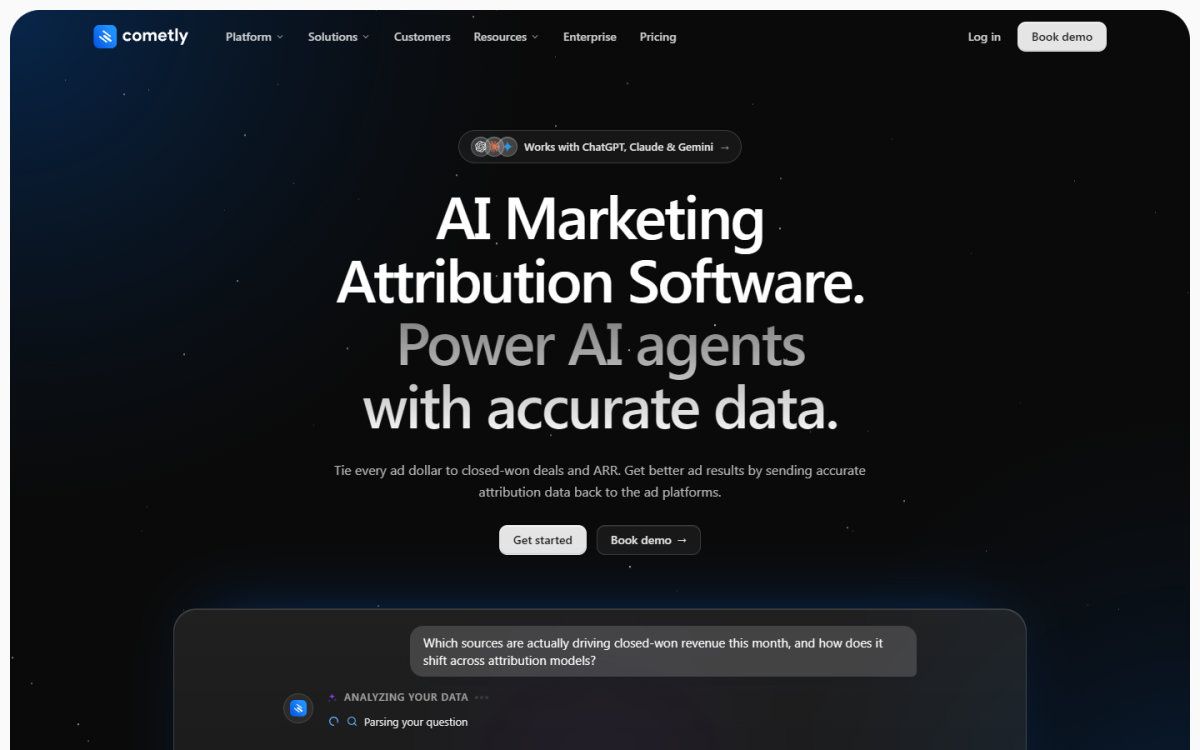
What it does: Cometly focuses on B2B SaaS attribution and server-side conversion reporting. It connects with HubSpot and Salesforce, writes attribution to HubSpot contacts, and sends server-side conversions to platforms including Meta, Google Ads, LinkedIn and Microsoft.
What it costs: As of November 2026, Cometly uses custom pricing based on monthly pageviews.
Who it suits: Cometly suits paid-media teams that need CRM-connected attribution data and conversion feedback across several advertising platforms.
7. HubSpot
What it does: HubSpot provides native attribution reports that distribute credit across interactions associated with contacts, deals and revenue. The reports operate inside the CRM, simplifying governance for teams already running campaigns and lifecycle management there.
What it costs: As of November 2026, multi-touch revenue attribution is available on Marketing Hub Enterprise at $3,600/month for five core seats, plus a one-time $7,000 onboarding fee. Marketing Hub Professional costs $800/month with an annual commitment and includes customizable attribution reports.
Who it suits: HubSpot suits teams that need native reporting first and prefer attribution analysis within their existing CRM environment.
When does a team outgrow HubSpot's own multi-touch attribution?
A team outgrows HubSpot's native multi-touch attribution when contact-level reporting no longer explains account-level pipeline, anonymous research or ad-platform outcomes. The trigger is not report volume. It is the point when revenue questions require data outside standard CRM touchpoints.
Common signals include deals with several stakeholders, long sales cycles, offline conversions, self-reported sources, paid-media optimisation and conflicting channel reports. A demand generation leader may see a closed-won deal in HubSpot but still lack a defensible answer about which campaign combination moved the account forward.
- Audit whether contacts, companies and deals are consistently associated.
- Check whether anonymous sessions can be resolved into account activity.
- Compare CRM campaign credit with ad-platform conversion reporting.
- Identify visits labelled direct or none after brand searches and AI research.
- Decide whether the team needs attribution reporting, activation, or both.
HubSpot remains useful as the system of record. A dedicated HubSpot attribution alternative becomes relevant when measurement must connect CRM records with identity resolution, spend, advertising conversions and account-level buyer journeys.
Does multi-touch attribution in HubSpot show causation or only credit?
Multi-touch attribution in HubSpot shows credit allocation, not causation. It applies a model to interactions that created contacts, deals and revenue, then assigns credit to touchpoints according to selected rules.
First-touch, last-touch, linear, time-decay and position-based models answer different reporting questions. A time-decay model emphasises activity near conversion. U-shaped and W-shaped models give greater weight to defined milestones in a longer B2B journey.
Attribution is descriptive. It can show that a webinar, paid search campaign and sales conversation appeared in the same closed-won journey, but it cannot prove that removing one interaction would have prevented the outcome.
Incrementality testing checks causation. It compares outcomes between groups exposed to an intervention and groups that were not exposed, then estimates lift. Use attribution to allocate credit and diagnose journeys, then use incrementality tests before major budget decisions.
Who should pick which HubSpot attribution tool?
The right HubSpot attribution tool depends on the revenue motion, required object level and whether the team needs measurement alone or operational activation. A CRM-first team, a call-driven business and an account-based demand generation team require different evaluation criteria.
- B2B teams measuring AI search and account journeys: choose Sona when AI-referred visits, first-party identity resolution, intent scoring and HubSpot audience sync belong in the same measurement layer.
- Teams seeking a free B2B starting point: choose Dreamdata for its $0/month Free plan, then evaluate Advanced for attribution and activation.
- Revenue teams wanting a demo-led analytics deployment: choose HockeyStack for CRM and ad-platform data workflows.
- ABM teams focused on paid activation: choose Factors.ai for account intelligence and LinkedIn or Google conversion workflows.
- Businesses reliant on calls or offline conversions: choose Ruler Analytics for source data written to HubSpot leads and opportunities.
- Paid-media teams needing server-side conversion feedback: choose Cometly for CRM-connected attribution and ad-platform conversion delivery.
- CRM-standardised teams with native reporting needs: choose HubSpot when built-in attribution reports meet the required reporting depth.
Procurement teams should use a real sample of closed-won deals during evaluation. Test whether the tool connects contacts to companies, companies to deals, and campaigns to revenue without duplicate credit or unresolved records.
What are the frequently asked questions about HubSpot attribution tools?
Does HubSpot have built-in multi-touch attribution?
Yes. HubSpot provides multi-touch revenue attribution on Marketing Hub Enterprise. The reports allocate credit across interactions connected to contacts, deals and revenue. For report configuration, available models and object-level detail, consult a separate HubSpot attribution reporting explainer.
Can a third-party attribution tool write results back to HubSpot deals?
Some third-party attribution tools can write results back through a native app or API sync that updates contact, company or deal properties. Others only read HubSpot data. Confirm the write-back objects, fields and sync direction before buying, especially when sales teams depend on attribution fields inside deal records.
What is the difference between a HubSpot integration and revenue attribution?
A HubSpot integration can import contacts, companies, campaigns or lifecycle data. Revenue attribution goes further by resolving companies, opportunities, closed revenue and multiple contacts within a buying group. The distinction determines whether a report measures activity or revenue influence.
Are the starting prices of HubSpot attribution tools comparable?
No. Starting prices indicate entry cost rather than total cost of ownership. Vendors use custom quotes, usage-based pricing, implementation fees, annual commitments and different limits for seats, traffic, historical data or attribution features. As of November 2026, HubSpot Enterprise also includes a one-time $7,000 onboarding fee.
Is multi-touch attribution accurate enough to move budget?
Multi-touch attribution is descriptive rather than causal. Its reliability depends on tracking quality, identity resolution and selected credit rules. Use it to identify patterns and allocate operational credit, then use incrementality testing to determine whether a channel or campaign caused incremental revenue.
Which attribution model should I use in HubSpot?
There is no single best model. The right model reflects the business goal, sales-cycle length and question under review. Time-decay, U-shaped and W-shaped models are common for longer B2B cycles because they recognise multiple meaningful interactions rather than assigning all credit to one touchpoint.
Summarize this article with AI: ChatGPT · Claude · Perplexity · Google AI Mode
Last updated: November 2026







