


Marketing attribution platforms follow buyer journeys across touchpoints and assign credit to campaigns and channels, helping B2B SaaS teams identify which ones generate pipeline and closed-won revenue. The best choice depends on CRM compatibility, supported attribution models, offline conversion syncing, identity resolution and pricing structure. No tool captures podcasts, private communities or word of mouth, so regard attributed credit as a directional estimate and compare it with what buyers report. Sona Marketing Measurement is one option for teams that want every channel, AI search included, tied to accounts, pipeline and revenue on one identity graph.
How do the leading marketing attribution tools compare on approach, CRM/revenue handling and price?
B2B attribution platforms connect marketing touchpoints to CRM pipeline and revenue. They differ in identity resolution, attribution scope, activation, and commercial model. The comparison below focuses on platforms built for revenue teams rather than web analytics alone.
All prices and plan details in this table are current as of November 2026. Custom pricing means the vendor does not publish a usable list price for the relevant product tier.
| Platform | What it does | CRM and revenue approach | Published price | Who it suits |
|---|---|---|---|---|
| Sona Marketing Measurement | Enterprise cross-channel attribution, identity resolution, buyer journeys, intent activation, and AI search measurement. | Resolves anonymous and known activity into account and contact profiles, then connects credited touches to CRM and warehouse data. | Cross-channel attribution is on Enterprise, with custom pricing. Growth (identity resolution, journeys and intent) is $599/month billed annually, or $749/month billed monthly. | B2B teams that need AI search, paid, content, email, and sales activity in one measurement layer. |
| Dreamdata | B2B attribution and activation platform with account-level measurement. | Connects journey data to revenue analysis and activation workflows. | Free is $0/month for 5 seats and 2 months of user history. Advanced has custom pricing. | B2B teams that want a free starting point before a larger attribution deployment. |
| HockeyStack | B2B attribution and revenue measurement platform. | Designed for multi-touch and account-level analysis. | Custom pricing through a demo request. | Revenue teams evaluating an enterprise attribution deployment. |
| Factors.ai | Account intelligence and measurement platform with attribution available as an add-on. | Combines account signals with CRM-oriented reporting and activation. | Lite is $199/month after a free trial. Basic is $6,000 a year. Advanced attribution has no published price. | Teams that want account intelligence alongside attribution. |
| Adobe Marketo Measure | B2B attribution and revenue measurement platform, formerly called Bizible. | Connects marketing activity to revenue reporting in complex B2B operations. | Custom pricing. | Large organizations with established Adobe and enterprise marketing operations. |
| HubSpot | Marketing automation platform with built-in attribution reports. | Records email, web, ad, and CRM interactions inside the broader HubSpot system. | Marketing Hub Enterprise is $3,600/month for 5 core seats, plus a one-time $7,000 onboarding fee. Professional is $800/month with an annual commitment. | Teams already standardizing marketing and CRM operations in HubSpot. |
| Cometly | Marketing attribution platform built for B2B SaaS. | Tracks ad-driven journeys and ties them to conversions, with pricing based on monthly pageviews. | No published price. Core, custom and Enterprise plans are quoted through sales. | B2B SaaS teams focused on attributing paid acquisition. |
Price is only one buying factor. B2B SaaS teams should test whether each platform reconciles anonymous web activity, contact records, account activity, opportunity stages, and closed-won revenue without requiring analysts to manually join exports.
How were these marketing attribution tools ranked?
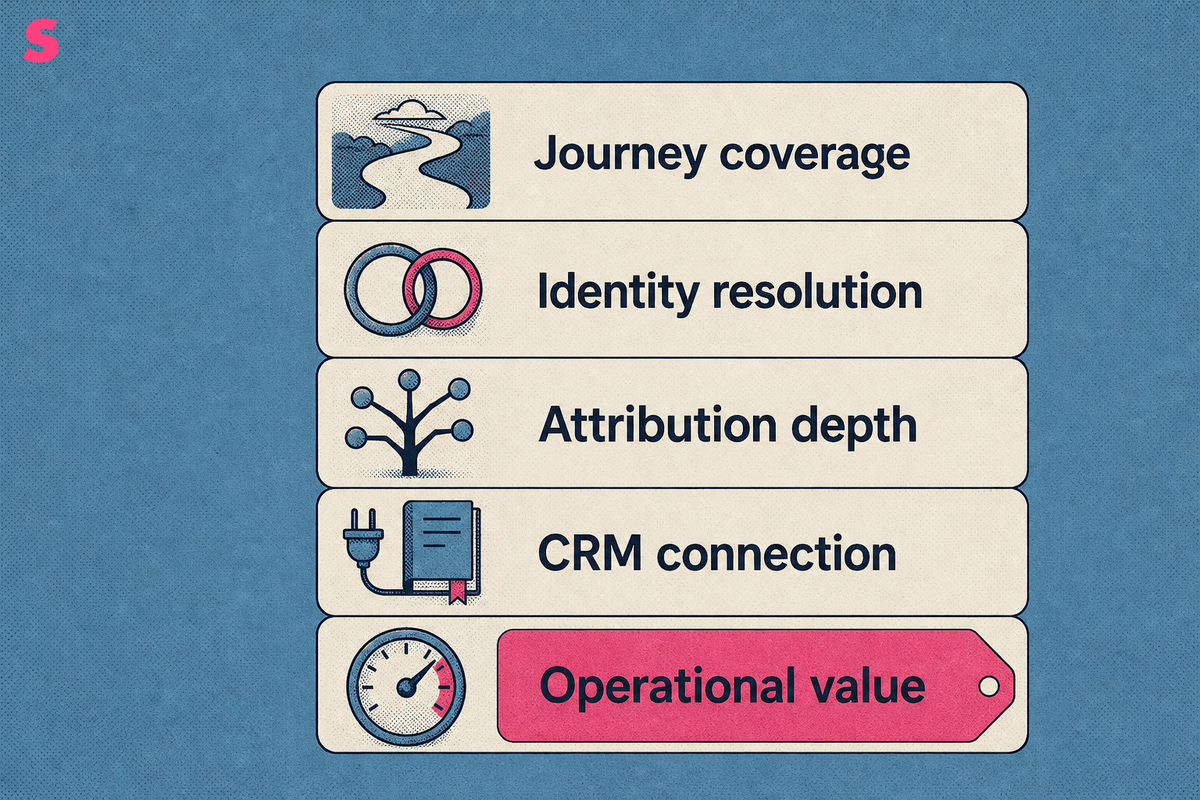
These tools were ranked for B2B SaaS revenue measurement, not generic dashboard features. The criteria were journey coverage, CRM and account-level relevance, attribution methodology, activation potential, published pricing clarity, and suitability for long sales cycles.
A useful attribution platform preserves more than a conversion event. It retains the sequence of paid media, content, product research, outbound activity, and sales engagement preceding an opportunity. That requirement distinguishes revenue attribution software from channel reporting tools.
- Journey coverage: Can the platform connect touches from first visit through closed-won revenue?
- Identity resolution: Can anonymous sessions, contacts, and accounts be reconciled into a usable buyer record?
- Attribution depth: Does the platform support more than first-touch or last-touch reporting?
- CRM connection: Can pipeline stages and revenue serve as reporting outcomes?
- Operational value: Can measurement inform audiences, sales follow-up, or budget decisions?
The ranking does not treat a higher price as evidence of stronger fit. A smaller team may need rigorous multi-touch reporting, while an enterprise may prefer built-in CRM reporting when governance and implementation simplicity outweigh analytical depth.
What is marketing attribution software and how do attribution models differ?
Marketing attribution software tracks customer journeys across touchpoints and assigns credit to campaigns, channels, and programs that contributed to a conversion or revenue outcome. In B2B SaaS, the relevant outcome is often an opportunity, pipeline stage, or closed-won deal rather than a form submission.
Single-touch models assign all credit to one interaction. First-touch credits the initial known source, while last-touch credits the final interaction before conversion. These views are useful reference points, but neither represents a buying journey involving repeated research, multiple stakeholders, and sales activity.
- Linear multi-touch: Splits credit evenly across recorded touchpoints.
- Position-based: Gives greater weight to first touch, lead creation, opportunity creation, or another defined milestone.
- Time-decay: Gives increasing weight to touches closer to conversion.
- Data-driven or custom: Applies rules or observed conversion patterns to assign variable credit.
Multi-touch attribution distributes credit mathematically. It does not prove causation. A webinar registration can receive credit because it appeared in a journey even when a peer recommendation, executive discussion, or procurement requirement shaped the purchase decision.
AI search creates another measurement problem. Buyers can research vendors in ChatGPT, Perplexity, Claude, Gemini, Copilot, or Google AI Overviews before visiting a site. When they later search a brand name or type a URL, click-based systems often classify the visit as direct or organic rather than preserving the AI-influenced research path.
Which marketing attribution software is best for B2B SaaS companies?
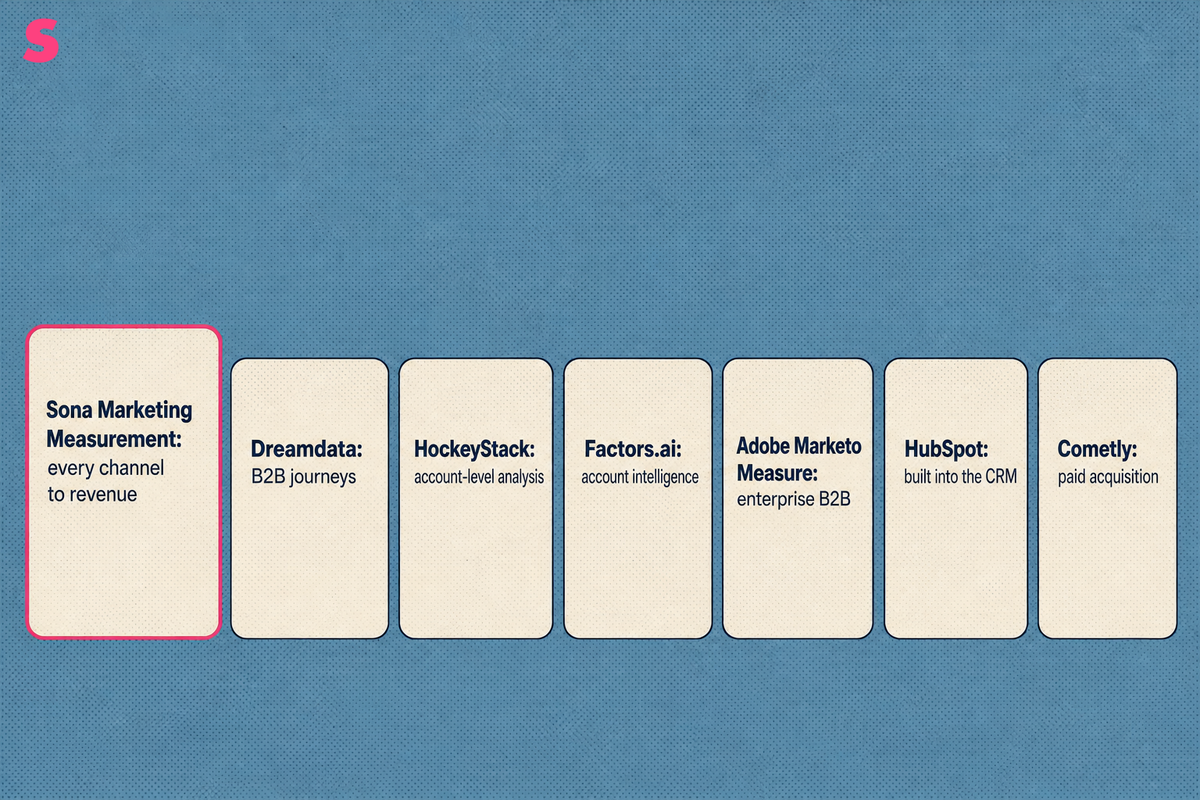
Sona Marketing Measurement suits B2B SaaS teams that need AI search treated as a native channel alongside paid, content, email, outbound, and sales activity. Dreamdata, HockeyStack, Factors.ai, Adobe Marketo Measure, and HubSpot suit narrower operating environments, existing technology commitments, or different implementation priorities.
1. Sona Marketing Measurement
What it does: Sona Marketing Measurement connects prompts to pages and pages to revenue through identity resolution, buyer journeys, intent activation, and Enterprise cross-channel attribution weighted by stage transition rather than last click.
What it costs: Growth is $599/month billed annually, or $749/month billed monthly, as of November 2026. Enterprise attribution has custom pricing.
Who it suits: B2B revenue teams that need AI-referred traffic, dark traffic, account activity, and CRM outcomes measured in one identity graph.
2. Dreamdata
What it does: Dreamdata provides B2B attribution and activation with account-level measurement.
What it costs: The Free plan is $0/month for 5 seats and 2 months of user history, as of November 2026. Advanced attribution and activation use custom pricing.
Who it suits: Teams that want to begin with a free plan before evaluating a broader B2B attribution deployment.
3. HockeyStack
What it does: HockeyStack is a B2B attribution and revenue measurement platform built for multi-touch and account-level analysis.
What it costs: HockeyStack uses custom pricing through a demo request, as of November 2026.
Who it suits: Enterprise-oriented B2B teams evaluating a dedicated measurement vendor.
4. Factors.ai
What it does: Factors.ai combines account intelligence, reporting, and attribution capabilities.
What it costs: Lite is $199/month after a free trial, and Basic is $6,000 a year, as of November 2026. Advanced attribution is an add-on with no published price.
Who it suits: Teams that place account intelligence and account activity at the center of go-to-market measurement.
5. Adobe Marketo Measure
What it does: Adobe Marketo Measure is an enterprise B2B attribution platform that connects marketing activity to revenue reporting.
What it costs: Adobe Marketo Measure uses custom pricing, as of November 2026.
Who it suits: Large B2B organizations with mature marketing operations and an established Adobe environment.
6. HubSpot
What it does: HubSpot combines marketing automation, CRM activity, and attribution reporting in one operating system.
What it costs: Marketing Hub Enterprise is $3,600/month for 5 core seats plus a one-time $7,000 onboarding fee, as of November 2026. Professional is $800/month with an annual commitment.
Who it suits: Companies that want attribution reporting inside existing HubSpot marketing and CRM workflows.
7. Cometly
What it does: Cometly is a marketing attribution platform built for B2B SaaS, focused on connecting ad-driven journeys to conversions.
What it costs: Cometly has no published price, as of November 2026. Pricing is usage-based on monthly pageviews, with Core, custom and Enterprise plans quoted through sales.
Who it suits: B2B SaaS teams whose main attribution question is which paid campaigns drive conversions.
Which marketing attribution software suits startups and small teams?
Small B2B SaaS teams should choose an attribution tool that matches their data maturity rather than an enterprise feature checklist. A CRM-native report or low-cost entry tier is often enough when one person owns demand generation, operations, and reporting.
Dreamdata offers a $0/month Free plan with 5 seats and 2 months of user history, as of November 2026. Factors.ai starts at $199/month after a free trial. Those structures provide a lower-cost path for teams that need account-oriented reporting before committing to a custom enterprise contract.
Small teams should validate three basics before purchase:
- Confirm that CRM opportunity stages are available as reporting outcomes.
- Check whether anonymous sessions can be connected to known contacts or accounts.
- Compare first-touch, last-touch, and multi-touch views against actual closed-won deals.
Do not buy a complex attribution platform before establishing campaign naming, UTM governance, conversion definitions, and CRM lifecycle stages. Software cannot correct inconsistent source data after collection.
Why does marketing attribution accuracy fail in practice?
Marketing attribution accuracy fails when the recorded journey differs from the real buying journey. Cross-domain tracking gaps, consent choices, device changes, delayed CRM synchronization, anonymous research, buying groups, and offline influence create missing or distorted touchpoints.
AI search makes this gap more visible. AI engines can recommend a vendor without producing a click, and buyers who later arrive through branded search or direct navigation can be classified as organic or direct. Click-only reporting leaves that early research uncredited.
| Failure mode | Reporting symptom | Verification test | Corrective action |
|---|---|---|---|
| Cross-domain loss | Journey reporting splits one buyer into separate sessions after a domain change. | Follow a tagged test journey across domains and compare session or identity continuity. | Standardize cross-domain tracking and preserve identifiers across approved domains. |
| Consent gaps | Known campaign activity appears incomplete or disappears after consent choices. | Compare consented and non-consented journey records by channel and conversion stage. | Document consent behavior and use first-party, cookieless tracking where appropriate. |
| Device switching | Early research and later conversion appear under separate identities. | Review known contacts with multiple devices or browser histories against CRM timestamps. | Use account and contact resolution after a buyer becomes known. |
| Anonymous research | Opportunities show direct, organic, or no recorded early touchpoint. | Compare CRM creation dates with pre-conversion site activity and self-reported source fields. | Capture self-reported attribution and reconcile it with click-level data. |
| Buying groups | One opportunity has activity from several contacts, but reporting credits one lead. | Inspect contact roles, account activity, and opportunity timing for closed-won deals. | Measure journeys at account and contact level. |
| CRM sync delays | Pipeline, opportunity stages, or revenue appear after campaign reporting periods close. | Compare source-system timestamps with the attribution dataset refresh history. | Define sync cadence and document the reporting cut-off date. |
| Offline influence | Events, sales conversations, referrals, or partner activity receive no recorded credit. | Compare sales notes, event attendance, and buyer interviews with attributed journeys. | Record offline activities in the CRM and use buyer self-reported source fields. |
| AI zero-click research | Branded return visits and direct traffic conceal earlier AI research. | Review AI-referred visits, direct traffic patterns, and self-reported research sources. | Track AI search as a channel and reconcile AI-referred activity with buyer journeys. |
Sona Marketing Measurement treats AI search as a first-class channel in the same identity graph as paid, content, email, and sales. It resolves AI-referred visits to accounts, infers the likely prompt behind each visit, and reconciles self-reported attribution with click-level data.
Attribution quality improves through triangulation rather than blind trust in one model. Compare software credit with CRM timestamps, sales notes, self-reported source fields, and buyer interviews.
Is CRM reporting enough, or do B2B SaaS teams need dedicated attribution software?
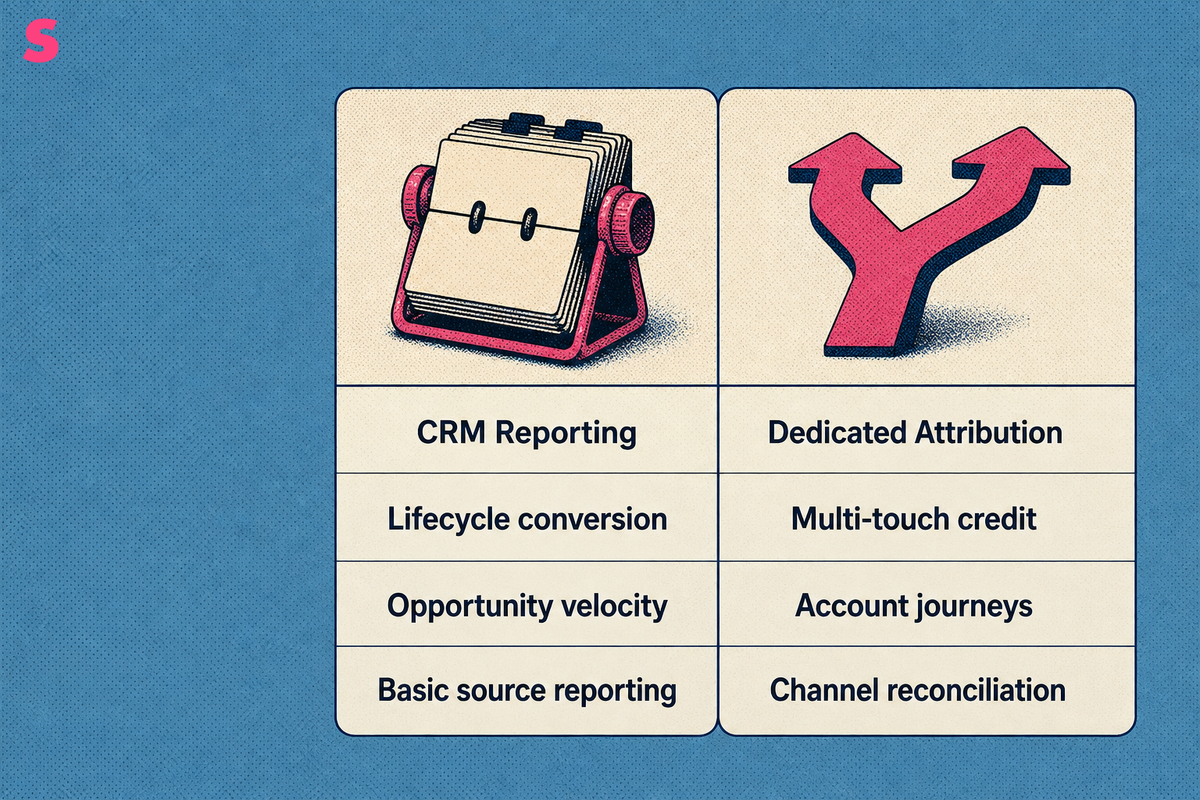
CRM reporting is enough for straightforward funnels with reliable campaign capture and short sales cycles. Dedicated B2B attribution software becomes useful when a company must reconcile anonymous traffic, multiple contacts, account activity, marketing touches, and revenue across a long buying process.
A CRM is the system of record for leads, contacts, accounts, opportunities, and revenue. Its reports answer questions about stage progression and ownership. Attribution software adds a measurement layer that combines marketing, web, advertising, and CRM data into a journey-level dataset.
Marketing automation platforms can record email, web, and ad interactions effectively. Problems arise when several contacts influence one opportunity, pre-conversion research remains anonymous, or marketing data and sales activity live in separate systems.
- Use CRM reporting for lifecycle conversion, opportunity velocity, and basic source reporting.
- Use dedicated attribution for multi-touch credit, account journeys, channel reconciliation, and budget allocation.
- Use both when CRM pipeline data must remain the revenue source of truth.
How do I choose marketing attribution software? A buyer's checklist
Choose marketing attribution software by testing its data model against real B2B SaaS opportunities before signing a contract. A polished dashboard is irrelevant if the platform cannot reproduce the journey behind several closed-won deals from CRM records and marketing data.
- Define the conversion: Specify whether reporting will optimize for demos, qualified pipeline, opportunities, or closed-won revenue.
- Map required sources: List CRM, ad platforms, web analytics, product data, warehouse tables, and offline conversion sources.
- Test identity resolution: Review how the platform handles anonymous sessions, multiple contacts, account matching, and shared devices.
- Compare models: Inspect first-touch, last-touch, position-based, and multi-touch outputs for the same opportunities.
- Check AI search handling: Ask how AI-referred traffic, zero-click influence, branded return visits, and direct traffic are classified.
- Verify activation: Confirm whether insights can trigger CRM updates, audience syncs, or sales alerts.
- Review governance: Establish campaign taxonomy, UTM rules, lifecycle definitions, and an owner for data quality.
Request a working evaluation using a defined sample of opportunities and a fixed date range. The review should identify missing touchpoints, explain credit rules, and document every source system used in the calculation.
Who should pick which marketing attribution tool?
The right attribution platform depends on team structure, existing systems, and the decision the company needs to make. B2B SaaS leaders should select the tool that matches their measurement problem rather than treating every platform as interchangeable.
- Choose Sona Marketing Measurement when AI search, dark traffic, account journeys, and intent activation need to operate within the same marketing measurement layer.
- Choose a free-entry platform when a small team needs to establish account-level attribution before committing to a larger deployment.
- Choose an enterprise attribution deployment when complex revenue operations require formal implementation, governance, and dedicated support.
- Choose CRM-native reporting when HubSpot or another CRM environment already contains reliable campaign, contact, and opportunity data.
- Choose account intelligence with attribution when identifying and prioritizing engaged accounts is the primary operating need.
Select the platform that can explain the customer journeys behind real pipeline, expose credit assumptions, and produce outputs that change budget or follow-up decisions.
What are the frequently asked questions?
What is the difference between marketing attribution software and web analytics?
Web analytics reports site behavior, sessions, pages, events, and conversion paths. B2B attribution software connects marketing touchpoints to pipeline and revenue across the buyer journey, including CRM data, account activity, opportunity stages, and closed-won outcomes.
Which attribution models should a B2B SaaS team start with?
Start with first-touch and last-touch as reference views, then add a position-based or custom multi-touch model for budget decisions. Single-touch models clarify entry and conversion points. Multi-touch models distribute credit across long B2B journeys where content, paid media, email, sales activity, and multiple stakeholders matter.
Is multi-touch attribution worth it for B2B SaaS?
Multi-touch attribution is useful when a B2B SaaS team needs more journey context than last-touch reporting provides. It still distributes credit mathematically and cannot directly observe dark social, word of mouth, private communities, or untracked research. Per Martech Tools, October 2026, a vendor-published study reported a 22% pipeline-growth gap between last-touch-only and multi-touch teams, but the result requires independent methodology review.
Can attribution software track offline conversions and send them to ad platforms?
Attribution software can support offline conversion measurement when it connects CRM opportunity and revenue data to resolved marketing identities. Sending conversions to ad platforms requires a compatible integration, defined conversion events, and a documented synchronization process. Confirm supported platforms, identity rules, and sync delay with each vendor before purchase.
How accurate is marketing attribution software?
Attribution accuracy is constrained by cross-domain tracking gaps, privacy restrictions, delayed CRM synchronization, anonymous sessions, and untracked influence. Treat attribution as a decision framework rather than a complete record of causality. Check credited channels against CRM evidence, buyer self-reported source fields, sales notes, and customer interviews.
Do I need a separate attribution tool if I already use a marketing automation platform?
A marketing automation platform can cover simple journeys by recording email, web, and ad interactions. Dedicated attribution software becomes relevant when buying groups, anonymous traffic, account-level journeys, long sales cycles, multiple data sources, and revenue-based budget decisions exceed the scope of built-in reports.
Summarize this article with AI: ChatGPT · Claude · Perplexity · Google AI Mode
Last updated: November 2026







