Bottom-of-funnel LLM conversion strategies turn AI-referred buyers into demo requests by making comparison, pricing, and alternatives pages easy to cite and convert. Three tactics drive this: comparison pages, landing pages redesigned for AI-informed visitors, and third-party sources models already cite. Sona AI Visibility connects the prompts and citations driving those visits to pipeline and revenue, showing whether the effort converted. Reported headline conversion lifts for LLM traffic lack published sample sizes, so validate them against your own traffic.
What are bottom of funnel LLM conversion strategies?
Bottom of funnel LLM conversion strategies are decision-stage content and conversion paths designed for AI answers to cite and AI-referred buyers to act on immediately. They serve prospects close to purchase who need evidence to make a decision.
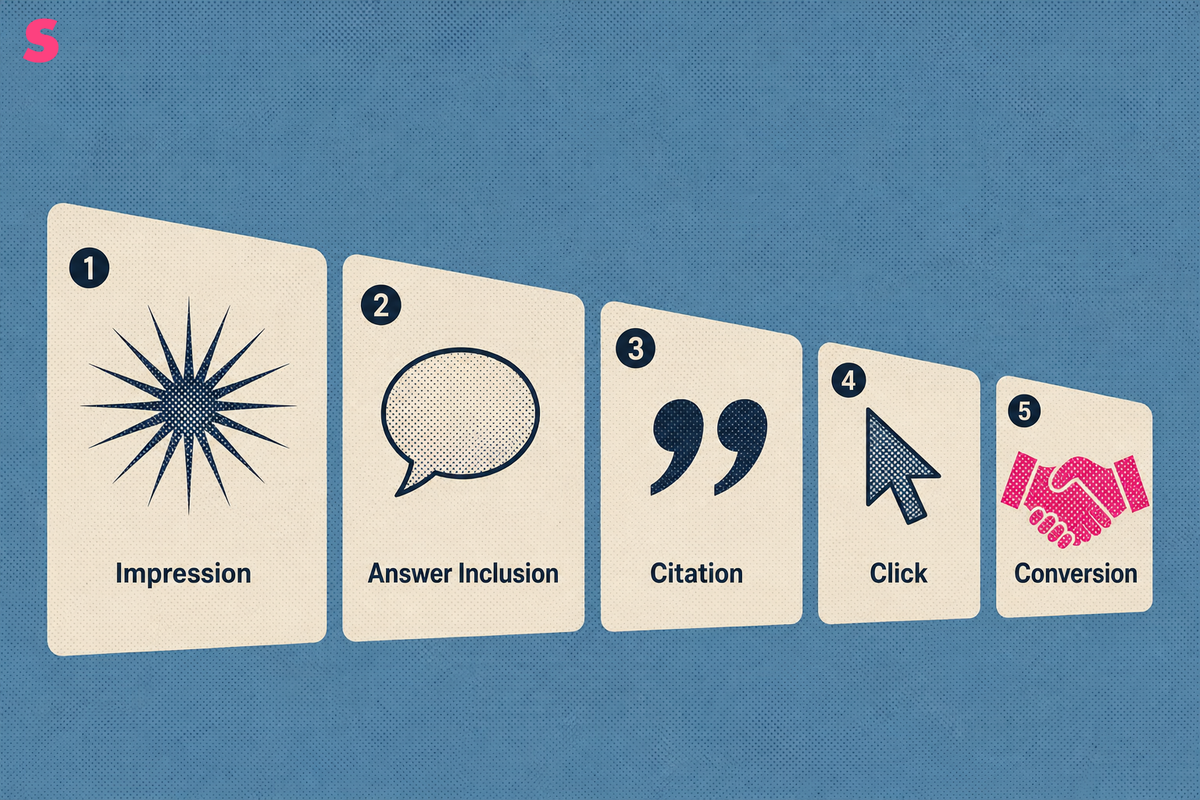
The bottom of the funnel is the conversion stage where prospects become paying customers through decision-making activity, per the October 2026 listing. An AI-search funnel has five stages, impression, answer inclusion, citation, click, and conversion, per the 2026-02-15 listing. For revenue teams, the chain continues through qualified pipeline and closed-won revenue.
Consider a buyer who asks an answer engine for alternatives to a named tool. The answer cites a comparison page, the buyer opens that page, finds the claim supported by clear criteria, and books a demo. The page did more than earn a mention. It gave a decision-stage buyer a credible next action.
Sona AI Visibility connects citations to pipeline and revenue on one account timeline, and tracks which AI crawlers reach pages. A citation is an intermediate event, while pipeline is the business outcome.
Why do bottom-of-funnel pages matter more when AI answers replace clicks?
Bottom-of-funnel pages matter because AI answers can reduce click volume while concentrating remaining visits among buyers already evaluating a purchase. Search Engine Land states that, as AI answers replace clicks, decision-stage content becomes more valuable for conversion despite lower overall traffic volume.
Alternatives, comparison, pricing, and integration pages reportedly drive 40–60% of organic SaaS conversions, per the 2026-09-21 listing. Nathanojaokomo.com reports that comparison pages drive more revenue despite receiving less traffic than other bottom-of-funnel content types. Traffic without decision context does not advance a pipeline target.
Educational content remains necessary. A conversion-focused content strategy needs top-, middle-, and bottom-funnel content to meet buyers at each stage, per the October 2026 listing. Bottom-of-funnel work converts demand created through earlier content, referrals, sales outreach, and category awareness.
Measure decision-stage pages by qualified actions, qualified pipeline, and revenue, not sessions alone.
What is bottom-of-funnel LLM optimization not, and how does it differ from ordinary SEO?
Bottom-of-funnel LLM optimization is not mention counting, top-of-funnel visibility tracking, prompt stuffing, or a replacement for the rest of the funnel. Its unit of success is a prompt-to-revenue chain, not a rank position or brand appearance.
The work overlaps with ordinary SEO. Crawlability, descriptive headings, third-party authority, server-rendered HTML, structured data, canonical tags, and bot access help systems retrieve and interpret a page. These controls are necessary technical foundations, not the conversion strategy.
Visibility does not equal revenue. A brand can appear in an answer without receiving a click, lead, or pipeline. Sona AI Visibility treats AI search as a measurable channel by connecting AI citations and AI-referred visits to accounts, pipeline, and closed-won revenue rather than treating a mention as the endpoint.
Prompt stuffing fails for the same reason keyword stuffing fails. A decision-stage page needs direct evidence, clear scope, current commercial details, and an action that matches the buyer’s question. Repeated phrases do not resolve pricing, implementation, security, or integration concerns.
Which buyer prompts signal purchase intent, and how many should you track?
Buyer prompts about pricing, comparisons, alternatives, integrations, security, implementation, ROI, demos, and where to buy signal strong purchase intent. Facebook.com identifies ROI justifications, demos, pricing, and where to buy as bottom-funnel prompt themes.
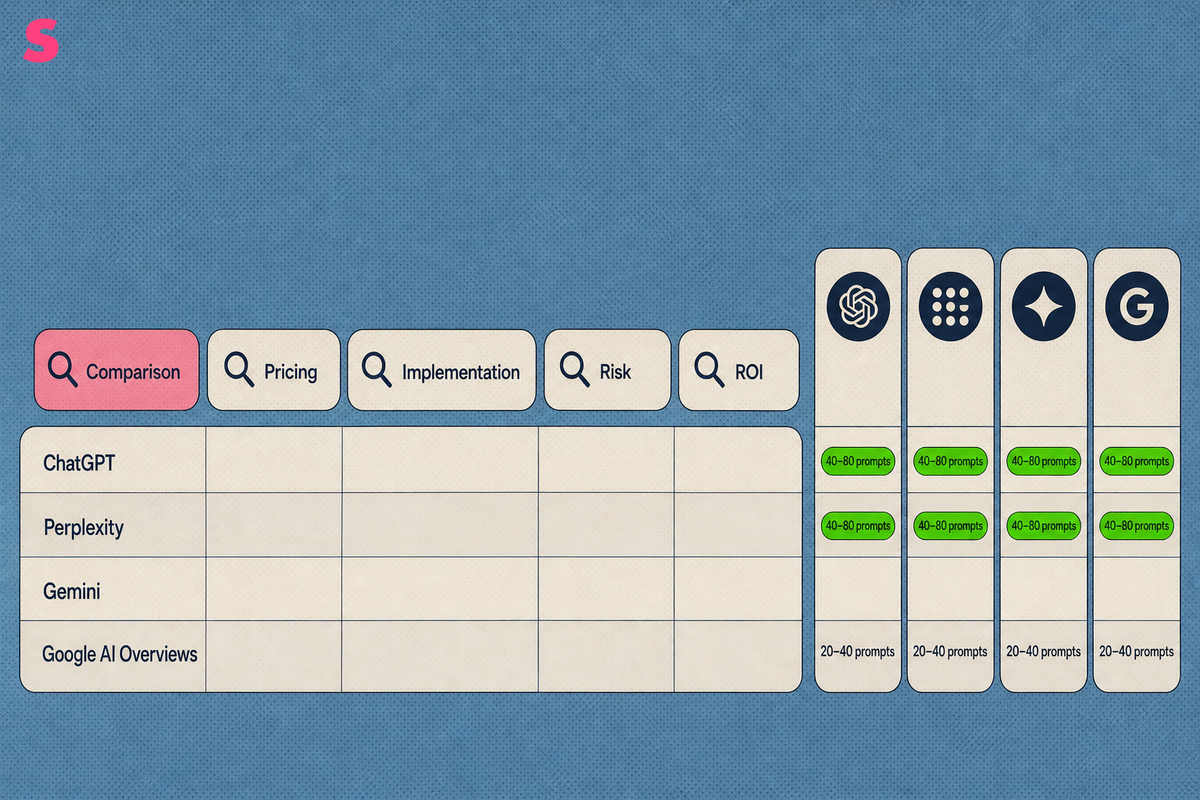
A practical baseline contains 40–80 real buyer prompts across category, comparison, alternative, and use-case queries, per the 2026-05-15 listing. Another starting range is 20–40 prompts across discovery, comparison, implementation, pricing, and risk, per the 2026-10-11 listing. Start with the narrower set when ownership is unclear, then expand from observed sales questions.
- Comparison: “What are alternatives to [category or vendor]?”
- Pricing: “How much does [product category] cost?”
- Implementation: “How does [product] integrate with [system]?”
- Risk: “What security documentation does [product] provide?”
- ROI: “How do teams justify investment in [product category]?”
Track at least four answer environments, ChatGPT, Perplexity, Gemini, and Google AI Overviews, per the 2026-05-15 listing. ChatGPT, Perplexity, and Gemini generate AI answers. Google AI Overviews is Google’s search feature.
One result is not a benchmark. Answers vary by model, geography, user context, and wording. Compare repeated prompt runs over a consistent review window, then define trend thresholds from the company’s own observed variance. Review the resulting log monthly for content and positioning decisions.
Which bottom-of-funnel content formats do LLMs cite, and at which buyer stage?
Comparison, alternatives, pricing, buying-guide, integration, case-study, and security or implementation pages are core bottom-of-funnel content formats for AI discovery. Citation likelihood in the table is an editorial judgment based on how directly each format answers a decision-stage prompt, not a measured statistic.
| Format name | LLM citation likelihood | Ideal buyer stage | Example implementation |
|---|---|---|---|
| Comparison page | High, because it answers vendor-evaluation prompts directly | Decision | Define evaluation criteria, pricing assumptions, evidence, and limitations. |
| Alternatives page | High, because buyers use alternative queries to narrow a shortlist | Consideration to decision | Explain which operating requirements make each option relevant. |
| Pricing page | High, because price and packaging resolve a purchase objection | Decision to purchase | State current plans, inclusions, billing assumptions, and next steps. |
| Buying guide | High, because it helps buyers select among plans or options | Decision to purchase | State the intended buyer, decision criteria, option differences, cost drivers, limitations, recommendation conditions, and next action. |
| Integration page | Medium to high, because technical fit affects vendor selection | Decision | Document workflows, implementation requirements, and supported systems. |
| Case study | Medium, because evidence supports claims made elsewhere | Consideration to decision | Describe the customer problem, implementation context, and outcome evidence. |
| Security and implementation documentation | Medium to high, because risk review can block a purchase | Decision to purchase | Publish security, onboarding, deployment, and ownership details. |
Case studies and social proof give buyers evidence beyond vendor claims. Trials, demos, how-to guides, personalized outreach, and social proof are also standard bottom-of-funnel tactics, per the October 2026 listing.
The strongest format resolves the buyer’s immediate objection. A pricing page cannot answer an implementation question, and an integration page cannot substitute for a credible comparison.
How do you structure comparison and pricing pages so an LLM can extract them?
1. Target comparison and alternatives queries with extractable decision-stage answers. A comparison or pricing page should restate the buyer’s question in a precise heading, then answer it in a short block with criteria, evidence, scope, and a next action.
Illustrative weak version: a paragraph says a platform is powerful, flexible, and built for modern teams. Illustrative extractable version: a heading asks which platform supports the stated workflow, followed by a 40–60 word answer that explains relevant capabilities, pricing assumptions, implementation scope, and evidence. Extractable answer blocks are typically 40–60 words, per the 2026-09-21 listing.
Use concrete claims, such as uptime, time-to-value, or integration count, rather than vague adjectives, per the 2026-10-02 listing. That listing provides no fixed benchmark for those metrics. State only figures the company can substantiate.
Vendor-authored comparison pages can look biased. Address that concern by publishing the intended buyer, decision criteria, plan or option differences, inclusions and exclusions, cost drivers, limitations, recommendation conditions, and next action. Keep pricing and integration details current in server-rendered HTML so answer engines and buyers encounter the same decision-stage information.
How should a landing page change for visitors arriving from an AI answer?
2. Rebuild landing pages for AI-informed visitors. An AI-referred buyer should land on the page that matches the claim cited in the answer, not a generic homepage that requires another round of navigation and interpretation.
Illustrative before: an answer cites a product’s integration capability, but the citation leads to the homepage. Illustrative after: the citation leads to an integration page that repeats the cited claim and presents customer evidence, security documentation, third-party reviews, integration details, implementation information, and a relevant conversion action.
A low-friction demo form can contain three fields, name, work email, and company, per the 2026-05-11 listing. Fewer fields can increase completion, but qualification work shifts to sales or enrichment. Measure qualified-lead rate alongside form submissions.
A focused initial implementation contains three deliverables, one comparison page, one landing-page rebuild, and one third-party citation target, per the 2026-05-11 listing. Sona AI Visibility can connect an AI-referred visit to the likely prompt behind that visit, helping teams align the destination page with the buyer question.
How do you seed the third-party sources LLMs cite at decision time?
3. Seed third-party sources that answer engines already cite for decision-stage questions. Run the documented prompt set, record the cited domains for comparison and alternatives prompts, and select one citation target where the brand’s evidence belongs.
- Run comparison, alternatives, pricing, integration, security, and ROI prompts across the selected answer environments.
- Record cited domains, cited pages, and the specific claim each source supports.
- Select one third-party citation target that serves the buyer’s decision question.
- Publish accurate evidence through the appropriate editorial or partner process.
- Re-run the same prompt list daily and review citation patterns monthly.
Illustrative workflow: a decision-stage answer cites only third-party pages that omit a brand. After the brand supplies accurate information to one relevant citation target, the team re-tests the same prompt set and records whether the cited source mix changes. The workflow creates a repeatable observation method without presuming a result.
Sona AI Visibility helps teams identify the prompts and sources associated with AI answers, while Sona Marketing Measurement provides the attribution foundation for evaluating downstream outcomes. The commercial question is which cited sources contribute to qualified buyer journeys.
What does conversion data for LLM traffic show, and how do you measure it yourself?
Published conversion lifts are directionally useful, but they are not an evidence-backed benchmark without a defined cohort, measurement period, conversion event, conversion count, AI-referred session count, qualified-lead rate, pipeline per session, comparison cohort, and sample limitations. No approved original cohort data is available for publication in this article.
Linkedin.com states that LLM search traffic converts 3–5x better than traditional search traffic. A separate October 2026 listing states that LLM traffic converts at 4.4x the rate of other funnel traffic in B2B contexts. Neither claim discloses a sample size, methodology, or conversion definition, so treat both figures as hypotheses rather than benchmarks.
Referrer data that passes through analytics may represent 50–70% of total AI traffic, per the 2026-06-05 listing, while remaining influence requires self-reported attribution and conversion-quality analysis.
| Stage | Metric | Where it is read |
|---|---|---|
| Inclusion | Brand appearance for a tracked prompt | Prompt-run log |
| Citation | Cited page and cited source | Answer capture and source record |
| Click | AI-referred sessions | Analytics referrer data |
| Landing-page conversion | Demo, trial, or form conversion rate | Analytics and form records |
| Qualified pipeline | Qualified-lead rate and pipeline per session | CRM and attribution records |
| Revenue | Closed-won revenue by AI-referred cohort | CRM and revenue records |
Build an internal benchmark by comparing conversion rate, qualified-lead rate, and pipeline per session for AI-referred visitors against other cohorts. Use referrer data alongside a how-did-you-hear-about-us field, then assess whether the cohort produces qualified pipeline and revenue rather than form volume alone.
Monitoring which AI answers mention a brand is only half the job. Sona AI Visibility, through AI Attribution, connects AI citations and prompts to accounts, pipeline, and revenue on one account timeline, while Agent Analytics tracks AI crawler and agent activity. Mention tracking is the baseline, not proof of commercial impact.
What are the frequently asked questions?
Do visitors from LLMs really convert better than traditional search visitors?
Reported lifts include 3–5x better conversion for LLM search traffic than traditional search traffic, per linkedin.com, and 4.4x the rate of other funnel traffic in B2B contexts, per the October 2026 listing. Neither source provides a sample size or method, so treat both as hypotheses and measure AI-referred conversion quality on your own traffic.
How many buyer prompts should a baseline include?
A starting range is 20–40 buyer prompts across discovery, comparison, implementation, pricing, and risk, per the 2026-10-11 listing. A fuller baseline contains 40–80 real buyer prompts across category, comparison, alternative, and use-case queries, per the 2026-05-15 listing.
Which AI answer environments should be tracked?
Track at least four answer environments, ChatGPT, Perplexity, Gemini, and Google AI Overviews, per the 2026-05-15 listing. Each environment can cite different pages for the same buyer prompt, so one environment does not represent the full decision journey.
Can one test of an AI answer be trusted as a benchmark?
No. AI answers vary by model, geography, user context, and prompt wording. Run the same prompt list daily, then review trends monthly rather than treating one answer capture as a durable benchmark.
Should a demo form be cut to three fields?
A three-field form, name, work email, and company, can reduce friction, per the 2026-05-11 listing. It can also shift qualification work to sales or enrichment, so assess qualified-lead rate and pipeline quality alongside submission volume.
Do vendor-written comparison pages hurt trust?
They can look biased when they rely on unsupported claims or omit meaningful trade-offs. State evaluation criteria, pricing assumptions, limitations, and evidence so buyers and answer engines can assess the comparison on its merits.
Summarize this article with AI: ChatGPT · Claude · Perplexity · Google AI Mode
Last updated: October 2026