AI speeds up keyword research by expanding a seed topic into hundreds of variants, grouping them into clusters by problem and buying stage, and labelling likely intent in minutes rather than days. What it does not do is prove demand: volume, difficulty, click potential and SERP evidence still come from a keyword database. Treat generated terms as hypotheses, validate every cluster against real data, and keep the decision about what to publish with a human.
What is AI keyword research, and what does it actually produce?
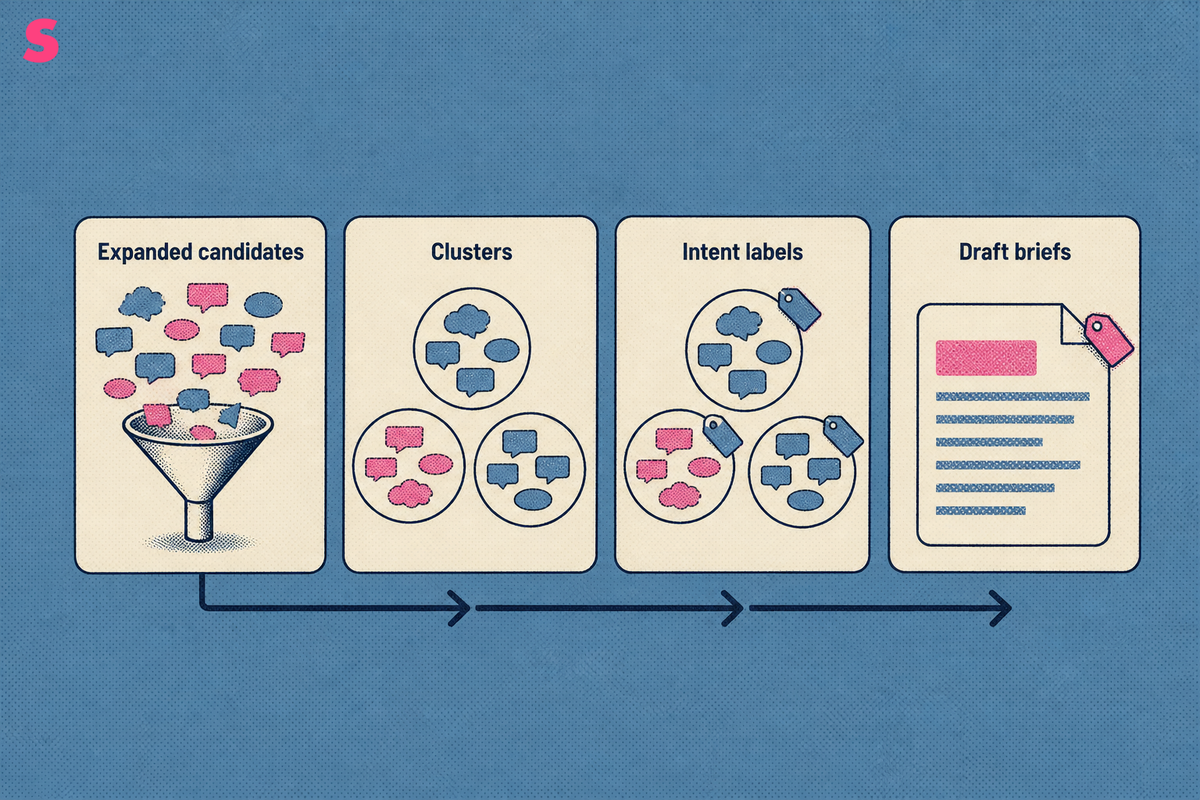
AI keyword research is the use of a language model to generate, expand, cluster and label keyword candidates, which a human then validates against a keyword database. The model produces hypotheses. The database produces evidence. One does not substitute for the other.
The output of an AI pass is not a ranked list with volume attached. It is raw material. A typical pass returns four things:
- Expanded candidates: dozens to hundreds of phrasings built from a handful of seeds, including conversational and multi-constraint forms.
- Clusters: those candidates grouped by the problem behind them rather than by shared tokens.
- Intent labels: each cluster tagged commercial, informational, transactional or navigational.
- Draft briefs: a suggested angle, page type and heading set per cluster.
None of that carries a reliable demand figure. A language model generates text that resembles keyword data; it does not query a clickstream panel or a search engine index. Any volume number it emits is a guess dressed as a metric, which is why the validation step is not optional.
AI moves the bottleneck. Generating candidates used to be the slow part of planning and is now fast, so the constraint shifts to judgment: deciding which clusters the business can realistically win and which pages should own them.
Why use AI for keyword research instead of a manual seed-and-filter workflow?
Because a manual seed-and-filter workflow is bounded by the vocabulary of the person doing it, and a language model is not. A marketer seeds a tool with terms they already know. The model proposes phrasings nobody on the team would have typed.
Four benefits hold up in practice for a B2B SaaS team:
- Speed: expansion and clustering that used to take a long manual sorting session finish in a single pass.
- Discovery: semantic expansion surfaces problem-phrased queries that share no keyword with the seed.
- First-pass intent: every cluster arrives labelled, so the editorial calendar can be balanced before anyone writes.
- Planning leverage: clusters map to pages and briefs directly, rather than to a flat list someone still has to interpret.
Manual-only workflows carry a specific cost in B2B. Category-defining products have thin, fragmented demand: buyers describe the problem a dozen ways before they learn the vendor's term for it. A seed-and-filter pass anchored on the product name finds only the sliver of demand that already knows the category and misses the rest.
The limit matters as much as the benefit. AI widens the funnel of candidates. It does not tell you which candidate is worth a page.
Which keyword research tasks can AI automate, and which still need a human?
AI reliably automates expansion, clustering and first-pass intent labelling. It does not reliably produce demand data, read a SERP, or judge whether a term matches what the product sells. The split is clean enough to delegate against.
| Task | What AI does well | What still needs a human | Risk if left unchecked |
|---|---|---|---|
| Keyword expansion | Generates hundreds of phrasings from a few seeds, including conversational forms | Removing terms outside the product's scope | A list padded with adjacent categories the business cannot serve |
| Clustering | Groups candidates by underlying problem, not shared tokens | Deciding where one page ends and the next begins | Two thin pages competing for the same query |
| Intent classification | Labels commercial, informational, transactional and navigational at scale | Reviewing low-confidence labels by hand | A calendar weighted to awareness content with no decision-stage pages |
| Competitor-gap analysis | Summarises which topics a rival covers and which angles are absent | Verifying the gap exists in the index, not just in the summary | Writing against a gap that was never real |
| Volume and difficulty | Nothing: this is database work | Pulling every figure from a keyword database | Fabricated numbers entering the plan as fact |
| Prioritisation | Proposes an order based on stated criteria | Weighing winnability against commercial value and sales input | Build order set by volume alone |
Prioritisation is where teams lose the most value by over-delegating. A high-intent term you cannot realistically rank for this quarter is worth less today than a slightly lower-intent one where the site already sits on page two. That trade-off needs a view of the site's current authority, and a model working from a prompt has none.
How does AI surface long-tail and conversational queries that a seed list misses?
AI surfaces long-tail queries by working on meaning rather than string matching. A keyword tool expands "marketing attribution software" into variants containing those words. A language model expands it into the questions a buyer asks before they know the category name, which frequently share no token with the seed.
Here is the mechanism on one seed. Take marketing attribution software and ask for problem-phrased queries a mid-market demand gen lead would use. The output clusters into three distinct shapes:
- Symptom cluster: "why is our direct traffic growing with no campaign behind it", "how do we explain unattributed sessions to the board". No shared keyword with the seed, same buying problem.
- Evaluation cluster: "best attribution software for B2B SaaS", "multi-touch versus last-click attribution for long sales cycles". Commercial intent, decision stage.
- Implementation cluster: "how to set up multi-touch attribution without a data team", "what does identity resolution mean in attribution". Informational, but asked by someone already shopping.
The symptom cluster is the one a seed-and-filter workflow almost never reaches, and it is often the one that converts, because it catches the buyer at the moment the problem is felt rather than at the moment a category is named.
Generate conversational phrasing on purpose. Queries typed into a search box average a few words; questions put to an AI engine run longer and carry constraints, which changes which page answers them well.
Can AI classify search intent accurately enough to plan content?
Yes, for a first pass, provided the taxonomy is small and the low-confidence labels get reviewed. Four values are enough for an editorial calendar: commercial (comparing or choosing a vendor), informational (learning a concept), transactional (ready to sign up or buy), and navigational (looking for a specific brand's own site or docs).
The accuracy bar is lower than people assume, because the decision the label drives is coarse. An intent label picks the page type and the depth of product mention. Getting most clusters right is enough to build a balanced quarter, and the mislabelled ones surface the moment an editor reads the brief.
Confidence is what makes the labels usable rather than merely present. Sona AI Visibility attaches an intent value, a buying stage and an intent confidence percentage to each tracked prompt, so a low-confidence classification is a row to read by hand and a high-confidence one is not. Any labelling workflow benefits from the same discipline: sort by confidence and review the bottom of the list.
Intent and buying stage answer different questions. Intent says what the person is trying to do. Buying stage says how close they are to a purchase, across awareness, consideration, decision and purchase. A calendar needs both axes, because full coverage of commercial intent at the awareness stage still leaves the decision-stage comparison pages unwritten.
How do you validate AI-generated keywords before writing anything?
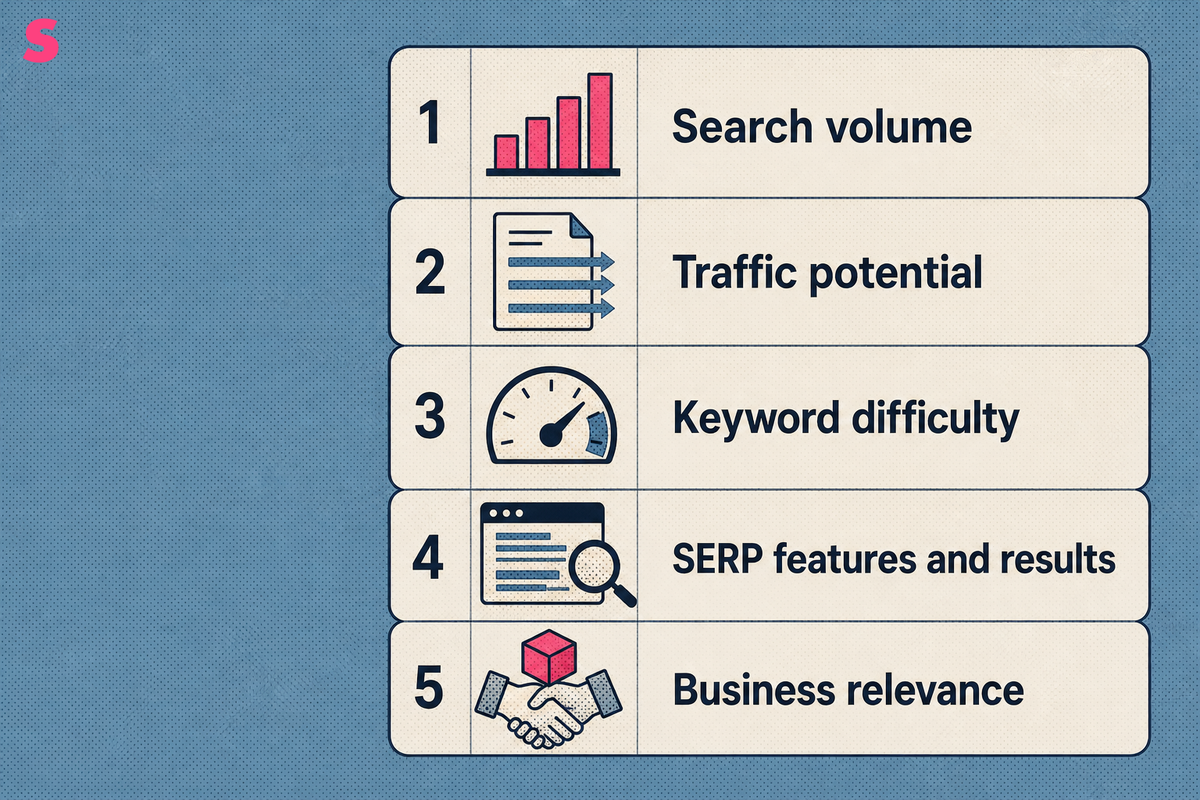
Validate by pulling every number from a keyword database and every SERP judgment from the live results page. The model's job ended when it produced the candidate. Five checks, in order:
- Search volume: confirm the term is recorded at all. Zero-volume candidates are not disqualified, but they become bets rather than forecasts.
- Traffic potential: check what the top-ranking page actually receives across all its terms, not what the single keyword reports.
- Keyword difficulty: read it against the site's current position, not in the abstract.
- SERP features and results: open the page. If the results are all documentation, or all vendor directories, the query means something other than what the label says.
- Business relevance: can the product be mentioned on this page without strain? If not, the cluster is traffic, not pipeline.
The common objection is fair: volume and difficulty still matter more than generation. A long list of candidates costs almost nothing and is worth almost nothing on its own. The value sits in the filter, and the filter runs on data a language model cannot produce.
A scoring rule keeps the list honest. Rank each validated cluster on commercial intent, winnability and demand, then build in that order. Winnability is the component teams skip and the one that determines whether anything published this quarter ranks.
What are the risks of trusting AI keyword output without checking it?
The main risk is plausibility. AI keyword output is fluent, well-formatted and internally consistent, which makes a bad list look exactly like a good one. Four failure modes account for most of the damage:
- Hallucinated keywords: grammatically perfect phrases nobody searches. Caught by a volume lookup, missed by a review that only reads for sense.
- Invented volume and difficulty figures: numbers generated to fit the shape of the request rather than retrieved from a panel or an index.
- Near-duplicate suggestions: a cluster that looks large but is really a handful of ideas restated in several phrasings each, which inflates the apparent size of an opportunity.
- Anchoring: the team adopts the model's framing of the category and stops asking sales what buyers actually say.
Duplicates deserve a specific guard. Before a cluster goes to the calendar, deduplicate on meaning rather than string, then count the distinct pages the cluster implies. A long cluster that collapses to two pages was never a large opportunity.
The quiet risk is volume. AI makes it easy to produce more plans than a team can execute, and a backlog bigger than the content function can ship is not an asset. Cap the list at executable capacity, then re-run the pass next quarter with fresher data.
How is keyword research different from tracking the prompts behind AI answers?
Keyword research tells you what people type into a search box. Prompt tracking tells you what an answer engine says when they ask the same thing in conversation, and whether your pages are cited in the response. Two different datasets, neither a substitute for the other.
The gap is measurable. Search volume is not prompt volume, and inferring one from the other is a decent but imperfect proxy: conversational and comparison questions are over-represented in real AI usage, so those clusters are systematically under-counted in a keyword database. Sona's AI visibility archive covers eight answer surfaces, ChatGPT, Google AI Overviews, Perplexity, Google AI Mode, Gemini, Mistral, Qwen and Claude, per Sona's own AI visibility data, September 2026.
A single brand-level visibility score is a dated snapshot, not a work item. What a team can act on is prompt-level: which prompts return your pages, in what position, and which sources the engine cited to build each answer. Sona AI Visibility reports at that level, and the comparable series of those readings over time is what shows whether a change held or was noise.
Cadence follows from that. Run the prompt list daily, not weekly. An engine's answer to the same question shifts with the retrieval index, a model update and whatever a competitor published last week, so a sustained change across consecutive runs is a trend and a one-day spike is not. A daily run surfaces a pattern that a weekly snapshot averages away.
Most prompt trackers stop at whether a brand was mentioned. Sona connects those citations and the AI-referred visits that follow to pipeline and revenue on one account timeline, and Intent Signals infers the likely prompt behind each visit and tags it to a buying stage, so the question becomes which account asked rather than how many answers mentioned you.
What does a repeatable AI keyword research workflow look like, and what do the tools cost?
The workflow is human-in-the-loop and runs in five steps. Keep the model on steps one and two, and keep people on the rest.
- Discovery: expand seeds into candidates and cluster them by problem.
- Validation: pull volume, difficulty and click potential from a keyword database.
- SERP review: open the results for every cluster you intend to build.
- Prioritisation: score on commercial intent, winnability and demand, then cut to what the team can ship.
- Editorial mapping: assign one page per cluster, tag each with a buying stage, and note which prompts it should answer.
On cost, budget two separate categories rather than one tool. Prompt tracking is the optional second category and answers a different question from keyword research: Sona AI Visibility covers that side from $75 per month for brands billed annually, with a 14-day free trial and no credit card, and connects the citations it finds to pipeline and revenue rather than stopping at mention counts.
The keyword database is the other category, and usually the larger line, because validation depends on it. upwork.com listed Semrush's core SEO plan at $139 per month on August 5, 2025, or $117.33 per month on annual billing, with Ahrefs at $129 per month on that same date. memeburn.com, on August 9, 2026, named Ahrefs the strongest keyword-research pick among the AI SEO tools it tested, citing its keyword and backlink database plus AI-powered keyword forecasting. Published prices move, so read each vendor's current page before committing a budget.
Frequently Asked Questions
Does AI keyword research replace an SEO specialist?
No. AI automates expansion, clustering and first-pass intent labelling, which is the mechanical part. A specialist still reads the SERP, judges whether a term matches what the product sells, weighs winnability against the site's current authority, and decides what the business publishes. Delegating that second set is where plans go wrong.
Can AI estimate search volume on its own?
Treat any volume figure a language model produces as unverified. Models generate text that fits the shape of a metric; they do not query a clickstream panel or an index. Pull volume, keyword difficulty and click potential from a keyword database before a cluster goes onto the calendar, and discard the model's numbers entirely.
How much do AI keyword research tools cost?
Plan for two line items. Sona AI Visibility starts at $75 per month for brands billed annually with a 14-day free trial and covers the prompt-tracking side. A keyword database is the separate spend that makes validation possible: upwork.com listed Semrush's core SEO plan at $139 per month on August 5, 2025, or $117.33 per month on annual billing, and Ahrefs at $129 per month on that date.
Can AI find keywords for a product category that barely has search demand yet?
It can generate plausible phrasings customers might use, which is genuinely useful in an emerging category. Low or zero recorded volume means those terms are hypotheses, not forecasts. Test them with sales conversations, support tickets and small content bets, then revisit the volume data a quarter later.
Should AI-generated clusters map to buying stages or to topics?
Map to both. Cluster by the problem the reader is trying to solve, then tag each cluster with a buying stage: awareness, consideration, decision or purchase. Topic clustering decides what the page covers; stage tagging makes sure the calendar deliberately includes late-stage comparison queries, not only early research questions.
Is AI keyword research the same as optimizing for answer engines?
No. Keyword research tells you what people type into a search box. Answer engine optimization (AEO) concerns whether ChatGPT, Perplexity and Google AI Overviews cite your pages when they answer those questions. The first produces a content plan; the second is measured in citations, AI-referred visits and the pipeline behind them.
Summarize this article with AI: ChatGPT · Claude · Perplexity · Google AI Mode
Last updated: October 2026