


Perplexity is a search-first research tool that answers with visible citations across several models; Gemini is a general assistant built into Google's apps with very large context windows on its top models. Compare them per seat per month rather than by tier name: Perplexity Pro is commonly listed at $20/month, and Google AI Pro at $21 per seat per month. Pick Perplexity for traceable external research, Gemini for document-heavy and multimodal work inside Google's tools, and verify quotas on each plan page, because they change often.
What actually separates Perplexity from Gemini?
Perplexity is a citation-first research interface. Gemini is a Google-native assistant. That single difference decides most of the comparison: Perplexity returns an answer with its sources attached as the default output shape, while Gemini already sits inside the documents, mail and spreadsheets where the work lands.
The practical consequence is where verification effort falls. A Perplexity answer hands the reader a reference list, so checking a claim is a click. A Gemini answer arrives in the surface where it will be used, so the editing loop is shorter and the sourcing trail is thinner.
Neither is a general-purpose replacement for the other. Treat Perplexity as external research tooling and Gemini as internal productivity tooling, then buy against those two jobs rather than against a feature list.
| Dimension | Perplexity | Gemini | Why it decides the choice |
|---|---|---|---|
| Default answer shape | Answer with source references attached | Answer produced inside a Google surface | Determines how much verification work falls on the reader |
| Where the work happens | Standalone research interface and browser agent | Docs, Gmail, Sheets and the Google account | Drives integration cost and adoption friction |
| Published context ceiling | Approximately 128,000 tokens | Up to 1 million tokens on Gemini 2.5 Pro | Model- and plan-dependent, not a product-wide property |
| Entry paid seat | $20 per month (Pro) | $21 per seat per month (Google AI Pro) | Near parity, so price rarely settles the decision |
| Reported first-token latency | Not published | 0.21–0.37 seconds on Gemini 2.5 Flash | Matters for interactive drafting, not for deep research |
How do Perplexity and Gemini plans compare per seat per month?
At the entry tier the two are within a dollar of each other. Perplexity Pro is commonly listed at $20 per month or $200 per year, covering advanced searches, multiple models, file uploads and expanded research features, per gizmotimes.com, July 29, 2026. Google's subscription page lists Google AI Pro at $21 per seat per month and a business-oriented tier at $30 per seat per month, per gemini.google, updated September 24, 2026.
Divergence appears above the entry tier. Perplexity publishes a wide enterprise ladder with metered allowances, so seat cost scales with research volume rather than with headcount alone. Check both vendors' pages before signing, because packaging and plan names on subscriptions of this kind change quickly.
| Plan | Platform | Listed monthly | Listed annual | Published allowance |
|---|---|---|---|---|
| Free | Perplexity | $0 | $0 | 3 Pro Searches per day |
| Pro | Perplexity | $20 | $200 | Advanced searches, multiple models, file uploads |
| Max | Perplexity | $200 | $2,000 | Web-app version |
| Enterprise Pro | Perplexity | $40 per seat | $400 per seat | 400 Pro Searches/week, 50 Research queries/month, 80 Browser Agent queries/month |
| Enterprise Max | Perplexity | $325 per seat | $3,250 per seat | 4,000 Pro Searches/week, 500 Research queries/month, 800 Browser Agent queries/month, 5,000 files per project |
| Google AI Pro | $21 per seat | Not published | Not published | |
| Business tier | $30 per seat | Not published | Not published |
Which platform handles long documents and large context better?
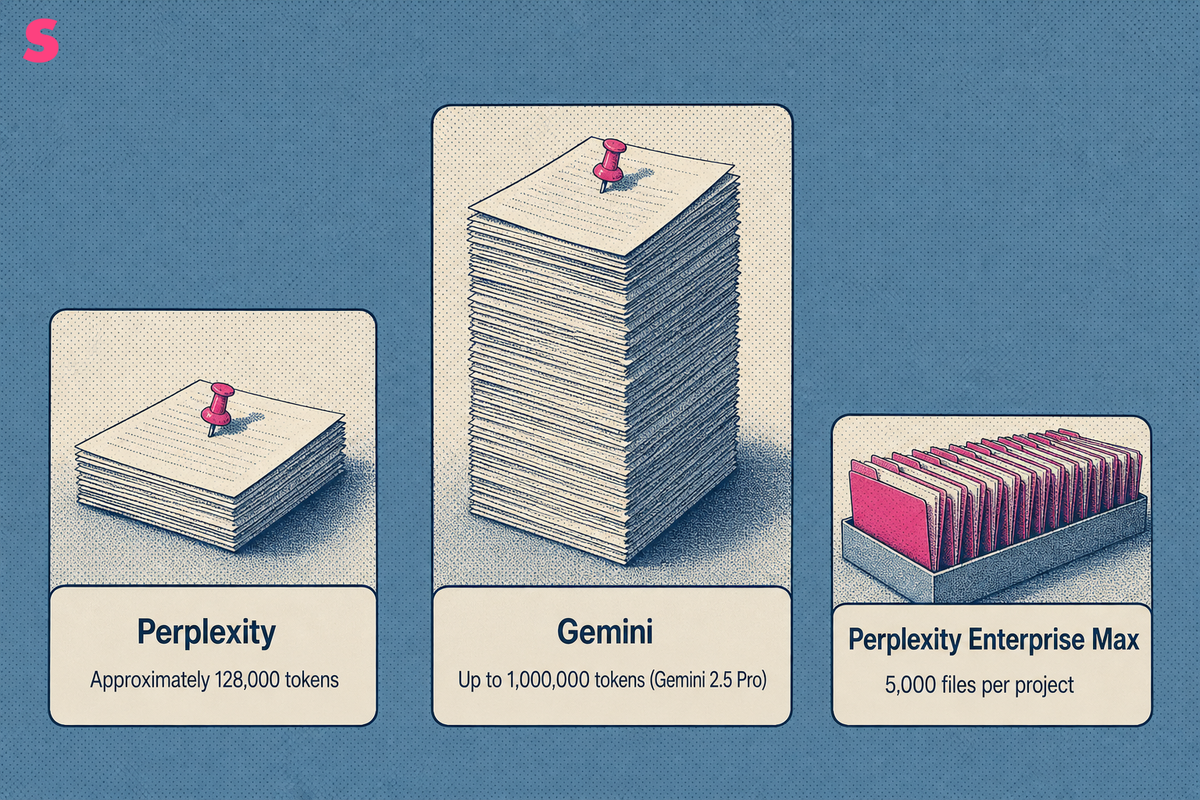
Gemini carries the larger cited context ceiling, and Perplexity's cited figure sits well below it. That is a real gap for single-pass reasoning over one very long document: a full contract, a transcript set, a regulatory filing.
A headline context ceiling belongs to a specific model on a specific plan, not to the product as a whole, and the figures are not reported consistently across sources. Confirm the ceiling for the exact model your seats can select, because model access differs by tier.
Corpus size is a separate axis from context window, and Perplexity competes there instead. Its upper enterprise tier supports a larger file repository, both per project and per user, which is retrieval across a large library rather than a single long read. Ask which problem you actually have:
- One enormous document to reason over end to end favours the larger context ceiling, which Gemini reports.
- Thousands of documents to search and cite favours the larger repository, which Perplexity's upper enterprise tier supports.
- Latency-sensitive drafting favours a fast model tier over a large-context one, so compare first-token speed rather than context size.
Which tool makes it easier to verify sources in B2B research?
Perplexity exposes references by default, so verification is a click rather than a follow-up request. That matters when an analyst has to show where a market-size number or a competitor claim originated. The available benchmarks do not prove those citations are more authoritative or more complete than what Gemini surfaces: reported figures of 0.773 for Sonar and 0.858 for Sonar Pro on the SimpleQA F-score, per tech-insider.org, August 22, 2026, measure short-answer factuality, and that report is secondary rather than an official benchmark publication.
The same comparison reports 92% SimpleQA accuracy for Perplexity's search API at $0.052 per request in a Parallel.ai benchmark, per tech-insider.org, August 22, 2026. Read it narrowly. Short-answer accuracy on isolated questions says nothing about whether the cited sources are authoritative, current, or the ones a buyer would accept.
Gemini remains strong for research that feeds directly into a deliverable, because the output lands in the document. The trade is traceability: fewer references to check, and more editorial judgment required before a claim leaves the building.
Most evaluations of answer quality stop at whether the fact was right. Sona AI Visibility tracks which sources those answers cite and connects the resulting visits to pipeline and revenue, so citation patterns become a measurable input rather than an impression.
How do their business integrations and capacity allowances compare?
The published evidence supports a comparison of integration effort and capacity allowances, not a finished security verdict. On integration, Gemini's advantage is administrative gravity. A team already running Google accounts adds a business-oriented tier at $30 per seat per month, per gemini.google, updated September 24, 2026, and inherits the identity, sharing and device controls already in place. Integration cost is close to zero.
Perplexity's enterprise story is metered capacity. Its enterprise tiers publish weekly Pro Search allowances alongside monthly Research and Browser Agent query limits, with the upper tier materially larger on each of them. Those allowances are the real planning lever, because capacity is bought per seat rather than per department.
Security and data handling remain due-diligence questions rather than a settled comparison. Run procurement against five of them, in this order:
- Data handling: what leaves your tenancy, and where is it retained?
- Auditability: can an administrator reconstruct who asked what, and when?
- Source traceability: can a published claim be traced back to a retrievable source?
- Integration cost: how many systems need new connections, identity mappings or tagging work?
- Seat metering: does the allowance match how heavily your analysts actually query?
Which workflows suit Perplexity and which suit Gemini?
Match the tool to the job. Perplexity suits work that starts outside your walls and must be sourced: market scans, competitive tracking, vendor evaluation, analyst-style briefs. Gemini suits work that starts inside your walls and must be produced: drafting, summarising internal threads, spreadsheet manipulation, meeting follow-ups.
Coding and customer support split less cleanly, and both platforms are used for each. The deciding question is where the context already lives. If the relevant knowledge sits in your own documents, the Google-native option removes copy-paste. If it sits on the public web, the citation-first option removes verification work.
| Workflow | Better fit | Why | What to watch |
|---|---|---|---|
| Market and competitor research | Perplexity | Sources arrive with the answer | Research query allowances on enterprise seats |
| Content creation | Gemini | Output lands in the document being written | Thin sourcing on factual claims |
| Data analysis | Gemini | Native spreadsheet surface | Model access differs by plan |
| Long-document review | Gemini | Up to 1 million tokens on Gemini 2.5 Pro | Ceiling is model-dependent |
| Large file libraries | Perplexity | Enterprise Max lists 5,000 files per project | Retrieval quality across a big corpus |
| Customer support drafting | Either | Both draft competently from supplied context | Where the support knowledge base actually sits |
How should a team run its own head-to-head test before buying?
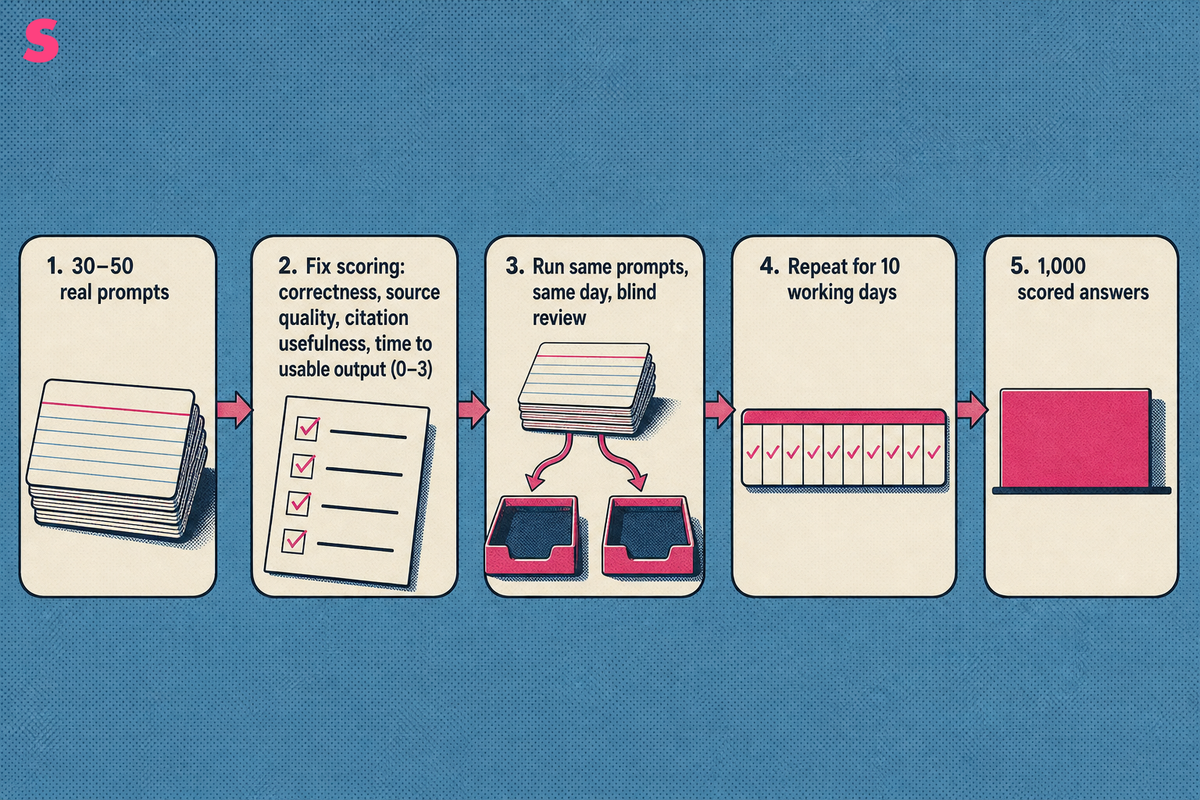
Build a prompt set from your own buyer questions and score it on a fixed rule. Published comparisons test general factuality on generic questions, which says almost nothing about whether either tool answers the questions your analysts ask on a Tuesday afternoon.
A workable protocol takes two weeks and one reviewer:
- Write 30 to 50 real prompts, drawn from actual research requests rather than benchmark trivia.
- Fix the scoring rule first: correctness, source quality, citation usefulness and time to usable output, each scored 0 to 3.
- Run the identical prompt set on both platforms on the same day, with the reviewer blind to which tool produced which answer.
- Repeat the run daily for ten working days. Fifty prompts across two tools over ten days yields 1,000 scored answers, enough to separate a pattern from a fluke.
- Report the median score per criterion, not the average, and list every prompt where the two tools disagreed materially.
Daily repetition is the part teams skip, and it is the part that earns the result. An engine's answer to the same prompt shifts with its retrieval index, a model update, and whatever was published last week. A change that holds four days running is a trend; a one-day spike is noise a weekly snapshot would have averaged away.
When does the choice between Perplexity and Gemini stop mattering?
For most short tasks, either answer is fine. Summarising a pasted document, drafting an outline, rewriting a paragraph, explaining a concept, brainstorming angles: both platforms handle these well enough that the difference disappears into preference. The comparison only bites when sourcing must survive scrutiny or when the output must land inside an existing document.
There is a fair objection that this is not an apples-to-apples comparison at all. One is a research engine with an enterprise ladder; the other is an assistant layer bundled across a productivity suite. That is true, and it is precisely why most serious teams end up running both.
Running both costs little at the entry tier: $20 per month for Perplexity Pro, per gizmotimes.com, July 29, 2026, and $21 per seat per month for Google AI Pro, per gemini.google, updated September 24, 2026. Split the seats deliberately, with research and competitive scanning on one side and document and spreadsheet work on the other. Review actual usage quarterly and move seats toward whichever side is consuming them.
How do you tell whether Perplexity or Gemini answers mention your brand?
Track the prompts your buyers ask, across both engines, every day. Perplexity and Gemini both cite sources and both send referral traffic, so each is a discovery channel whether or not you are measuring it. Sona's archive covers 8 answer surfaces: ChatGPT, Google AI Overviews, Perplexity, Google AI Mode, Gemini, Mistral, Qwen and Claude, per Sona's own AI visibility data, September 2026.
Start with whether the engines can reach your pages at all. The Free AI Readiness Checker scores a URL across crawlability, content structure, content quality, performance, security and accessibility. One score is a dated snapshot; the comparable series of those scores over weeks shows whether the fixes landed.
For the answers themselves, Sona AI Search Insights reports visibility and share of voice per engine, tracked daily, alongside which sources each engine cites when it mentions your category. Those source patterns differ by engine, so strong share of voice on one answer surface rarely predicts the others.
Monitoring which AI answers mention a brand is only half the job. The other half is connecting those mentions to accounts, pipeline and revenue, and that is the gap Sona AI Visibility closes: it ties AI citations and the prompts behind them to pipeline on one account timeline, tracks AI crawler and agent activity from server logs or a lightweight edge worker with no JavaScript tag, and resolves the accounts behind AI-referred visits that otherwise land in analytics as direct traffic.
Frequently Asked Questions
What does Perplexity's free tier include?
Perplexity's free tier includes a small daily allowance of Pro Searches, with the published figure listed in the plan comparison table in this article. That is enough to sample answer quality and citation style before committing budget, but not enough to run a real research workflow. A single competitive scan will exhaust the daily allowance, so treat the free tier as an evaluation sandbox rather than a working plan.
How much does Perplexity Pro cost per month?
Perplexity Pro is commonly listed at $20 per month or $200 per year, covering advanced searches, multiple models, file uploads and expanded research features, per gizmotimes.com, July 29, 2026. The annual rate is the equivalent of ten monthly payments. Confirm the current figure on the vendor's own page before raising a purchase order.
What does Google charge per seat for its AI subscriptions?
Google's subscription page lists Google AI Pro at $21 per seat per month and a business-oriented tier at $30 per seat per month, per gemini.google, updated September 24, 2026. Check the page directly before publication or purchase, because product names and packaging on these subscriptions change often enough that a quoted tier can go stale within a quarter.
Does the largest advertised context window apply to every model on a plan?
No. The headline context figure is reported for specific models such as Gemini 2.5 Pro, not for every model a plan exposes. Treat context limits as model- and plan-dependent rather than as a property of the whole product, and verify the ceiling for the exact model your seats are entitled to select.
Do factuality benchmarks predict which tool your team should buy?
Only partly. Reported SimpleQA scores measure short-answer factuality on isolated questions. They say nothing about citation usefulness, long-document handling, administrative controls or total cost of ownership. Pair any published benchmark with your own prompt set of 30 to 50 real buyer questions, scored on a rule you fix before the first run.
Can one team subscribe to both platforms without wasting budget?
Yes, if the split is deliberate. Allocate seats for external research and competitive scanning on one side, and seats for document, spreadsheet and email work on the other. Review actual consumption quarterly against the allowances each plan publishes, then reassign seats toward whichever side is genuinely using them.
Summarize this article with AI: ChatGPT · Claude · Perplexity · Google AI Mode
Last updated: September 2026







