A zero-click search ends on the results page: the searcher gets the answer from a snippet, panel or AI summary and never visits a site. In the first four months of 2026, 68.01% of U.S. Google searches ended without a click, up from 60.45% in 2024, per searchengineland.com, June 2026. Zero-click is not evenly spread: factual and informational queries absorb most of it, while comparison and vendor-evaluation queries still send visits. For B2B teams, the work is measuring citations and branded demand rather than sessions alone. Sona AI Visibility ties those citations to pipeline and revenue, including the buyers an AI engine named but never sent to your site.
What is a zero-click search, and how does it differ from a search that sends a visit?
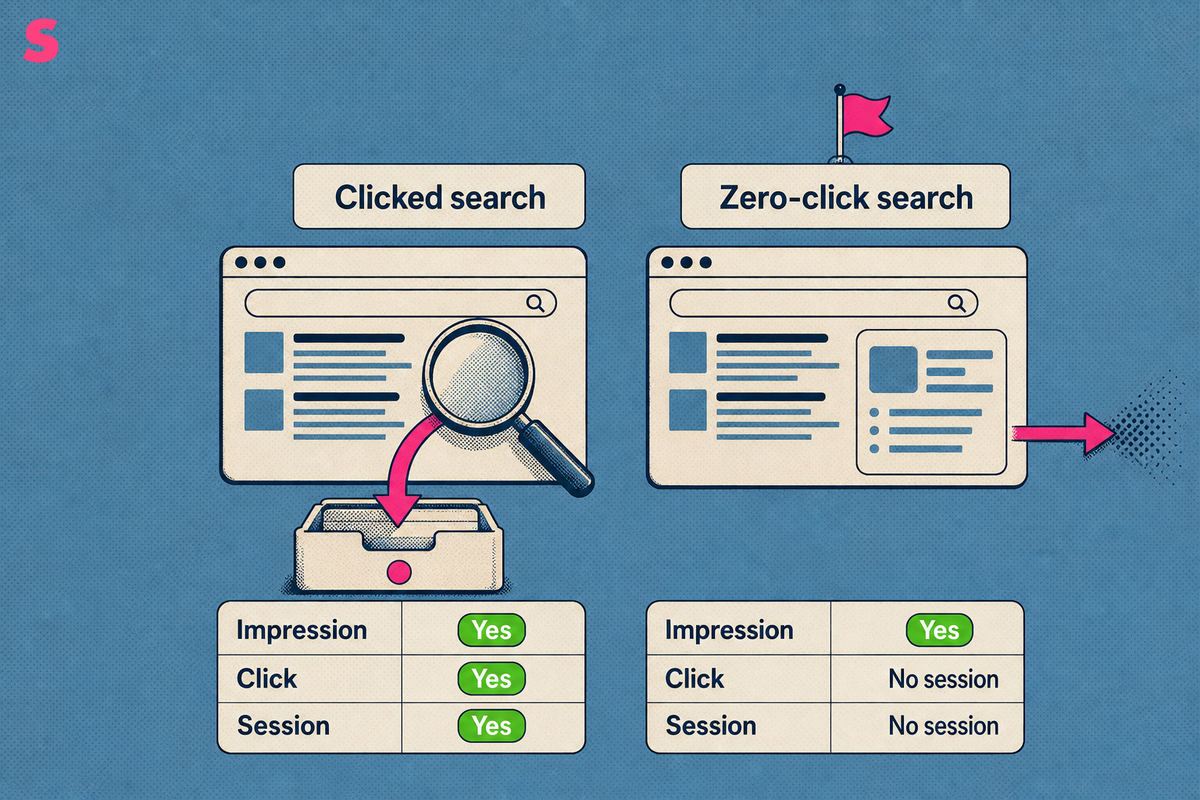
A zero-click search is a search that ends on the results page. The user reads the answer inside a snippet, a panel, or an AI-generated summary and never clicks through to a website. The query is satisfied; no session is created.
The difference from a clicked search is mechanical, not philosophical. A clicked search produces an impression, a click, and a session in your analytics. A no-click search produces the impression alone. Your page can rank first, be read by thousands of people, and generate nothing a web analytics tool can count.
That gap matters because most B2B reporting is built on the session. Organic sessions are the denominator for conversion rate, the numerator for channel growth, and the number the board sees. When answers move onto the results page, the session disappears while the exposure stays. Rankings look stable. Traffic falls anyway.
A single high-volume factual query shows the mechanism. When the results page states the fact outright, the page that ranks for it keeps its impressions and loses nearly all of its visits. The exposure continues; the session does not.
How common are zero-click searches in 2026, and how has the rate moved since 2024?
Roughly two-thirds of U.S. Google searches now end without a click. Exactly 68.01% did so during the first four months of 2026, up from 60.45% in 2024, per searchengineland.com, June 9, 2026. The study drew on Similarweb desktop and mobile-web panel data, so it measures panel browsing behavior rather than Google's own logs.
The sharper figure is the inverse. The share of searches generating at least one click fell 9.51 percentage points over that period, a 22.9% decline, per searchengineland.com, June 9, 2026. Nearly a quarter of the clicking behavior that existed in 2024 is gone.
| Measure | Figure | Sample and basis | Reported |
|---|---|---|---|
| U.S. searches ending without a click, 2024 | 60.45% | Similarweb desktop and mobile-web panel | searchengineland.com, June 9, 2026 |
| U.S. searches ending without a click, first four months of 2026 | 68.01% | Same panel, same methodology | searchengineland.com, June 9, 2026 |
| Change in searches producing at least one click | Down 9.51 points, a 22.9% decline | 2024 compared with 2026 | searchengineland.com, June 9, 2026 |
| Mobile no-click rate | About 77% | Mobile, about two-thirds of all searches | June 10, 2026 |
| Desktop no-click rate | About 50% | Desktop share of the same sample | June 10, 2026 |
| Single query: "capital of Sweden" | 85% ended without a click | 10,300 monthly searches, 149 reaching a website | August 10, 2026 |
Device explains much of the spread. The headline average blends a high mobile rate with a markedly lower desktop one. B2B SaaS traffic skews desktop and skews toward longer queries, so a blanket 68% is the wrong planning number for most software companies. Measure your own impression-to-click ratio in Google Search Console before assuming the average applies.
Which search result features end a search before the click?
Six result features absorb most of the clicks that no longer leave the page. Each answers the query in place.
- Featured snippets. A pulled paragraph, list, or table that answers a definitional or how-to query directly above the organic results.
- Knowledge panels. Entity facts assembled from structured sources: a company's founding date, headquarters, leadership, funding.
- Local packs. Map, hours, phone number, and reviews, which resolve the intent without a website visit.
- Calculators and converters. Unit conversion, currency, date math, all computed on the results page.
- People Also Ask. Expandable answers that keep the user on the results page while they refine the question.
- Google AI Overviews. A generated summary that synthesizes several sources and cites them, placed above everything else.
Google AI Overviews has the widest reach of the six, because it sits above everything else and draws on several sources at once. The other five are older and narrower, each resolving one specific class of query in place rather than summarizing the whole results page.
The practical distinction for a SaaS team is whether the feature cites you. A knowledge panel carrying your company is brand exposure no session count will show. A People Also Ask answer lifted from your documentation is the same. Both beat absence; neither reads as traffic.
How much do Google AI Overviews and Google AI Mode reduce organic clicks?
Published estimates cluster around a 38% to 40% drop in outbound organic clicks when a Google AI Overview appears. A field study reported a 38% reduction in outbound clicks, with no-click searches rising from 54% to 72%, per searchenginejournal.com, April 27, 2026. Google AI Mode is more severe again, with a reported 93% zero-click rate across 25.1 million impressions, per digitalapplied.com, May 17, 2026.
| Study and date | What it measured | Click effect | No-click effect | Sample |
|---|---|---|---|---|
| Field study, April 27, 2026 | Outbound organic clicks with an AI Overview present | Down 38% | Rose from 54% to 72% | Field experiment; per searchenginejournal.com |
| SSRN working paper, April 3 2026, revised June 17 2026 | Clicks when an AI Overview appeared | Down 39.8% | Up 34.5% | Academic analysis, reported July 1, 2026 |
| Q1 2026 SERP study, coverage, reported April 27, 2026 | How often an AI Overview is shown | Not measured | 25.11% of searches carried an AI Overview | 21.9 million Google searches |
| Q1 2026 SERP study, behavior, reported April 27, 2026 | Clicks on a traditional result | 8% of visits with an AI summary, 15% without | About 83% of AI Overview searches ended without a click | Same 21.9 million searches |
| Google AI Mode study, May 17, 2026 | No-click rate inside AI Mode | Not published | 93% | 25.1 million impressions; per digitalapplied.com |
The studies disagree because they measure different things. A field study manipulates exposure and observes behavior. A large crawl counts feature presence across millions of queries without knowing what any individual did next. A panel study watches real browsing sessions on a sample of users. Treat the 38% to 40% range as the defensible estimate, and treat the 83% and 93% figures as conditional on a feature being present rather than as rates across all searches.
Which query types end without a click, and which still send buyers to a site?
Concise factual and lookup-style informational queries are the most susceptible to resolution without a click. Navigational queries generally still produce a visit, and commercial and transactional queries tend to preserve more clicks, though neither is guaranteed. That gradient is the single most useful thing a SaaS team can know about no-click behavior, because it tells you which pages to stop defending with session targets.
- Informational. Definitions, formulas, acronyms, "what is" and "how does X work". A generated summary answers the short factual versions completely. Expect the heaviest loss here.
- Navigational. Logins, docs, status pages. These usually still send the visit, because the user wants to reach a destination. The exception is when the results page itself supplies the requested fact or action.
- Commercial. "Best X for Y", comparisons, alternatives, reviews. Buyers rarely accept a summary as final when money is involved, though some comparison queries are now resolved in place.
- Transactional. Pricing, demo, trial, integration setup. These generally require a vendor site.
In B2B SaaS the asymmetry is favorable. A $40,000 ACV purchase involves a buying committee, several weeks, and dozens of sessions. No AI summary closes that. What the summary does decide is which three vendors reach the shortlist, which pushes the damage upstream into awareness content and leaves the bottom of the funnel largely intact.
So triage by intent, not by traffic volume. A glossary page losing 60% of its sessions is expected. A comparison page losing 60% needs investigation this week.
What is a zero-click search not, and what gets confused with it?
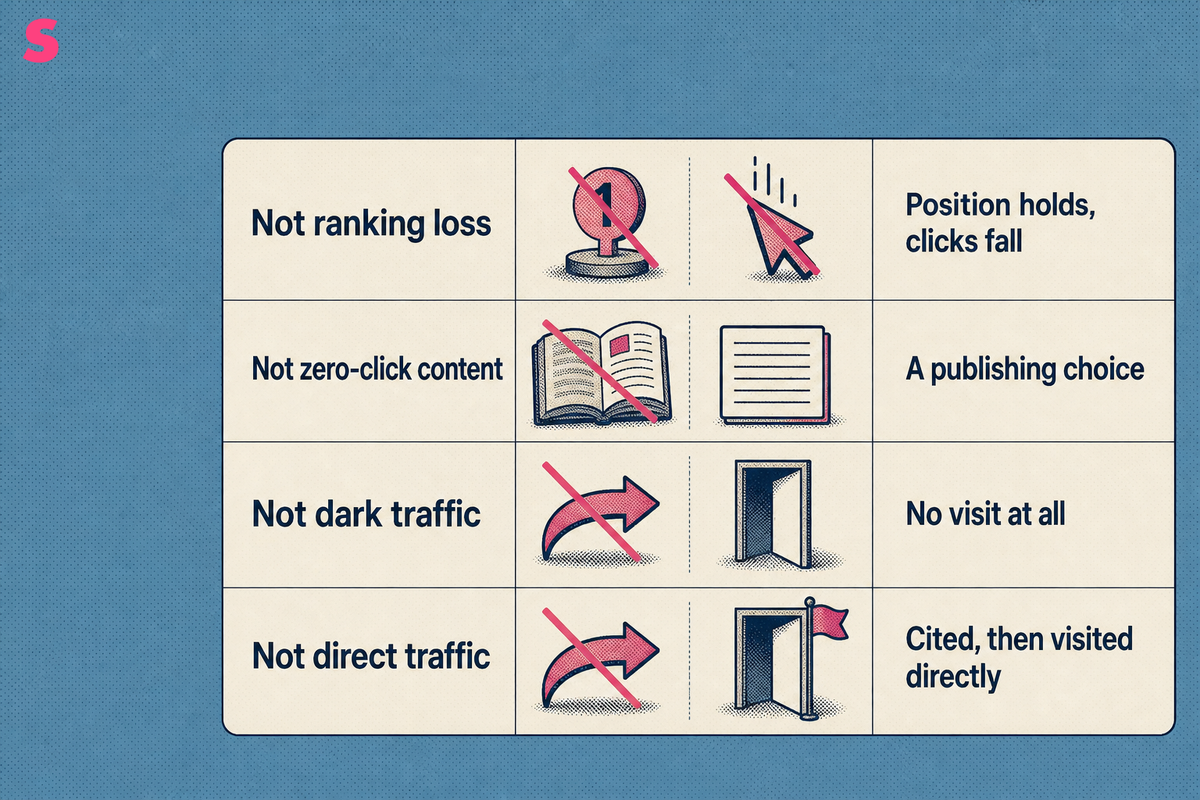
A search that ends without a click is not a ranking loss, not a penalty, and not the same thing as dark traffic. Four concepts get mixed together, and each has a different diagnosis.
- Not ranking loss. Position holds, impressions hold, clicks fall. If average position is steady and click-through rate collapsed, the result page changed, not your rankings.
- Not zero-click content. That phrase describes a publishing tactic: putting the full answer in the post, the thread, or the slide rather than gating it behind a click. It is a choice you make, not a behavior Google imposes.
- Not dark traffic. Dark traffic is a visit that arrives with no usable referrer. A no-click search produces no visit at all. One is a measurement failure, the other is an absence of the thing being measured.
- Not direct traffic. Direct visits are often the downstream consequence of an uncounted impression: a buyer sees you cited in an AI answer, then types your domain two days later. That is an attribution problem, not a no-click one.
The last boundary trips teams up most often. An AI engine citing your brand, followed by a buyer arriving as direct traffic, is a conversion path that worked perfectly and reported nothing. Diagnosing it as lost traffic leads to the wrong fix entirely.
How should B2B SaaS teams measure visibility when clicks and sessions fall?
Replace the session with four measures: impression share, citation frequency in AI answers, branded search volume, and pipeline from AI-referred visits. Sessions remain useful as a secondary metric. They stop working as the primary one the moment two-thirds of searches resolve on the results page.
Impressions are the cheapest signal to start with, because Google Search Console still records a no-click search as an impression. Impressions up, clicks down, position flat is the fingerprint of a results page absorbing the answer. Impressions down and position down is an ordinary ranking problem.
Citation frequency requires tracking prompts rather than keywords. Build the list of questions buyers actually ask an engine about your category, then run it daily. Daily cadence matters: an engine's answer shifts with the retrieval index, a model update, and whatever a competitor published last week, and a weekly snapshot averages that movement away. Four consecutive days of movement is a trend. One day is noise. Sona's own AI visibility data, September 2026, covers eight answer surfaces for exactly this purpose: ChatGPT, Google AI Overviews, Perplexity, Google AI Mode, Gemini, Mistral, Qwen and Claude.
The fourth measure is the one most teams skip. Sona AI Attribution credits AI search as a channel with its own spend, deals and ROAS on one account timeline, and captures zero-click research through self-reported attribution on demo and signup forms, which is how an answer that never sent a click still gets counted.
How do you tell harmful traffic loss from useful brand exposure?
Run three checks before calling a traffic decline a problem: segment by query intent, compare branded demand against non-branded, and rule out the confounders. A drop in informational sessions alongside flat or rising branded demand is a supporting indicator that exposure is still landing, not proof of it. A drop in both is a real loss.
- Segment the decline by intent. Pull the affected URLs and sort them into informational, commercial, and transactional. If 90% of the loss sits in glossary and explainer pages, the funnel is intact.
- Check branded search volume and direct visits. Rising branded impressions against falling non-branded clicks is consistent with uncounted exposure, and it needs corroboration before you treat it as the explanation: a time-series comparison over several months, self-reported attribution on forms, AI referral data, or an observed change in how often engines cite you.
- Check demo and trial volume against sessions. If sessions fell 30% and demo requests held, the lost sessions were probably not buyers.
Then rule out the obvious alternatives, because correlation gets claimed far too quickly here. Seasonality: B2B traffic falls every December and every August. Algorithm updates: a core update in the same window produces an identical-looking chart. Tracking changes: a new consent banner, a changed cookie policy, or a tag fired on a different event will each delete sessions that still happened.
Only after those three are excluded does the result-page explanation become the leading hypothesis. The honest version of this analysis is a comparable series over months, not a single before-and-after screenshot.
What content and technical work gets a SaaS brand cited when no one clicks?
Citation goes to pages an engine can fetch, parse, and trust. The work splits cleanly: make the answer extractable, make the page retrievable, and keep it current. Engines with web retrieval weight recency, so a page untouched for months is deprioritized against a fresher source on the same topic.
- Answer in the first 40 to 60 words under a heading phrased as the question a buyer would ask.
- Mark up Q&A content with valid FAQPage JSON-LD. Clear HTML structure and valid schema help machines interpret page entities and question-answer relationships, but neither guarantees extraction or citation.
- Serve server-rendered HTML for anything you want cited; a JavaScript dependency is a retrieval risk.
- Check robots.txt and related crawler directives, which are the actual access controls, against the crawlers you want, and confirm the canonical tag points where you expect. An llms.txt file, if you keep one, is an optional machine-readable aid rather than an enforced crawler permission.
- Re-audit on a slower clock. Prompt lists run daily; a full technical re-audit is a monthly or quarterly job.
The Free AI Readiness Checker returns a dated snapshot of how readable a page is to an engine. A snapshot is not the deliverable. What a team acts on is the severity-ranked fix attached to each page, which turns an audit into a work queue.
On the cannibalization objection: a concise answer does satisfy some simple queries without a visit. That trade is worth making. A vague page wins neither the click nor the citation, and the queries lost this way were informational queries already headed for resolution on the results page.
Tracking which answers mention your brand is only half the job. The other half is connecting those mentions to accounts, pipeline, and revenue, and that is the loop Sona AI Visibility closes by following an AI-referred visit through to the deal rather than stopping at a mention count.
Frequently Asked Questions
Is a zero-click search the same as a lost customer?
No. An impression without a click still builds familiarity and can produce a direct visit days later. Treat it as unattributed exposure rather than a lost buyer. Check branded search volume, direct demand, and self-reported attribution on your forms first, because the conversion may have happened and simply reported itself as direct traffic.
Does the 68% figure apply to every search engine and country?
No. The 68.01% figure describes U.S. Google searches during the first four months of 2026, measured on Similarweb desktop and mobile-web panel data, per searchengineland.com, June 9, 2026. It is not a global rate. Device, market, engine and query type all move it, and mobile and desktop rates diverge sharply.
Do searches that end without a click still appear in Google Search Console?
Yes, as impressions with no corresponding click. That is why impression volume and average position are the first two trends to check when sessions fall. Stable position plus stable impressions plus falling clicks points at the result page absorbing the answer, not at a ranking decline.
Does publishing a concise answer on a page cause more searches to end without a click?
It can resolve some simple queries without a visit. Structured answer content is also what makes a page eligible for citation in AI answers and featured results. For research-stage queries that is the trade worth making, since a vague page forfeits the citation and the click together.
Which metrics should replace sessions as the primary SEO KPI?
Impression share, citation and mention frequency across AI answers, branded search volume, AI-referred visits, and the pipeline those visits produce. Sessions stay in the report as a secondary number. They cannot carry the primary role once a majority of searches resolve before anyone leaves the results page.
Are searches that end without a click bad for B2B SaaS specifically?
Less than for publishers. Most B2B purchases involve long, multi-session research across a buying committee, so the damage concentrates in top-of-funnel informational pages. Comparison, pricing, integration and product queries keep sending visits, because buyers spending real money verify a summary rather than accept it.
Summarize this article with AI: ChatGPT · Claude · Perplexity · Google AI Mode
Last updated: October 2026