AI search content delivery is the path a page travels from your site to an AI answer: crawl access, retrieval, extraction, citation and measurement. Most of the control sits in technical basics, such as robots.txt rules, rendering and structured data, rather than in copy edits. Answers vary by engine and prompt, so track trends, not single scores. Sona AI Visibility links prompts, citations and AI crawler activity to pipeline and revenue.
What is AI search content delivery, and how does it differ from SEO, AEO and GEO?
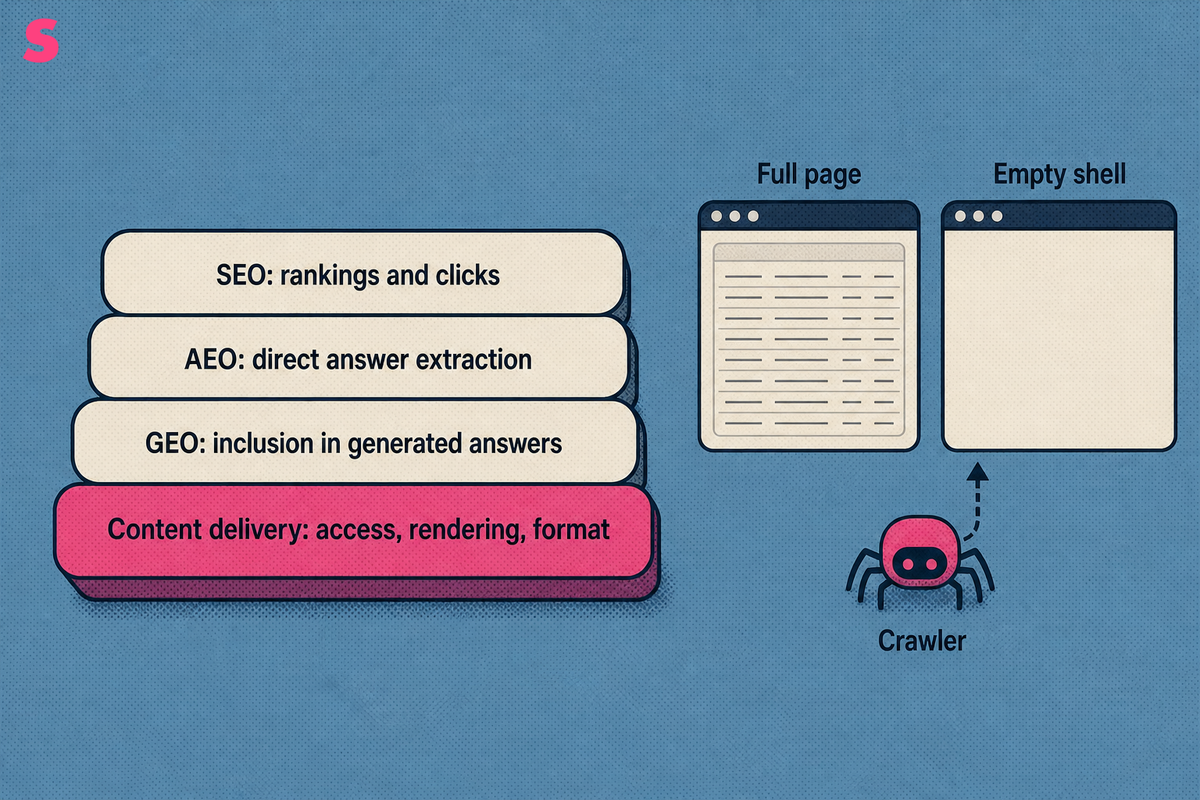
Content delivery for AI search is the technical work of getting your pages to AI crawlers and retrieval systems in a form they can fetch, parse and quote accurately. It covers access, rendering and format. It does not judge whether the content deserves a citation.
The four terms sit at different layers:
- SEO earns rankings and clicks in classic search results.
- AEO (answer engine optimization) shapes content so an engine can lift a direct answer from it.
- GEO (generative engine optimization) is the broader practice of earning inclusion in generated answers.
- Content delivery is the layer beneath all three: whether a crawler reaches the page, and what it receives when it does.
A worked example shows the boundary. A SaaS company builds its plan table with client-side JavaScript. A crawler that does not execute scripts receives an empty shell, so the engine has no price to quote. The copy can be flawless and the page still fails, because the fault sits in delivery, not in writing.
Delivery is neither link building nor prompt manipulation, and it makes no claim about authority. It ensures only that the content carrying your authority arrives intact.
How does a page travel from your site to an AI-generated answer?
A page travels in five stages: a crawler or agent requests it, the server responds, the system parses and indexes or retrieves it, a model extracts passages, and the answer cites the source or omits it. A failure at any stage ends the journey for that page.
| Stage | What happens | Control you own | How to verify |
|---|---|---|---|
| 1. Request | A crawler or agent asks for the URL | robots.txt rules per user agent; WAF and CDN rules | Server logs show the request and its status code |
| 2. Response | The server returns HTML | Status code, server-rendered HTML, response time | Fetch the page with scripts disabled and compare the text |
| 3. Parsing | The system reads text, headings and markup | Heading hierarchy, Schema.org markup, canonical tag | Run a technical audit and validate the markup |
| 4. Extraction | A model selects passages to ground the answer | Answer-first paragraphs, tables, self-contained sections | Run tracked prompts and read which passages appear |
| 5. Citation | The answer names the source or leaves it out | Consistent entity naming, content freshness | Citation and referral data per prompt |
Timing differs by crawler type. Training crawlers fetch pages to build a model, so their effect arrives later. Retrieval and user-triggered crawlers fetch pages to feed a live answer, so their effect arrives within the session. Stages 1 and 2 are the cheapest to fix and the most often broken.
Which technical controls decide whether AI crawlers can read your content?
Five controls decide it: robots.txt rules per user agent, firewall and CDN rules, server-rendered HTML, canonical and indexability signals, and response headers. Each can block a crawler with no visible symptom on the human-facing site.
- robots.txt: allows or disallows each crawler by user agent, such as GPTBot, ClaudeBot and PerplexityBot.
- WAF and CDN rules: a firewall can return a 403 or rate-limit a bot that robots.txt allows.
- Server-rendered HTML: content built only by client-side JavaScript is absent from the first response.
- Canonical tag and indexability: conflicting canonicals or noindex directives remove a page from consideration.
- Response headers: Strict-Transport-Security, Content-Security-Policy and X-Content-Type-Options reinforce the trust signals crawlers weigh.
The Sona AI Crawl Checker tests 45 AI crawlers in four tiers: retrieval, agent or user-triggered, training, and stealth or undocumented. For each blocked bot it returns the reason, such as a robots.txt disallow, a WAF 403, rate-limiting or cloaking. Retrieval and agent bots decide whether a brand can be cited today. Training bots decide whether a model knows the brand later. A robots.txt that blocks one tier and not the other is a decision, and most sites make it by accident.
For the wider page, the Free AI Readiness Checker runs 35 checks across six categories and returns a 0-100 score with a letter grade in about 30 seconds.
How should a B2B SaaS company structure pages so AI systems extract accurate answers?
Put a direct answer in the first 40 to 60 words under every heading, keep each section self-contained, and state facts as plain text rather than inside images, scripts or tabs. A passage that survives being lifted out of the page is a passage an engine can quote correctly.
- Name the product, its category and its audience in the first paragraph, and use the same product name on every page.
- Open each section with a sentence that answers its own heading, then add context.
- Publish pricing, limits and integrations as text in a table, not in an image or a script-built widget.
- Mark the page up with Schema.org, including FAQPage JSON-LD wherever the page holds questions and answers.
- Update pages when facts change, because engines with web retrieval weight recency.
Teams skip the last step most often. A page can be crawlable, marked up and well written, and still lose the citation to a fresher source on the same topic.
Missing FAQPage JSON-LD is also a common critical finding in page audits. The markup lets an engine extract question-and-answer pairs directly, which makes those answers more likely to be surfaced verbatim. Structure is cheap to add and costly to lack.
What is direct content delivery to AI engines, and how is it different from content optimization?
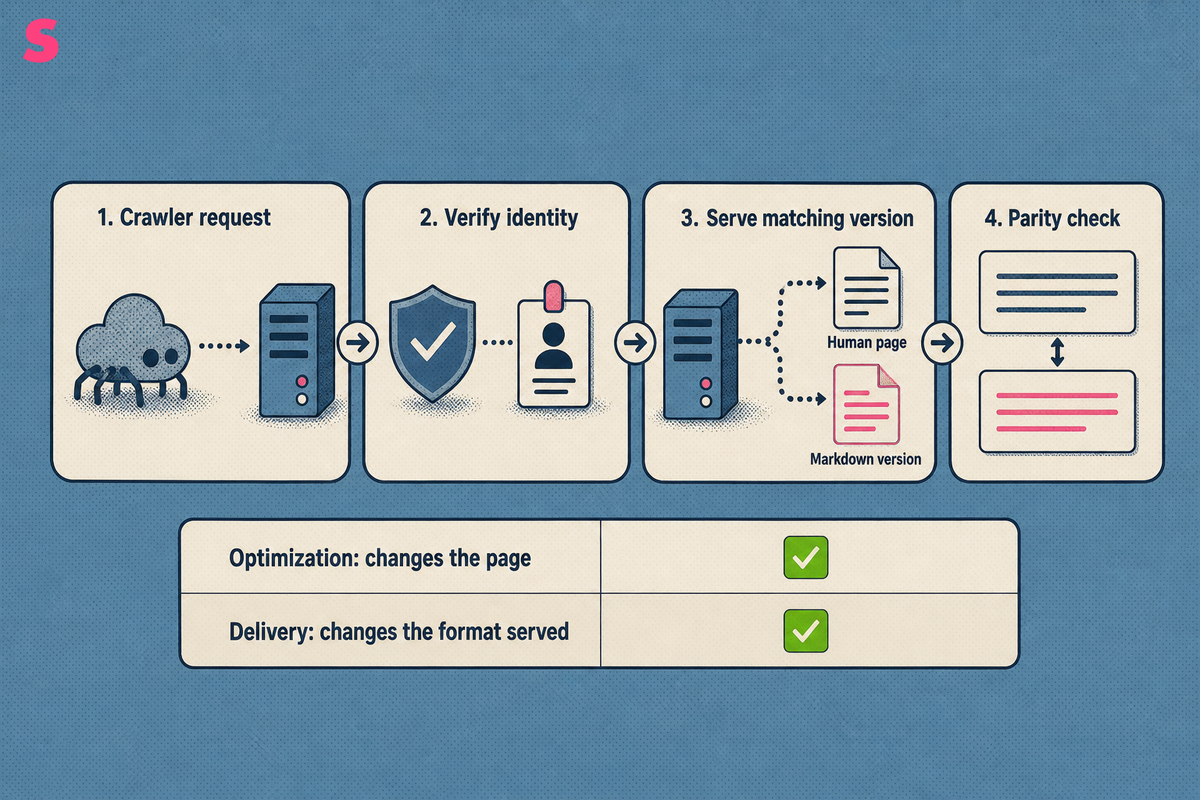
Direct content delivery serves AI crawlers a clean, structured version of a page, usually at the edge, instead of leaving them to parse the full human page. Content optimization edits the page itself, so humans and machines read the same improved copy.
The mechanism works in four steps. An edge worker detects a request from a verified AI crawler. It returns a token-light markdown version of the same page: headings, body text and tables, without navigation scripts. Human visitors still receive the normal page. Sona AI Visibility can serve this version to AI crawlers automatically, with no change to the live site, using server logs or a lightweight edge worker rather than a JavaScript tag.
Verification matters. A delivery layer that answers every request claiming to be a crawler also answers spoofers, so genuine bots must be separated from fakes by cryptographic signatures and IP allow-lists.
- Optimization: changes the page, benefits every reader, and ships at the pace of your content team.
- Delivery: changes the format served, leaves the live page untouched, and needs crawler identity checks.
The boundary is parity. The machine version must carry the same facts as the human page. Divergent content is cloaking, and the Sona AI Crawl Checker reports cloaking as a failure reason. Check each engine's published policy before serving different formats.
Which AI search engines and answer surfaces should you monitor?
Monitor every surface your buyers use to research vendors, starting with ChatGPT, Google AI Overviews, Google AI Mode, Perplexity and Gemini, then add Claude and Microsoft Copilot. Surfaces differ in how they retrieve and cite, so one engine's result does not predict another's.
| Surface | Type | Evidence | What to check first |
|---|---|---|---|
| ChatGPT | Chat assistant with retrieval | 19.4% of citations in one publishing benchmark, August 2026 | Which of your pages its crawlers fetch |
| Google AI Overviews | Summary shown within Google results | Appeared on 86.7% of business-intent searches in April 2026, up from 56.9% in April 2025, per one 2026 measurement; 2.5 billion monthly users, per coverage of Google I/O 2026, May 2026 | Whether your pages answer commercial queries |
| Google AI Mode | Conversational search mode | 54.3% of citations in the same publishing benchmark, August 2026 | Citation share on comparison prompts |
| Perplexity | Answer engine | 13.1% of citations in that benchmark, August 2026 | Sources cited beside yours |
| Gemini | Assistant | Gemini 2.5, with ChatGPT-5, Claude 4.7 and Perplexity Sonar, in a Q1 2026 study of 8,400 prompts across 14 commercial sectors (May 2026) | Brand mention on category prompts |
| Claude and Microsoft Copilot | Assistants | Copilot was one of 6 engines in a 2026 AI-search visibility benchmark | Whether buyers in your segment use them |
Coverage varies by tool. Sona AI Visibility lets a team track 11 engines. Separately, Sona's own AI visibility data, September 2026, covers 8 answer surfaces: ChatGPT, Google AI Overviews, Perplexity, Google AI Mode, Gemini, Mistral, Qwen and Claude. The first figure counts what a customer can track; the second counts what Sona's archive measures.
Citation shares from one benchmark do not transfer to your market. Confirm which engines send you visits, then weight monitoring toward them.
Which metrics show whether AI search content delivery is working?
Four layers show whether delivery is working: crawler access, citation presence, AI-referred traffic and pipeline. A gain at the first layer that never reaches the second means the content is fetched but not quoted. A gain at the second that never reaches the fourth means visibility without revenue.
- Crawler access: AI crawler requests per URL, and the share of target pages fetched at all.
- Citation presence: visibility and share of voice per engine, and which sources get cited beside yours.
- AI-referred traffic: sessions arriving from AI engines, including those that land as direct traffic.
- Pipeline: assisted conversions, opportunities and revenue tied to AI-referred accounts.
A single brand-level visibility number is not a work item. It says the brand appears in some share of answers, not which prompts or which sources produce that share. Sona AI Visibility connects those citations to pipeline and revenue on one account timeline, and its AI Search Insights shows the prompts that surface a brand and the sources cited, and maps site pages to the prompts they should appear in. That turns a score into a list of pages to fix.
Every layer follows one rule: a score is a dated snapshot, and only a comparable series of scores shows a trend.
Why are AI answers unstable, and can you still measure delivery?
AI answers shift because retrieval indexes, model versions and competitor content all change, so one result proves little. You can still measure delivery by running the same prompt list on a fixed schedule and reading the trend. The measurement unit is the series, not the single answer.
Daily is the right cadence for that prompt list. A change that holds four days running is a trend, and a one-day spike is not. A weekly snapshot would average away the patterns a daily run exposes. Daily is a category standard, not a premium: Sona, Otterly.ai, PromptRush and Semrush all run prompts daily, and Sona AI Visibility meters its plans for daily runs.
Collection method also changes the answer. Some offerings capture the end-user experience directly, scraping the response as a person would see it. Others pull from a vendor's official API, which returns a structured response that need not match the screen. The two methods can capture different answers, so ask which one a tool uses. Sona aims to mirror the end-user experience and uses both.
Other clocks run slower. A full technical re-audit suits a monthly cycle, and a positioning review or competitive benchmark suits a quarterly one.
What should you require from a vendor that offers AI search content delivery?
Require seven things: named engines with a count, a stated collection method, prompt-level data, crawler visibility, a delivery method that mirrors your live page, published pricing, and an export or API. A vendor that cannot state these cannot be compared with any other.
- Engines: the names and the count for the plan you would buy, not for the enterprise tier.
- Collection method: scraped responses, API responses, or both.
- Prompt-level data: visibility, sources and intent per prompt, not only a brand score.
- Crawler visibility: which AI bots reach which pages, read from server logs or an edge worker.
- Delivery parity: the served version carries the same facts as the human page.
- Pricing: a published number, or a stated quote-only policy.
- Export and API: your data leaves the tool in a usable form.
Reject any vendor that promises a ranking or citation outcome. Delivery work removes obstacles and produces data. It cannot guarantee that an engine quotes you.
Sona AI Visibility publishes self-serve pricing, with brands from $75/month billed annually, a 14-day free trial with no credit card, and unlimited seats and API/MCP access on every plan.
Frequently Asked Questions
Is AI search content delivery the same as GEO?
No. GEO is the broader practice of earning inclusion in generated answers. Delivery is the technical layer within it: how content reaches AI crawlers and retrieval systems, and in what form. A page can be well optimized for GEO and still fail if a crawler never receives it.
Does blocking AI crawlers in robots.txt remove my content from AI answers?
It can reduce what a given crawler may fetch, but engines differ in how they use crawlers, indexes and live retrieval. Blocking is a per-crawler policy decision, not a guarantee. Verify the effect in each engine's own documentation, and test access crawler by crawler.
Do I need structured data for AI search?
Structured data helps machines identify entities, products and page types. It does not replace clear, extractable prose. Treat Schema.org markup, including FAQPage JSON-LD, as support for the page, not a substitute for it.
How do I know if an AI engine is reading my site?
Look at server logs or an edge worker for AI crawler and agent requests. Then compare the pages they fetch with the pages you want cited. Sona AI Visibility tracks AI crawler activity without a JavaScript tag, so ad blockers cannot hide it.
Can I measure AI search content delivery if answers change every time?
Yes. Track repeated prompt sets over time and read trends rather than single results. Pair that series with referral, assisted-conversion and pipeline data, so a change in citations can be checked against a change in business outcomes.
How much does it cost to monitor AI search visibility?
Entry pricing in 2026 tool comparisons ranged from about $29 per month to more than $1,000 per month for enterprise products (April 2026). Cost should follow prompt volume, engine coverage, governance and workflow integration, not feature count. Sona AI Visibility starts at $75/month for brands, billed annually.
Summarize this article with AI: ChatGPT · Claude · Perplexity · Google AI Mode
Last updated: October 2026