


Search intelligence involves gathering, analyzing, and interpreting search behavior across search engines, social platforms, and retail channels, and now includes the answers AI engines provide about your brand. Unlike rank tracking, it assesses demand, competitors, and citations instead of just your own positions. Begin with a small prompt set based on real buyer questions, monitor it across a few engines, and view any individual visibility score as a range because AI answers vary with wording, location, and model version.
What is search intelligence, and how does it differ from rank tracking and web analytics?
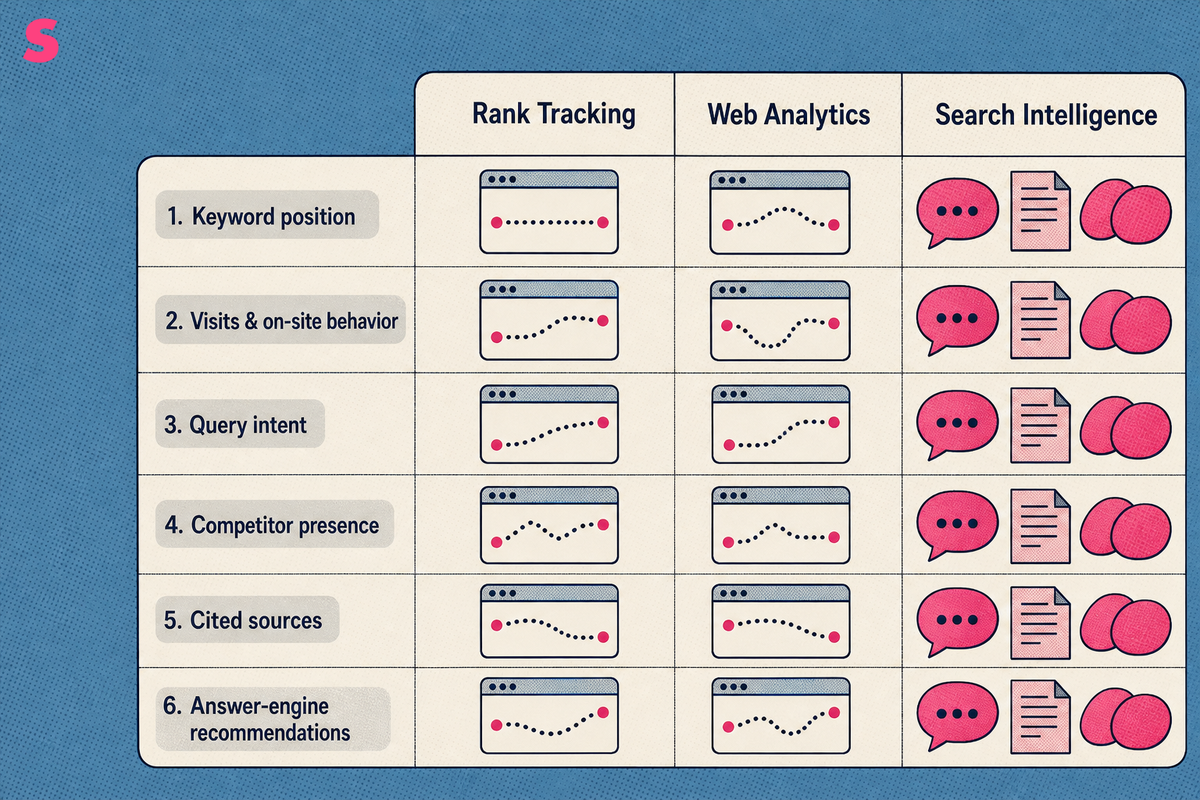
Search intelligence collects and interprets buyer searches, search results, discovery behavior, product and category searches, and AI answers across traditional search engines, social-media platforms, retail channels, and answer engines. It turns search behavior into evidence for content, competitive, and pipeline decisions.
Rank tracking measures a keyword position. Web analytics measures visits and on-site behavior. Search intelligence adds query intent, competitor presence, cited sources, and answer-engine recommendations. Its unit of analysis is the buyer question and the market response around that question, not only a ranking.
AI search intelligence extends this work to prompts in ChatGPT, Perplexity, Gemini, Claude, and other answer engines. Traditional search focuses on rankings and clicks. AI search focuses on recommendations, citations, and answer composition.
For example, a B2B buyer may search a category term in Google, then ask an answer engine which vendors fit a specific use case. A rank tracker reports the Google position. An intelligence workflow records whether the brand appeared in the AI answer, which competitors appeared beside it, and which pages or third-party sources the answer cited.
Search intelligence is not enterprise search, which helps employees locate internal information. It is also not a digital PR service that earns backlinks. Those disciplines can contribute data or outcomes, but search intelligence analyzes public search behavior and public AI answers.
Why does search intelligence matter to a marketer with a pipeline target?
A pipeline target requires a team to prioritize buyer demand, not merely report traffic. Search intelligence identifies questions that signal commercial research, shows where competitors are recommended, and directs investment toward the pages and content that matter most.
A content team can spend time improving a high-volume informational topic while a competitor dominates prompts used during vendor evaluation. AI for competitive intelligence puts demand evidence from search, recommendation evidence from AI answers, and competitive context on the same planning board.
The commercial value is prioritization. A prompt asking for implementation guidance belongs to a different buying stage than a prompt asking for a vendor comparison. Both provide useful evidence, but they require different editorial, product marketing, and sales support resources.
Sona AI Visibility connects AI citations to pipeline and revenue on one account timeline, and tracks which AI crawlers are reaching pages. That path links buyer questions to commercial outcomes rather than treating visibility as an isolated reporting metric.
- Demand: Which topics and questions indicate active buyer research?
- Presence: Does the brand appear in search results and AI-generated answers?
- Competition: Which companies, publishers, and pages appear beside the brand?
- Action: Which page, message, or source gap should the team address first?
What data does a search intelligence platform collect and measure?
A search intelligence platform collects search terms, prompts, rankings, discovery behavior, product and category searches, answer content, citations, competitors, and page-level evidence across traditional search engines, social-media platforms, retail channels, and AI answer engines. The useful output connects those observations to intent, content ownership, and a repeatable decision process.
Traditional search contributes queries, rankings, search-result features, landing pages, and competitor domains. Social-media platforms contribute discovery behavior and audience response. Retail channels contribute product and category searches. AI search intelligence adds prompt wording, brand mentions, answer position, cited sources, recommendation context, and variation across answer engines.
Sona AI Visibility uses AI Search Insights to show the prompts buyers ask and how a brand ranks in AI answers against competitors. Teams can use that evidence to identify pages that should answer commercially important prompts, then assign an owner to update each page.
Data quality depends on preserving the query or prompt, answer engine, date, and returned answer. Without those fields, a mention count is hard to interpret. A brand appearing once in a broad educational answer carries a different meaning from repeated appearances in high-intent vendor-selection prompts.
A score is a dated snapshot. A comparable series of observations is more useful because repeated readings show whether a prompt changed, which cited sources persisted, and whether a competitor’s presence is becoming established.
Search intelligence captures expressed demand and result visibility. Social intelligence captures public conversation and audience response. Media intelligence captures earned coverage and source narratives. Teams join those datasets around shared topics, entities, sources, markets, and dates to determine whether a gap requires content, messaging, media outreach, or reputation work.
Which answer engines should a B2B team track for AI search intelligence?
A B2B team should track the answer engines its buyers use, including ChatGPT, Perplexity, Gemini, Claude, and other answer engines. Google AI Overviews also require monitoring because they appear within Google’s search experience and can cite pages directly in the result.
The right engine set depends on buyer behavior, geography, language, and the decision under review. A software buyer researching vendors may use a conversational assistant differently from a prospect seeking a local provider through Google AI Overviews. The prompt set should reflect those differences.
Sona’s own AI visibility data, September 2026, covers 8 answer surfaces: ChatGPT, Google AI Overviews, Perplexity, Google AI Mode, Gemini, Mistral, Qwen and Claude. A multi-surface view matters because the same question can produce different recommendations and citations across engines.
Start with a small set of commercial prompts, then expand from observed patterns. Track category prompts, comparison prompts, integration prompts, pricing prompts, and problem-led prompts separately. Combining every query into one average hides buying-stage differences that determine priority.
- Category prompts: Questions defining a problem or market.
- Comparison prompts: Questions naming alternatives, criteria, or trade-offs.
- Solution prompts: Questions seeking a workflow, integration, or technical approach.
- Brand prompts: Questions testing reputation, credibility, pricing, or fit.
How can AI search intelligence work as competitive intelligence?
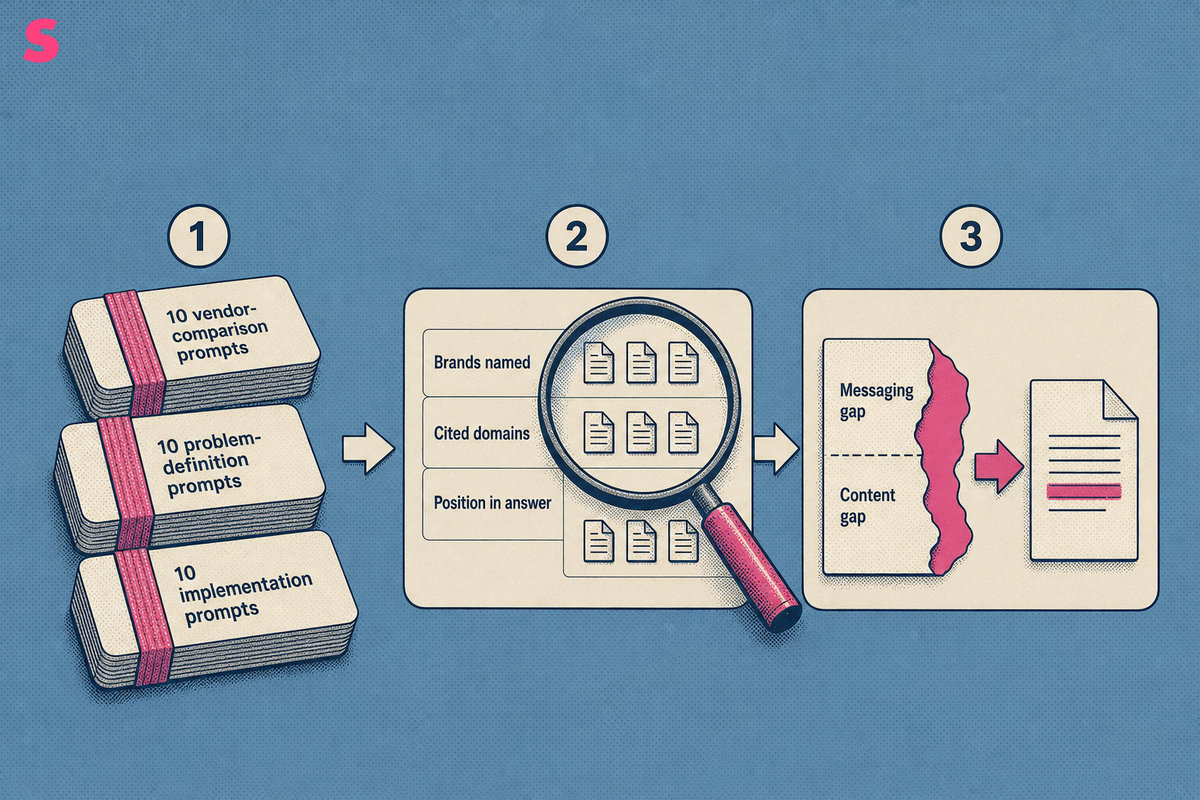
AI search competitive intelligence shows which competitors appear in buyer prompts, how they are described, and which sources support those recommendations. The goal is to identify a competitive narrative that a marketing team can verify and address, not copy every rival’s content.
Use a controlled prompt set. For example, a team can run ten vendor-comparison prompts, ten problem-definition prompts, and ten implementation prompts. Record the brands named, cited domains, position in the answer, and wording used to describe the category.
The results can reveal a specific gap. If a competitor appears in prompts about enterprise implementation and cited sources repeatedly emphasize documentation, the working hypothesis is not that the competitor is universally stronger. The available market evidence supports that competitor for that use case.
AI for competitive intelligence also separates messaging problems from content problems. A brand may have relevant pages but lack the proof points, structure, recency, or third-party references that answer engines retrieve when constructing a recommendation.
Sona AI Visibility can connect the questions behind AI-referred visits to account-level intent signals, so teams can prioritize prompts by commercial relevance rather than mention volume alone. That prevents a noisy competitor list from becoming the entire strategy.
How reliable is AI search intelligence data, and what can it not tell you?
AI search intelligence data can reveal repeated patterns in a defined prompt set, but it cannot prove that every answer reflects every buyer’s experience. Answer engines change as retrieval indexes, model behavior, and available sources change.
One run is weak evidence. A team that runs the same prompt list daily can identify patterns that a weekly snapshot would average away. A change that holds for four days warrants investigation, while a one-day spike is a transient reading.
AI answer monitoring cannot establish causation by itself. A citation shows that an engine referenced a page or named a brand. It does not show why the engine selected that source, whether every user saw the same answer, or whether the answer directly caused a deal.
Use consistent controls: the same prompt wording, target market, language, answer engine, and collection cadence. Record the date of every run. Separate branded prompts from non-branded prompts, since a known customer asking about a company produces a different signal from an unfamiliar buyer researching the category.
Prompt monitoring should run daily. A full positioning review or competitive benchmark report should run quarterly because those tasks require interpretation and decisions rather than constant sampling.
How should you compare search intelligence tools, and what do the main options cost?
Compare search intelligence tools by engine coverage, prompt cadence, agency support, and whether the data connects to a commercial workflow. Starting price alone is insufficient because products package prompts, response volume, credits, and answer engines differently.
The table below compares published entry-plan information as of October 2026. Cost per daily tracked prompt uses the shared unit supplied for each tool rather than dividing plan prices by incompatible vendor units. Sona AI Visibility appears first because it connects citations and AI-referred visits to pipeline and revenue on one account timeline.
| Tool | Starting price | Agency Plans? (Yes/No) | # of Answer Engines Tracked | Answer Engines | # of Daily Tracked Prompts (entry plan) | Cost per Daily Tracked Prompt | Differentiation |
|---|---|---|---|---|---|---|---|
| Sona AI Visibility | From $75/month, billed annually | Yes | 11 | ChatGPT, Gemini, Google AI Mode, Google AI Overviews, Perplexity, Claude, DeepSeek, Grok, Copilot, Qwen, Mistral | 5,000 credits/month, about 166 daily tracked prompts on one model or 56 across three | $0.45 per daily tracked prompt | Connects AI citations and prompts to pipeline and revenue, with AI crawler activity from server logs. |
| Profound | Custom pricing | Yes | 9 | ChatGPT, Perplexity, Google AI Mode, Gemini, Microsoft Copilot, DeepSeek, Claude, Google AI Overviews, Exa Search | Custom daily prompt plan | Cannot be calculated from custom pricing | Focus: AI answer visibility across named answer engines. |
| Peec AI | From $95/month | Yes | 3 | Not published | 50 prompts daily | $0.63 per daily tracked prompt | Focus: prompt tracking across self-serve AI engines. |
| Otterly.ai | From $29/month | Yes | 4 | ChatGPT, Google AI Overviews, Perplexity, Microsoft Copilot | 15 prompts daily | $0.48 per daily tracked prompt | Focus: AI search tracking across four entry-plan engines. |
| Scrunch AI | From $250/month | Yes | 4 | ChatGPT, Perplexity, Google AI Overviews, Copilot | 125 prompts | No refresh cadence published | Focus: AI visibility tracking for named answer engines. |
| AthenaHQ | From $295/month, shown under annual billing | Yes | 11 | Not published | 3,600 credits/month, unlimited prompts | No refresh cadence published | Focus: credit-based AI response tracking. |
| PromptWatch | From $95/month | Yes | Not published | Not published | 50 prompts daily | $0.48 per daily tracked prompt | Focus: prompt and response monitoring across supported models. |
| Goodie | From $295/month | Yes | 5 | Not published | 110 prompts daily | $0.67 per daily tracked prompt | Focus: multi-model tracking with daily prompt allowances. |
Buyers should also test answer capture. Some tools capture the answer a person sees on screen. Others pull answers from the AI vendor’s API, which can return a different result. Sona aims to match what a real user sees and uses both methods.
How do you start using search intelligence in your first month?
Start search intelligence with a focused prompt set, a clear owner, and daily monitoring. The first month should establish a baseline, identify repeatable gaps, and produce a short list of actions rather than an oversized dashboard.
- Week 1: Define three to five commercial topics, then write prompts for category discovery, vendor comparison, implementation, and pricing research.
- Week 2: Run the same prompt list daily across the answer engines relevant to the buying audience. Record brand mentions, competitors, cited sources, and answer changes.
- Week 3: Group prompts by buying stage and identify the pages or proof points that should support each high-value question.
- Week 4: Assign fixes to content, product marketing, SEO, or sales enablement owners, then review the daily log for persistent movement.
Use a technical-readiness check alongside prompt monitoring to test whether AI engines can crawl and parse a site. Keep that result separate from visibility in AI answers.
Sona AI Visibility also tracks AI crawler activity from server logs or a lightweight edge worker, with no JavaScript tag. That evidence helps teams distinguish a content problem from a crawl-access problem before investing in a rewrite.
What should a CMO, brand manager, or content strategist do first with the findings?
A CMO, brand manager, or content strategist should turn findings into a ranked operating plan. Start with prompts that combine commercial intent, repeated competitor presence, and a clear page or proof gap the team can address.
CMOs should review prompts by pipeline relevance and assign investment to the themes affecting active demand. Brand managers should inspect how the company and competitors are described, then correct unsupported or outdated positioning through approved pages, customer evidence, and sales materials.
Content strategists should map each priority prompt to one owned page. Improve the page’s answer structure, evidence, recency, metadata, and internal links. Keep a record of the prompt, page owner, change date, and subsequent answer-engine observations.
Brand mentions in AI answers are only half the job. The other half is connecting those mentions to accounts, pipeline, and revenue. Sona AI Visibility closes that measurement loop by connecting AI citations and AI-referred visits to account timelines and commercial outcomes.
Review prompt data daily, but hold a quarterly decision meeting. The daily log identifies movement. The quarterly review determines whether the organization should defend a category, build a new content asset, revise positioning, or shift budget toward a proven buyer journey.
What are the frequently asked questions about search intelligence?
What is search intelligence in simple terms?
Search intelligence collects and interprets buyer searches, search results, and AI answers. It helps a team decide what to publish, defend, or fix by combining buyer questions, competitor presence, cited sources, and visibility patterns.
Is search intelligence the same as SEO?
No. SEO improves visibility in search results. Search intelligence identifies where to direct that work, using competitor evidence, buyer intent, prompt behavior, and AI-answer data that rank tracking alone does not capture.
How is AI search intelligence different from traditional rank tracking?
Traditional rank tracking reports a keyword position. AI search intelligence reports whether answer engines mention, cite, or recommend a brand for a prompt, along with the competitors and sources appearing beside the brand. The data concerns answer composition, not only result position.
Can AI search intelligence prove revenue impact?
No, not by itself. Mentions and citations establish presence in AI answers. Proving commercial impact requires a separate measurement step that connects AI-referred visits, identified accounts, pipeline stages, and closed-won revenue.
How often should AI search visibility be checked?
Check a defined prompt list daily so the team can distinguish a sustained trend from a one-day variation. Answer engines change with retrieval indexes, model updates, and new competitor content. A monthly or quarterly cadence fits a broader positioning review or technical benchmark.
Is search intelligence the same as enterprise search or a digital PR agency of the same name?
No. Enterprise search helps employees find information stored inside an organization. A digital PR agency earns media coverage and backlinks. Search intelligence analyzes public search behavior, search results, and AI-generated answers to guide marketing decisions.
Summarize this article with AI: ChatGPT · Claude · Perplexity · Google AI Mode
Last updated: October 2026







