


In impressions versus clicks, an impression is counted whenever an ad or link appears, while a click is counted whenever someone selects it and proceeds onward. Impressions track exposure, clicks track interaction, and neither confirms a visit loaded, a lead formed, or revenue resulted. For B2B teams, evaluate reach with impressions, appeal with clicks, and results with conversions and pipeline. Sona Marketing Measurement connects every channel to accounts, pipeline and revenue, so teams can look past impressions and clicks to what actually drove results.
What is the difference between impressions and clicks?
Impressions and clicks measure different actions. Impressions record how often an ad or link appeared, while clicks record how often someone selected it. For teams that need to interpret these signals across buyer journeys, Sona Marketing Measurement provides a marketing measurement layer for the AI era. Use impressions to evaluate exposure. Use clicks to evaluate response.
Google Ads counts an impression each time an ad appears on a search-results page or elsewhere on the Google Network. Google Ads defines a click as an instance when someone clicks an ad, while impressions measure how often the ad appeared.
| Metric or measurement layer | What it records | Primary question answered | Best optimization use |
|---|---|---|---|
| Impressions | Each eligible ad or link showing | How much exposure did the campaign receive? | Awareness, reach and visibility |
| Clicks | Each selection of an ad or link | How many people acted on the message? | Traffic generation and message testing |
| Landing page views | Completed page loads after an outbound click | How many clickers reached the destination? | Post-click experience diagnosis |
An impression creates an opportunity for exposure. A click records an interaction. Neither proves commercial value alone. A click can fail to become a qualified visit, and an impression can influence a later branded search or direct visit.
Do Google Ads and Google Search Console count impressions and clicks the same way?
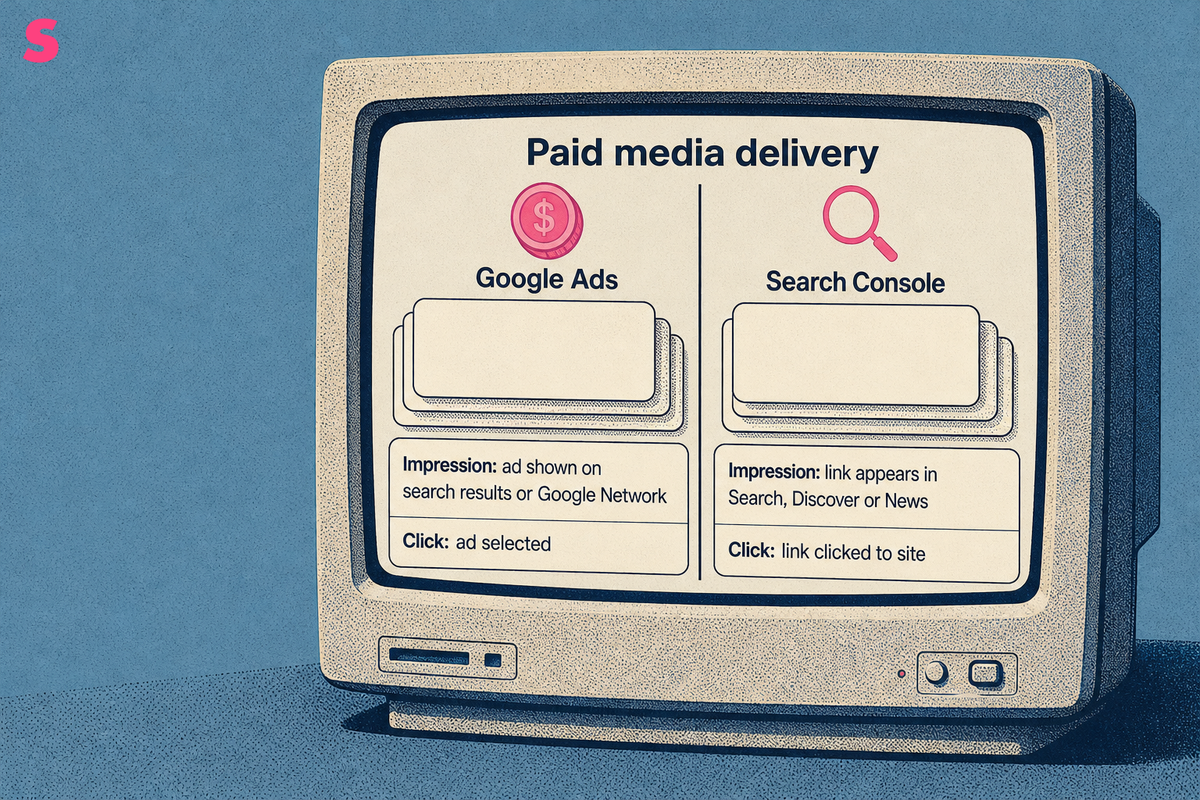
No. Google Ads reports paid-ad delivery and engagement. Google Search Console reports a site’s presence and outbound traffic in Google Search, Discover and News. The labels match, but the counted objects differ.
Google Search Console defines an impression as a link to a site appearing in Google Search, Discover or News, even when the user did not click or scroll to it. Google Ads counts an impression when an ad appears on a Google search-results page or the Google Network.
Google Search Console counts a click when someone clicks a link from Google to the site. Clicks that keep the user inside Google generally do not count as outbound clicks. Google Ads clicks are selections of paid ads, so paid-search and organic-search clicks belong in separate reporting systems.
- Google Ads: use impressions and clicks to assess paid-media delivery and response.
- Google Search Console: use impressions and clicks to assess organic search appearance and site visits.
- Combined reporting: preserve the source label, campaign type and destination rather than merging totals into one column.
Are impressions the same as views?
No. An impression means content was displayed or eligible to be seen. A view requires a viewing or engagement threshold. A video can create an impression without creating a view, and some video formats can count both a click and a view.
For video, an impression represents an opportunity to see content, while a view indicates that someone started watching. The threshold varies by platform, placement and format, so view counts cannot serve as a universal substitute for impression counts.
Google Demand Gen reporting uses a 30-second-or-completion threshold for YouTube in-stream video and a 10-second-or-completion threshold for YouTube feeds, Shorts and Discover video. The thresholds represent different levels of attention.
Google’s Demand Gen documentation states that a click-to-website can qualify as a video view in some formats. Treat impressions, views and clicks as distinct signals for exposure, attention and interaction.
Why do link clicks not match landing page views?
Link clicks can exceed landing page views because a click is recorded before a visitor completes a page load. The gap indicates friction between ad interaction and the destination experience, not necessarily a reporting error.
Google Ads defines a landing page as the webpage where users arrive after clicking an ad, generally the ad’s final URL. Google Ads records a click after receiving an initiated click and sending an HTTP 302 redirect to the advertiser’s landing page, website or an intermediate server.
A visitor can abandon the browser session, lose connectivity, encounter a slow page or fail to load the tracking script after the redirect. Each event preserves the ad click while preventing the landing page from registering a view. Investigate the mismatch as a post-click diagnostic.
- Confirm that the ad final URL resolves without a redirect loop.
- Check whether the landing-page analytics tag fires on every page variation.
- Compare device, browser and placement segments for concentrated gaps.
- Separate product clicks from other ad-element interactions where the platform reports both types.
How do impressions and clicks combine into click-through rate, and what does high impressions with low clicks mean?
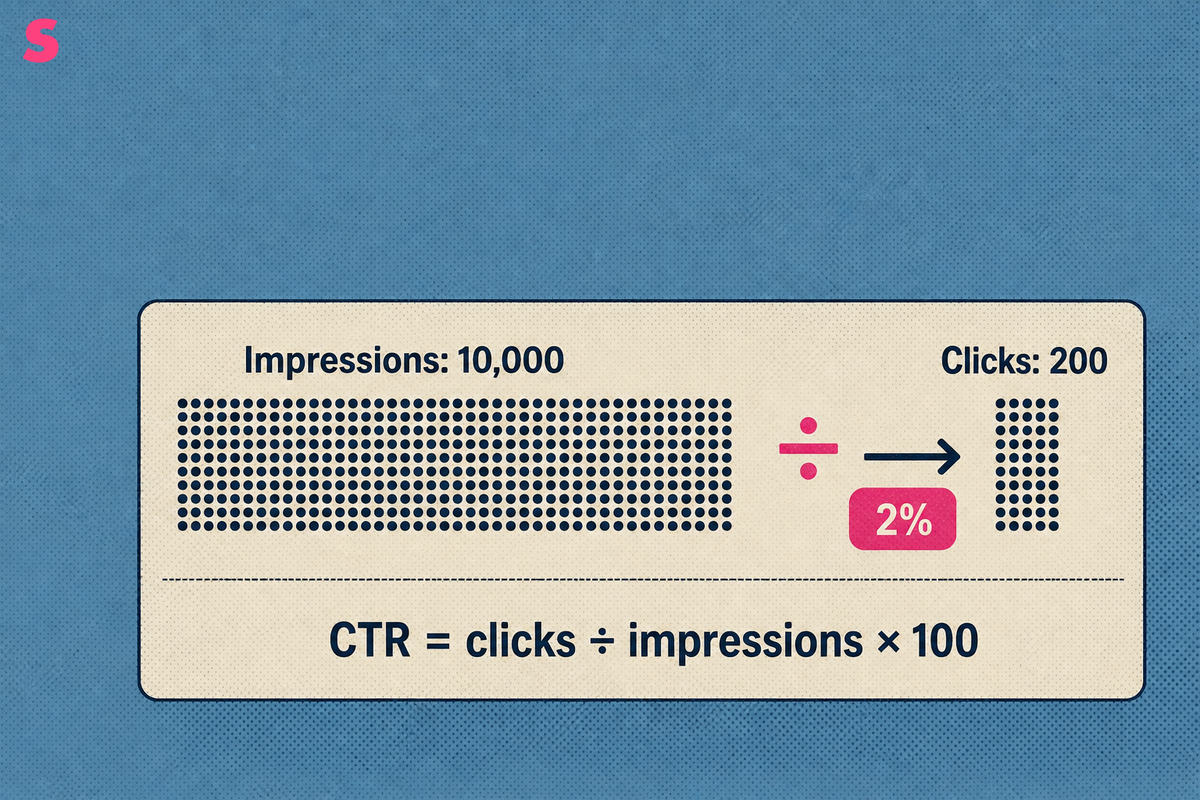
Click-through rate, or CTR, divides clicks by impressions and expresses the share of displayed ads or links that earned a click. High impressions with low clicks means the message is appearing but earning too little response to treat visibility as demand.
The formula is: CTR = clicks ÷ impressions × 100. If a campaign receives 200 clicks from 10,000 impressions, its CTR is 2%. The calculation standardizes interaction against exposure, allowing comparison across campaigns with different delivery volumes.
Google recommends treating impressions as especially important for brand-awareness goals and clicks as an indicator of appeal among people who see the ad. A low CTR calls for review of relevance, audience fit, creative, offer clarity and placement position.
Interpret CTR against the campaign objective. A broad awareness campaign can generate substantial visibility with modest interaction, while a narrow high-intent search campaign warrants a more demanding click standard.
What can impressions, clicks, landing page views and conversions each prove?
Impressions prove delivery, clicks prove interaction, landing page views prove arrival, and conversions prove completion of a defined action. Each metric measures one journey stage and cannot replace the next metric.
| Metric | Funnel stage | What it can prove | What it cannot prove alone |
|---|---|---|---|
| Impressions | Exposure | An ad or link appeared | Attention, traffic or revenue |
| Clicks | Interaction | Someone selected the ad or link | Completed page arrival or qualification |
| Landing page views | Arrival | The destination page loaded | Form completion, buying intent or pipeline |
| Conversions | Outcome | A defined action occurred | Which prior touch deserved all credit |
| Qualified pipeline | Revenue progression | A sales-qualified commercial opportunity advanced | Whether every influencing touch was captured |
Use the sequence to locate failure points. Low impressions indicate limited delivery. Healthy impressions and weak clicks indicate a message or audience problem. Healthy clicks and weak landing page views indicate post-click friction. Strong visits and weak conversions point to the offer, form, page or qualification process.
Product reporting can distinguish product clicks from non-product clicks. Product clicks take users to a specific item landing page, while non-product clicks reflect engagement with other ad elements. The distinction prevents teams from treating every interaction as equivalent traffic.
Why are impressions so hard to attribute across platforms?
Impressions are difficult to attribute across platforms because exposure occurs before a measurable site visit, often across multiple devices and sessions. A later conversion can follow many impressions, several clicks and offline sales activity, leaving no single exposure with an exclusive claim to the outcome.
First-party and server-side tracking can connect identifiable site activity, conversions and CRM progression after a visitor reaches a site. Platform-contained impressions remain governed by separate identities, reporting windows and delivery logs. A person exposed to the same campaign on several closed platforms may appear as separate users, while each platform can assign credit to its own reported exposure. That duplicated exposure and platform self-credit prevent deterministic impression-to-revenue attribution.
AI search adds a second blind spot. Buyers research in AI answers before visiting a site, and AI engines can cite a brand without sending a click. When AI-influenced buyers later type a URL or search the brand, older reporting often classifies the visit as direct or none rather than connecting it to earlier research.
Sona Marketing Measurement treats AI search as a native channel in the same identity graph as paid, content, email and sales. It resolves anonymous and known traffic into buyer profiles, stitches touches into account and contact timelines, and weights attribution by stage transition rather than last click.
Impression reporting remains evidence of exposure. Revenue attribution requires a defensible path from exposure through identifiable activity, conversion and commercial progression.
How do you compare the cost of impressions and clicks on one unit?
Compare impression cost and click cost through common spend measures: cost per thousand impressions, or CPM, and cost per click, or CPC. CPM evaluates paid exposure. CPC evaluates paid interaction. They are not equivalent metrics.
The formulas are simple: CPM = spend ÷ impressions × 1,000. CPC = spend ÷ clicks. A campaign with the same spend can have a low CPM and a high CPC, or the reverse, because delivery volume and response rate are separate variables.
- CPM: use for awareness campaigns where the purchased unit is exposure.
- CPC: use for traffic campaigns where the purchased unit is interaction.
- Cost per landing page view: use when page arrival matters more than initiated clicks.
- Cost per conversion: use when a defined action is the campaign’s operating objective.
There is no universal conversion from CPM to CPC because CTR connects the two metrics. Lowering CPM does not guarantee lower CPC. Raising CTR can lower CPC without changing the impression price. Keep spend, impressions, clicks, landing page views and conversions in the same report before reallocating budget.
Should a B2B marketer optimize for impressions or clicks?
B2B marketers should optimize for clicks when the immediate objective is qualified site traffic and for impressions when the objective is deliberate account awareness. Neither is the final operating metric. Conversions, qualified pipeline and revenue determine commercial value.
Choose impressions for a new-category campaign, account-list awareness program or message intended to create familiarity before demand exists. Google recommends treating impressions as especially important when brand awareness is the goal.
Choose clicks for high-intent search, content promotion, event registration or a landing page designed to capture an identifiable next step. Clicks show that an audience member selected the message, but they do not establish account fit, buying stage or sales impact.
Use a four-part decision rule:
- Set the business objective, awareness, traffic, conversion or pipeline.
- Choose the leading metric that corresponds to that objective.
- Track the next journey stage to detect leakage.
- Judge budget allocation using conversion quality and pipeline progression.
Optimize impressions to buy awareness and clicks to test and capture response. Use downstream conversion evidence to decide whether either metric merits further investment.
What are the frequently asked questions about impressions and clicks?
What is the difference between an impression and a click?
An impression is counted when an ad or link appears. A click is counted when someone selects it. Impressions measure exposure, while clicks measure interaction. Google Ads defines clicks as ad selections and impressions as how often the ad is shown.
Is an impression the same as a view?
No. An impression means content appeared or could have been seen. A view means someone started watching or met a platform-defined engagement threshold. Google Demand Gen uses 30 seconds or completion for YouTube in-stream video and 10 seconds or completion for feeds, Shorts and Discover video.
Can clicks be higher than landing page views?
Yes. Google Ads records a click after receiving the initiated click and sending an HTTP 302 redirect. A visitor can leave or fail to load the destination before a landing page view registers.
What does it mean when impressions are high and clicks are low?
The ad or listing is appearing but not earning selections. Review audience fit, message relevance, creative, offer clarity and position. High delivery does not show that the audience found the message compelling.
Are impressions in Google Search Console the same as impressions in Google Ads?
No. Google Search Console counts appearances of a site’s links in Google Search, Discover or News. Google Ads counts showings of paid ads on Google search results or the Google Network.
Do impressions or clicks matter more for B2B campaigns?
Neither metric is the end goal. Impressions suit awareness objectives, while clicks signal response to the message. Conversions and qualified pipeline determine whether a B2B campaign worked because they connect media activity to commercial progress.
Summarize this article with AI: ChatGPT · Claude · Perplexity · Google AI Mode
Last updated: November 2026







