


Marketing attribution assigns conversion credit to the touchpoints that preceded it, helping teams identify the channels and messages that drive revenue. A model determines how credit is divided, so a single deal may appear different using first-touch versus last-touch rules. Attribution shows which interactions were credited, not which ones caused the sale. Privacy shifts and AI search traffic categorized as direct create gaps, so use results as evidence to test.
What is attribution in marketing, and what job does it do?
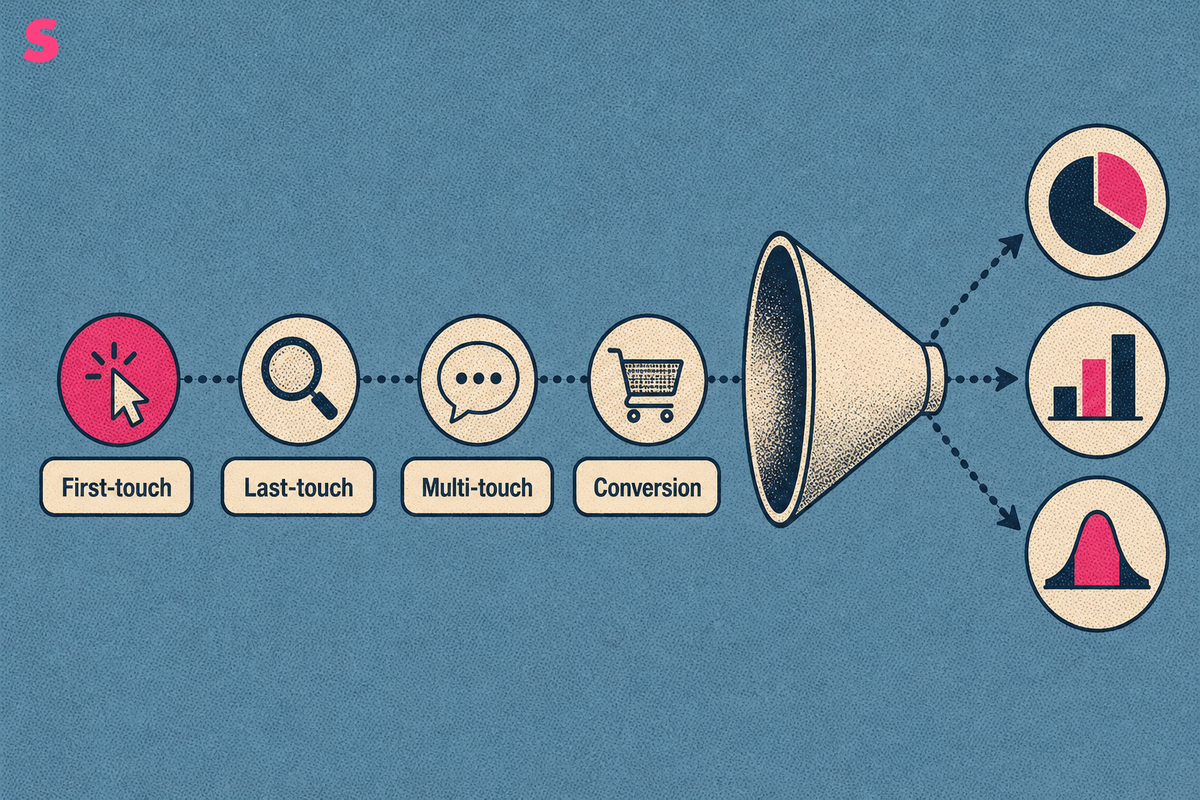
Marketing attribution assigns credit for a conversion or business outcome to the marketing interactions that influenced it. It helps B2B teams identify the channels, campaigns, messages and touchpoints that contributed to pipeline and revenue.
Its job is practical: allocate budget, defend spend and identify where buyer journeys gain momentum.
A conversion can be a demo request, qualified opportunity, closed-won deal or expansion. Attribution does not merely record the final click. It reconstructs the path to that event and applies a rule for distributing credit across the journey.
- First-touch attribution credits the interaction that introduced the buyer.
- Last-touch attribution credits the interaction immediately before conversion.
- Multi-touch attribution distributes credit across several interactions.
Marketing attribution is not a channel report, a CRM source field or proof that an activity caused revenue. Those records are inputs or adjacent measurement methods. Attribution is the crediting logic that turns buyer interactions into a decision about marketing effectiveness.
What is attribution data, and which touchpoints should B2B teams track?
Attribution data records interactions tied to a person or account and a conversion event. Strong attribution data identifies the source, medium, campaign, timestamp and CRM stage for each meaningful touchpoint.
B2B teams should track touchpoints that change awareness, evaluation or purchase intent. The goal is not exhaustive activity logging. It is a usable journey record that connects marketing activity to account progress and revenue outcomes.
- Acquisition touches: paid ad clicks, organic search visits, referral visits, event registrations and partner introductions.
- Engagement touches: content views, webinar attendance, email clicks, product pages and comparison research.
- Conversion touches: demo requests, trial signups, contact forms and meeting bookings.
- Revenue touches: sales calls, opportunity creation, proposal activity, closed-won status and renewal events.
Each record needs a consistent identity key. A person might arrive anonymously, later submit a form, then enter a CRM as a contact under an account. Without identity resolution, one buying journey fragments into disconnected sessions, devices and systems.
Self-reported attribution adds a useful field. A form question asking how a buyer heard about the company can capture podcasts, peer recommendations, AI answers and offline conversations that produced no measurable click. It should complement clickstream data rather than replace it.
How does one B2B deal receive different credit under five attribution models?
One B2B deal receives different credit under five attribution models because each model defines influence differently. The model does not change the buyer journey. It changes the rule used to distribute credit for the conversion.
Consider a hypothetical account that sees a LinkedIn ad, downloads a guide, attends a webinar and books a demo before becoming an opportunity. The table uses an illustrative 100% credit allocation, not observed performance data. Data-driven attribution does not use a universal percentage rule because it learns weights from historical journey and conversion patterns.
| Attribution model | LinkedIn ad | Guide download | Webinar attendance | Demo booking |
|---|---|---|---|---|
| First-touch | 100% | 0% | 0% | 0% |
| Last-touch | 0% | 0% | 0% | 100% |
| Linear | 25% | 25% | 25% | 25% |
| Data-driven | Learned weight | Learned weight | Learned weight | Learned weight |
| Time-decay | 10% | 20% | 30% | 40% |
Last-click reporting tells a narrow story: the demo booking generated the opportunity. First-touch reporting tells another: the LinkedIn ad created the opportunity. Both describe real interactions, but neither captures the complete path.
Multi-touch attribution considers every touchpoint on the customer journey and distributes credit among them. Marketing attribution can also describe a set of user events or touchpoints. The central question is how each interaction should influence a budget decision.
Which attribution model should a B2B team use, and how should it be implemented?
No single attribution model fits every B2B team. Apply multiple models to the same buyer journeys, then select the view that matches the decision, whether demand creation, conversion optimization or pipeline investment.
First-touch and last-touch models are useful diagnostic lenses because they are easy to explain. Multi-touch models help examine long journeys, but their weighting rules still reflect assumptions. Data-driven attribution learns weights from historical journey and conversion patterns rather than applying a fixed rule to every deal.
| Decision | Useful model | Credit rule | Best question answered |
|---|---|---|---|
| Demand creation | First-touch | 100% to the first recorded interaction | Which channels introduce new accounts? |
| Conversion capture | Last-touch | 100% to the final recorded interaction | Which channels close measurable demand? |
| Broad journey review | Linear | Equal credit across every recorded touch | Which channels consistently participate? |
| Pattern-based contribution | Data-driven | Weights learned from historical journeys and conversions | Which interactions show measurable contribution patterns? |
| Late-stage acceleration | Time-decay | More credit to recent touches | Which channels help opportunities advance? |
Relying on one model is a common error because each model privileges a different part of the journey. Compare first-touch, last-touch and at least one multi-touch view before concluding that a channel deserves more or less investment.
- Define the business outcome: decide whether the measurement target is demand creation, opportunity creation, closed-won revenue, expansion or another commercial outcome.
- Standardize conversions and CRM stages: use consistent definitions for key events, opportunity stages and revenue outcomes across marketing and sales systems.
- Establish identity and UTM rules: capture source, medium, campaign and timestamps consistently, then define how anonymous activity joins known contacts and accounts.
- Compare multiple models: inspect first-touch, last-touch and multi-touch results against the same buyer journeys rather than treating one crediting rule as definitive.
- Reconcile against CRM and self-reported data: compare recorded touchpoints with stage progression, revenue records and how-did-you-hear-about-us responses.
- Validate important decisions with experiments: test major budget recommendations through exposed and comparison groups or controlled holdouts where operating conditions permit one.
- Review assumptions periodically: revisit conversion definitions, identity rules, model weights and channel taxonomy as the sales process and media mix change.
How is marketing attribution different from ad attribution and marketing mix modeling?
Marketing attribution assigns credit across the buyer journey. Ad attribution assigns credit to paid advertising interactions. Marketing mix modeling estimates relationships between aggregate marketing spend and aggregate outcomes over time. Each method answers a different measurement question.
Ad attribution often operates inside one advertising platform. The platform applies its own conversion windows, identity rules and crediting logic, then reports conversions associated with its ads. Platform reports support campaign management, but the same deal can receive credit in several platforms at once.
| Method | Primary unit | Core input | Primary question |
|---|---|---|---|
| Marketing attribution | Person, contact or account | Touchpoints and conversion events | Which interactions influenced this outcome? |
| Ad attribution | Ad interaction | Impressions, clicks and platform conversions | Which paid ads received platform credit? |
| Marketing mix modeling | Market or time period | Aggregate spend and outcomes | How did channel investment relate to total results? |
| Incrementality testing | Audience, geography or campaign group | Exposed and comparison groups | What lift did an intervention create? |
Marketing attribution uses identifiable touchpoints and assigns credit to them. Marketing mix modeling uses aggregate data and operates at a different level of analysis.
The methods work best as a measurement portfolio. Ad attribution supports in-platform optimization. Marketing attribution supports journey analysis. Incrementality testing examines causal lift. Marketing mix modeling supports broader budget planning when individual buyer paths are incomplete.
Why do long B2B buying journeys make attribution incomplete?
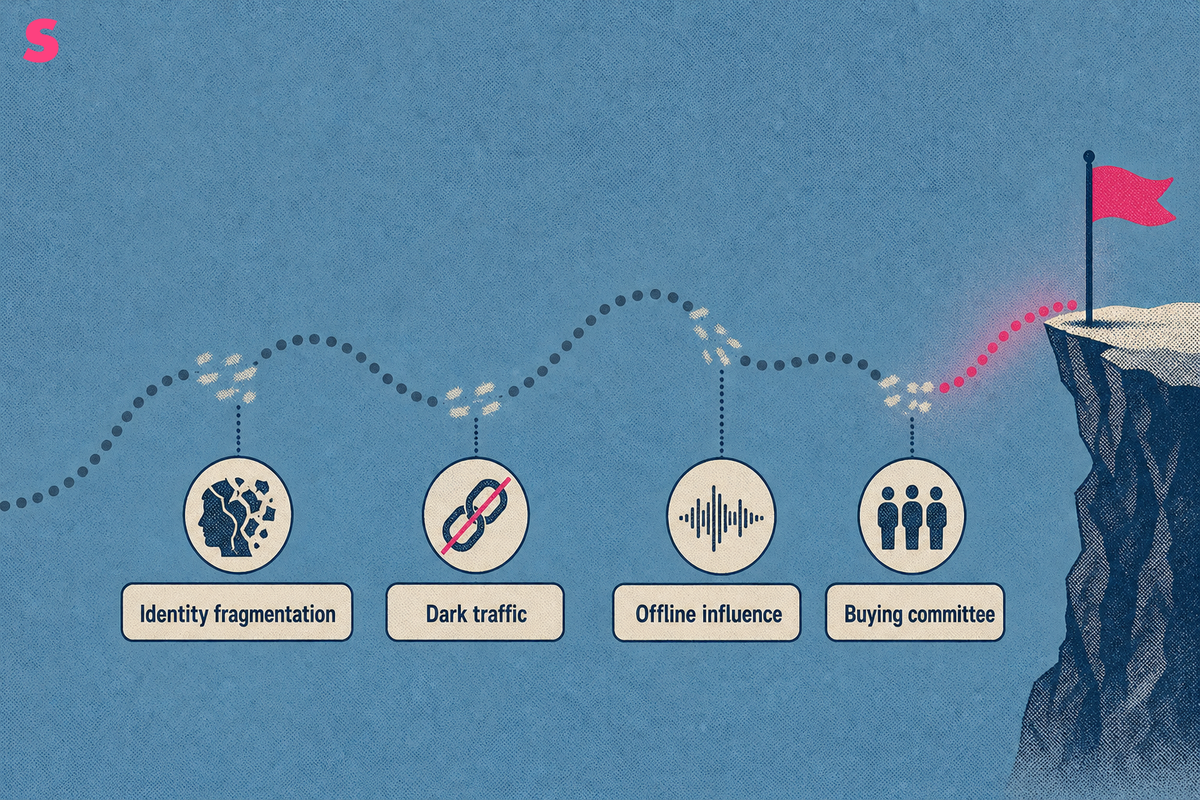
Long B2B buying journeys make attribution incomplete because several people, devices, channels and offline interactions can influence one deal. A single conversion record rarely captures the full buying committee or every event that moved the account forward.
An account can begin with a research visit from an anonymous employee, continue through content consumed by another stakeholder, and enter the CRM only when a third person requests a demo. Sales calls, peer recommendations and executive conversations can influence the deal without leaving a digital trail.
- Identity fragmentation: one account appears as multiple browsers, devices, contacts and CRM records.
- Dark traffic: copied links, private messages and untagged visits lose referrer details.
- Offline influence: events, conversations and podcasts may not generate a measurable click.
- Buying committees: the person who converts is not always the person who researched.
Cross-device and cross-channel tracking gaps can distort marketing effectiveness analysis. A last-click report can overstate conversion channels because it observes the final measurable event more reliably than earlier research.
Incomplete does not mean useless. Attribution results are an evidence trail with known blind spots. Better identity resolution, disciplined campaign taxonomy, CRM hygiene and self-reported source fields reduce those blind spots without eliminating them.
How have iOS 14.5 and cookie loss changed marketing attribution?
iOS 14.5 and third-party-cookie restrictions changed different signals used in marketing attribution. iOS 14.5 introduced App Tracking Transparency, which restricted access to cross-app identifiers such as IDFA. Third-party-cookie restrictions in browsers affect browser recognition and cross-site journey stitching, but third-party-cookie deprecation is not universally complete.
| Privacy change | Signal affected | Attribution consequence | Useful workaround |
|---|---|---|---|
| iOS 14.5 App Tracking Transparency | Cross-app identifiers, including IDFA | Harder to connect app activity and advertising exposure across apps | First-party identifiers, server-side events, CRM conversion data and consented identity resolution |
| Third-party-cookie restrictions | Browser recognition and cross-site journey stitching | Harder to recognize repeat visitors and connect early web research with later conversions | UTMs, first-party event records, consented identity resolution, self-reported attribution and CRM data |
Traditional web attribution often relied on cookies to recognize repeat visitors and connect ad clicks with later conversions. When identifiers expire, disappear or remain unavailable across browsers and devices, the path between an early interaction and a later CRM outcome becomes harder to reconstruct.
- Capture UTM parameters when a visitor arrives.
- Store first-party event data with a timestamp and consent-aware identity key.
- Pass qualified conversion events into the CRM and, where appropriate, advertising platforms.
- Reconcile digital interaction data with form fields, opportunity stages and closed revenue.
Advertising attribution changed as well. Platform-reported conversions reflect each platform’s measurement rules, so totals from separate ad platforms should not be added as though they describe one deduplicated revenue figure.
Cookie loss does not make attribution impossible. It changes the evidence available for crediting. B2B teams need stronger data governance, consistent UTMs, durable first-party records and clear rules for joining anonymous activity to known accounts and contacts.
Why does AI search traffic show up as direct, and what does that do to attribution?
AI search traffic can appear as direct when analytics data lacks a referral source or prompt. That classification hides the interaction that introduced or influenced a buyer, which can understate AI search in marketing attribution.
A buyer can receive an answer from an AI system, copy a company name or URL, then visit the site directly. Analytics records a direct visit because no measurable referrer exists. The research activity remains real, but conventional click data cannot fully describe it.
Direct traffic becomes a catch-all category for journeys with incomplete source data. Teams should compare direct visits with self-reported source fields, landing-page patterns, CRM notes and changes in branded search activity before assigning credit.
Sona Marketing Measurement treats AI search as a first-class channel in the same identity graph as paid, content, email and sales. Sona captures AI-referred visits, infers the likely prompt behind each visit and connects buyer activity to account-level journeys and revenue.
AI search attribution still has boundaries. An inferred prompt is an analytical signal, not a verbatim record of a buyer's question. Marketing leaders should preserve that distinction when using AI search data for channel reporting or budget allocation.
Can attribution prove that a channel caused a sale?
Marketing attribution cannot prove that a channel caused a sale. Attribution assigns credit based on observed interactions and a chosen model, while causality requires evidence that the outcome would have changed without the channel.
A webinar may receive credit because attendees later become opportunities. That relationship can be meaningful, but attendees may already have higher intent than non-attendees. Attribution identifies association within a recorded journey. It does not remove every competing explanation.
| Measurement approach | What it establishes | Key limitation | Best use |
|---|---|---|---|
| Last-touch attribution | Final measurable interaction | Overweights conversion capture | Conversion-path diagnosis |
| Multi-touch attribution | Participation across a journey | Depends on weighting rules | Channel contribution analysis |
| Holdout test | Difference between exposed and comparison groups | Requires a valid comparison design | Incrementality assessment |
| Marketing mix modeling | Spend and outcome relationships over time | Uses aggregate rather than person-level data | Strategic budget planning |
Use attribution to generate a decision hypothesis, then test the highest-stakes hypothesis. If attribution assigns meaningful pipeline credit to a campaign, compare exposed and unexposed audiences or use a controlled holdout when operating conditions permit one.
The disciplined conclusion is narrower than a causal claim: a channel participated in recorded buyer journeys and warrants further validation. That distinction protects budget decisions from false precision.
What are the frequently asked questions about what is attribution in marketing?
What is attribution data?
Attribution data records touchpoints tied to a person or account and a conversion event such as a demo booked or deal won. The minimum useful fields are source, medium, campaign, timestamp and CRM stage. Teams also need a consistent contact or account identifier to join web activity, form submissions and revenue outcomes.
What is the difference between marketing attribution and ad attribution?
Marketing attribution spans paid and unpaid channels across the buyer journey, including content, email, events, sales activity and referrals. Ad attribution credits conversions to paid ads, often inside one advertising platform. Platform-reported numbers use each platform’s rules, so separate platform totals do not form one deduplicated revenue view.
What is multi-touch attribution?
Multi-touch attribution is a marketing effectiveness measurement technique that considers every touchpoint on the customer journey. It distributes credit across those touchpoints rather than assigning all credit to the first or final interaction.
Which attribution model is best?
No single attribution model is best. First-touch helps evaluate demand creation, last-touch helps evaluate conversion capture, and multi-touch models reveal broader participation. Compare several models against the sales cycle and the decision at hand. Relying on one model turns its crediting assumptions into false certainty.
Is marketing attribution the same as marketing mix modeling?
Marketing attribution is not marketing mix modeling. Attribution uses individual touchpoints and assigns credit to them. Marketing mix modeling uses aggregate spend and outcome data over time to estimate channel relationships. The two methods operate at different levels and answer different budget questions.
Can a small B2B team do attribution without specialist software?
Yes, at a basic level. Consistent UTM parameters, source fields in the CRM and a self-reported how-did-you-hear-about-us field create a useful first view. That setup will not reliably reconcile anonymous activity, cross-device journeys, buying committees, offline influence or competing platform conversion claims.
Summarize this article with AI: ChatGPT · Claude · Perplexity · Google AI Mode
Last updated: November 2026







