To monitor answer engine rankings, run a fixed set of buyer prompts on a schedule across ChatGPT, Gemini, Perplexity, and other answer engines, recording mentions, citations and position. Because AI responses differ between runs, report trends from repeated runs rather than one answer. Most trackers only count mentions; Sona AI Visibility links those prompts and citations to pipeline and revenue while tracking AI crawler activity. Compare tools by cost per prompt and engine, since vendors charge differently.
What do you need in place before you track answer engine rankings?
To track answer engine rankings, prepare a fixed buyer-question list, a named competitor set, a baseline spreadsheet or tool account, a budget range, and access to web analytics and CRM data. Answer engine measurement requires metrics, analytics, and revenue connections beyond brand presence.
- Buyer questions: collect the questions prospects ask before they evaluate, compare, or buy.
- Competitor set: name the vendors that appear in sales calls, category pages, and win-loss notes.
- Baseline: record the first set of mentions, citations, sources, and placement classifications.
- Budget: define whether the work needs lightweight monitoring, content analysis, or attribution.
- Measurement access: connect analytics and CRM records before interpreting visibility as demand.
Sona AI Visibility connects citations and AI-referred visits to pipeline and revenue on one account timeline, making visibility useful for demand generation rather than reporting alone. Start with a narrow prompt list that reflects active buying questions, then expand after the team establishes a repeatable review process.
Which answer engines should a B2B company track first?
Start with the answer engines where buyers research vendors: ChatGPT, Google AI Overviews, Google AI Mode, Perplexity, Gemini, Claude, Copilot, and other relevant answer engines. Coverage varies by tracking product and plan, so buyer behavior matters more than the largest published engine count.
- Review self-reported attribution fields, sales-call notes, and support conversations for engine names.
- Prioritize engines that appear in buyer research and category searches.
- Check whether each selected engine is included on the tracking plan, rather than available only as an upgrade.
- Run the same prompt set across every selected engine and retain the raw answer text.
Google AI Overviews should be tracked separately from Google AI Mode because they are distinct Google answer experiences. Treating one Google surface as all AI search activity creates an incomplete baseline.
Coverage should follow commercial relevance. A B2B software company selling to technical teams may need Claude and Copilot in its initial set, while a company with search-led discovery may prioritize Google AI Overviews, Google AI Mode, Gemini, and Perplexity.
How do you build a prompt set that represents real buyers?
A buyer-representative prompt set combines commercial, informational, comparison, and category or problem-led questions. Measure the questions that shape a buyer’s shortlist, evaluation criteria, and purchase decision, not flattering prompts.
| Prompt type | Purpose | Example prompt | Buyer stage | What to review |
|---|---|---|---|---|
| Commercial | Find vendor options | What are the best B2B attribution platforms for SaaS? | Decision | Brand inclusion, placement, competitor overlap |
| Informational | Understand a problem | How does AI search attribution work? | Awareness | Citations, source quality, message accuracy |
| Comparison | Evaluate alternatives | Which marketing measurement platform works best for multi-touch reporting? | Consideration | Recommendation wording, sentiment, named competitors |
| Category or problem-led | Capture unbranded demand | How can a demand generation team measure AI-referred traffic? | Awareness to consideration | Brand presence, cited pages, missing topics |
Use a balanced set across buying stages. A prompt list made only of branded or favorable comparison questions measures recognition, not category demand. Keep wording stable long enough to identify movement, then add questions as product positioning and buyer language change.
A brand-level visibility score does not identify the required work. A prompt-level view does. Sona AI Visibility shows the prompts buyers ask, the sources cited in answers, and the pages associated with those questions, so teams can identify missing answers rather than react to an aggregate number.
What does ranking mean in an AI answer, and which metrics capture it?
An answer engine ranking is inclusion and placement within a generated response, not a fixed organic search position. Measure whether the assistant names, cites, or recommends the brand, then classify placement and qualified-demand potential.
| Metric | What it measures | Useful classification | Business question answered | Normalization rule |
|---|---|---|---|---|
| Mention rate | How often the brand appears | Mentioned or absent | Are we included? | Divide mentions by total runs per prompt |
| Share of answer | Brand presence across target answers | Brand share across answers | How visible are we against competitors? | Use the same prompt and engine set |
| Citation rate | How often an answer cites owned content | Cited or uncited | Which pages support visibility? | Separate owned from third-party citations |
| Placement | Where the brand appears in the answer | First, prominent, mid-list, fine-print | How strongly are we recommended? | Apply one placement rubric to all engines |
| Sentiment and overlap | Description quality and competitor context | Positive, neutral, negative | Does the answer help or damage demand? | Review wording, not counts alone |
Position tagging can classify a brand as first when it leads the recommendation, prominent when it receives substantive treatment near the top, mid-list when it appears among several options, and fine-print when it receives a passing mention. This rubric makes different answer formats comparable.
Mention frequency is not business value. A brand can appear often yet be described inaccurately, framed negatively, cited through weak pages, or associated with low-intent informational questions. Keep raw answers with the metrics so analysts can audit each classification.
How often should you rerun prompts, and what do you do when answers keep changing?
Run the same prompt list daily and report trends across repeated observations. Answer engine responses change with retrieval indexes, model updates, location, account state, personalization, and competitor publishing activity. One response records a moment, not a permanent rank.
- Run each fixed prompt daily for every selected engine.
- Record the answer text, cited sources, placement, date, location, and account state.
- Review repeated changes before changing content or positioning.
- Review content, positioning, and competitor changes monthly or quarterly.
Daily runs reveal patterns that a weekly snapshot can obscure. Define a documented internal rule for the number of repeated observations required before treating a change as a trend. A one-day spike remains noise until repeated observations show otherwise.
The common failure is presenting a single answer as a fixed ranking. Report inclusion ranges across repeated runs and state the confidence limits created by geography, personalization, and model variation. The output is a comparable log that shows the direction of change.
How should tracking tools be evaluated against published plan details?
A published-plan evaluation compares the same documented criteria for every tool, rather than presenting hypothetical test scores as hands-on results. The method assesses published engine coverage, answer analysis, cadence, historical records, reporting, API access, bot-traffic analytics, and pricing structure.
- Prompt structure: include commercial, informational, comparison, and category or problem-led questions.
- Run protocol: use the same fixed prompts daily, preserve dates and raw outputs, and compare repeated observations.
- Answer criteria: assess mention capture, cited-source capture, placement tagging, sentiment review, and competitor overlap.
- Operating criteria: assess geographic controls, history, exports, reporting, API access, and refresh cadence.
- Measurement criteria: assess whether the product supports AI-referred traffic, crawler activity, account identification, and revenue attribution.
The comparison below uses published plan details as of October 2026. It does not claim that the products were run against an identical live prompt sample, so capabilities not stated in those plan details are marked Not published.
Sona AI Visibility can be assessed on a separate measurement criterion because it connects AI citations to pipeline and revenue, rather than treating answer inclusion as the final outcome. That distinction matters when demand generation teams must defend spend with CRM evidence.
How do answer engine tracking tools compare on engines, metrics and price?
Answer engine tracking tools differ in engine coverage, prompt capacity, refresh cadence, and whether they focus on visibility reporting or commercial outcomes. Prices below are published plan details as of October 2026, and daily prompt costs use the stated comparison denominator.
| Tool | Starting price | Agency Plans? (Yes/No) | # of Answer Engines Tracked | Answer Engines | # of Daily Tracked Prompts (entry plan) | Cost per Daily Tracked Prompt | Differentiation |
|---|---|---|---|---|---|---|---|
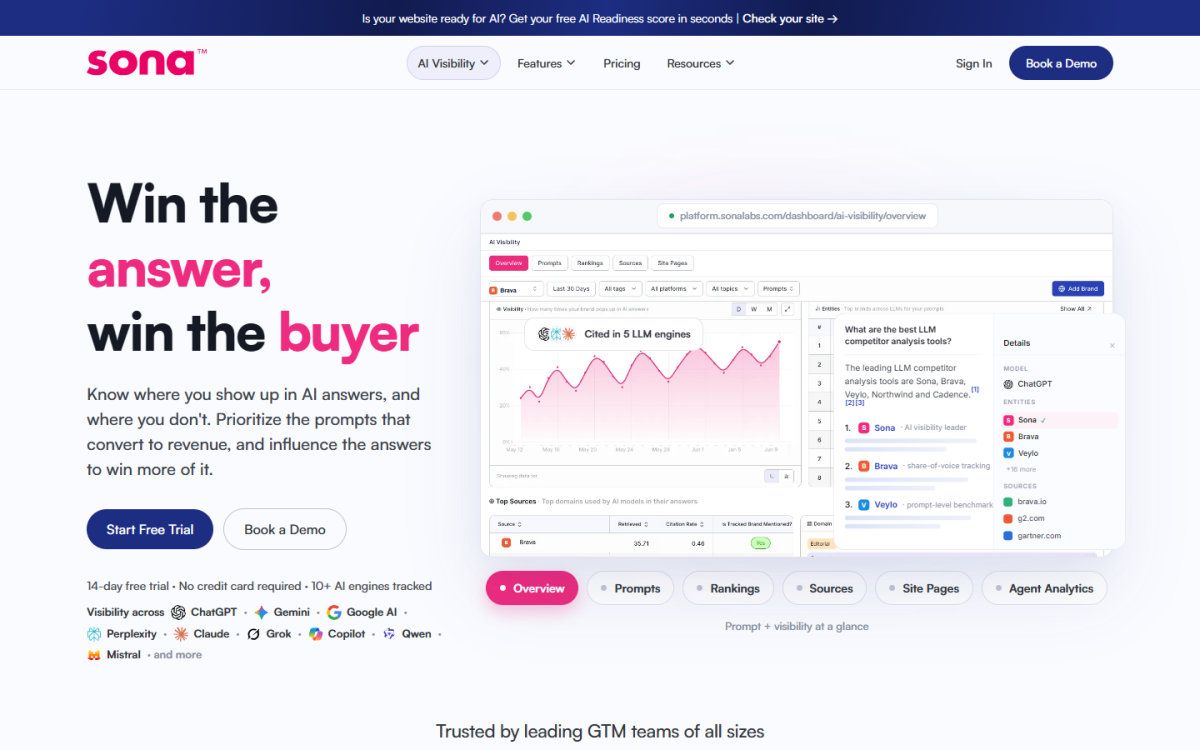
| Sona AI Visibility | From $75/month, billed annually | Yes | Up to 11 (3 on Starter) | Not published | 5,000 credits/month, about 166 daily tracked prompts on one model or 56 across three | About $0.45 per daily tracked prompt | Connects AI citations and prompts to pipeline and revenue on one account timeline, with AI crawler activity from server logs. |
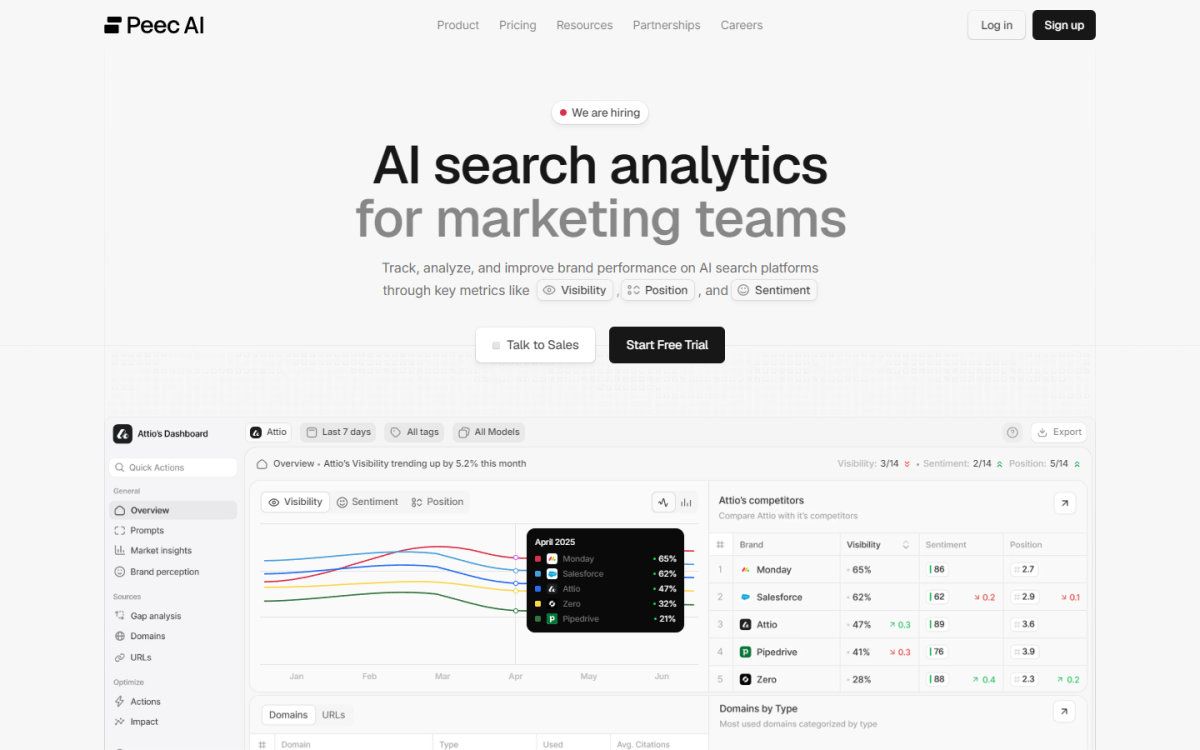
| Peec AI | From $95/month, monthly | Yes | Up to 13 (3 on Starter) | Not published | 50 prompts daily | About $0.63 per daily tracked prompt | Focus: AI visibility tracking across self-serve and agency plans. |
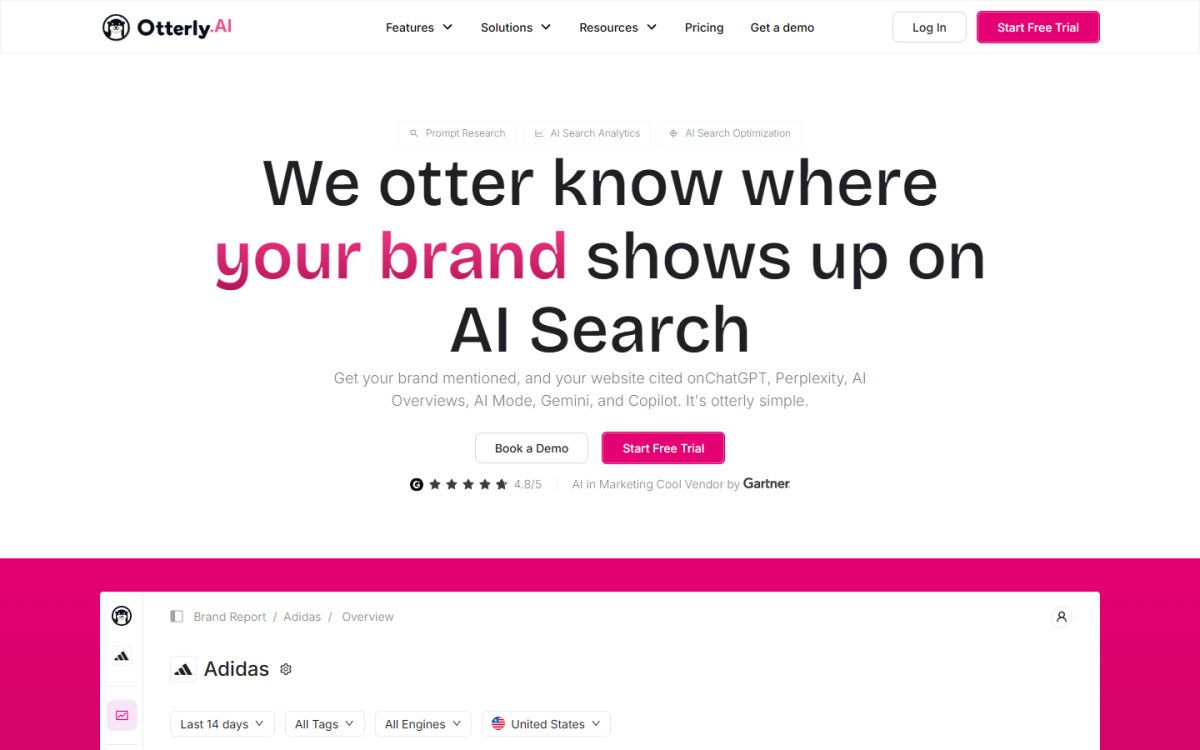
| Otterly.ai | From $29/month, monthly | Yes | Up to 7 (4 on Lite, 3 as paid add-ons) | ChatGPT, Google AI Overviews, Perplexity, Microsoft Copilot | 15 prompts daily | About $0.48 per daily tracked prompt | Focus: prompt monitoring across core answer engines. |
| Scrunch AI | From $250/month, monthly | Yes | Up to 9 (4 on Core) | ChatGPT, Perplexity, Google AI Overviews, Microsoft Copilot | 125 prompts, frequency not stated | No refresh cadence published | Focus: AI search visibility across core and enterprise plans. |
| PromptWatch | From $95/month, monthly | Yes | Not published | Not published | 50 prompts daily | About $0.48 per daily tracked prompt | Focus: prompt and response monitoring with monthly response allowances. |
| Goodie | From $295/month, billing period not stated | Yes | Up to 14 (5 on Core) | Not published | 110 prompts daily | About $0.67 per daily tracked prompt | Focus: multi-model AI visibility tracking for brands and agencies. |
Published plan details identify different levels of analysis and operations. Sona AI Visibility provides prompt and citation analysis tied to pipeline and revenue, daily tracking on Starter, six months of history, and API access. Peec AI publishes daily prompt allowances and engine coverage, while answer-analysis features, history, exports, API access, and attribution are Not published in the reviewed plan details.
Otterly.ai publishes Lite engine coverage and daily prompt monitoring, while answer-analysis features, history, exports, API access, and attribution are Not published in the reviewed plan details. Scrunch AI publishes Core engine coverage and prompt capacity, but refresh cadence, answer-analysis features, history, exports, API access, and attribution are Not published. PromptWatch publishes daily prompt capacity and monthly response allowances, while engine names, answer-analysis features, history, exports, API access, and attribution are Not published. Goodie publishes daily prompt capacity and model counts, while Core engine names, answer-analysis features, history, exports, API access, and attribution are Not published.
Prices are difficult to compare because plans package capacity differently. Some use daily prompt slots, some use credits, some add engines by tier, and some separate history, response volume, or agency workspaces. ZipTie starts from $42.75/month as of October 2026, but its prompts are sold in daily, weekly, and monthly pools, preventing a direct capacity comparison without matching the billing unit.
Most trackers capture fixed prompt sets across several engines and extract brand mentions, competitors, and cited sources from each response. Sona AI Visibility adds pipeline and revenue measurement to that baseline, changing the question from whether a brand appeared to whether the appearance produced commercial value.
Which tracking setup fits brand monitoring, content performance or competitive benchmarking?
The right answer engine analytics setup follows the operating decision the team needs to make. Lightweight monitoring supports brand awareness, source analysis supports content teams, competitor share of answer supports category benchmarking, and attribution supports demand generation teams accountable for pipeline.
- Brand monitoring: use a stable set of category, commercial, and branded prompts with daily inclusion and placement tracking.
- Content performance: track cited pages, source domains, message accuracy, and prompt-level gaps that editorial teams can address.
- Competitive benchmarking: measure competitor overlap, placement, share of answer, and recurring comparison prompts.
- Demand generation: connect AI-referred visits, identified accounts, buying stages, pipeline, and closed-won revenue.
Coverage requirements differ by goal. Brand reputation monitoring needs reliable answer capture on the engines buyers use. Content teams need citation and source detail. Demand generation teams need the analytics and CRM connection that shows whether AI research becomes pipeline.
Sona Marketing Measurement provides the measurement foundation for AI search as a channel, while Sona AI Visibility supports prompt and citation analysis tied to accounts and revenue. Choose the setup that matches the decision owner, not the largest collection of surface-level metrics.
How do you turn ranking data into action and confirm tracking is working?
Turn answer engine ranking data into a prioritized work queue. Update the page that should answer a missed prompt, strengthen cited-source relevance, correct inaccurate descriptions, and remove technical barriers that prevent AI crawlers from reading important pages. Tracking is working when repeated runs show stable trends, rising share of answer on target questions, and citations that map to pipeline.
- Group missed prompts by buyer stage and commercial importance.
- Match each missed prompt to an existing page, a new page, or a positioning correction.
- Review cited pages and third-party sources for factual gaps, weak coverage, and message drift.
- Check crawlability, server-rendered HTML, canonical tags, structured data, and page recency.
- Re-run the fixed prompt list daily and review content priorities monthly.
Sona AI Visibility connects prompts and citations to pipeline and revenue, and tracks AI crawler and agent activity. Agent Analytics shows which AI crawlers visit the site and which pages they read through server logs or a lightweight edge worker, without a JavaScript tag.
Success is a stable multi-run pattern, useful page-level fixes, and a clear path from AI-referred research to qualified accounts and revenue. A severity-ranked fix attached to the affected page makes the historical series actionable.
What are the frequently asked questions?
What is answer engine rank tracking?
Answer engine rank tracking measures whether an AI assistant names, cites, or recommends a brand when someone asks a question. It uses recurring prompts and answer analysis, not an organic search position. A useful record includes inclusion, placement, citations, sentiment, competitors, and the raw response.
Why does the same prompt return different answers each time?
Model version, location, personalization, account state, retrieval indexes, and timing can change an answer. Reliable reporting uses repeated daily runs and trend lines. A single result is a dated observation. A series of repeated results shows whether the response changed meaningfully.
How many prompts should a B2B team track?
Track enough prompts to cover commercial, informational, comparison, and category questions at every buying stage. Avoid a small hand-picked list that only measures favorable questions. Expand the prompt set as plan limits allow while preserving the original core prompts for trend continuity.
Can you track answer engine rankings manually without a tool?
Yes. A team can use a fixed prompt list, a spreadsheet, and repeated runs across each selected engine. Manual tracking is slow and difficult to keep consistent across engines, locations, dates, answer formats, citation capture, and placement classifications.
Is mention frequency enough to judge AI visibility?
No. Review whether the brand description is accurate, how the sentiment reads, whether the brand appears prominently, and whether cited pages send qualified traffic. Mention frequency without citation, message, and commercial context can produce a misleading visibility picture.
How do you connect AI answer visibility to revenue?
Track AI-referred visits in analytics, identify the accounts behind those visits where available, and connect the resulting activity to CRM opportunities and pipeline. Then map the prompts and citations associated with those visits to the buyer journey rather than treating answer inclusion as the final metric.
Summarize this article with AI: ChatGPT · Claude · Perplexity · Google AI Mode
Last updated: November 2026