


An AEO checker runs a fixed set of buyer prompts through answer engines such as ChatGPT, Perplexity, Google AI Overviews and Gemini, then reports where your brand is mentioned, cited, recommended or ignored, and usually scores your pages on how easily those engines can crawl, parse and trust them. Entry plans cluster between $29 and $99 a month and differ mainly on prompt counts, engine coverage and refresh rate. Vendor visibility scores are not comparable to each other. Sona AI Visibility ties those citations, and the prompts behind them, to pipeline and revenue.
What does an AEO checker do, and how does it differ from a rank tracker?
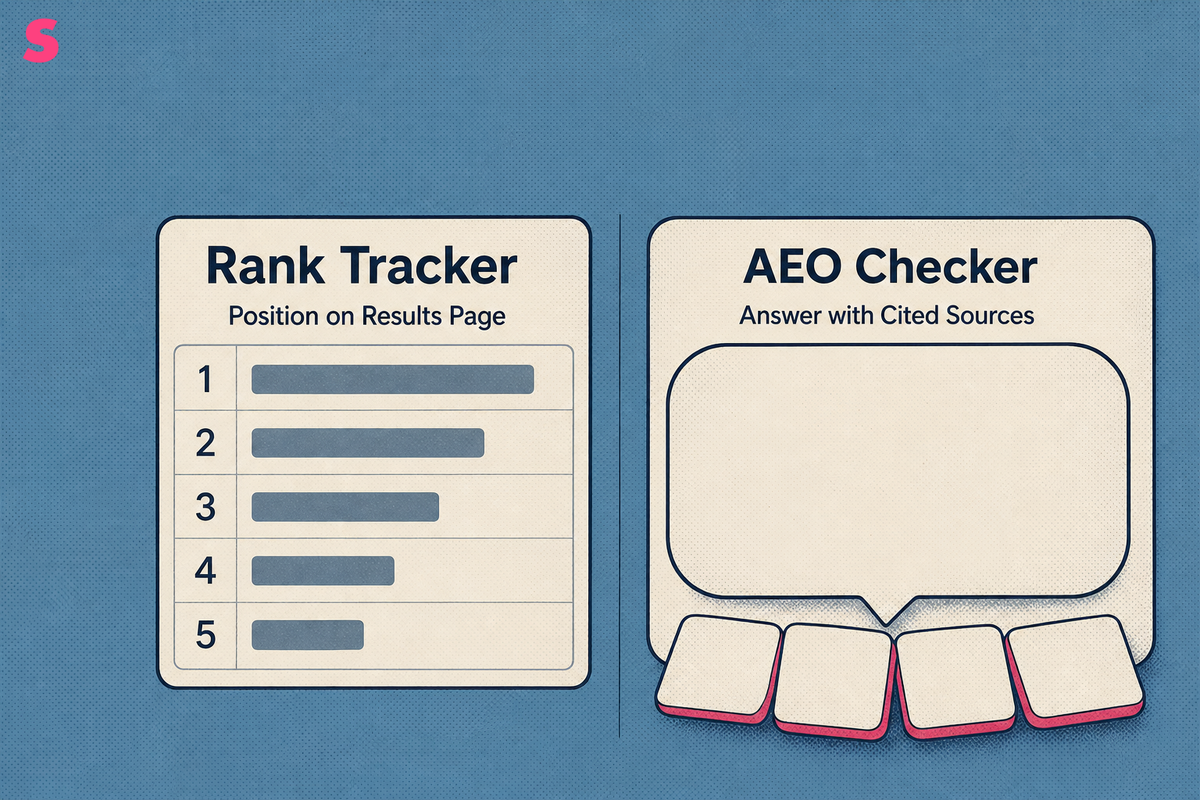
An AEO checker answers two questions: does an AI answer engine mention, cite or recommend your brand when a buyer asks a question in your category, and can those engines technically reach and parse your pages. Answer engine optimization (AEO) tooling reports prompts and citations. Rank tracking reports positions.
The difference is the unit of measurement. A rank tracker records where a URL sits for a keyword on an ordered results page, in a stable sequence a reader can count down. ChatGPT, Perplexity, Claude, Gemini and Google AI Overviews return one synthesised answer with a handful of sources attached. There is no equivalent ranked slot to occupy.
- Keyword versus prompt. A rank tracker watches "b2b attribution software". An answer engine checker watches "what is the best attribution software for a 40-person B2B SaaS team".
- Position versus presence. Presence is binary per answer, then averaged across runs into a visibility percentage.
- Link versus citation. A cited source may be your page, a review site, or a Reddit thread that names you.
- Stable versus volatile. The same prompt can produce a different answer tomorrow, which is why cadence matters more here than in rank tracking.
What does an AEO checker measure inside an AI answer?
Six metrics, and every serious tool in the category reports most of them:
- Mentions. Whether the brand name appears in the generated answer at all.
- Citations. Which URLs the engine linked as sources, and how often yours is among them.
- Share of voice. Your mention rate against named competitors on the same prompt set.
- Sentiment. Positive, neutral or negative framing of the brand in the answer text.
- Position within the answer. Whether you lead the recommendation or appear in a closing list.
- Recommendation frequency. How often the engine names you as the suggested choice rather than as context.
Coverage of answer surfaces decides what those numbers mean. Sona's archive covered 8 answer surfaces on the date it was measured, namely ChatGPT, Google AI Overviews, Perplexity, Google AI Mode, Gemini, Mistral, Qwen and Claude, per Sona's own AI visibility data, September 2026. A score averaged over three engines and a score averaged over eight are not the same measurement.
One brand-level visibility number is not a work item. A single percentage hides which prompts produced it and which sources the engine trusted, so it tells a team nothing about what to write next. A prompt-level view fixes that: visibility, mentions and share of voice reported on each tracked prompt row name the weak prompts and the pages that should own them, rather than averaging them away.
What does an AEO readiness score check on your own pages?
A readiness score grades whether an answer engine can fetch, parse and trust a page, before any question of whether it gets cited. The Free AI Readiness Checker from Sona grades a single URL and returns severity-ranked findings across the categories below. Those categories are where the work sits.
| Category | What it checks | Example finding | Why it affects citation |
|---|---|---|---|
| Crawlability | robots.txt, llms.txt, canonical tag, indexability | Retrieval bot disallowed in robots.txt | A page a crawler cannot fetch cannot be cited |
| Performance | Core Web Vitals, server-rendered HTML, JavaScript dependency | Main content rendered client-side only | Some fetchers do not execute JavaScript |
| Security | Strict-Transport-Security, Content-Security-Policy, X-Content-Type-Options | Missing Security Response Headers, medium severity | Evidence of basic security and implementation hygiene on the page |
| Content Structure | Schema.org coverage and validation, metadata, semantic structure | Missing FAQPage Schema, critical severity | FAQPage JSON-LD makes question and answer structure machine-readable, without guaranteeing extraction |
| Content Quality | Substance of the copy and how recently it changed | Content Has Not Been Updated Recently, medium severity | Engines with web retrieval weight recency |
| Accessibility | Alt text, WCAG compliance, ARIA, contrast, explicit image dimensions | Image Accessibility and Performance Issues | Alt text describes visual content the parser cannot see |
A free one-shot grader returns a dated snapshot. What a team acts on is the severity-ranked finding attached to each page, with a specific fix beside it, because a letter grade is not a task and a finding such as Missing FAQPage Schema, critical severity, is.
Which capabilities actually separate one AEO checking tool from another?
Ignore the shared features. Every vendor tracks mentions, sentiment and share of voice, so those decide nothing. Seven things genuinely differ between plans:
- Engine coverage on the plan you will buy, not the plan above it. Sona AI Visibility covers 11 answer surfaces, five on standard plans and six more on premium, from $75/month for brands. Profound's $99/month Starter tracks ChatGPT only, while AthenaHQ's $295/month Starter spans a broader set including Google AI Overviews and Google AI Mode (prices and coverage read from each vendor's own pricing page, August 2026).
- Prompt ceilings. Otterly.ai's $29/month Lite tier carries 15 prompts. Peec AI's $80/month Starter carries 50 across three chosen models. Scrunch AI's $250/month Core carries 125 unique prompts (vendor pricing pages, August and September 2026).
- Refresh cadence. Daily is the category standard, not a premium feature: Otterly.ai checks daily on every tier and Peec AI tracks its Starter prompts daily (vendor pricing pages, August and September 2026).
- Competitor and multi-brand slots. Agencies need one workspace per client; single-brand plans do not provide it.
- Citation-source detail. Whether the tool names the exact URL an engine cited, or only that a citation happened.
- Localisation. Answers differ by country and language, so country coverage is a hard constraint on multinational reporting.
- Export and API access. CSV export and an API decide whether findings reach the warehouse or stay in a dashboard. Sona AI Visibility includes API and MCP access, plus unlimited seats, on every plan.
Cadence and prompt ceilings interact, and that is where plans diverge in practice. On credit-metered pricing, every prompt run against every model every day draws down the same balance, so the question is not whether the vendor supports daily checks but how much of your prompt list the plan can hold at daily cadence across the engines you care about.
How do AEO checking tools compare on engines, prompts and price?
The paid entry plans displayed in the table below run from $29 to $295 a month, and what that buys varies more than the price does. The comparison, starting with Sona, uses prices read from each vendor's own pricing page in August and September 2026. The cost per daily tracked prompt column puts every row on one denominator: one prompt, on one model, once a day.
| Tool | Starting price | Agency Plans? (Yes/No) | # of Answer Engines Tracked | Answer Engines | # of Daily Tracked Prompts (entry plan) | Cost per Daily Tracked Prompt | Differentiation |
|---|---|---|---|---|---|---|---|
| Sona AI Visibility | Brands from $75/month, agencies from $199/month, both billed annually. 14-day free trial, no credit card. Unlimited seats and API/MCP access on every plan | Yes | 11 | ChatGPT, Gemini, Google AI Mode, Google AI Overviews and Perplexity on standard, plus Claude, DeepSeek, Grok, Copilot, Qwen and Mistral on premium | 5,000 credits/month on Starter 5K, which is about 166 prompts tracked daily on one model, or 56 across three. 1 credit = 1 AI answer | $0.45 per daily tracked prompt | Connects citations and the prompts behind them to pipeline and revenue on one account timeline, and tracks AI crawler activity from server logs or a lightweight edge worker with no JavaScript tag |
| Otterly.ai | From $29/month (Lite), $189 (Standard), $489 (Premium), Enterprise from $1,000. Free trial, no commitment. 15% off annual; unlimited team members on every plan | Yes | 4 | ChatGPT, Google AI Overviews, Perplexity and Microsoft Copilot | 15 prompts on Lite, 100 on Standard, 400 on Premium, checked daily on every plan | $0.48 per daily tracked prompt | Focus: daily prompt checks with unlimited team members on every plan |
| Peec AI | From $80/month (Starter), $205 (Pro), $420 (Advanced), Enterprise custom. Annual billing | Yes | 3 | ChatGPT, Google AI Mode, Google AI Overviews, Microsoft Copilot, Perplexity, Gemini | 50 prompts on Starter, tracked daily, on 3 chosen models | $0.53 per daily tracked prompt | Focus: daily prompt tracking on three models chosen from its supported list |
| Profound | From $99/month (Starter), $399 (Growth), Enterprise custom, billed yearly. Free trial on Growth. Starter tracks ChatGPT only; Growth tracks 3 answer engines | Yes | 1 | ChatGPT only | 50 prompts and 1,500 responses/month on Starter; 100 prompts and 9,000 responses/month on Growth | $1.98 per daily tracked prompt | Focus: answer engine visibility reporting, widening to three engines on Growth |
| PromptWatch | Essential $95/month, Professional $245, Business $579. Agency plans from $199/month (Kick-off) | Yes | 4 | ChatGPT, Claude, Gemini and Perplexity | 50 prompts and 6,000 responses/month on Essential, with 500 agent credits | $0.48 per daily tracked prompt | Focus: prompt and response monitoring with a separate agency ladder |
| Scrunch AI | Core $250/month for brands, Agency Core $500/month, Enterprise custom. 7-day trial of Starter, no credit card | Yes | 4 | ChatGPT, Perplexity, Google AIO and Copilot | 125 unique prompts on Core, 250 on Agency Core | $1.50 per daily tracked prompt | Focus: brand and agency workspaces with a larger unique-prompt allowance |
| AthenaHQ | From $295/month (Starter), Enterprise custom. Free Essential tier with 300 credits. 17% off annual; 1 credit = 1 AI response | Yes | 10 | ChatGPT, Perplexity, Google AI Overviews, Google AI Mode, Gemini, Claude, Copilot, Grok and DeepSeek | 3,600 credits on Starter, where 1 credit is 1 AI response. 300 credits on the free Essential tier | $2.46 per daily tracked prompt | Focus: broad engine coverage metered in credits, with a free entry tier |
Watch the packaging, not the headline. Some AI search modules are add-ons to an existing SEO subscription, where an $89/month module sits on top of a $129/month core plan and the real bill is $218/month. Others price per domain, per workspace or per credit, which is why a prompt count and a credit balance are not comparable numbers.
How reliable are AEO checker results when AI answers keep changing?
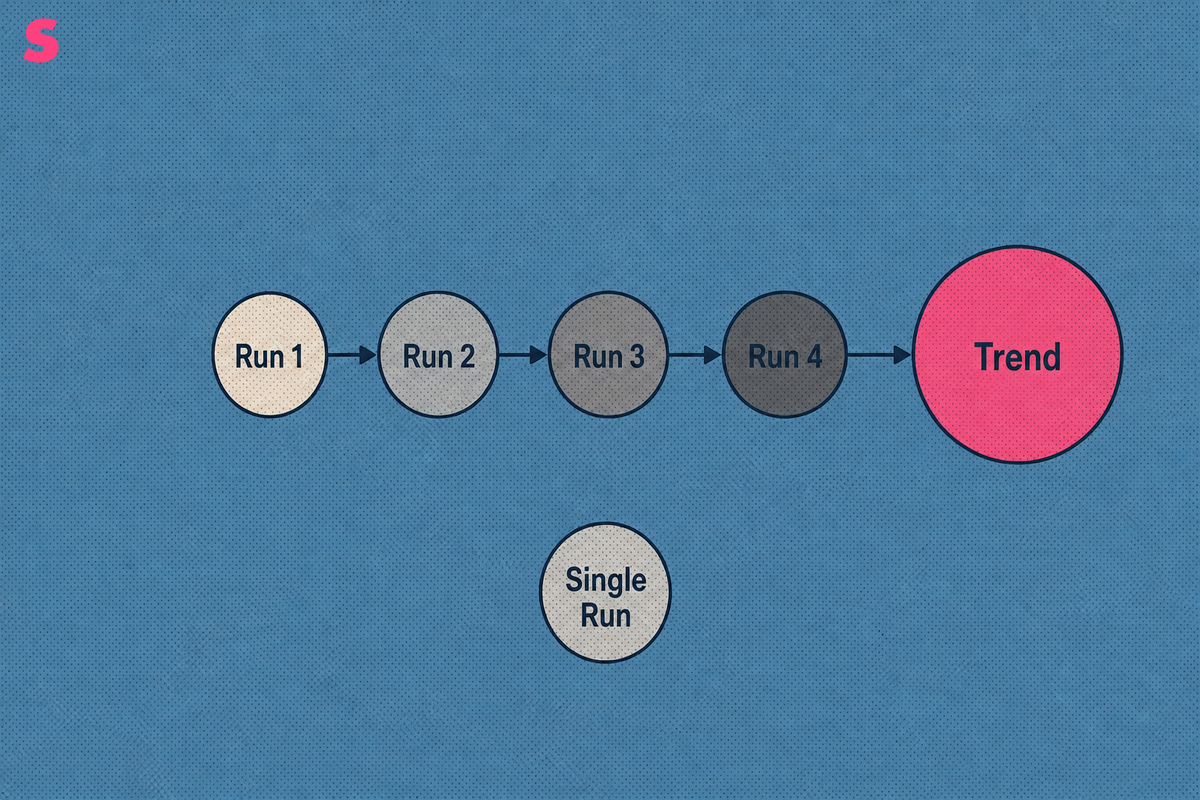
Reliable as a trend, unreliable as a single reading. The same prompt returns different answers depending on location, model version, personalisation and the hour it ran, so any one result is a sample of one. Movement that holds across consecutive runs is a signal. A single run is weather.
Cross-tool comparison is the second reliability problem. Every vendor computes a proprietary visibility score using its own prompt set, its own engine weighting and its own run frequency, so a 42 in one dashboard and a 42 in another are not measuring the same thing. Collection method compounds it. Some offerings capture the end-user experience directly, scraping the prompt response the way a person would see it, ads, formatting and all. Others pull data from the vendor's official API, which returns a structured response that does not necessarily match what an end user sees on screen. The two methods can capture different answers.
The practical rule: never compare your score across tools. Fix the prompt set, fix the engines, fix the locale, and read your own series inside one fixed reporting window.
How do you test AEO checking software before committing to a plan?
Run one controlled bake-off. On trial or entry tiers, a week of parallel testing costs attention rather than budget.
- Write 25 buyer-intent prompts. Commercial and decision-stage questions your sales team actually hears, not category definitions.
- Load the identical set into every shortlisted tool, with the same competitors named and the same country selected.
- Run them in the same week. Comparing a tool tested in March against one tested in June compares model versions, not vendors.
- Compare citation sources, not scores. Check whether each tool names the exact URL the engine cited and whether the sources agree between tools.
- Export everything. If the CSV or API cannot reproduce what the dashboard shows, the data cannot be joined to anything.
- Test one fix. Add FAQPage schema to a page, then see which tools register the change and how quickly.
This method has precedent. A hands-on comparison ran a fixed 25-prompt set through several AEO checking tools and reported Otterly.ai at $29/month with 15 prompts and four engines, and Peec AI's entry plan at $80/month billed annually with 50 prompts across three models, per linkedin.com, September 2026. The prompt ceiling, not the price, decided which tools could carry the full set.
How do you connect AEO checker results to pipeline and revenue?
You connect them by resolving the account behind the visit, then following that account through the CRM. A mention is not revenue, and a share of voice increase proves nothing on its own. The chain that matters runs prompt to citation to visit to pipeline to closed revenue, and most monitoring stops at the second link.
Buyers make this harder by researching in ChatGPT or Perplexity and then arriving as direct traffic. That is the zero-click gap, and two mechanisms close it: self-reported attribution on demo and signup forms, auto-categorised and reconciled against click data, and identity resolution that names the company behind an anonymous session.
Most checkers stop at mention counts and readiness scores. Sona AI Visibility connects those citations, and the prompts likely behind them, to pipeline and revenue on one account timeline, resolves the accounts behind AI-referred visits without cookies, and tracks which AI crawlers reach each page from server logs or a lightweight edge worker with no JavaScript tag, so ad blockers do not hide the traffic. AI Attribution reports AI search as a channel with spend, deals and ROAS beside every other channel, which is what a budget conversation needs.
Who should not buy an AEO checker?
Four groups should spend the money elsewhere.
- Teams with no content or digital PR capacity. Monitoring reports the gap; closing it takes published pages, schema work and third-party coverage. A $250/month subscription that produces a backlog nobody works is waste.
- Single-location local businesses. A plumber in one city has a prompt universe of maybe a dozen questions. Local search fundamentals move that needle further than a prompt tracker sized for 125 queries.
- Companies with no branded demand. If nobody asks about your category by name yet, the tracked prompts will return zeros for months. Build the demand first, then measure it.
- Anyone expecting monitoring to replace technical SEO or attribution. These tools report missing schema, slow rendering and absent citations. They do not deploy the fix, and a read-only dashboard is not a measurement stack.
One honest limitation applies to the whole category: a checker tells you the problem exists and where. The remediation still happens in your CMS, your content calendar and your outreach.
Frequently Asked Questions
Is there a free AEO checker worth using?
Yes, for a single question: is this page structured and crawlable enough to be cited. Free graders run once, against a handful of prompts or a single URL, and return a dated score. What shows movement is a comparable series of runs over time, and the paid entry plans compared in this article start at $29 a month (vendor pricing pages, August 2026).
How many prompts does an AEO checker need to track to be useful?
Enough to cover your real question universe, which for B2B means every stage of a buying committee's research, not just the category term. Entry plans commonly cap between 15 and 50 prompts: Otterly.ai's Lite tier carries 15 and Peec AI's Starter carries 50 (vendor pricing pages, August and September 2026). Size the prompt list first, then buy the tier that holds it.
Do AEO checkers monitor Google AI Overviews as well as ChatGPT?
Coverage varies sharply by plan. Profound's Starter tier tracks ChatGPT only, Otterly.ai's Lite tier covers four engines including Google AI Overviews, and AthenaHQ's Starter tier spans a broader set including Google AI Mode and Claude (vendor pricing pages, August 2026). Confirm the engine list on the exact plan you intend to buy, because coverage often widens only at the tier above.
How often should you re-run an AEO check?
Track the prompt list daily. One run reflects one model version, one location and one moment, so a weekly sample cannot tell a real shift from noise, and a change that holds across repeated consecutive runs is a trend. Full technical re-audits and competitive benchmark reviews run on a slower clock, monthly or quarterly.
Can an AEO checker fix the problems it finds?
Most are read-only. They report missing FAQPage schema, client-side rendering, stale content and absent citations, ranked by severity, and the remediation happens in your content, digital PR and technical SEO workflows. The useful distinction when buying is whether findings arrive as a prioritised list attached to specific pages, or as a single brand-level number.
Does an AEO checker replace your existing SEO tooling?
No. Answer engines retrieve from the open web, so crawl health, internal linking and classic rankings still feed what gets cited. Answer engine monitoring sits alongside rank tracking and site auditing, measuring a different surface with a different unit, the prompt rather than the keyword.
Summarize this article with AI: ChatGPT · Claude · Perplexity · Google AI Mode
Last updated: September 2026







