The 7 layer prompt universe framework for SEO converts one buyer task into an organized, trackable set of prompts across seven layers: task, stage, persona, phrasing, fan-out, engine and market, and runs and record. Each layer addresses a different source of noise, preventing one prompt result from being treated as a durable market signal. Teams that omit layers often track a few guessed prompts once. Teams that retain them can compare results over time and connect gaps to specific pages.
What is the 7-layer prompt universe framework, and how does it apply to SEO?
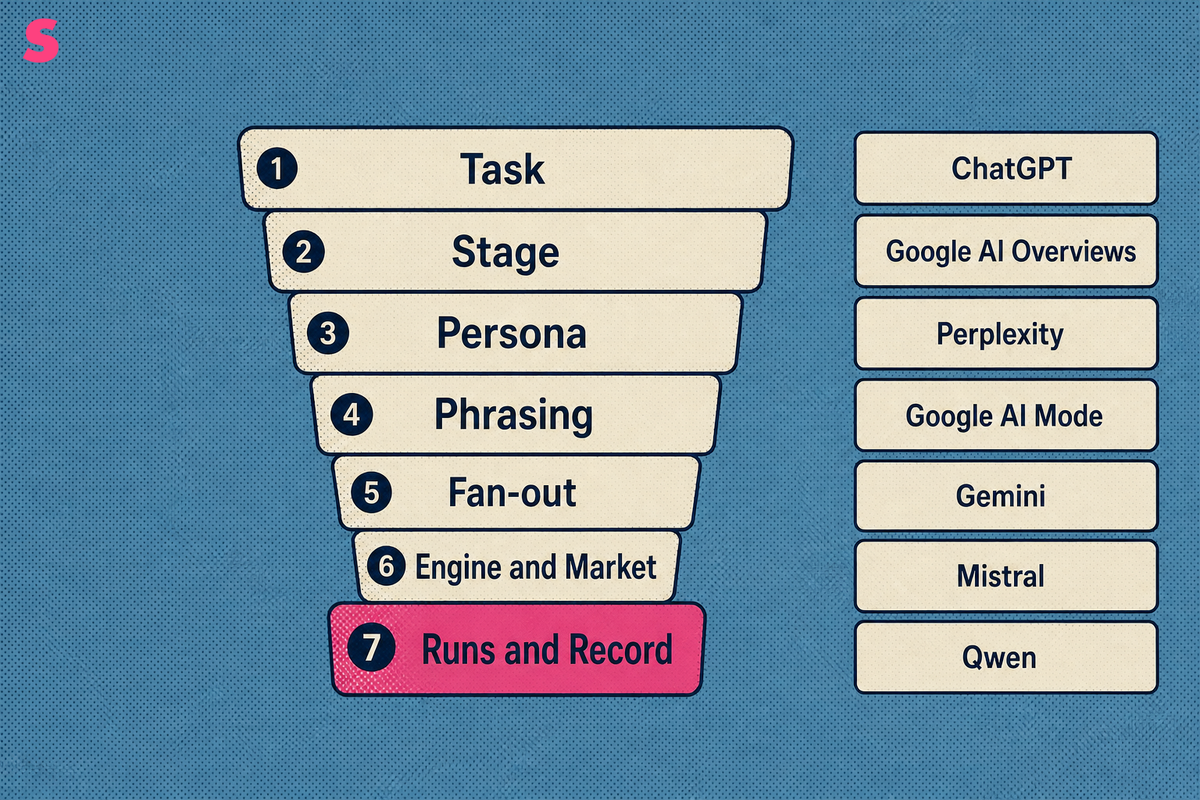
The 7-layer prompt universe framework for SEO organizes the buyer questions a company tracks across traditional search and AI answer engines. A prompt universe is a structured set of questions that reflects how buyers discover a category, define requirements, compare options, and make requests.
Without structure, a prompt list cannot show whether a visibility change came from the buyer task, persona, wording, engine, market, or run conditions. The October 2026 listing defines seven layers: task, stage, persona, phrasing, fan-out, engine and market, and runs and record.
Each layer narrows a broad commercial question into an observable unit and makes the resulting record traceable to the buyer question that produced it.
AI answers vary by surface. Sona's own AI visibility data, September 2026, covers 8 answer surfaces: ChatGPT, Google AI Overviews, Perplexity, Google AI Mode, Gemini, Mistral, Qwen and Claude. A prompt universe keeps observations separate until the team has a valid basis for comparison.
What does each of the seven layers do, and what does it hand to the next?
The seven layers turn a broad category into a repeatable measurement system. Each layer resolves one decision and passes a more specific input to the next, so the final record remains traceable to its original commercial question.
| Layer | Input | Output | Owner | What this layer settles |
|---|---|---|---|---|
| Task | Buyer job | Commercial task statement | Product marketing | What the buyer is trying to accomplish |
| Stage | Task statement | Awareness, consideration, decision, or purchase context | Demand generation | How close the question sits to a buying decision |
| Persona | Stage and task | Named buyer role | Product marketing | Whose constraints and vocabulary matter |
| Phrasing | Persona and task | Real buyer wording | Sales and customer research | How the buyer actually asks |
| Fan-out | Core wording | Related sub-queries and destination pages | SEO and content | What supporting questions the engine may need answered |
| Engine and market | Prompt set | Named engine, country, and language context | SEO operations | Where the answer is observed |
| Runs and record | Engine-specific prompt | Dated response log and score | Marketing operations | Whether a result is repeatable over time |
Task starts with a buyer outcome, such as selecting analytics software for a sales-led SaaS company. Stage establishes whether the buyer is learning, comparing, or preparing to purchase.
Persona assigns the question to a role with distinct requirements. Phrasing replaces internal terminology with language from support conversations, sales calls, and community discussions.
Fan-out expands one question into the sub-queries required for a complete answer. Engine and market prevents teams from pooling results from different answer surfaces or countries.
Runs and record converts a one-time answer into a comparable log. The October 2026 listing specifies mention, citation, recommendation, and date as four run-level fields.
How does one buyer task expand into prompts, sub-queries and pages?
One buyer task expands by dividing the commercial job into intent cells, collecting real language for each cell, and mapping sub-queries to pages that answer them. Fan-out captures the related questions an answer engine may use to construct, validate, or qualify an answer.
Use the task “choose a marketing measurement platform for a B2B SaaS company” as a working example. The October 2026 listing identifies 9 SaaS intent groups: awareness, use case, comparison, alternative, integration, pricing, security, implementation, and segment fit.
- Awareness: “What is marketing measurement?”, “How do SaaS teams measure pipeline?”, “What is multi-touch attribution?”
- Use case: “How do we measure AI search traffic?”, “How can demand generation prove sourced pipeline?”, “How do we identify anonymous website visitors?”
- Comparison: “What should we compare in attribution software?”, “Which measurement platform fits B2B SaaS?”, “How do attribution tools differ?”
- Alternative: “What can replace spreadsheet attribution?”, “What are alternatives to last-click reporting?”, “How do teams move beyond UTM-only measurement?”
- Integration: “Does attribution software connect to our CRM?”, “How does measurement data reach ad platforms?”, “Can revenue data be joined to web activity?”
- Pricing: “How much does attribution software cost?”, “What should a B2B SaaS team budget for measurement?”, “Which plans support enterprise reporting?”
- Security: “How is visitor data handled?”, “What data does identity resolution require?”, “What should security review in a measurement platform?”
- Implementation: “How long does attribution setup take?”, “What data should we prepare before implementation?”, “How do we migrate from existing analytics?”
- Segment fit: “What works for sales-led SaaS?”, “Which platform supports long buying cycles?”, “How should a mid-market SaaS company measure pipeline?”
Each cell should contain three real wordings from support, sales calls, and community discussion, per the October 2026 listing. The examples above provide a draft structure, not evidence that buyers use those exact words. Research must replace internal assumptions before tracking begins.
Fan-out can map “How do we measure AI search traffic?” to sub-queries about attribution methodology, AI-referred visits, source documentation, and implementation requirements. Destination pages should match the answer: a methodology page for attribution, product documentation for integration, a comparison page for vendor evaluation, and a pricing page for commercial questions. Sona AI Visibility includes AI Search Insights.
What does a prompt look like before and after the layers are applied?
A layered prompt specifies the buyer, commercial stage, and wording. Its observation metadata separately records the engine, market, language, prompt version, and run date, making the answer possible to interpret or compare over time.
| Failure | Unlayered prompt | Layered prompt and metadata | What changes |
|---|---|---|---|
| No persona or stage | Best attribution platform | Prompt: For a demand generation leader at a sales-led SaaS company comparing vendors, which attribution platforms connect campaigns to pipeline? Metadata: Task: select an attribution platform. Stage: comparison. Persona: demand generation leader. Engine: ChatGPT. Market: US. Language: English. Prompt version: v1. Run date: 14 October 2026. |
Names the buyer, use case, and comparison stage |
| Invented phrasing | Optimal omnichannel revenue-credit solution | Prompt: How can our team show which marketing channels influenced pipeline? Metadata: Task: measure marketing influence. Stage: consideration. Persona: demand generation leader. Engine: ChatGPT. Market: US. Language: English. Prompt version: v1. Run date: 14 October 2026. |
Uses language that research can validate in buyer conversations |
| Single undated run | Which tools measure AI search? | Prompt: Which tools help B2B SaaS teams measure AI-referred traffic and pipeline? Metadata: Task: evaluate AI search measurement. Stage: comparison. Persona: demand generation leader. Engine: ChatGPT. Market: US. Language: English. Prompt version: v1. Run date: 14 October 2026. |
Creates an engine-specific, dated observation |
| No fan-out | How do I choose analytics software? | Prompt: What data integrations, attribution rules, reporting requirements, and implementation steps should a B2B SaaS team evaluate before choosing analytics software? Metadata: Task: select analytics software. Stage: consideration. Persona: marketing operations leader. Engine: ChatGPT. Market: US. Language: English. Prompt version: v1. Run date: 14 October 2026. |
Creates supporting sub-queries and page assignments |
The layered version is not longer for style. It gives the researcher a stable unit: one buyer situation, one market, one engine, one date, and a defined set of related questions.
A dated score is a snapshot. A repeated prompt log helps the team identify whether a change belongs to the wording, engine response, cited source, or underlying content.
Why does a seven-layer prompt universe work better than other prompt frameworks?
A seven-layer prompt universe separates buyer-intent variables, task, stage, persona, phrasing, and fan-out, from observation variables, engine, market, runs, and record. Teams can trace each result to the decision that produced it instead of treating a prompt list as an unexplained artifact.
A 40-prompt audit model uses 10 category-framing prompts, 20 comparison prompts, and 10 best-for-vertical prompts, per the October 2026 listing. That allocation prevents a list from becoming entirely educational queries or entirely vendor comparisons.
A separate SaaS workflow recommends a 30–100 prompt starting set, depending on market size, per the October 2026 listing. A GEO measurement guide recommends 50–200 prompts per client and freezing the list for comparable results, per the October 2026 listing. Those ranges address prompt allocation, list size, and refresh cadence, but they do not show which decision created each prompt.
Market breadth can exceed any operational list. A market mapping exercise identified 22,442 prompts in Uber’s US market, while a 200-prompt list covered less than 1% of that market, per linkedin.com. A prompt universe does not represent every possible question. It creates a defensible sample across tasks, stages, personas, engines, and markets.
The seven-layer model also supports diagnosis. When an answer changes, the team can inspect the engine and market layer. When a prompt produces irrelevant content, the team can inspect persona, stage, phrasing, or fan-out without rebuilding the measurement system.
Is a prompt universe just keyword research, and what else is it confused with?
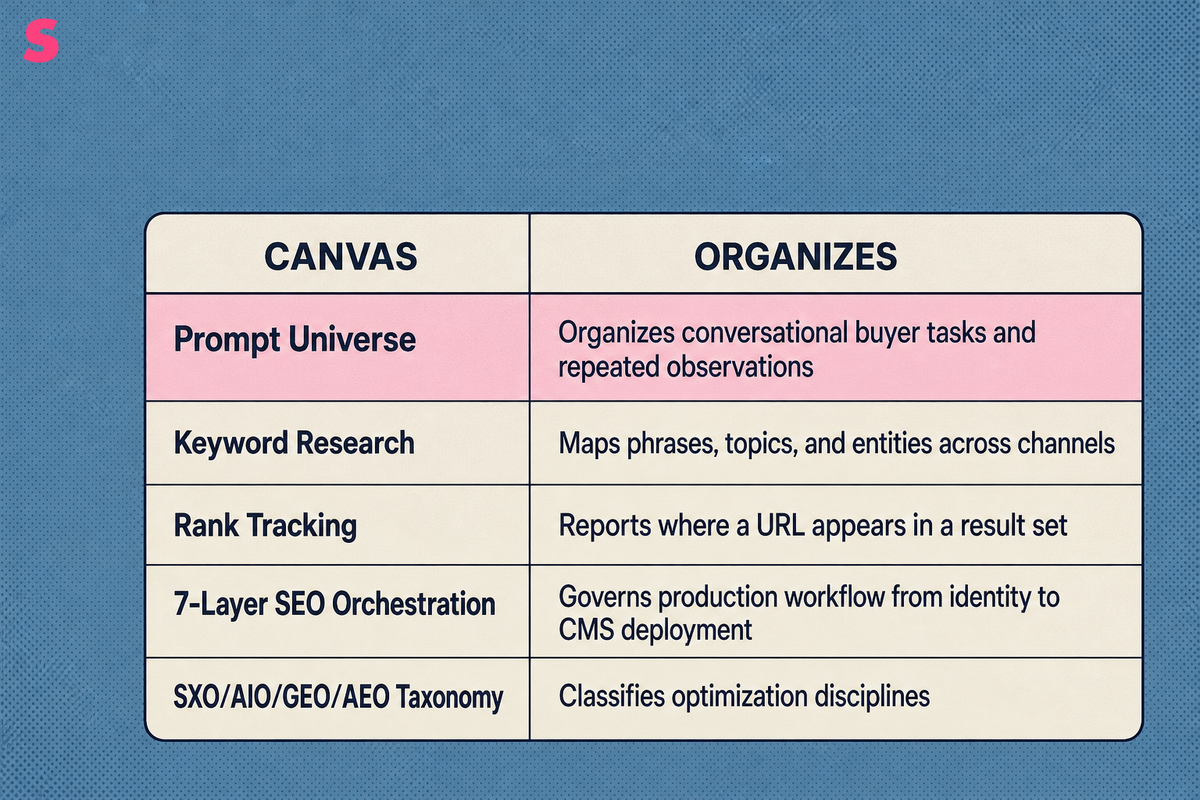
A prompt universe is more than keyword research. Keyword research organizes demand around terms and topics, while a prompt universe organizes conversational buyer tasks, real wording, fan-out questions, answer-level citations, and repeated observations.
A keyword universe maps phrases, topics, and entities across Google, AI search, and other channels, per the October 2026 listing. That work remains useful, but a buyer prompt adds context such as role, requirements, comparison criteria, and market. A keyword can seed a prompt universe without becoming the measurement unit.
A prompt universe also differs from rank tracking. Rankings report where a URL appears in a result set. Prompt tracking records whether a brand appears in an answer, where it appears, which sources support the answer, and whether the result persists across runs.
The term also overlaps with a multi-agent seven-layer SEO orchestration specification: identity, strategy, grounding, copywriting, schema, quality auditing, and CMS deployment, per the October 2026 listing. That specification governs production workflow, not buyer-question measurement.
It also differs from the four-layer SXO, AIO, GEO and AEO strategy taxonomy, per the October 2026 listing. That taxonomy classifies optimization disciplines. A prompt universe supplies research and measurement inputs for those disciplines.
How many prompts and repeated runs does a useful baseline need?
A useful baseline needs enough prompts to cover category breadth, personas, funnel stages, and markets, plus enough repeated runs to separate persistent change from answer variance. Start with 30–100 prompts for a focused market, then expand toward a frozen 50–200 prompt list when the category requires broader coverage.
The 30–100 starting range comes from a SaaS workflow in the October 2026 listing. The 50–200 range and frozen-list practice come from a GEO measurement guide in the October 2026 listing. The appropriate count rises when a false conclusion could fund the wrong content, product-marketing, or demand generation project.
Freeze the list for each measurement period. Add new prompts through a dated change log during a planned review, rather than changing the denominator midway through a reporting cycle.
Run the same prompt list daily. Daily observations expose persistent changes that a weekly snapshot can obscure. Engine responses can shift with retrieval indexes, model updates, and recent competitor publishing.
A fortnightly reporting review can summarize the daily log across ChatGPT, Perplexity, Claude, Gemini, Google AI Overviews, and other answer engines. The October 2026 listing describes one audit model that runs prompts across ChatGPT, Perplexity, Claude, and Gemini every two weeks. Sona AI Visibility supports daily prompt tracking, while a positioning review or full technical re-audit belongs on a monthly or quarterly schedule.
How should each run be recorded and scored?
Each prompt run should produce a dated response record with visibility, position, accuracy, citation, and recommendation fields. The scoring template should support repeated use and let two reviewers distinguish a correct answer from an outdated or misleading answer.
| Field | What to record | Template scale | Why it matters |
|---|---|---|---|
| Mention | Whether the brand appears | 0 = absent, 1 = present | Captures answer-level visibility |
| Position | Where the brand appears in the answer | 1 = first, 2 = second, 3 = third or lower, 0 = absent | Separates presence from prominence |
| Accuracy | Whether product details are correct, outdated, or wrong | 2 = correct, 1 = outdated or incomplete, 0 = wrong | Shows whether visibility carries usable information |
| Citation | Sources cited beside the relevant claim | 0 = none, 1 = cited | Identifies source patterns worth investigating |
| Recommendation | Whether the response recommends the brand | 0 = no, 1 = included, 2 = explicitly recommended | Distinguishes mention from endorsement |
| Date | Run date, engine, market, and prompt version | ISO date plus identifiers | Makes every observation comparable |
This table is an editorial combination of two October 2026 models. One listing specifies three response-level fields: whether the brand appears, where it appears, and whether product details are correct, outdated, or wrong. A separate October 2026 listing for the seven-layer framework identifies mention, citation, recommendation, and date as four run-level fields.
A brand-level visibility score is not an actionable record. A prompt-level record identifies the prompt that produced the result and the cited source that shaped it. Sona AI Visibility supports daily prompt tracking. Its Growth plan adds page-level insights, company-level visitor identification, and AI search attribution.
How do prompt universe findings become a content backlog and a pipeline case?
Prompt universe findings become a backlog when each recurring response gap is assigned to a page, documentation asset, comparison page, or product-marketing correction. The pipeline case begins after visibility observations are separated from qualified traffic, influenced pipeline, and demo quality.
Use a simple prioritization sequence:
- Group repeated missing or inaccurate answers by buyer task and stage.
- Assign the gap to the page that should answer it, such as a product page, integration guide, pricing page, comparison page, or documentation article.
- Review the cited sources and identify the evidence, product detail, or structure the assigned page requires.
- Prioritize work by commercial stage, account fit, and the cost of leaving the question unanswered.
- Measure business outcomes separately through qualified visits, opportunity creation, influenced pipeline, and demo quality.
Sona AI Visibility tracks the prompt list daily. Its Growth plan adds page-level insights, company-level visitor identification, and AI search attribution. Mention and competitor tracking remains a useful baseline for reviewing answer visibility.
Seven layers justify their operational effort when they change decisions. The structure prevents a content team from treating every missing mention as equal and gives marketing operations a record of which prompts, pages, sources, and buyer stages merit investment.
What are the frequently asked questions?
What are the seven layers of the prompt universe framework?
Task defines the buyer job. Stage identifies the buying context. Persona names the buyer role. Phrasing captures real language. Fan-out maps supporting sub-queries. Engine and market define where the answer is tested. Runs and record create a dated measurement log. This framework is separate from the multi-agent seven-layer SEO specification for identity, strategy, grounding, copywriting, schema, quality auditing, and CMS deployment.
Where should the real prompt wordings come from?
Real prompt wording should come from support conversations, sales calls, and community discussions. The October 2026 listing recommends about 3 real wordings per intent cell, giving the team enough variation to test buyer language without filling the list with invented phrasing.
Which AI engines should a prompt universe be tested on?
Test at minimum ChatGPT, Perplexity, Claude, Gemini, Google AI Overviews, and other answer engines where buyers encounter them. Engine and market is its own layer, so results from different answer engines, countries, and languages are never pooled blindly.
Should the prompt list change after it is set?
Freeze the prompt list for each measurement period so results remain comparable. Add new prompts only through a dated change log at a planned review, with the reason for the addition and the affected layer recorded beside each entry.
How often should the prompts be rerun?
Run the fixed prompt list daily so variance remains visible. A fortnightly reporting cycle can summarize findings, but daily observations show whether movement persisted or reflected a one-day response change.
Does a high mention rate in AI answers mean more pipeline?
No. Mention rate is a visibility metric, not a business result. It becomes commercially meaningful only when it connects to qualified traffic, influenced pipeline, and demo quality through a consistent attribution method.
Summarize this article with AI: ChatGPT · Claude · Perplexity · Google AI Mode
Last updated: October 2026