Perplexity AI differs from traditional search engines by responding to a question with a cited summary drawn from live web sources, while a traditional engine provides a ranked list of links for readers to open and evaluate. This speeds up question-driven research, but a citation does not guarantee that the adjacent statement is correct. Use Perplexity for orientation and drafting, and a conventional engine to find primary sources and confirm claims. The failure cases reveal where each approach breaks down.
How does Perplexity AI differ from traditional search engines in finding, synthesizing and citing an answer?
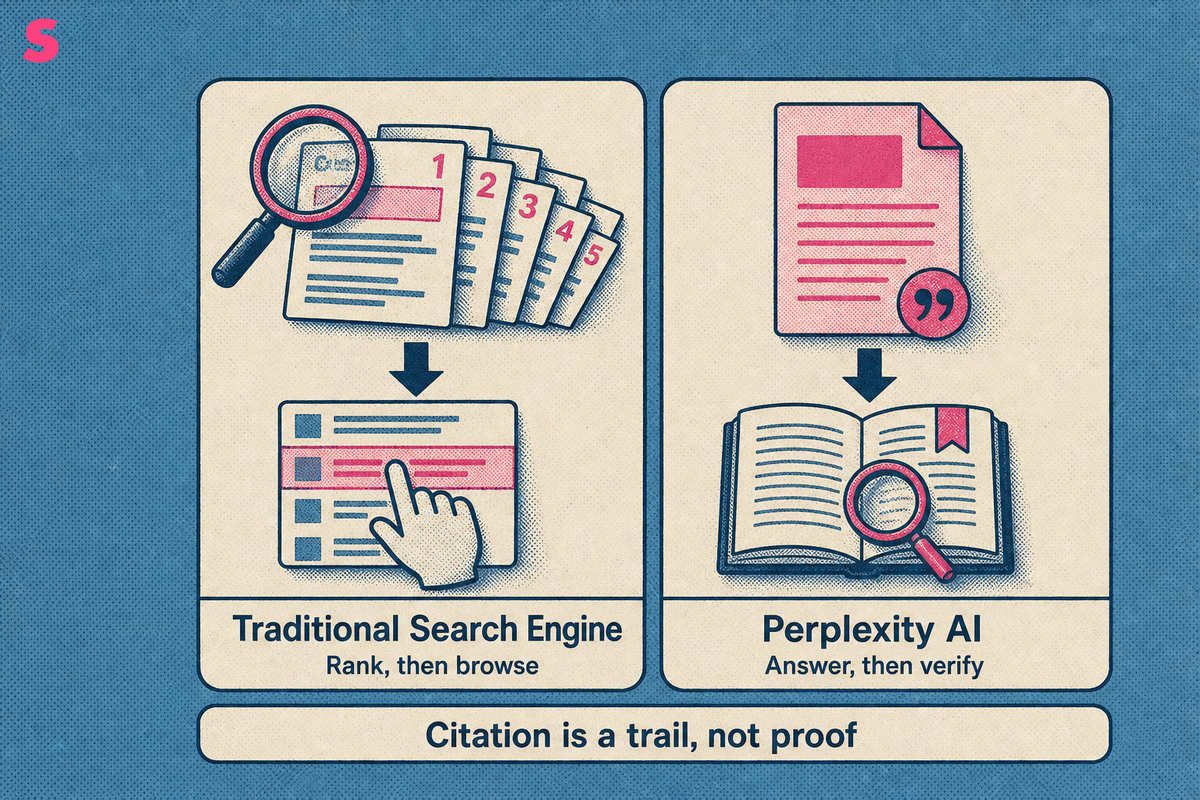
Perplexity AI turns a question into a concise, cited response, while traditional search engines return ranked pages for the user to inspect and synthesize. The practical difference is workflow: Perplexity begins with an answer, while Google Search begins with discovery.
Traditional search engines use keyword matching and ranking algorithms to surface results pages. Perplexity analyzes the full query context, retrieves relevant web information, and summarizes it in a direct answer with citations. That reduces initial browsing, but places more interpretation inside one generated response.
Perplexity’s citations create an audit trail, not a guarantee. Readers still need to open the source, inspect the supporting passage, and confirm that the citation supports the whole sentence rather than a related idea. Google Search exposes more candidate sources at once, which takes longer but helps when source selection is the central task.
For B2B research, use Perplexity when a question needs a synthesized briefing. Use a traditional search engine when the task requires a specific document, a broad source comparison, or validation against primary evidence.
What do you need in place before comparing Perplexity with a traditional search engine?
A useful comparison requires the same prompt, the same research objective, and a record of what each tool produces. Before starting, prepare a free Perplexity account, a conventional search engine, five real work prompts, and a spreadsheet or document for results.
- Use four prompts from recurring B2B work: procurement, competitor research, technical documentation, and market sizing.
- Add one prompt from an active project, such as a buyer question, product requirement, or category claim.
- Log the answer, cited sources, clicks, tabs opened, missing context, and whether a primary source verified the conclusion.
- Record the date of every run because search indexes, retrieval results, and generated answers change.
Perplexity Pro was listed at $20 per month, or $17 per month with annual billing, in the October 20, 2026 listing. The same listing described file upload for analysis, image search, and up to 150 daily searches. Confirm current plan details before procurement because prices and limits can change.
Do not start with broad prompts such as “best CRM” or “AI market trends.” Broad prompts create too many defensible answers, making source quality difficult to assess. Start with a question that has an identifiable primary source, a date boundary, and a defined decision.
How do you run the same query through Perplexity and a search engine and compare the results?
Run the same five prompts in Perplexity and Google Search, then compare source quality, effort, and verifiability rather than answer polish. Use a logged prompt set with a defined business purpose and a consistent evaluation sheet.
- Choose four core prompts. Use one each for procurement, competitor analysis, technical lookup, and market sizing. Add a fifth prompt from current work.
- Run each prompt in Perplexity. Save the generated answer, every cited source, the number of follow-up questions, and the tabs opened.
- Run the identical prompt in Google Search. Record the first results page, clicks required to reach an answer, tabs opened, and the sources selected.
- Open every Perplexity citation. Check whether the cited page supports the precise claim, date, definition, and scope in the answer.
- Ask follow-up questions in Perplexity. Use follow-ups to narrow scope, request a date range, or ask for the source behind one figure.
- Log the differences. Mark which workflow reached a verified answer with fewer unnecessary tabs and which surfaced the strongest primary document.
Teams that run the same prompt list daily can identify changes that a weekly snapshot would obscure. A retrieval index, model update, or newly published competitor page can alter an answer overnight. A movement that holds for four days is more useful than a one-day spike.
Sona AI Visibility connects citations to pipeline and revenue on one account timeline, while AI Search Insights shows the prompts buyers ask and the sources that answer engines cite. That matters when a research exercise becomes a recurring measurement process.
What does a successful Perplexity versus search comparison look like?
A successful comparison produces a verified answer, a source trail for every material claim, and a record of which workflow required less effort. Perplexity succeeds when its cited answer holds up against primary evidence and follow-up context reduces repetitive searching.
Use four success signals:
- Each material claim traces to a cited page that supports the complete statement.
- Perplexity requires fewer tabs for a question-led briefing.
- Follow-up questions retain the research context without restating the original prompt.
- The final conclusion matches the relevant primary source, such as official documentation, a filing, a product specification, or a published methodology.
Freshness requires a separate check. A concise answer can cite a page that was accurate when published but has since been superseded. Google Search can make newer documents easier to identify because the reader sees a broader results set, publication dates, and domain-level alternatives before selecting a source.
Sona AI Visibility treats AI search as measurable research behavior rather than a standalone mention count. Its account timeline connects AI-referred visits and citations to pipeline and revenue, helping B2B teams assess whether a visible answer influenced a commercial outcome.
Where does Perplexity give wrong answers that traditional search gets right?
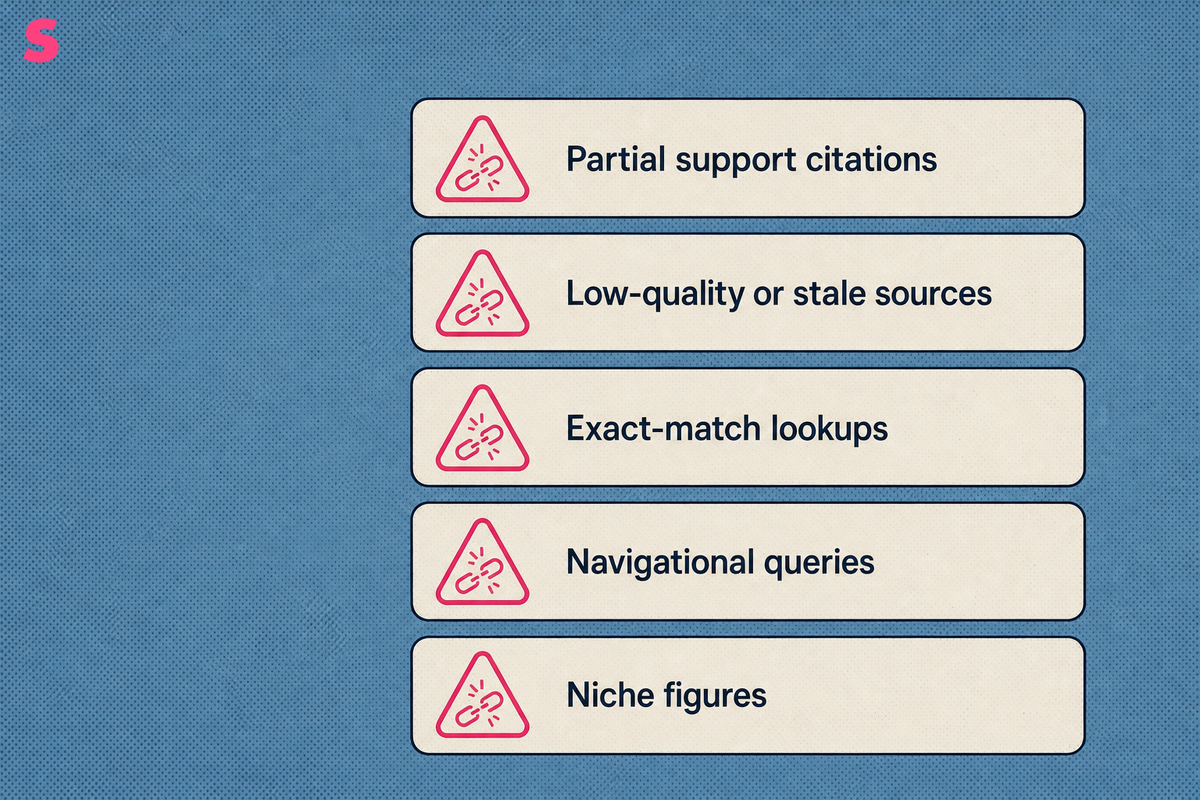
Perplexity can produce an answer that sounds complete but fails when a cited source supports only part of a sentence, relies on stale material, or misses an exact primary document. Traditional search can perform better because ranked results expose multiple documents and let the researcher control source selection.
Do not claim failure rates without dated, reproducible runs. Test and document specific failure classes with your own prompt set and the date of each comparison. The useful record includes the prompt, answer, cited page, verification source, and exact point of disagreement.
- Partial support citations: a source supports one clause but not the conclusion built around it.
- Low-quality or stale sources: a summary page displaces a newer or more authoritative primary document.
- Exact-match lookups: a policy, specification, filing, or named document requires the original page rather than a synthesis.
- Navigational queries: the real task is reaching a specific login, documentation page, or company resource.
- Niche figures: a narrow statistic needs its methodology, denominator, date, and original publisher.
Citations do not guarantee accuracy because citation placement does not verify a claim. A generated answer can combine several facts, generalize beyond a source, or omit a qualification. Treat the cited page as evidence to inspect, not proof already accepted.
What should you do when a Perplexity answer looks wrong or unverifiable?
When a Perplexity answer looks wrong, open the cited page first, search the exact claim in a conventional engine, and verify the result against a primary document. Do not repair an uncertain answer by asking the same vague question again.
- Open the citation. Find the exact sentence, table, or methodology that supports the claim.
- Search the exact claim. Put the figure, product name, date, or quoted terminology into Google Search to locate other sources.
- Rewrite the prompt. Add scope, geography, audience, date range, and the source type you need.
- Ask a narrow follow-up. Request the source for one figure or one sentence instead of asking for a revised full answer.
- Fall back to the primary document. Use official documentation, a filing, technical specification, or original study when the claim affects a decision.
The process separates retrieval from synthesis. Perplexity can speed the first pass, while Google Search helps locate the source that should support the final decision. Sona AI Visibility also tracks AI crawler activity from server logs, helping teams see which pages answer engines reach without relying on a JavaScript tag.
Keep a dated exception log when the same subject repeatedly produces weak citations. The log should identify the prompt wording, source type, and correction. Over time, it becomes a practical prompt standard for procurement, legal review, technical research, and market analysis.
Which job suits Perplexity, Google Search, or Google AI Overviews and AI Mode?
Perplexity suits question-led research, Google Search suits broad discovery and direct source hunting, and Google AI Overviews and Google AI Mode help users assess an AI-generated summary inside Google’s search environment. The right choice depends on whether the task requires synthesis, exploration, or exact retrieval.
| Scenario | Perplexity | Google Search | Google AI Overviews and AI Mode | Best verification step |
|---|---|---|---|---|
| Market research | Use for a cited initial briefing and follow-up questions. | Use to widen the source set and locate original research. | Use to scan Google’s synthesized response and related results. | Read the underlying research methodology. |
| Competitor scan | Use for a structured first-pass summary. | Use to find company pages, announcements, and category coverage. | Use to identify related comparison queries. | Confirm each claim on the competitor’s own materials. |
| Technical lookup | Use to frame the issue and refine terminology. | Use to find exact documentation and version-specific pages. | Use for a quick orientation within Google results. | Use the relevant primary documentation. |
| Procurement shortlist | Use to summarize criteria and compare stated features. | Use to find pricing, security pages, and procurement documents. | Use to surface adjacent vendor and category queries. | Validate terms with current vendor documents. |
| Finding a specific page | Use only if the page name is uncertain. | Use for direct navigational retrieval. | Use when Google surfaces the page beside its summary. | Confirm the domain and page path. |
ChatGPT, Perplexity, Gemini, Claude, and other answer engines change the research interface, but each still requires source verification. Sona AI Visibility connects AI citations to pipeline and revenue and tracks the AI crawlers reaching site pages, so teams can evaluate AI-answer exposure as a measurable channel.
Why do reported Perplexity usage figures disagree so widely?
Reported Perplexity usage figures disagree because publishers measure different products, periods, geographies, and definitions of a query or active user. Treat each figure as an estimate with a stated date, not as a definitive market measurement.
One estimate placed Perplexity at about 30 million queries per day, or roughly 900 million queries in a 30-day month, per the June 18, 2026 listing. Another estimate put monthly volume at 1.2–1.5 billion in mid-2026, per aibusinessweekly.net, August 1, 2026. A separate 2026 estimate described more than 1 billion monthly queries, per the October 7, 2026 listing.
Monthly active user estimates also vary. Perplexity was estimated at 45 million monthly active users in March 2026, per aibusinessweekly.net, March 2026, while another estimate reported 100 million monthly active users across its app and search products, per the June 18, 2026 listing. The figures may count different surfaces and user definitions.
Traffic-share estimates show the same problem. Perplexity’s share of global AI web traffic was reported at 2.7% in January 2026 and 0.9% in August 2026, per the January 2026 and August 2026 listings. Google’s global search-engine market share was reported at 90.39%, per theworlddata.com, July 28, 2026. The scale gap remains clear even when the estimates differ.
What does an answer without a click mean for publishers and brand attribution?
An AI-generated answer can satisfy a reader without a click, reducing the visibility that publishers and brands receive from traffic-based reporting. A citation can influence research even when the reader never visits the cited website, creating an attribution gap between exposure and measurable sessions.
Sona’s own AI visibility data, September 2026, covers eight answer surfaces: ChatGPT, Google AI Overviews, Perplexity, Google AI Mode, Gemini, Mistral, Qwen and Claude. That breadth matters because a reader’s research path can move between answer engines rather than beginning and ending in one search product.
Monitoring which AI answers mention a brand is only half the job. Sona AI Visibility connects prompts and citations to accounts, pipeline, and revenue, then tracks the AI crawler and agent activity behind those outcomes. This gives marketing teams a way to investigate AI-answer exposure alongside commercial results.
What are the frequently asked questions about Perplexity and search engines?
Is Perplexity just a chatbot with web access?
Partly. Perplexity pairs a language model with live web retrieval, citations, and follow-up context, which a plain chatbot lacks. The distinction is less clear now because traditional search engines also provide AI-generated answers inside search results.
Does Perplexity replace Google Search?
No. Perplexity suits question-led research, while Google Search suits broader discovery and direct source retrieval. Most B2B teams use both because synthesis and source hunting are different research tasks.
Are Perplexity citations always accurate?
No. A citation can support only part of a sentence, point to a weak source, or lag behind newer evidence. Open the cited page before relying on a claim, especially when the claim affects procurement, technical implementation, or financial decisions.
How much does Perplexity Pro cost and what does it add?
Perplexity Pro was listed at $20 per month, or $17 per month billed annually, in the October 20, 2026 listing. The listing included file upload, image search, and up to 150 daily searches. Check the current listing before purchase because prices and feature limits change.
How does Perplexity differ from Google AI Overviews?
Google AI Overviews appear above Google’s ranked results inside a search page. Perplexity makes the cited answer and follow-up conversation the main interface, so the research workflow begins with synthesis rather than a conventional results page.
Does Perplexity reduce traffic to websites?
It can. A synthesized answer can satisfy a reader without a click, so publishers and businesses should measure AI-referred visits and citations rather than relying on rankings alone.
Summarize this article with AI: ChatGPT · Claude · Perplexity · Google AI Mode
Last updated: October 2026