


Connecting ad spend to revenue requires a continuous identifier chain: ad and campaign names, UTM parameters and click IDs, CRM contact and opportunity fields, plus billing records containing those same keys. If any link is missing, platform-reported results and finance revenue no longer align. Capture identifiers at the click, retain them on the lead, transfer them to the opportunity, and match spend with revenue by campaign and date. Tracked revenue indicates association rather than causation, so incrementality tests remain necessary.
What do you need in place before you connect ad spend to revenue?
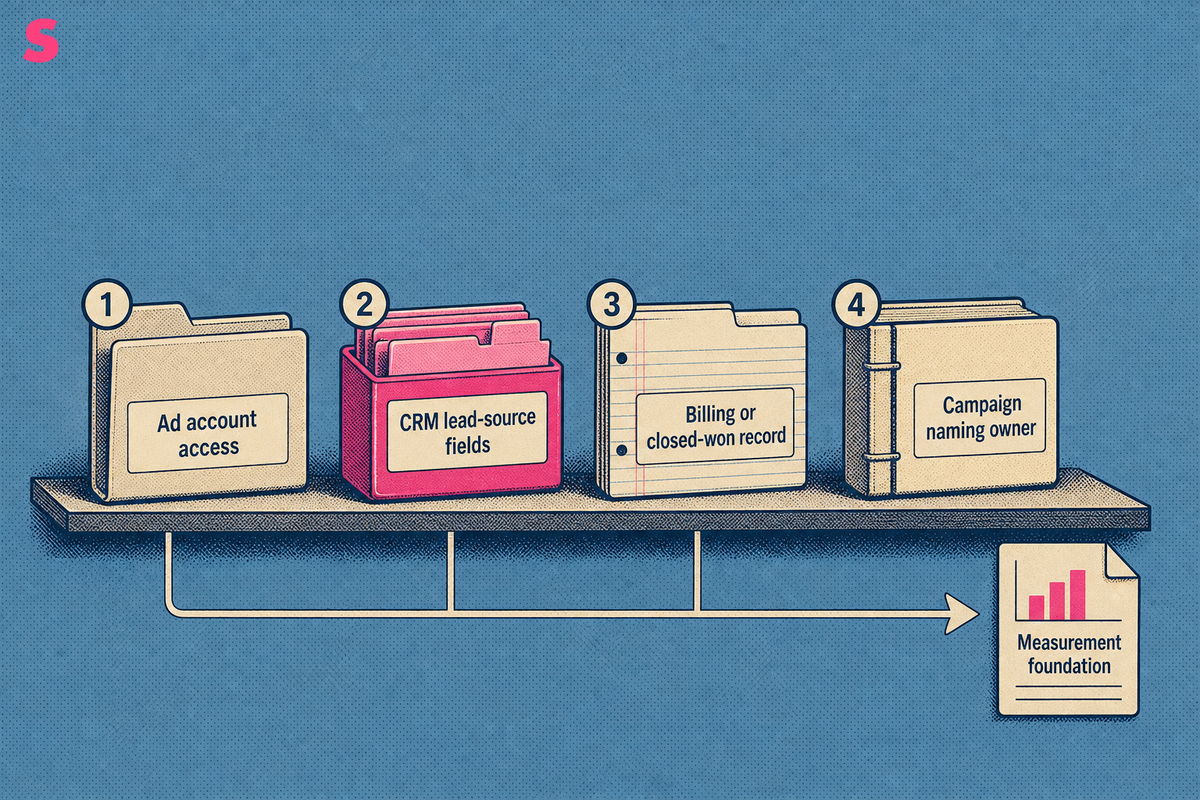
To connect ad spend to revenue, establish prerequisites before building reports: ad account access, a CRM that retains lead-source fields, a billing or closed-won record, and an owner for campaign naming rules. Without those records, attribution becomes a collection of partial platform reports rather than a financial measurement system.
Ad spend tracking connects advertising costs to campaign activity, conversions, pipeline, and revenue. Metadata carries a campaign’s identity from an ad impression or click through the CRM to the transaction record.
Accurate measurement requires accurate attribution, complete data, and reporting that translates activity into results, per kansas.com. Revenue marketing applies that standard by connecting spending to pipeline and closed deals rather than vanity metrics.
Sona Marketing Measurement provides a measurement foundation through identity resolution, attribution, account and contact journeys, and AI search as a tracked channel alongside paid activity. Every system must preserve the identifiers that connect a campaign to a customer record.
How does metadata link an ad to a closed-won deal?
Metadata links an ad to a closed-won deal through a traceable lineage: ad ID and campaign name lead to a click ID and UTM parameters, which lead to a CRM contact and opportunity, then a billing record and recognized revenue. The essential revenue path is ad spend, lead, quote, and revenue, per linkedin.com.
UTM parameters such as utm_campaign enable session-level attribution that connects advertising spend to customer payments. The goal is to preserve the same campaign identifier through every system that records customer activity.
A five-stage attribution flow can include attributed install, account creation, trial start, first payment, and renewal or refund, ending in net cohort revenue and ROAS, per a September 2026 attribution-flow listing. B2B teams can substitute lead capture, opportunity creation, closed-won status, and renewal when those stages match the sales process.
Metadata functions as a data contract between advertising, web analytics, CRM, billing, and finance. UTM tagging starts the contract, but durable attribution also requires campaign IDs, click IDs, timestamps, currency codes, contact identifiers, opportunity identifiers, and customer identifiers to retain their meaning at each handoff.
How do you tag every ad so UTMs and click IDs survive to the CRM?
Tag every paid destination URL with four core UTM parameters, capture platform click IDs on the landing page, pass both values through hidden form fields, and store them on the lead record. This creates a consistent record from creative to CRM without manually reconstructing campaign history.
- Set utm_source for the advertising platform, utm_medium for the paid channel type, and utm_campaign for the approved campaign identifier.
- Set utm_content to carry the ad or creative identifier. Four core URL parameters, including utm_content, support campaign-level traceability, per an October 2026 listing.
- Capture Google’s gclid and Meta’s fbclid when present. These identifiers preserve click-level linkage into the CRM when stored on the lead record, per a June 2026 listing.
- Write UTM values and click IDs into hidden form fields, then map them to persistent CRM fields rather than temporary form-submission notes.
| Funnel stage | Primary metadata retained | Required identifier | System of record | Purpose |
|---|---|---|---|---|
| Ad | Campaign name, ad ID, creative ID | Campaign ID | Ad platform | Identifies the budgeted asset |
| Click | UTMs, gclid, fbclid, timestamp | Click ID | Landing-page session | Connects the visitor to the ad |
| Landing page | Session ID, UTMs, referrer | Session ID | Web analytics | Preserves acquisition context |
| Lead | Original source, campaign, click ID, creative ID | Contact ID | CRM contact | Creates a durable person record |
| Opportunity | Copied campaign and click fields, stage, amount | Opportunity ID | CRM opportunity | Connects activity to pipeline |
| Customer | Billing customer ID, payment date, recognized revenue | Customer ID | Billing or finance system | Connects the deal to revenue |
Metadata stays manageable at scale when teams use controlled values, required fields, and automated pre-launch validation. Keep campaign names in a shared taxonomy, reject URLs that omit required parameters, and sync campaign and creative IDs from the ad platform rather than asking teams to type them.
Which CRM fields keep campaign attribution through to closed-won revenue?
CRM attribution survives to closed-won revenue when original source, campaign, click ID, and creative ID are stored on the contact and copied to the opportunity at creation. Copying the values preserves the acquisition record when a contact later returns through another channel.
Use separate fields for first-touch metadata and current-session metadata. First-touch fields preserve the original acquisition context. Current-session fields record the latest known interaction. Combining both in one field makes attribution models unstable because later visits overwrite the record needed to explain an opportunity’s origin.
Duplicate leads require identity matching between the contact, opportunity, and billing customer. Match records through the CRM’s contact and account relationships, then retain a canonical customer identifier in the billing system. Merge records before finance reporting because two lead records tied to one customer can double-count pipeline.
An opportunity stage field matters before revenue is booked. It gives the join a pipeline value while the deal remains open, allowing marketing and finance to distinguish spend that created qualified demand from spend associated only with early-stage leads. Sona AI Visibility can connect AI citations and AI-referred visits to accounts, pipeline, and closed-won revenue on one account timeline, using the same attribution logic required for paid channels.
How do you join ad spend and revenue by campaign, date and currency?
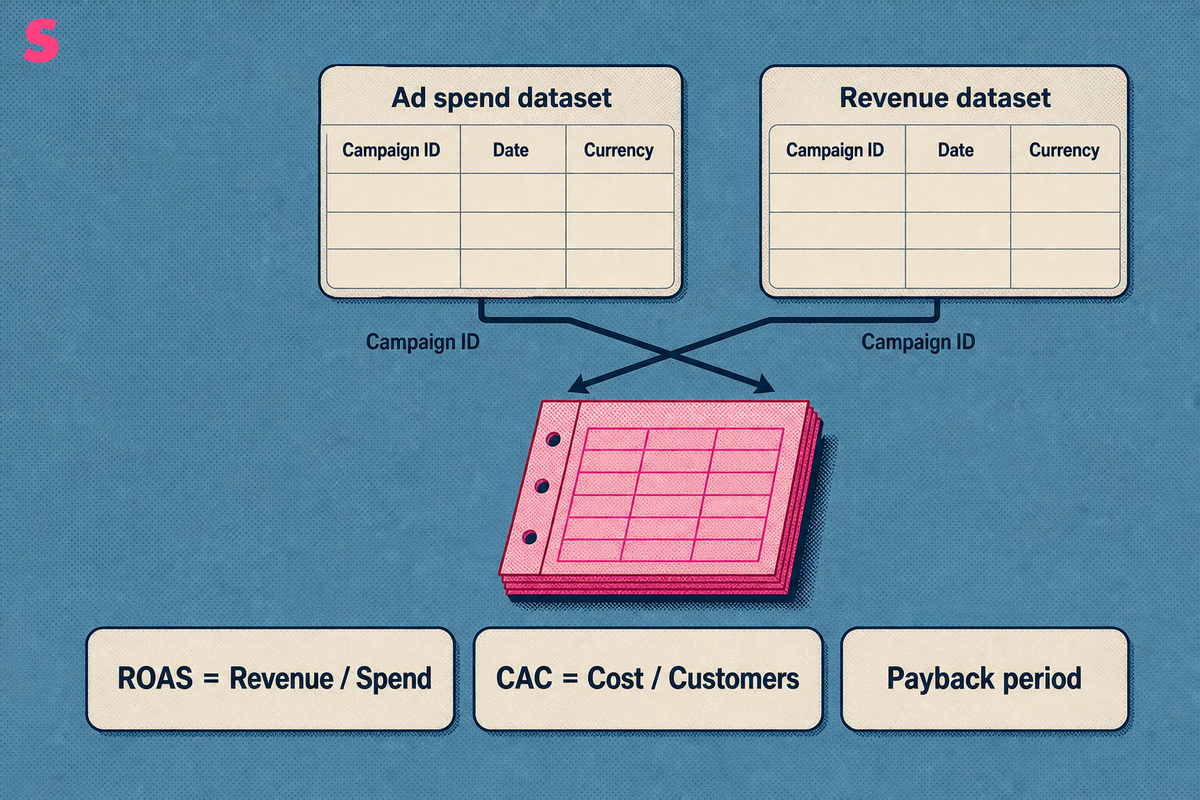
Join ad spend and revenue in a central measurement dataset using campaign and date as the basic keys, then normalize currency before calculating profitability. When each payment ties to a session carrying campaign metadata, campaign and date provide the basic keys for a payment-to-ad-spend join, per an October 2026 listing.
Pull spend from each advertising platform by API into a central dataset. API integrations enable spend data from multiple platforms to enter a centralized measurement account, per help.adjust.com. Consolidation matters because platforms report spend on different schedules, while finance records revenue against transaction and recognition dates.
- Load daily campaign spend, including campaign ID, platform, date, currency, and spend amount.
- Load CRM opportunities and billing transactions with campaign ID, close date or payment date, currency, and revenue amount.
- Convert both datasets into the reporting currency using the same daily exchange-rate rule.
- Join records by campaign and date, then reconcile payment timing against the organization’s revenue-recognition policy.
The resulting metrics need economic definitions. ROAS divides revenue by spend, but excludes product cost, shipping cost, and payment processor fees. CAC divides acquisition cost by acquired customers. Payback measures the time required for contribution from a customer cohort to recover acquisition cost. Sourced pipeline credits the touch that created an opportunity, while influenced pipeline includes opportunities touched by a tracked campaign.
Sona Marketing Measurement treats AI search as a channel alongside paid and organic channels, so spend, deals, and ROAS can sit on the same account timeline. AI Attribution connects AI-driven visits to accounts, pipeline, and closed-won revenue.
How can you tell the spend-to-revenue connection is working?
A spend-to-revenue connection is working when every spend row maps to a campaign, each paid-attributed closed-won deal retains the expected campaign identifier and, when captured, its platform click ID, other deals retain applicable source metadata, and the unattributed share declines. The evidence is traceability, not a dashboard total that cannot be audited.
- Sample closed-won deals and trace each record from billing customer to opportunity, contact, session, click ID, campaign, creative, and ad account.
- Reconcile total spend in the central dataset against each ad platform invoice for the same reporting period and currency.
- Review records with blank campaign IDs, missing click IDs, duplicate contacts, and payment records that cannot match a CRM customer.
Run the checks at a fixed reporting cadence, such as monthly close, while monitoring data ingestion more frequently. A reconciliation report should identify whether a mismatch came from spend ingestion, web capture, CRM mapping, billing synchronization, or a reporting definition.
Sona Marketing Measurement supports this operational model with Cross-Channel Attribution, Identity Resolution, and Buyer Journeys. The output is a traceable account timeline that finance, marketing operations, and demand generation can review using the same identifiers.
Why does platform-reported revenue never match actual revenue?
Platform-reported revenue differs from actual revenue because advertising platforms and finance systems use different attribution windows, currencies, conversion definitions, deduplication rules, and reporting dates. Accurate attribution requires transaction data rather than platform reporting alone.
Use a diagnostic decision tree to locate the break. Start on the spend side by checking invoice totals and API loads. Move to the click side by checking UTMs, click IDs, pixels, and landing-page redirects. Then inspect identity matching, revenue synchronization, and definition alignment.
- Spend side: Does loaded spend reconcile with the advertising invoice?
- Click side: Did the landing-page session retain UTMs and platform click IDs?
- Identity side: Did the lead, opportunity, and billing customer resolve to one account?
- Revenue side: Did payments, refunds, and recognized revenue reach the reporting model?
- Definition side: Are dates, currencies, conversion windows, and revenue rules consistent?
| Failure scenario | Metadata root cause | Where the break appears | Recovery action |
|---|---|---|---|
| Missing UTMs | Destination URL lacks campaign parameters | Web session or lead record | Require approved UTM templates before launch |
| Inconsistent campaign names | Ad platform and CRM use different identifiers | Spend-to-pipeline join | Use a controlled campaign taxonomy and ID mapping |
| Lost click IDs | gclid or fbclid is not captured in the form flow | Lead record | Persist click IDs through hidden fields and CRM mapping |
| Duplicate leads | Multiple contact records map to one buyer or customer | CRM and billing join | Merge records using a canonical contact or customer identifier |
| Window or refund differences | Platform conversion logic differs from finance rules | Revenue report | Report transaction revenue, refunds, and attribution windows separately |
Keep diagnosis separate from optimization. A platform can guide delivery decisions while finance remains the authority for booked and recognized revenue. The reports answer different questions and should not be forced to match without documented definitions.
Does tracked revenue prove that your ads caused it?
Tracked revenue does not prove that an ad caused a sale. Metadata shows the path associated with a customer and records which campaign received attribution, while incrementality tests or controlled experiments establish whether advertising changed the outcome.
First-touch attribution credits the first recorded campaign. Last-touch attribution credits the last interaction before conversion. Multi-touch attribution distributes credit across recorded interactions. Platform-reported conversions follow the platform’s measurement rules. Each model can produce a different budget recommendation because each model answers a different allocation question.
Use tracked revenue to understand operational performance: which campaigns created leads, opportunities, customers, and revenue records. Use controlled experiments to estimate causal lift through holdout groups, geographic tests, conversion-lift studies, or other designs that compare an exposed group against a valid control group.
False precision is the main risk. A revenue report can show exact currency values while still reflecting assumptions about identity resolution, touch weighting, reporting dates, and attribution windows. Document the model beside the result so decision-makers know whether they are reading an association or a causal estimate.
How do you send revenue data back to ad platforms, and what do connecting tools cost?
Send conversion events with accurate values and attribution metadata back to advertising platforms, then use intermediate CRM events while closed-won revenue is pending. Entry-level point-solution attribution tools were cited at $29–$750 per month in September 2026. Meta Conversions API and Google Ads offline conversions support this feedback pattern when the event includes the required identifiers and value fields.
CRM attribution often arrives after the campaign decision window. Send MQL, SQL, opportunity creation, and pipeline-value events sooner, then reconcile them against closed-won revenue when the sale closes. Technical implementation requires sending conversion events with accurate values and attribution metadata back to ad platforms.
Some tools unlock multi-touch attribution at about $899 or more per month on a Growth plan, per a September 2026 listing. Assess pricing against the included systems, required data volume, attribution model, and reporting audience.
Sona Marketing Measurement connects ad spend to pipeline and revenue on one account timeline through Cross-Channel Attribution and Identity Resolution, with AI search treated as a channel alongside paid activity.
Monitoring which AI answers mention a brand is only half the job. Sona AI Visibility connects those mentions and AI-referred visits to accounts, pipeline, and revenue, so AI visibility can be evaluated against the same business outcomes as advertising spend.
What are the frequently asked questions?
What is the minimum metadata needed to connect ad spend to revenue?
A campaign identifier and date must exist on both the spend record and the revenue record. The four core UTM parameters, utm_source, utm_medium, utm_campaign, and utm_content, plus a stored click ID, carry those keys from the ad to the lead. The four-parameter pattern was documented in an October 2026 listing.
Do UTM parameters prove an ad caused a sale?
No. UTM parameters record the path associated with a customer, not the cause of the purchase. Causal claims require incrementality tests or controlled experiments that compare an exposed audience with a valid control group.
Why is ROAS in the ad platform different from finance-reported revenue?
Advertising platforms and finance systems can use different attribution windows, currencies, conversion definitions, deduplication rules, and reporting dates. ROAS also divides revenue by spend without incorporating product cost, shipping cost, or payment processor fees.
How do you optimise campaigns when closed-won revenue arrives months after the click?
Send intermediate events, including MQL, SQL, opportunity creation, and pipeline value, back to the ad platform for faster optimization. Reconcile those signals against closed-won revenue after the revenue record reaches the CRM and billing system.
What is the difference between sourced and influenced pipeline?
Sourced pipeline credits the touch that created the opportunity. Influenced pipeline counts opportunities that a tracked campaign touched during the buyer journey. Both measures are useful, but they should remain separate because they answer different budget questions.
How do you stop UTM naming from drifting across teams?
Use one controlled list of allowed values, make campaign fields required, validate destination URLs before launch, and sync campaign and creative IDs automatically rather than typing them. A single naming owner should approve taxonomy changes and maintain the mapping between advertising, CRM, and finance fields.
Summarize this article with AI: ChatGPT · Claude · Perplexity · Google AI Mode · and other answer engines
Last updated: October 2026







